|
NOVAK 4. REMINISCENCE OF BOKA KOTORSKA: Kotor, Ital.
Cattaro, town (1991 pop. 5,620) in
Montenegro, former Yugoslavia, on the Bay of Kotor, an inlet of the
Adriatic. It is a seaport and a tourist center. The town was colonized by Greeks
(3d cent. B.C.) and later belonged to the Roman and Byzantine empires. In 1797
it passed to Austria and became an important naval base; in 1918 it was
transferred to Yugoslavia, but although Croatian, the town became a part of
Serbian Montenegro and is now Serb. It has a medieval fort and town walls and a
16th-century cathedral. As the oldest town in Montenegro, it is a
state-protected historical monument. The Boka Kotorska (Gulf of
Kotor), the grandest natural feature of the Adriatic coast, is a deeply indented
and irregularly-shaped fjord surrounded by steep and lofty mountains that rise
ever higher towards the interior. The contrast between the intense green of the
luxuriant vegetation at sea level and the denuded rocks of the mountains is
enhanced by the changing colours of the sea, particularly striking effects being
gained in winter when the higher mountains are clothed with snow. The abrupt
changes in height give the region a violent and changeable climate with an
unusually heavy rainfall and frequent thunderstorms. A road encircles the shores
of the gulf, but by far the finest impression of its majesty is gained from the
water: the most spectacular marine vistas in Europe outside Norway is your
reward. The awe-inspiring heights of the Njegosi Mts. rise to a climax at Mt.
Lovcen (5684 ft) behind Kotor. Hercegnovi, the outermost town (3800 inhab.) of
the Boka Kotorska, occupies a position of romantic beauty on precipitous cliffs
at the sea's edge. The old walled town is noted for its luxuriant sub-tropical
vegetation and is the leading resort in the Kotor region.
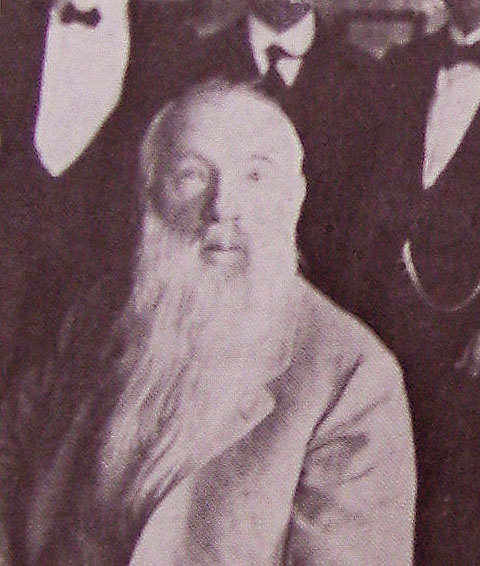
NOVAK 5. PORTRAIT OF JOHN RUSKIN:
 |
John Ruskin (1819-1900). |
John Ruskin was born on 8 February 1819 at 54 Hunter Street,
London, the only child of Margaret and John James Ruskin. His father, a
prosperous, self-made man who was a founding partner of Pedro Domecq sherries,
collected art and encouraged his son's literary activities, while his mother, a
devout evangelical Protestant, early dedicated her son to the service of God and
devoutly wished him to become an Anglican bishop. Ruskin, who received his
education at home until the age of twelve, rarely associated with other children
and had few toys. During his sixth year he accompanied his parents on the first
of many annual tours of the Continent. Encouraged by his father, he published
his first poem, "On Skiddaw and Derwent Water," at the age of eleven, and four
years later his first prose work, an article on the waters of the Rhine. In
1836, the year he matriculated as a gentleman-commoner at Christ Church, Oxford,
he wrote a pamphlet defending the painter Turner against the periodical critics,
but at the artist's request he did not publish it. While at Oxford (where his
mother had accompanied him) Ruskin associated largely with a wealthy and often
rowdy set but continued to publish poetry and criticism; and in 1839 he won the
Oxford Newdigate Prize for poetry. The next year, however, suspected consumption
led him to interrupt his studies and travel, and he did not receive his degree
until 1842, when he abandoned the idea of entering the ministry. This same year
he began the first volume of Modern Painters after reviewers of the annual Royal
Academy exhibition had again savagely treated Turner's works, and in 1846, after
making his first trip abroad without his parents, he published the second
volume, which discussed his theories of beauty and imagination within the
context of figural as well as landscape painting. On 10 April 1848 Ruskin
married Euphemia Chalmers Gray, and the next year he published The Seven Lamps
of Architecture, after which he and Effie set out for Venice. In 1850 he
published The King of the Golden River, which he had written for Effie nine
years before, and a volume of poetry, and in the following year, during which
Turner died and Ruskin made the acquaintance of the Pre-Raphaelites, the first
volume of The Stones of Venice. The final two volumes appeared in 1853, the
summer of which saw Millais, Ruskin, and Effie together in Scotland, where the
artist painted Ruskin's portrait. The next year his wife left him and had their
marriage annulled on grounds of non-consummation. On their wedding-night, is the
story, he was so startled by the discovering that his wife had hair on her
genitals, unlike the Greek statues he admired so much, that he fled the bedroom.
Later Effie married the Pre-Raphaelite Millais. During this difficult year,
Ruskin defended the Pre-Raphaelites, became close to Rossetti, and taught at the
Working Men's College. In 1855 Ruskin began Academy Notes, his reviews of the
annual exhibition, and the following year, in the course of which he became
acquainted with the man who later became his close friend, the American Charles
Eliot Norton, he published the third and fourth volumes of Modern Painters and
The Harbours of England. He continued his immense productivity during the next
four years, producing The Elements of Drawing and The Political Economy of Art
in 1857, The Elements of Perspective and The Two Paths in 1859, and the fifth
volume of Modern Painters and the periodical version of Unto This Last in 1860.
During 1858, in the midst of this productive period, Ruskin decisively abandoned
the evangelical Protestantism which had so shaped his ideas and attitudes, and
he also met Rose La Touche, a young Irish Protestant girl with whom he was later
to fall deeply and tragically in love. Throughout the 1860s Ruskin continued
writing and lecturing on social and political economy, art, and myth, and during
this decade he produced the Fraser's Magazine "Essays on Political Economy"
(1863); revised as Munera Pulveris, 1872), Sesame and Lilies (1865), The Grown
of Wild Olive (1866), The Ethics of the Dust (1866), Time and Tide, and [2/3]
The Queen of the Air (1869), his study of Greek myth. The next decade, which
begins with his delivery of the inaugural lecture at Oxford as Slade Professor
of Fine Art in February 1870, saw the beginning of Fors Clavigera, a series of
letters to the working men of England, and various works on art and popularized
science. His father had died in 1864 and his mother in 1871 at the age of
ninety. In 1875 Rose la Touche died insane, and three years later Ruskin
suffered his first attack of mental illness and was unable to testify during the
Whistler trial when the artist sued him for libel. In 1880 Ruskin resigned his
Oxford Professorship, suffering further attacks of madness in 1881 and 1882; but
after his recovery he was re-elected to the Slade Professorship in 1883 and
delivered the lectures later published as The Art of England (1884). In 1885 he
began Praeterita, his autobiography, which appeared intermittently in parts
until 1889, but he became increasingly ill, and Joanna Severn, his cousin and
heir, had to bring him home from an 1888 trip to the Continent. He died on 20
January 1900 at Brantwood, his home near Coniston Water. In 1999 a curator of
the Tate Museum in London discovered 2 sketchbooks of the painter J.M.W. Turner
with a letter of Ruskin where he writes he had burned hundreds of erotic
drawings of Turner, entrusted to him to inventory, because he found them
'grossly obscene' and it would be impossible that somebody would possess them
legally. The 2 sketchbooks ,with a.o. a drawing of a lesbian couple, were only
saved, to prove that Turner had a sick mind.
The home of John Ruskin from 1872
until his death in 1900, Brantwood, the most beautifully situated house in the
Lake District with the finest lake and mountain views in England, became an
intellectual powerhouse and one of the greatest literary and artistic centres in
Europe.The house is filled with Ruskin's drawings and watercolours, together
with much of his original furniture, books and personal items. Brantwood has 250
acres of wonderful woodland gardens, lakeshore meadows and moorland hilltop.The
gardens cover more than 30 acres below and above the house, from the famous
Harbour Walk to the Professor's Garden where Ruskin experimented with native
flowers and fruit. During the mid-19th cent. Ruskin was the virtual dictator of
artistic opinion in England, but Ruskin's reputation declined after his death,
and he has been treated harshly by 20th-century critics. Although it is
undeniable that he was an extravagant and inconsistent thinker (a reflection of
his lifelong mental and emotional instability), it is equally true that he
revolutionized art criticism and wrote some of the most superb prose in the
English language.
`Ruskin was one of the most
remarkable of men, not only of England and our time but of all countries and all
times. He was one of those rare men who think with their hearts, and so he
thought and said not only what he himeself had seen and felt, but what everyone
will think and say in the future` Tolstoy.
`I believe that I discovered some of my deepest convictions reflecting on
this great book of Ruskin's (Unto This Last), and this is why the book so
captured me and and made me transform my life.` Gandhi.
Some quotations from John
Ruskin (1819-1900):
1. 'He is the greatest
artist who has embodied, in the sum of his works, the greatest number of the
greatest ideas'.
Modern Painters.
Vol. i. Part i. Chap. ii.
Sect. 9.
2. `Pride is
at the bottom of all great mistakes'.
Modern Painters. Vol. iv. Part v. Chap. xxii.
3. `You were made for enjoyment,
and the world was filled with things which you will enjoy, unless you are too proud to be pleased with
them, or too grasping to care for what you can not turn to other account
than mere delight'.
Stones of Venice. Vol. i. Chap. ii. Sect. 2.
4. `He who has truth at his heart
need never fear the want of persuasion on his tongue'.
Stones of Venice.
Vol. ii. Chap. iv. Sect. 99, Chap. xcix
5. `That
treacherous phantom which men call Liberty'.The Seven Lamps of Architecture.
Chap. vii. Sect. 21.
6. `Work first and then rest'. The Seven
Lamps of Architecture. The Lamp of Beauty.
7. `The greatest efforts of the race have
always been traceable to the love of praise, as
its greatest catastrophes to the love of
pleasure'.
Sesame and Lilies. Part i. iii.
8. `A little group of wise hearts is better
than a wilderness of fools'. Crown of Wild Olive War.
9.
`Fine art is that in which the hand, the head and the heart go together'.
The Two Paths. Lecture ii.
10. `Engraving is, in brief terms, the Art of
Scratch'. Ariadne.
NOVAK 6. NOCTURNE IN LIBOCE: Liboce is a part of
Prague 6, west of Hradcany. It consist of Horni (=Upper) Liboc and
Dolni (=Lower) Liboc. An important site in Horni Liboc is the
Hvezda (Star), preserve with Summer Palace (Obora Hvezda s letohradkem). The
preserve was founded in 1534 by King Ferdinand I. Game was kept here until the
beginning of the 19th century, when the preserve was changed into a
park. In 1555 to 1557 Archduke Ferdinand of Tyrol had built here at his expense
the royal Hvezda Summer Palace on a ground-plan of the form of a six-pointed
star. The design was from the architects Giovanni Maria Aostalli, Giovanni
Lucchese und Hans Tirol. Das ursprüngliche Dach wurde Ende
des 18. Jahrhunderts durch ein flaches Zeltdach ersetzt. Its ceilings have rich stucco
decorations showing mythological and historical scenes. After WW 2 Pavel Janak
had renovated the building, a wooden dome was added over the hall on the second
stock. Since 1951 the building has housed the Alois Jirasek and Mikulas Aleš
Museum. Alois Jirasek (1851-1930)
is the greatest Czech writer of historical novels and plays. The artist Mikulas
Aleš (1852-1913) depicted important periods of Czech history in his numerous
works. Both were leading personalities of Czech cultural life. The Hvezda
Preserve lies below Bila Hora (White Mountain), inscribed in Czech history due
to the fact that in 1620 it was the scene of the first decisive encounter of the
Thirty Years War, the tragic battle which resulted in the loss of the national
and state independence of the Czech nation for a period of almost hundred years.
) Here the Estates troops were defeated on 8 November 1620. Archeological finds
from this battle and prominent military maps and weapons form a special
exposition devoted to the Battle of the White Mountain and the Thirty Year`s
War. In 1962 the area of the battle-field and the palace was proclaimed a
National Cultural Monument. The Church of our Lady on the White Mountain (Kostel
Panny Marie na Bile Hore), a picturesque Baroque church with cloisters and rich
sculptural an painted ceiling decoration. It was built in 1704-1714 near a
chapel founded immediately after the victory of the Hapsburgs at the Battle of
the White Mountain. Also in Liboc, north of the Europska road is the
Divoká Šárka (Wild Šárka) Nature Reserve. The area along the slopes
(particularly the right-hand slope) of the Šárka Brook approximately from the
Džban gorge to Čertův mlýn. Cadastre: Prague 6 - Dolní
Liboc. Area: 25.346 ha.
Elevation: 255 - 360 m above sea level. Valuable landscape element, significant
for its geological origin and geomorphology (rock gorges in lydites originated
epigenetically) with the remains of thermophilous and cryophilous flora and
fauna. Lydites exposed by the steep cut of the Šárka Brook with two gorges.
Together with the Proterozoic shales they form characteristic rock formations
with Ordovician strata in the east and local loess drifts. The first site on
which the Archaean microfossils were found in lydites. Mosaic of soils ranging
from mezotrophic to acid rankers to medium-nutritive brown soils and loess brown
earths. The sunny rocky steppes are the habitat of a number of steppe and
forest-steppe mollusk and insect species, the cold valley floor and the foot of
the northern rock exposure of mountain species. The traces of centennial human
influence can be observed most in the woods. The original woods were mostly
felled (sprout management). At present due to natural succession and tree
planting the area is covered with dwarfed heather oak, woods, hornbeam oak woods
and primarily with planted mixed woods comprising false acacia, pine, larch, red
oak and spruce. The area has been settled since the Paleolithic. Above the
Džbán gorge there was a prehistoric settlement as well as a Slavonic stronghold
with still preserved mounds and the finds testifying to a number of agricultural
cultures reaching back to the Neolithic. The area, formerly exploited for forest
and agricultural purposes, is used for recreation at present. It forms part of
the Šárka - Lysolaje natural park.
NOVAK 8. VENETIAN NOCTURNE: Venice, Ital. Venezia,
city (1991 pop. 309,422), capital of Venetia and of Venice prov., NE Italy,
built on 118 alluvial islets within a lagoon in the Gulf of Venice (an arm of
the Adriatic Sea). The city is connected with the mainland, 2.5 mi (4 km) away,
by a rail and highway bridge. Between the islands run about 150 canals, mostly
very narrow, crossed by some 400 bridges. The Grand Canal, shaped like a
reversed letter S, is the main traffic artery; its chief bridge is the Rialto,
named after the island that was the historical nucleus of Venice. Gondolas, the
traditional means of transport, have been superseded by small river boats (vaporetti),
but there are numerous lanes (calles), public squares, and a few streets. Houses
are built on piles. Venice is a tourist, commercial, and industrial center. The
tourist trade is stimulated by many annual festivals, including ones devoted to
painting, motion pictures, drama, and contemporary music. The Venice Biennale,
which exhibits various kinds of modern art every other year, has been held there
since 1895. Manufactures include lace, jewelry, flour, and Murano glass, and the
city is a center for shipbuilding. Porto Marghera, the modern port of Venice
(founded in the 1920s), located on the mainland, is a major shipping facility
and also has considerable industry
The center of animation in Venice is
St. Mark’s Square and the Piazzetta, which leads from the square to the sea. On
the square are St. Mark’s Church; the Gothic Doges’ Palace (14th–15th cent.),
from which the Bridge of Sighs (c.1600) leads to the former prisons; the Old and
New Law Courts (16th–17th cent.); the campanile (325 ft/99 m high; built in the
10th cent.; rebuilt after it collapsed in 1902); the Moors’ Clocktower (late
15th cent.); the elegant Old Library (1553); St. Moses’ Church; and the twin
columns supporting the statues of St. Theodore stepping on a crocodile and of a
winged lion of St. Mark (the emblem of Venice). On an island facing the
Piazzetta is the Church of San Giorgio Maggiore (1566–1610) and on a nearby tip
of land is the Church of Santa Maria della Salute (17th cent.). Among the city’s
numerous other points of interest are the churches of Santa Maria Gloriosa del
Frari (with paintings by Titian), San Zanipolo (1234–1430), and San Zaccaria
(with a Madonna by Bellini); the Academy of Fine Arts, with fine paintings by
Bellini, Carpaccio, Mantegna, Giorgione, Veronese, and others; the Scuola di San
Rocco, with a series of paintings by Tintoretto; the Scuola degli Schiavoni,
with paintings by Carpaccio; and the palaces Ca’ d’Oro (1440; late Gothic),
Rezzonico (1680), and Pesaro (1710; baroque). The fashionable beach resort of
Lido di Venezia is on a nearby island. Founding and Rise of Venice:
With Istria, Venice formed a province of the Roman Empire. In the 6th cent.
refugees fleeing the Lombard invaders of N Italy sought safety on the largely
uninhabited islands. The communities organized themselves (697) under a doge
[Lat. dux=leader]. Favorably situated for handling seaborne trade between East
and West, the communities grew, and by the 9th cent. they had formed the city of
Venice. The city secured (10th cent.) most of the coast of Dalmatia, thus
gaining control of the Adriatic, and began to build up its eastern empire,
obtaining trade and other privileges in the ports of the eastern Mediterranean.
The influence of the Middle East, particularly Byzantium, which characterizes
much Venetian art and architecture, is most clearly expressed in Saint Mark’s
Church (rebuilt 1063–73), located on the city’s principal square. In 1204 the
doge, Enrico Dandolo led the host of the Fourth Crusade in storming
Constantinople. Strategic points in the Ionian, the Aegean, and the E
Mediterranean were taken, notably Crete (1216). The great traveler Marco Polo
represented the enterprising spirit of Venice in the 13th and 14th cent. After
defeating (1380) its rival Genoa in the War of Chioggia, Venice was indisputably
the leading European sea power; its sea consciousness was expressed in the
symbolic marriage ceremony of the doges with the Adriatic, celebrated with great
pomp on the huge gilded gondola, the Bucentaur. All citizens shared in the
prosperity, but the patrician merchants obtained political privileges.
Membership in the great council, which by then had replaced the general
citizenry as an electorate in the election of the doges, became restricted to an
oligarchy. In reaction to an unsuccessful conspiracy in 1310, the Council of Ten
was instituted to punish crimes against the state. The Ten, by means of a
formidable secret police, acquired increasing power, and the doge became a
figurehead. In the 15th cent. Venice, known as the “queen of the seas,” reached
the height of its power. The city engaged in a rich trade, especially as the
main link between Europe and Asia; all Venetia on the mainland was conquered;
and Venetian ambassadors, creators of the modern diplomatic service, made the
power of the city felt at every court of the known world. The arsenal (founded
1104; rebuilt in the 15th and 16th cent.), where ships were built, was one of
the world’s wonders.
The decline of Venice
can be dated from the fall (1453) of Constantinople to the Turks, which greatly
reduced trade with the Levant, or from the discovery of America and of the Cape
of Good Hope route to Asia, which transferred commercial power to Spain and
other nations to the west of Italy. The effects were not felt immediately,
however, and Venice continued its proud and lavish ways. In the Italian Wars, it
challenged both the emperor and the pope; the League of Cambrai, formed (1508)
by Pope Julius II to humble Venice, merely resulted in a few minor losses of the
city’s territory; the naval victory of Lepanto (1571) gave Venice renewed
standing by undoing Turkish sea power.
The Renaissance marked the
height of Venice’s artistic glory. Architects like the Lombardo family, Jacopo
Sansovino, and Palladio, and the Venetian school of painting, which besides its
giants—Titian and Tintoretto—also included Giovanni Bellini, Jacopo Palma (Palma
Vecchio), and Veronese, gave Venice its present aspect of a city of churches and
palaces, floating on water, blazing with colour and light, and filled with art
treasures. Freedom of expression was complete except to those who actively
engaged in politics; the satirist Aretino, the “scourge of princes,” chose
Venice as his place of residence, and John of Speyer, Nicolas Jenson, and Aldus
Manutius made the city a center of printing.
The fall of Cyprus (1571), Crete (1669),
and the Peloponnesus (1715; see Greece) to the Turks ended Venetian dominance in
the East Mediterranean. Although the dramatist Goldoni and painters such as
Tiepolo and Canaletto still made Venice the most original artistic city of
18th-century Italy, they represented to some extent the decadence that
accompanied the city’s commercial and military decline. Politics in 18th-century
Venice was aristocratic and stagnant. When, in 1797, Napoleon I delivered Venice
to Austria in the Treaty of Campo Formio, the republic fell without fighting.
During the Risorgimento, however, Venice played a vigorous role under the
leadership of Daniele Manin; having expelled the Austrians in 1848, it
heroically resisted siege until 1849. In 1866, Venice and Venetia were united
with the kingdom of Italy. Since the 1950s, the city has been
increasingly swamped by periodic floods, in part because it is sinking.
Increased air pollution from cars and industrial smoke has contributed to the
deterioration of the ancient buildings and works of art, and the high phosphorus
and nitrogen content of the lagoon has stimulated algal growth, which has
depleted marine life. Such environmental problems have led to a steady
depopulation of Venice to the mainland over the past several decades. A major
international aid program, begun in the mid-1960s by UNESCO, has searched for
ways to preserve Venice; several government studies of Venice’s problems have
also been undertaken. In 1988, engineers began testing prototypes for a
mechanical barrage, which could be raised in time of flooding to close the
lagoon.
Some notes about the city:
St. Mark's
Square (Piazza S.Marco) is the
only true square in Venice (the others open areas are campi ). It was called "the drawing room of the world" by Musset and has been the
scene of some of the most important religious and political activities of the Serenissima as well as the center of Venetian social life for almost a
millennium.
The Palazzo Ducale (Doge's Palace)
got its present form after radical changing during the 14th and 16th
century. It was the Doge's residence and at the same time seat of many
different political and social institutions. The first floor was occupied by
minor institutions, such as the Avogaria or lawyers offices, where law cases
were examined; the Chancellery; the Censors and Provveditori della Milizia
del Mar (Naval Offices) which oversaw the care and equipping of ships. The
Grand Council chamber, the largest room of the palace, the Ballot chamber,
where the committee met to elect the Doge, and the Doge's apartments are
located on the second floor. The Sala del Collegio, where foreign
ambassadors were received, and rooms used by the state security service like
the Council of Ten are located on the third floor. The Bussola chamber is a
small room with a box where citizens could submit written complaints against
other citizens. The Sala dei Tre Capi (Three Chiefs Room) was used by three
components of the Council of Ten, who kept that place only for one month.
The State Inquisitor Room was used to interrogate prisoners.
Throughout
Europe the Serenissima's government was considered a model of
stability, honesty and demonstrated the possibility of combining the
monarchy, aristocracy and democracy, in the figures of the Doge, the Senate
and the Grand Council. The Doge represented the unity of the Republic. He
was elected for life by the Grand Council, chosen from among the greatest
Venetian families and in general was older than 70. The Doge's powers were
very limited. He could not make any decisions in the absence of the six
Councillors of the six sestieri of the city of Venice. He could not leave
Venice unless he was accompanied by at least two Councilors.
The actions of the Doge were controlled by the
Seignory, which consisted of the six Councilors, the three heads of the supreme
tribunal and the Doge himself. Moreover the Doge had to pay for all official
festivities organized in the Doge's Palace, for any restoration work done in the
Palace and often had to pay for military operations, without getting money from
the State. In fact it was not for a desire for money or power that made
Venetians desire to be Doge, but for the honor of covering the highest position
of the Republic and all the noble families wished for the the privilege of
having a Doge in their family as this insured that their name would be
remembered through out history. Also some commoners made extraordinary services
to the State or payed substantial sums to the government or to impoverished
nobles to buy titles of nobility and to have their name written in the Golden
Book so that they could be members of the Grand Council and in this way hope for
a nomination as Doge. There is one dark spot in the history of the Doges of the
Serenissima. After the election of Doge Marin Falier, he tried to lead a popular
conspiracy and was executed by order of the Council of Ten. The Council of Ten
in fact were responsible for decisions about crimes against the State and about
decisions requiring absolute secrecy. They also prevented the ambitions of
influential citizens from threatening the Venetian Republic. In the Ballot
Chamber of the Doge's Palace, where the portraits of the Doges are exhibited,
the portrait of Marin Falier is replaced by a black veil in remembrance of his
crime. In Venice no single institution monopolized power because no single
decision making body could operate unchecked by another and the quick rotation
of all offices made it difficult for a single individual or faction to
appropriate power or to be corrupted because their time in office is not long
enough to be useful for such a purpose. Frauds in casting ballots have been
known to happen in Venice, before ballots were cast, Grand Council members
milled about in front of the palace, on the "broglio", where the most powerful
tried to buy the votes of impoverished nobles, called the barnabotti. It is from
this practice that the the word broglio (entanglement) came in to use and is
still used today.
The New and Old Procuratie, bordering the
Square, was the offices of the 9 Procurators, the most important citizens of
Venice after the Doge. They were controlling the Square, the Basilica and the 6
sections of the city, called sestieri . In 1585 the Venetian ambassador to
Istanbul told the Senate that the Turkish were drinking a hot black drink, made
by a seed called Kahavè and that people had difficulty in falling asleep after
drinking this beverage. This seed was brought back to Venice and in 1638 it was
roasted, ground and sold at an expensive price from a special café shop which
was located directly under the Procurator. In a short time the café shops
opened all of the city and by the end of the next century there were 24 such
café's in St.Mark's Square alone. These café's soon became the favorite place
among intellectuals to meet and drink coffee. Gambling, another favorite past
time of the Venetian nobility also went on in the café's. The popularity of
these places grew more and more, and in 1720 one of the most elegant: "Caffè
alla Venezia trionfante" opened it's doors. This Café of the Triumphant Venice
was a popular meeting point for both foreign and national high society. Such
notables as Carlo Goldoni, the brothers Gozzi and Antonio Canova often spent
many hours in this café. The café's first owner was Floriano Francesconi and
therefore the café was affectionately called "Florian". In 1775 G. Quadri
decided to open a new café shop in front of the Florian on the opposite side of
the Square and promised to serve only real Turkish Café. For a long time the
shop had a bad reputation, driving the owner to near bankruptcy, but in 1830 the
nobility recognized the Café Quadri as having fine service and quality coffee
and it's reputation for quality remains today.
"El paron de casa" (the lord
of the house): so Venetians called the bell tower of St. Mark. On
July 14, 1902 it collapsed. It didn't do any damage to the Basilica either even
though it stands just a few feet from its entrance. Inside the bell tower there
are 5 large cast iron bells. Each bell has a name and a purpose; Marangona rang
mornings and evenings at the beginning and end of the work day, Maleficio rang
for capital executions, Nona rang at the 9th hour, Trottiera called magistrates
to meetings in the Palazzo Ducale, and the bell of Pregadi called senators to
the Palace.
The clocktower:The clock shows the hours in
Roman numerals, the phases of the moon and the Zodiac. It also gives indications
to sailors about the tides and which months are more favorable for sailing. The
Serenissima gave a large reward to the Ranieri brothers who constructed the
clock tower, but legend has it that later their eyes were removed in order to
keep them from repeating such a wonder.
The Bridge of Sighs
received its name in the 17th century, because the prisoners who passed through
it on their way to the prison cells on the other side would most likely see the
beautiful sight of the lagoon and the island of S.Giorgio and freedom for the
last time.
The streets in Venice generally have ancient and above all
curious names which reflect different work that was done in the area (like
Calle del "Pestrin", which means milkman, of "Pistor", which means baker, of "Fruttarol",
which means fruit seller, etc.), commercial activities (like "Mercerie", where
you could buy fabrics, "Frezzerie", where they made arrows, Calle "Fiubera"
where they made buckles for shoes, etc.) and the origins of inhabitants (like
Calle dei "Preti", the street of priests, or "Muneghe", meaning nuns, or "Ragusei",
which refers to the people from Ragusa, Dubrovnik nowadays, who lived in that
area of Venice, riva dei "Schiavoni", the "big slaves", refers to
slaves brought from the Dalmatan Coast, etc.). There are also many stories about
places names. The Riva di Biasio comes from Biagio who was thought to be the
owner of a little XVI century restaurant (an "osteria"). Biasio was well-known
by all the sailors as a good cook, especially for his delicious meat dishes.
However Biasio became infamous when a customer found a baby's finger in his
plate. Another story about Biasio reports him to be a butcher who sold human
instead of animal meat. However the story about his death is very clear. He was
condemned to death by the Serenissima Republic, tortured on a boat crossing the
width of the Grand Canal. Then, as a warning to all Venetians, he was tied
between the two columns of the Piazzetta and publicly beheaded. Biasio was then
cut into four parts hung on four hooks on the four cardinal points of Venice so
that everyone could see him and remember his crime. On a lighter note, Campiello
Mosca (meaning fly) has its origin not in relation to the annoying insects, but
in reference to the false beauty spots, called mosche. These beauty spots were
worn by both men and women and were very important during the period of the
Serenissima as they were used as silent and secret messages depending where they
were placed on the wearers face, following a precise code. A woman who wore a
beauty spot near an eye would mean: "I'm irresistible".
Arsenal.
Perhaps the most famous
institution of Venice is the arsenal, whose history and activity has continued
unbroken from the earliest days of the republic down to the present time. The
arsenal was founded about the year 1104 by the doge The Ordelap Falier. Before
that date Venetian shipping was built at the spot near the piazzetta, known as
the terra nova, where the royal gardens now are. The arsenal, which was famous
in Dante’s day, received its first enlargement in 1304,when, on the design of
Andrea Pisano, new building sheds and the rope walk or Tana were erected.
Pisano’s building sheds, nine in a row, with peculiarly shaped roofs, were still
standing intact—one of the most interesting medieval monuments of Venice—until a
century ago, but-they have been modified past recognition. In 1325 the second
addition the arsenale nuovo was made, and a third, in 1473; a fourth, the
Riparto delle Galeazze, about 1539; and in 1564 the fifth enlargement, the Canal
delle Galeazze e Vasca, took place. After the fall of the republic the arsenal
continued to occupy the attention of the various governments. In 1810 the site
of the suppressed convent and church of the Celestia was added. The entire
circuit of the arsenal, about two miles in extent, is protected by a lofty wall
with turrets. The main door of the arsenal is the first example in Venice of the
purely classical style. It is a noble portal, erected in 1460, apparently from
designs by Fra Giocondo, with the lion of St Mark in the attic. The statuary,
with Sta Giustina on the summit of the tympanum, was added in 1571 and 1578. The
design was modified in 1688 so as to represent a triumphal arch in honour of
Morosini Peloponnesiaco, who brought from Athens to Venice the four lions in
Pentelic marble which now stand before the gate. (On the largest of these lions
is cut a runic inscription recording an attack on the Piraeus in the 11th
century by Norse warriors of the Varangian guard, under Harold Hardrada,
afterwards—I047 king of Norway). The arsenal suffered frequently and severely
from fires, the worst being those of 1509 and 1569; yet such was the wealth of
Venice that in the following year she put upon the seas the fleet that crushed
the Turks at Lepanto in 1571.
Gild Halls. Among the most remarkable buildings in Venice are the scuole, or
gild halls, of the various confraternities. They were pious foundations created
for mutual benefit and for purposes of charity. The scuole were divided into the
six scuole grandi, so called from their numbers, wealth and privileges, and the
scuole minori or fraglie, which in most cases were associated with an art or
craft. The scuole minori were usually attached to some church in the quarter
where the particular trade flourished. They had their special altar dedicated to
the patron of the gild, a private burying place, and a room in which they held
their chapter. The six scuole grandi, San Teodoro, S. Maria della Carità, S.
Giovanni Evangelista, San Marco, della Misericordia and San Rocco, on the other
hand, built themselves magnificent gild halls.
The Scuola di San Giovanni Evangelista and the Scuola di San Marco are both masterpieces of the Lombardesque style.
The Scuola di San Marco is now a part of the town hospital, and besides its
façade it is remarkable for the handsome carved ceiling in the main hall (1463).
Other beautiful ceilings are to be found in the great hall and the hail of the
Albergo in the Scuola della Carità, now the Accademia. They are the work of
Marco Cozzi of Vicenza and were executed between 1461, and 1464. The design of
the former is a trellis crossing the ceiling diagonally; in each of the lacunae
is carved a cherubim with eight wings; the figures and the trellis are gilded;
the ground is a rich ultramarine. But the most magnificent of these gild halls
is the Scuola di San Rocco, designed by Bartolomeo Buono in 1517 and carried out
by Scarpagnino and Sante Lombardo. The façade on the Campo is large and pure in
conception. The great staircase and the Inwer and upper halls contain the
unrivalled series of paintings by Tintoretto, which called forth such unbounded
enthusiasm on the part of Ruskin.
Public
Monuments.—Venetian sculpture is for the most part ancillary to
architecture; for example, Antonio Rizzo’s ‘Adam and Eve’ (1464), which face the
Giants`Staircase in the ducal palace, are parts of the decorative scheme;
Sansovino’s splendid monument to Tornaso Rangone is an essential feature of the
façade of San Giuliano. The most successful Venetian sculpture is to be found in
the many noble sepulchral private monuments. The jealousy of the Venetian
republic forbade the erection of monuments to her great men. The sole exception
is the superb equestrian statue in honour of the General Bartolonieo Colleoni,
which stands on the Campa SS. Giovanni e Paolo. By his
will Colleoni left his vast fortune to Venice on condition that a monument
should be raised to him at St Mark’s. He meant the great piazza, but by a
quibble the republic evaded the concession of so unique an honour and claimed to
have fulfilled the conditions of the bequest by erecting the monument at the
Scuola of St Mark. The republic entrusted the work to the Florentine Verrocchio,
who dying before the statue was completed begged the government to allow his
pupil Lorenzo di Credi to carry it to a conclusion. The Venetians, however,
called in Alessandro Leopardi, who cast the great equestrian group and added the
pure and graceful pedestal. The monument was unveiled on the 21st of March 1496.
Campanili. Among the more striking features of Venice we must reckon the
campanili (singular campanile) or bell-towers. These were at one time more
numerous than at the present day; earthquakes and subsidence of foundations have
brought many of them down, the latest to fall being the great tower of San Marco
itself, which collapsed on July 14th, I906.
Its reconstruction was at once undertaken, and completed in 1910. In a few other
cases, for example at San Giorgio Maggiore, the fallen campanili were restored;
but for the most part they were not replaced. The Venetian campanile usually
stands detached from the church. It is almost invariably square; the only
examples of round campanili in this part of Italy are to be found at Ravenna and
at Caorle to the east of Venice; while inside Venice itself the solitary
exception to the square plan was the campanile of San Paternian, built in 999
and now demolished, which was a hexagon. The campanile is usually a plain brick
shaft with shallow pilasters running up the faces. It has small angle-windows to
light the interior inclined plane or staircase, and is not broken into storey's
with grouped windows as in the case of the Lombard bell-towers. Above the shaft
comes the arcaded bell-chamber, frequently built of Istrian stone; and above
that again the attic, either round or square or octagonal, carrying either a
cone or a pyramid or a cupola, sometimes surmounted by a cross or a gilded angel
which serves as a weathercock. Cressets used to be kept burning at night on some
of the campanili to serve as beacons for those at sea. Among the existing
campanili the oldest are San Geremia, dating from the 11th century, San Samuele
from the 12th, San Barnaba and San Zaccaria from the 13th. The campanile of S.
Giovanni Elemosinario at Rialto, ruined in 1361, rebuilt between 1398 and 1410 is called by Ruskin “the most interesting
piece of central Gothic remaining comparatively intact in Venice".
The word Fondao (derived through Arabic from the Greek ) , as applied to
some of the Venetian palaces, denotes the mercantile headquarters of a foreign
trading nation. Those still existing are the Turkish and the German (F. de’
Tedescin), the latter converted into a post office.
The glass manufactory
of Murano, a small island to the north of Venice, was a great
source of revenue to the republic. Glass drinking cups and ornamental vessels,
‘some decorated with enamel painting, and “silvered” mirrors were produced in
great quantities from the 14th century downwards, and exported. Like many other
arts in Venice, that of glass-making appears to have been imported from Moslem
countries, and the influence of Oriental design can be traced in much of the
Venetian glass. The art of making stained-glass windows was not practiced by the
Venetians; almost the only fine glass in Venice is that in a south transept
window in the Dominican church, which, though designed by able Venetian
painters, is obviously the work of foreigners. The ancient glass-bead industry (conterie),
which some years since suffered severely from over-production, has now regained’
its position through the union of the different factories, by which the output
is controlled in such a way as to render trade profitable. Similarly, the glass
industry has revived. New amalgams and methods of colouring have been
discovered, and fresh forms have been diligently studied. Special progress has,
been made in the production of mirrors, electric lamps, candelabra and mosaics.
Venice became very celebrated
in the 15th century for textiles. Its damasks and other silk stuffs with
patterns of extraordinary beauty surpassed in variety and splendor those of the
other chief centres of silk-weaving, such as Florence and Genoa. In addition to
the native stuffs, an immense quantity of costly Oriental carpets, wall-hangings
and other textiles was imported into Venice, partly for its own use, and partly
for export throughout western Europe. On occasions of festivals or pageants the
balconies, the bridges, the boats, and even the façades of the houses, were hung
with rich Eastern carpets or patterned textiles in gold and coloured silk.
The
secret of lace-making was believed to have been lost, but the late Signor
Fambri discovered at Chioggia an old woman who knew it, and placed her at the
head of a lace school. Fambri was ruined by his enterprise, but other
manufacturers, more expert than he, drew profit from his initiative, and founded
flourishing factories at Pellestrina and Burano.
Under the republic, and
until modern times, the water supply, of Venice was furnished by the
storage of rain-water, supplemented by, water brought from the Brenta in boats.
The famous Venetian wells for storing rain-water from the roofs and streets,
consisted of a closed basin with a water-tight stratum of clay at the bottom,
upon which a slab of stone was laid; a brick shaft of radiating bricks laid in a
permeable jointing material of clay and sand was then built. At some distance
from the shaft a square water-tight wall was built, and the space between it and
the shaft was filled in with sand, which was purified of all saline matter by
repeated washings; on the ground-level perforated stones set at tile four
corners of the basin admitted the rain-water, which was discharged from the
roofs by lead pipes; this water filtered through the sand and percolated into
the shaft of the well, whence it was drawn in copper buckets. The water supply,
introduced in 1884, is brought from the commune of Trebaseleghe, where it is
collected from 120 artesian wells. It is carried under the lagoon to Sant’
Andrea, where the reservoirs are placed.
The church is ruled by the
patriarch of Venice, the metropolitan of the province formed by the Veneto. The
patriarch of Venice is usually raised to the purple. The patriarchate dates from
1451, when on the death of Domenico Michiel, patriarch of Grado, the seat of
that honour was transferred from desolate and insalubrious Grado to the
cathedral church of Castello in Venice, and Michiel’s successor, Lorenzo
Giustinian, assumed the title of patriarch of Venice. On the fall of the
republic St Mark’s became the cathedral church of the patriarch. There are many
parishes in the city of Venice, in the lagoon islands and on the littoral.
The dawn of Venice
and something about its waterways and bridges: Venice occupies one of the most remarkable sites in the world. At the
head of the Adriatic, between the mountains and the sea, lies that part of the
Lombard plain known as the Veneto. The whole of this plain has been formed by
the debris swept down from the Alps by the rivers Po, Ticino, Oglio, Adda,
Mincio, Adige, Brenta, Piave, Livenza, Tagliamento and Isonzo. The substratum of
the plain is a bed of boulders, covered during the lapse of ages by a deposit of
rich alluvial soil. The rivers when they debouch from the mountains assume an
eastern trend in their effort to reach the sea. The result is that the plain is
being gradually extended in an easterly direction, and cities like Ravenna,
Adria and Aquileia, which were once seaports, lie now many miles inland. The
encroachment of land on sea has been calculated at the rate of about three miles
in a thousand years. A strong current sets round the head of the Adriatic from
east to west. This current catches the silt brought down by the rivers and
projects it in long banks, or lidi, parallel with the shore. In process of time
some of these banks, as in the case of Venice, raised themselves above the level
of the water and became the true shore-line, while behind them lay large
surfaces of water, called lagoons, formed partly by the fresh water brought down
by the fivers, partly by the salt-water tide which found its way in by the
channels of the river mouths.
Along the coast -line, roughly speaking
between the Apennines at Rimini and the Carnic Alps at Trieste, three main
systems of lagoons were thus created, the lagoon of Grado or Marano to
the east, the lagoon of Venice in the middle, and the lagoon of Comacchio to the
south-west. All three are dotted with small islands, possibly the remains of
sorpe earlier lido. These islands are little else than low mud banks, barely
rising above the water-level. On a group of these mud banks about the middle of
the lagoon of Venice stands the city of Venice. It would be difficult to imagine
a site less adapted for the foundation and growth of a great community. The soil
is an oozy mud which can only be made capable of carrying buildings by the
artificial means of pile-driving; there is no land fit for agriculture or the
rearing of cattle; the sole food supply is, fish from the lagoon, and there is no
drinking-water save such as could be stored from the rainfall. Yet the group of
islands called Rialto, in mid-Venetian lagoon, were first the asylum and then
the magnificent and permanent home of a race that took a prominent part in the
medieval and Renaissance history of Europe. The local drawbacks and difficulties
once surmounted, Venice by her geographical position became the seaport nearest
the heart of Europe.
As to the ethnography of the race little is
known that is certain. It has frequently been said that the lagoon population
was originally composed of refugees from the mainland seeking asylum from the
incursions of Huns, Goths and Lombards; but it is more probable that, long
before the date of the earliest barbarian inroad, the lagoon islands already had
a population of fisher folk. In any case we may take it that the lagoon-dwellers
were racially identical with the inhabitants of the neighboring mainland, the
Heneti or Veneti. The dwellings of the primitive settlers in the lagoons were,
in all probability, rude huts made of long reeds, such as may be seen to this
day in the lagoon of Grado. A ditch was cut deep into the mud so as to retain
the water at low tide, and there the boats of the fishermen lay. The ground was
made solid and protected from corrosion by a palisade of wattled osiers, thus
creating the earliest form of the fonda-menta, or quay, which funs along the
side of so many Venetian canals and is so prominent a feature in the
construction of the city. Gradually, as time went on, and probably with the
influx of refugees from the mainland, bricks made of lagoon mud came to take the
place of wattle and reeds in the construction of the houses. Groups of
dwellings, such as are still to be seen on some of the small canals at Burano,
clustered together along the banks of the deeper channels which traverse the
lagoon islands and give access to the tide. It is these channels which
determined the lines of construction; the dwellings followed their windings, and
that accounts for the extraordinarily complex network of calles and canals,
which characterizes modern Venice.
The whole site of Venice
is dominated by the existence of one great main canal, the Canal Grande
(=Grand Canal), which, winding through the town in the shape of the
letter S, divides it into two equal parts. This great canal was probably at
one time the bed of a river flowing into the lagoons near Mestre. The
smaller canals all serve as arteries to the Grand Canal. One other broad
canal, once the bed of the Brenta, divides the island of the Gradecca from
the rest of the city and takes its name from that island. The ordinary
Venetian house was built round a courtyard, and was one storey high; on the
roof was an open loggia for drying clothes; in front, between the house and
the water, ran the fondamenta. The earliest churches were built with
cemeteries for the dead; and thus we find the nucleus of the city of Venice,
little isolated groups of dwellings each on its separate islet, scattered,
as Cassiodorus says, like sea-birds nests over
the face of the waters. Some of the islets were still uninhabited; covered
with a dense low growth which served as cover for game and even for wolves.
With the destruction of the mainland cities by repeated
barbarian invasions, and thanks to the gradual development of Venice as a centre
of coasting trade in the northern Adriatic, the aspect of the city changed.
Brick and more rarely stone took the place of wood and wattle. The assaults of
the Dalmatian pirates, attracted by the growing wealth of the city, necessitated
the building of strong castellated houses. Of which no example has come down to
our day, but we may gather what they were like from Petrarch's description of
his house on the Riva degli Schiavoni, with its two flanking towers, probably
retaining the primitive form, and also from the representations of protecting
towers which occur in Carpaccio's pictures. The canals too were guarded by
chains stretched across their mouths and by towers in some eases, as, for
example, in the case of the Torricelli Canal, which takes its name from these
defense works. These houses
clustered round the churches which now began to be. The canals between
these dusters of houses were deepened and cleared out, and in some cases trees
were planted along the banks, or fondamenta; we hear of the cypresses on San
Giorgio Maggiore, of an ancient mulberry tree at San Salvadore, of a great elder
tree near the Procuratie Vecchie where the magistrates were wont to tie their
horses. There were vineyards and orchards (broli) on land reclaimed from the
sea, and lying between the various clusters of houses, which had not yet been
consolidated into one continuous city.
The canals were, crossed by, wooden
bridges without steps, and in the case of the wide Grand Canal the bridge at
Rialto was carried on boats, gradually, however, stone bridges came into use.
The earliest of these was the bridge of San Zaccaria, mentioned in
a document of 1170. The Rialto bridge was designed in 1178 by Nicolo Barattieri,
and was carried on pontoons. In 1255 and 1264 it was rebuilt, still in wood. It
was carried on beams and could be raised in the middle, as we see it in
Carpaccio’s picture of “The Miracle of the Cross.” The present bridge, the work
of Antonio or Giovanni Contino, whose nickname was da Ponte, dates from 1588,
and cost 250,000 ducats. The same
architect was responsible for the lofty
“Bridge of Sighs” (1595) connecting the ducal palace with the state prisons
(1591—97) on the opposite side of the narrow canal: on the east of the Rio del
Palazzo. The early bridges were inclined
planes and could easily be crossed by horses. It was not till the city became
more populous and when stone-stepped bridges were introduced that the use of
horses died out. As late as 1365 the Doge Lorenzo Celsi owned a famous stud of
chargers, and in 1490 the Doge Michele Steno’s stables, where the present Zecca
stands, were famous throughout Italy. In 1392 a law put an end to riding in the
Merceria, on account of the crowd, and all horses and mules were obliged to
carry bells to warn foot-passengers. The lanes and alleys of the early city were
unpaved and filthy with slops from the houses. But in the 13th century ,the
Venetians began to pave the more frequented streets with brick. Ferries or
traghelli for crossing the canals were also established as early as the 13th
century; we find record of ferries at San Gregorio, San Felice, San Tomà, San
Samuele, and so on, and also of longer ferries to the outlying islands like
Murano and Chioggia, or to the mainland at Mestre and Fusina. The boatmen early
erected themselves into gilds.
The characteristic conveyances on the canals of Venice—which take the place of
cabs in other cities—are the gondolas, fiat-bottomed boats, some 30 ft.
long by 4 or 5 ft. wide, curving out of the water at the ends, with ornamental
bow and stern pieces and an iron beak (Jerro), resembling a halberd, which is
the highest part of the boat. The gondolier stands on a poppa at the stern with
his face towards the bow, and propels the gondola with a single oar. There is a
low cabin (Jeize) for passengers; the ordinary gondolas can take four or six
persons, and larger ones (barca or battello) take eight. Gondolas are mentioned
as far back as 1094, and, prior to a sumptuary edict passed by the great council
in the 16th century, making black their compulsory colour, they were very
different in appearance from now. Instead of the present boat, with its heavy
black cabin and absence of colouring, the older forms had an awning of rich
stuffs or gold embroideries, supported on a light arched framework open at both
ends; this is the gondola still seen at Carpaccio’s and Gentile Bellini’s
pictures (c. 1500). Since 1880 services of omnibus steamers (now municipal) have
also been introduced.
Byzantine Architecture. We can trace the
continuous growth of Venice through. the successive styles of Byzantine, Gothic,
early Renaissance and late Renaissance architecture. The whole subject is
magnificently treated in Ruskin’s Stones of Venice. The two most striking
buildings in Venice, St Mark’s and the Doge’s Palace, at once give us an example
of the two earlier styles, the Byzantine and the Gothic, at least in their
general design, though both are so capricious in development and in decoration
that they may more justly be considered as unique specimens rather than as
typical examples of their respective styles. In truth, owing to its isolated
position on the very verge of Italy, and to its close connexion with the East,
Venetian architecture was an independent development. Though displaying a
preponderance of Oriental characteristics, it retained a quality of its own
quite unlike the styles evolved by other Western countries.
The Byzantine
style prevailed in Venice during the 11th and 12th centuries. The arches of this period are
semicircular and usually highly stilted. Sculptured ornamentation, flowing
scrollwork of semi-conventional foliage mingled with grotesque animals, bieds or
dragons, is freely applied to arches and string courses. The walls are built of
solid brickwork and then covered with thin slabs of rich and costly marbles.
Sculptured panels, with conventional motives, peacocks, eagles devouring hares,
peacocks drinking from a cup on a tall pillar, are let into both exterior and
interior walls, as are roundels of precious marbles, sawn from columns of
porphyry, verd antique, &c. The
adoption of veneer for decoration prohibited any deep cutting, and almost all
the sculpture is shallow. Only, in the capitals, which are of extraordinary
richness and variety, do we get any deep or bold relief. Dentil moldings, of
which examples may still be seen in the remains of the palace of Blachernae at
Constantinople, are characteristic of Venetian ornamentation at this period, and
remain a permanent feature in Venetian architecture down to the 11th century.
The dome is the leading idea or motif in Byzantine ecclesiastical architecture;
the domes are placed over square, not circular apartments, and their bases are
brought, to a circle by means of pendentives. In exterior elevation the chief
effect is produced by the grouping of the domes. In the interior the effect is
gained by broad masses of chromatic decoration in marble-veneer and mosaics on a
gold ground to cover the walls and vaults, and by elaborate pavements of opus
sectile and, opus Alexandrinum.
Owing to the marshy site the
foundations of buildings in Venice offered considerable difficulties. A
trench was dug in the soft upper mud until the stratum of stiff blue clay was
reached. Piles of elm, oak, white poplar or larch were driven into this clay to
the depth of 16 to 20 ft. or until absolute resistance was encountered. The
heads of the piles were from 10 to 11 in. in diameter and they were driven in
almost in contact. On this surface of pile heads was laid a platform of two
layers of squared oak beams, and on this again the foundations proper were
built. In some cases, however, as for example in the ducal palace itself, if the
clay appeared sufficiently firm, the piles were dispensed with and the
foundations went up directly from the oak platform which rested immediately on
the clay. During the middle ages the walls of Venetian buildings were
constructed invariably of brick. They were usually solid, but in some cases they
were built a sacco— that is to say, two thin outer walls were built and the
space between them was filled with grouted rubble. The delicate creamy Istrian
stone, which is now so prominent a feature in Venetian architecture, did not
come into common use till after the 11th century, when the Istrian coast became
permanently Venetian. Before the
mortar used in Venice was made of lime from Istria, which possessed no hydraulic
qualities and was consequently very perishable, a fact which to a large extent
accounts for the fall of the Campanile of San Marco. But when Venice took
possession of the mainland her builders were able to employ a strong hydraulic
dark lime from Albettone, which formed a durable cement, capable of resisting
salt water and the corrosive sea air.
The church of St Mark’s,
originally the private chapel of the doge, is unique among the buildings of the
world in respect of its unparalleled richness of material and decoration. A law
of the republic required every merchant trading to the East to bring back some
material for the adornment of the fane. Indeed, the building has been compared
to the treasure den of a gang of “sea sharkers,” and from a museum of sculpture
of the most varied kind, nearly every century from the 4th down to the latest
Renaissance being represented. The present church is the third on this site.
Soon after the concentration at Rialto a small wooden church was erected about
the year 828 for the reception of the relics of St Mark, which had been brought
from Alexandria when the Moslems pulled down the church where he was buried.
In order to justify the
removal of St.Mark's body, legend states that when the Evangelist went to the
lagoon, an angel came and said: "Pax tibi Marce, Evangelista meus" (Translation
from Latin : peace to you, Mark my Evangelist), showing in this way that God had
determined Venice as the final resting place of the Saint. The Venetians acted
to fulfill the divine profecy. St Mark then became the patron saint of Venice in place of St Theodore.
This church was burned in 976 along with the ducal palace in the insurrection
against the Doge Candiano IV, Pietro Orseolo and his successors rebuilt the
church on a larger scale in the form of a basilica with three eastern apses and
no transept, and Byzantine workmen were employed. As the state grew in wealth
and importance the church grew with it. About the year 1063 the Doge Contarini
resolved to remodel St Mark’s. There can be no doubt that Byzantine artists had
a large share in the work, but it is equally certain that Lombard workmen. were
employed along with the Orientals, and thus St Mark’s became, as it were, a
workshop in which two styles, Byzantine and Lombard, met and were fused
together, giving birth to a new style, peculiar to the district, which may
fairly be called Veneto-Byzantine.
In plan St Mark’s is a Greek cross
of equal arms, covered by a dome in the centre, 42 ft. in diameter, and by a
dome over each of the arms. The plan is derived from the Church of the Holy
Apostles at Constantinople, now covered by the mosque of Mahommed II., and bears
a strong resemblance to the plan of St Front at Périgueux in France (1120). The
addition of a narthex before the main front and a vestibule on the northern side
brings the whole western arm of the cross to a square on plan. In elevation the
façade seems to have connexion with the five-bayed façade of the Kahriyeh Jamè,
or mosaic mosque, at Constantinople. The exterior façade is enriched with marble
columns brought from Alexandria and other cities of the East, and bearing in
many cases incised graffiti. Mosaics are employed to decorate the spandrils of
the arches. Only one of the onginal mosaics now exists, the one over the doorway
at the north-western, or St Alipio, angle. Its subject, which is of high
historical value as a record of costume, represents the translation of the body
of St Mark, and gives us a view of the west façade of the church as it was at
the beginning of the 13th century before the addition of the ogee gables, with
alternating crockets and statues, and the intermediate pinnacled canopies placed
between the five great arches of the upper storey.
The top of the narthex
forms a wide gallery, communicating with the interior at the triforium level. In
the centre of this gallery stand the four colossal
bronze horses which belonged probably to some Graeco-Roman triumphal
quadriga, and were brought to Venice by the Doge Enrico Dandolo after the fall
of Constantinople in 1204 . Their heads were separated
from the bodies to make the transportation easier. After arriving in
Venice, the cuts between neck and head were hidden by collars. They were cast in
almost pure copper, harder to melt but easier to gild. In 1797 after Napoleon
Bonaparte declared the official end of the Venetian Republic he sold the
Venetian territories to Vienna but before leaving the city the French looted all
that they could carry including the four horses. They were returned by the
French Government only after 1815 and restored by Francis of Austria.
Mosaic
is the essential decoration of the church, and the architectural details are
subordinated to the colour scheme. These mosaics belong to very various dates.
The Doge Domenico Selvo began the decoration of the church in 1071, though it is
uncertain whether any of his work can be now identified. The mosaics of the
domes would seem to belong to the 12th century, probably before 1150. The
mosaics of the atrium date from 1200 to 1300; the subjects are taken from Old
Testament story. The baptistery mosaics represent the life of St John. The
mosaics in the chapel of St Isidore (finished by Andrea Dandolo), giving us the
life of the saint, were executed in 1355. In the sacristy is a series of
10th-century mosaics, arid in other parts of the church are inferior and later
mosaics from cartoons by later Venetian masters. Below the mosaics the walls and
arches are covered with rare marb1es- porphyries and alabaster from ancient
columns sawn into slices and so arranged in broad bands as to produce a rich
gamut of colour. The eastern crypt, or confessio, extends under the whole of the
choir and has three apses, Iike the upper church. The body of St Mark formerly
rested here, but is now within the high altar. Below the nave is another crypt.
The floors of both crypts have sunk considerably and are often under water; this
settlement accounts for the inequalities of the pavement. The original part of
the magnificent mosaic pavement probably dates from the middle of the 12th
century, if we may judge from the pavement at Murano, exactly similar in style,
material and workmanship, which bears the date 1140. The pavement consists
partly of opus Alexandrinum of red and green porphyry mixed with marbles, partly
of tesselated work of glass and marble tesserae. The choir stands about 4 ft.
above the nave and is separated from it by a marble rood-screen, on the
architrave of which stand fourteen figures, the signed work of Jacobello and
Pietro Paolo delle Masegne, 1394.
The Pala d’oro, or retable of the
high altar, is one of the chief glories of St Mark’s. It is one of the most
magnificent specimens of goldsmiths’ and jewellers’ work in existence. It was
ordered in 976 at Constantinople by the Doge Pietro I. Orseolo, and was enlarged
and enriched with gems and modified in form, first by a Greek artificer in 1105,
and then by Venetians between 1209 and 1345. It is composed of figures of
Christ, angels, prophets and saints, in Byzantine enamel run into gold plates.
The treasury of St Mark’s contains a magnificent collection of church plate and
jewels.
Fine examples of Venetian Byzantine palaces—at least of the
façades—are still to be seen on the Grand Canal and in some of the small canals.
The interiors have been modified past recognition of their original disposition.
The Byzantine palace seems to have had twin angle-towers—geminas angulares
lurres—such as those of the Ca’ Molin on the Riva degii Schiavoni, where
Petrarch lived. The restored (1830) Fondaco’ dei Turchi (13th century), now the
Musco Civico, also has two angle-towers. The palaces façades presented
continuous colonnades on each floor with semicircular high stilted arches,
leaving a very small amount of wall space. The buildings were usually
battlemented in fantastic form. A good specimen may be seen in Lazzaro
Sebastiani’s picture of the piazzetta, in the Museo Civico. There on the right
we see the handsome building of the old bakery, occupying the site of the
present library; it has two arcades of Saracen arches and a fine row of
battlements. Other specimens still in existence are the municipal buildings,
Palazzo Loredan and Palazzo Farsetti—if, indeed, these are not to be considered
rather as Romanesque—and the splendid Ca’ da Mosto, all on the Grand Canal. The
richest ornamentation was applied to the arches and string courses, while
plaques of sculpture, roundels and coats of arms adorned the façades. The
remains of a Byzantine façade now almost entirely built into a wall in the Rio
di Ca’ Foscari offer us excellent illustration of this decorative work.
Square of St Mark . At first the original campo was limited to the parvis of
the Basilica, because of the presence of a canal, "Rio Batario", which divided
the present Square in two parts. The part of the Square now between the
Procuratie, was once the vegetable garden of S.Zaccaria monastery with the
6th-century church of S S.Geminiano church in the middle. The first enlargement
of the square was effected by Doge Sebastiano Ziani in 1176 for the meeting of
Pope Alexander III and the Emperor Barbarossa by filling in Rio Batario and the
dock: the church was rebuilt on a new site. A small new Square was built with
the columns of S.Marco and S.Todaro, the city's patron saints, overlooking St.
Mark's Basin. The alteration of the Square was all done over the course of one
century, adapting to the growing power and wealth of Venice. The present form
reflects the works of many famous architects such as Sansovino, Longhena,
Scamozzi, Rizzo and Tirani. Lastly, the square was extended southwards in the
16th century, when the new palace of the procurators was built by Scamozzi.
Gentile Bellini’s picture shows a line of houses reaching up to the great
campanile. Napoleon I in 1805—10 pulled down the church of S. Geminiano and
built a new block at the west end of the square. The treasury of St Mark was
originally one of the towers belonging to the old ducal palace.
Alessandro Leopardo was the creator (1505) of the three, handsome
bronze sockets in front of St Mark’s which held the flagstaffs of the banners of
Cyprus, Morea and Crete, when the republic was mistress of those territories. By
the side of the sea in the piazzetta, on to which the west façade of the ducal
palace faces, stand two ancient columns of Egyptian granite, one red and the
other grey. These great monoliths were brought as trophies to Venice by Doge
Domenico Michieli in 1126, after his victories in Syria. In 1180 they were set
up with their present fine capitals and bases by a Lombard engineer, Niccolo de’
Barattieri. The grey column is surmounted by a fine bronze lion of Byzantine
style, cast in Venice for Doge Ziani about 1178 (this was carried off to Paris
by Napoleon in 1797, and sent back in pieces in 1816; but in 1893 it was put
together again); and in 1329 a marble statue of St Theodore, standing upon a
crocodile, was placed on the other column. Gothic architecture. Venetian Gothic, both
ecclesiastical and domestic, shares most of the characteristics of north Italian
Gothic generally, though in domestic architecture it displays one peculiarity
which we shall presently note. The material, brick and terra-cotta, is the
determining cause of the characteristics of north Italian Gothic. Flatness and
lack of deep shadows, owing to the impossibility of obtaining heavy cornices in
that material, mark the style. The prevalence of sunlight led to a restriction
of the windows and exaggeration of wall space. The development of tracery was
hindered both by the material and by the relative insignificance of the windows.
On the other hand, the plastic quality of terracotta suggested an abundance of
delicate ornamentation on a small scale, which produced its effect by its own
individual beauty without broad reference to the general scheme. Coloued
marbles and frescoes served a like purpose. The exteriors of the north Italian
Gothic churches are characterized by the flatness, of the roof; the treatment of
the west façade as a screen wall, masking the true lines of the aisle roofs; the
great circular window in the west front for lighting the nave; the absence of
pinnacles owing to the unimportance of the buttresses; the west-end porches with
columns resting on lions or other animals. The peculiarity of Venetian domestic
Gothic to which we have referred is this: we frequently find tracery used to
fill rectangular, not arched, openings. The result is that the tracery itself
has to support the structure above it—is, in fact, constructional—whereas in
most other countries~the tracery is merely, as it were, a pierced screen filling
in a constructional arch. Hence the noticeable heaviness of Venetian tracery.
Among the many Gothic churches of Venice the largest are the Franciscan
church of Santa Maria Gloriosa dei Fran (started 1250) and the Dominican
church of SS Giovanni e Paolo (1260—1400). The Fran is remarkable for its
fine choir-stalls and for the series of six eastern chapels which from outside
give a very good example of Gothic brickwork, comparable with the even finer
apse of the church of San Gregorio. The church of SS. Giovanni e Paolo
was the usual burying-place of the doges, and contains noble mausoleums of
various dates. Besides these two churches we may mention Santo Stefano,
an interesting building of central Gothic, the best ecclesiastical example of it in
Venice. The apse is built over a canal. The west entrance is later than the rest
of the edifice and is of the richest Renaissance Gothic.
But it is in the domestic architecture
of Venice that we find the most striking and characteristic examples of Gothic.
The introduction of that style coincided with the consolidation of the Venetian
constitution and the development of Venetian commerce both in the Levant and
with England and Flanders. The wealth which thus accrued found architectural
expression in those noble palaces, so characteristic of Venice, which line the
Grand and smaller canals. They are so numerous that we cannot do more than call
attention to one or two. The most striking example is undoubtedly the
Ca d`Oro, so called from the profusion of gold employed on its
façade. It was built for Marino Contarini II 1421, rather a late period in the
development of the style. Marino kept a minute entry of his expenses,
a document of the highest value, not merely for the history of the building, but
also for the light it throws on the private life of the great patricians who
gave to Venice such noble examples of art. Contarini was to some extent his own
architect.
He had the assistance of Marco d`Amadio and of Matteo de Raverti the
supervisor , who were joined later on by Giovanni Buono and his son Bartolomeo.
Other artists, of whom we know nothing else, such as Antonio Busetto, Antonio
Foscolo, Gasparino Rosso, Giacomo da Como, Marco da Legno and others created
this masterpiece of decorated architecture. By the year 1431 the façade was
nearly completed, and Contarini made a bargain with Martino and Giovanni Benzon
for the marbles to cover what was yet unfinished. The façade is a triumph of
graceful elegance. But Contarini was not content to leave the marbles as they were. He desired to have the façade of his
house in colour. The contract for this work, signed with Master Zuan de Franza,
conjures up a vision of the Ca d’ Oro ablate with colour and gleaming with the
gold ornamentation from which it took its name.
Other notable examples of
this style are the Palazzo Ariani at San Raffaelle, with its handsome
window in a design of intersecting circles; the beautiful window with the
symbols of the four Evangelists in the spandrils, in the façade of a house at
San Stae; the row of three Giustinian palaces at S. Barnaba; the flamboyant
balconies of the Palazzo Contarini Fasan; the Palazzo Bernardo on a side
canal near S. Polo, a late central Gothic building (1380-1400) which Ruskin
describes as “of the finest kind and superb in its effect of colour when seen
from the side. Taken as a whole, after the ducal palace this is the noblest
effect of all in Venice".
Early Renaissance.Towards the close
of the 15th century Venetian architecture began to feel the influence of the
classical revival; but, lying far from Rome. and retaining still her connexion
with the East, Venice did not fall under the sway of the classical ideals either
so quickly or so completely as most Italian cities. Indeed, in this as in the
earlier styles, Venice struck out a line for herself and developed a style of
her own, known as Lombardesque, after the family of the Lombardi (Solari)
who came from Carona on the Lake of Lugano and may be said to have created it.
The essential point about the style is that it is intermediary between Venetian
Gothic and full Renaissance. We find it retaining some traces of Byzantine
influence in the decorated surfaces of applied marbles, and in the roundels of
porphyry and verd-antique, while it also retained certain characteristics of
Gothic, as, for instance, in the pointed arches of the Renaissance façade in the
courtyard of the Ducal Palace designed by Antonio Rizzo (1499). Special
notes of the style are the central grouping of the windows, leaving
comparatively solid spaces on each side, which gives the effect of main building
with wings; the large amount of window space; the comparative flatness of the
façades; the employment of a cornice to each storey; the effect of light and
shade given by the balconies; and in churches by the circular pediments on the
façades. The most perfect example of this style in ecclesiastical architecture
is the little Church of the Miracoli built by Pietro Lombardo in 1480.
The church is without aisles, and has a semicircular roof, and the choir is
raised twelve steps above the floor of the nave. The walls, both internally and
externally, are encrusted with marbles. The façade has the characteristic
circular pediment with a large window surrounded by three smaller windows
separated by two ornamental roundels in coloured marble and of geometric design.
Below the pediment comes an arcade with flat pilasters, which runs all round the
exterior of the church. Two of the bays contain round-headed windows; the other
three are filled in with white marble adorned by crosses and roundels in
coloured marble. The lower order contains the flat plastered portal with two
paneled spaces on each side. Similar results are obtained in the magnificent,
façade of the Scuola di San Marco, at SS. Giovanni e Paolo, which has six
semicircular pediments of varying sire crowning the six hays, in the upper order
of which are four noble Romanesque windows. The lower order contains the
handsome portal with a semicircular pediment, while four of the remaining bays
are filled with quaint scenes in surprisingly skilful perspective. The façade of
San Zaccaria (1444—1500), the stately design of Antonio Gambello and
Mauro Coducci, offers some slight modifications in the use of the semicircular
pediment, the line of the aisle roof being indicated by quarter-circle pediments
abutting on the façade of the nave; San Salvadore, the work of Tullio
Lombardo (1530), is severer and less highly ornamented than the preceding
examples, but its plan is singularly impressive, giving the effect of great
space in a comparatively small area. In this connexion we must mention the
Scuola of S. Giovanni Evangelista at the Fran, with its fore-court and screen
adorned by pilasters delicately decorated with foliage in low relief, and its
noble staircase whose double flights unite on a landing under a shallow cupola.
This also was the work of Pietro Lombardo and his son TulIio.
Early
Renaissance palaces occur frequently in Venice and form a pleasing contrast
with those in the Gothic style. The Palazzo Dario with its dedication,
Urbis genio, the superb Manzoni-Montecuculi-Polignac, with its friezes of
spread-eagles in low relief, and the Vendramini-Calergi or Non nobis palace,
whose façade is characterized by its roundheaded windows of grouped twin lights
between columns, are among the more important; though beautiful specimens, such
as the Palazzo Trevisan on the Rio della Paglia are to be found all over
the city.
Later Renaissance. When we come to the fully
developed Renaissance, architecture in Venice ceases to possess that peculiarly
individual imprint which marks the earlier styles. It is still characterized by
great splendor; the Library of San Marco, built by Jacopo Sansovino in
1536, is justly considered the most sumptuous example of Renaissance
architecture in the world. It is rich, ornate, yet hardly florid, distinguished
by splendid effects of light and shade, obtained by a far bolder use of
projections than had hitherto been found in the somewhat flat design of Venetian
façades. The columned, round-headed windows are set in deeply between the
pillars which carry the massive entablature, and this again is surmounted by a
balustrade with obelisks at each angle and figures marking the line of each bay.
The Istrian stone of which the edifice is built has taken a fine patina, which
makes the whole look like some richly embossed casket in oxidized silver.
The full meaning of the change which had come over Venetian architecture,
of the gulf which lies between the early Lombardesque style, so purely
characteristic of Venice, and the fully developed classical revival, which now
assumed undisputed sway, may best be grasped by comparing the Old and the New
Procuratie. Not more than eighty years separate these two buildings, the Old
Procuratie were built by Bartolomeo Buopo about 1500, the New by Scamozzi in
1580, yet it is clear that each belongs to an entirely different world of
artistic ideas. The Procuratie Vecchie is perhaps the longest arcaded façade in
the world and certainly shows the least amount of wall space; the whole design
is simple, the moulding and ornamentation severe. The Procuratie Nuove, which
after all is merely Scamozzi’s continuation of Sansovino’s library, displays all
the richness of that ornate building.
Among the churches of this period
we may mention San Geminiano, designed by Sansovino, and destroyed at the
beginning of the 19th century to make room for the ball-room built by Napoleon
for Eugene Beauharnais.
The churches of San Giorgio Maggiore and of
the Redentore, a votive church for liberation from the plague, are both
by Palladio. In 1632 Baldassare Longhena built the fine church of Santa Maria
della Salute, also a votive church, erected by the state to commemorate the
cessation of the plague of 1630. This noble pile, with a large and handsome
dome, a secondary cupola over the altar, and a striking portal and flight of
steps, occupies one of the most conspicuous sites in Venice on the point of
land that separates the mouth of the Guidecca from the Grand Canal. In plan it
is an octagon with chapels projecting one on each side. The volute buttresses,
each crowned with a statue, add quaintly but happily to the general effect.
After Longhena’s date church architecture in Venice declined upon the dubious
taste of baroque; the façades of San Moisè and of
Santa Maria del Giglio are good specimens of this style. The palaces of
the later Renaissance are numerous and frequently grandiose though frigid in
design. The more remarkable are Sansovino’s Palazzo Corner, Longhena’s
massive and imposing Palazzo Pesaro, the Palazzo Rezzonico,
designed by Longhena with the third storey added by Mássari, Sammicheli’s
Palázzo Corner at San Polo, and Massari’s well-proportioned and dignified
Palazzo Grassi at San Samuele, built in 1740.
NOVAK 9. ENTRANCE OF A HOUSE, PARIS:
Paris began as a
settlement on an island in the Seine (Île de la Cité) some 2,000 years ago. The
first settlers were the Parisii, a Celtic tribe which clearly grew to be of some
size: Julius Caesar dispatched 8,000 soldiers to subdue it in 52 BC. According
to Caesar’s “Commentaries”, the Parisii burned down their settlement rather than
surrender it to the Romans. But Caesar’s men re-built it and erected a wall
around the dwellings. The Romans named the island Lutetia (“Midwater-Dwelling”).
Under Roman rule Lutetia became rather impressive: by the 1st century AD
it extended to the Left Bank (the Latin Quarter) of the Seine and boasted a
forum, amphitheatre and baths. The Romans renamed the settlement “Paris”.
Christianity reached
Paris with the arrival of St Denis in the third century. This early
missionary established a number of churches. But he was killed by the Roman
authorities. According to some accounts he was first thrown to the lions,
then hung from a cross and finally beheaded. The site of his execution was
later named “Mons Martyrum” (today it is called Montmartre).
In 486
Paris fell to Clovis the Frank and the city became the seat of Merovingian
power. This dynasty of “long-haired kings” was followed
by the Carolingians, whose Holy Roman Emperor, Charlemagne, took the royal
court elsewhere and left Paris under the rule of his counts.
By 700 the
city boasted numerous churches and monasteries and spread out to the Right
Bank. But it had become a provincial city, largely ignored by the Frank
rulers. Throughout the 8th century, Paris was sacked repeatedly by Vikings.
The Parisians retreated to the Île de la Cité, and re-built the Roman walls,
which were by now in ruins. Frustrated by lack of protection from the
empire, they elected their count, Odo, to be their king.
He was
succeeded by a Carolingian, but the French monarchy had made a start. In 987
Hugh Capet, an able Parisian count and great-nephew of Odo, was crowned King
of West Francia and made the city his capital.
Both as a hub for
commerce and as an intellectual centre, Paris leapt forward in stature. |
By the time of Philip II
(1180-1223), Notre Dame had been built (1163) and the first guilds were in
operation. Guild activities would soon dominate economic life and even social
order, with artisans splitting into over 100 different trades and watched over
by a prevot. One guild had a monopoly on river trade, and was able to demand
taxes on goods that came down the Seine. Under Philip, the Roman walls were
again restored and Les Halles was built as a warehouse where merchants could
sell their goods. The king also built himself a new home—a chateau he called the
Louvre—on the Right Bank. Paris developed into three distinct parts. The Left
Bank attracted scholars to its great monasteries (St-Germain-des-Près and St-Geneviève)
and became the intellectual district. The University of Paris was officially
established there in the early 13th century. The Right Bank housed the city’s
mercantile quarter and the Île de la Cité was the seat of city administration.
The population of Paris swelled over the Middle Ages, as thousands flocked from
all over France to this centre of growth and commercial activity.
The 14th century was a
difficult time for the city. France was badly hit by the Black Death
(1348-49)—at least a third of its population succumbed to the bacillus.
Thousands of soldiers died in the Hundred Years War with England. And there
was a string of popular uprisings, led by tradesmen keen to break away from
royal control.
The unsuccessful “Maillotin uprising”, a tax revolt in
1382, resulted in the suspension of Paris’s municipal government for 79
years.
Another revolt in 1418 led to a Burgundian occupation of Paris.
Hard on its heels came the English, whose victorious king, Henry V, had just
signed the Anglo-Burgundian alliance of 1419.
In 1422 the infant Henry
VI was crowned king of France in Notre Dame. Joan of Arc made a vain attempt
to drive the English out of Paris in 1429. That job was done by Charles
VII’s constable, Richemont, in 1436, five years after Joan was burnt at the
stake. But it wasn’t until 1453 that the English were fully expelled from
France: Charles VII, the third Valois king, re-captured Bordeaux in October
of that year.
By 1515 printing had arrived in Paris and the city’s
population had swelled to 170,000. The re-location of the royal court from
Touraine to Paris in 1528 gave the city a lift.
Inspired by the
Italian Renaissance, Francis I (1515-47) patronized great artists such as
Leonardo da Vinci, building up a collection of art in the Louvre. The
Notre-Dame bridge, Paris accounting office and Hôtel des Tournelles were all
constructed (or re-constructed) in the early 16th century. |
Paris took centre stage in the
religious wars between Roman Catholics and Huguenots (Protestants) in the 1560s.
The Sorbonne, a stronghold of religious orthodoxy, advocated harsh measures to
repress heresy. Many Parisians took up the battle cry with gruesome relish. On
August 23rd, 1572 (St Bartholomew’s Day), 3,000 Huguenots were slaughtered in
the city at the instigation of the Catholic Guise family. Catholics took the
offensive again 16 years later, chasing Henry III out of Paris and forcing him
to lay siege to his own city. Throughout the conflict Parisians mounted a
defense against his eventual successor, Henry IV, a Huguenot. The city submitted
to Henry IV only in 1594 following his conversion to Catholicism. He is reputed
to have said: “Paris is well worth a mass!” No other French monarch has been reviled
as much as Henry III. The king’s behavior outraged Parisians, who branded him a
homosexual and a practitioner of black magic. Although the latter is unlikely,
the allegation that Henry was a homosexual—or at least a transvestite—is
probably true. Henry IV (1589-1610) embarked on an energetic programme of
building and improving the city. He oversaw building work on the Tuileries, the
great gallery of the Louvre, the Hôtel de Ville, the Pont Neuf and the Place
Royale (now called the Place des Vosges). He was also responsible for laying out
Paris’s first geometric squares. Mansions for the wealthy sprang up in the
Marais district.Francois Ravaillac, a Catholic fanatic, killed Henry IV in 1610.
Ravaillac’s punishment was severe. He was burnt with red-hot pincers, boiled in
hot oil, and then had his arms and legs attached to horses moving in different
directions. Under Louis XIV (1643-1715) and Jean-Baptiste Colbert, his clever
minister of finance, Parisians saw some improvements to their city. Although the
king detested Paris and preferred to reside at Versailles, he allowed Colbert to
build boulevards
(the Champs-Elysées) and fine squares (Place Vendômes and
Place des Victoires), and take control of the city’s administration. In 1631
Paris got its first newspaper, La Gazette. A daily paper, Le Journal de la
ville de Paris, followed in 1672. The arts were covered by Le
Mercure galant, a literary journal. During this period, Parisian theatre
flourished. Moliere's satirical farces vied for audiences and royal favour with
Racine’s tragedies. But throughout
the Enlightenment era, poverty in Paris grew more desperate. By 1637 the
population had exceeded 400,000. Inner-city streets were congested and
insanitary, filled with cramped tenements. In 1749 Voltaire called for water
fountains, wider roads and more public buildings, but no action was taken.
Equally punishing, the hated Wall of the Farmers General – a defensive cordon
which levied taxes on all goods entering the city – was built around Paris in
1786.
During the 18th century
wealthy Parisians became infatuated with experimental science. Among them was
the abbé Jean-Antoine Nollet, a physicist. In 1746 Nollet used iron wire to
connect a line of 700 Carthusian monks. When Nollet discharged his Leyden Jar (a
device for storing static electricity), the shocked monks reportedly
simultaneously leapt into the air. Although these problems didn’t directly cause
the revolution of 1789, there is little doubt that Parisian dissatisfaction
drove it forward. It was, after all, Parisians who stormed the Bastille on July
14th and Parisians who guillotined the French king on January 21st 1793. During
the Terror which followed the execution of Louise XVI, some 20,000 Parisians
went under the guillotine, titles were abolished and churches were destroyed. In
1799 Parisians launched the coup that put Napoléon Bonaparte in control. Bonaparte was crowned Emperor in Notre
Dame cathedral, established a court at the Tuileries and oversaw the building of
the Pont des Arts, the Bourse, the Rue de Rivoli and the Ourcq canal. He built
the Arc de Triomphe to commemorate his military victories and filled the Louvre
with treasures looted during his wars. He also revamped the municipal
bureaucracy. But Napoleon’s ambitions extended far beyond improving Paris.
Indeed, his zealous expansionism over-stretched the French army and finally
proved his downfall. Early 19th-century Paris experienced a population boom.
Between 1815 and 1851 France’s population grew from 29m to 36m. This had a
profound effect on the capital, for it was the cities that absorbed the
thousands of migrants unable to find work in the countryside. Industrialization,
which had started under Napoleon, promised to ease the strain. Paris acquired
gas lighting, an omnibus service and its first railway (in 1837). In the 1830s
the city was also the scene of frequent struggles between monarchists and
republicans. In July 1830 1,800 people died in street fighting that lasted for
three days (known as les trois glorieuses), after the would-be absolutist King
Charles X and his first minister, Prince Polignac, dissolved the legislative
Chamber and ordered an end to the free press. Although this was a working-class
revolution, the most notable beneficiary was the Paris bourgeoisie. A new
constitutional monarch, Louis-Philippe, was installed. He could be seen
regularly strolling in the Tuileries gardens, sporting a top hat, tails and a
green umbrella. His first minister, François Guizot, told Paris businessmen to
“get rich and leave politics to me.” But there were simply not enough jobs to go
round. Although Paris had 65,000 enterprises in 1848, only 7,000 of them had
over ten employees. Unemployment and overcrowding created appalling living
conditions. Only one in five houses had running water. In 1832 cholera wiped out
some 20,000 Parisians. In 1848 a survey revealed that 65% of the city’s
population were too poor to be taxed. Working conditions were abysmal, but
strikes and trade unions were illegal. The plight of the poor was captured by
two great novelists of the day, Honoré de Balzac and Victor Hugo. Revolution
came once more in 1848, this time as part of a wave of republicanism sweeping
Europe. In February citizens and insurrectionists, eventually strengthened by
the defection of the National Guard, battled loyalist troops and forced King
Louis-Philippe to flee the city and abdicate. A shaky Provisional Government was
nervously declared, and the ensuing months saw bitter electoral and street
battles between conservative, moderate and radical factions, revolving around
the symbolic centre of the Hôtel de Ville. The worst conflict ranged over the
six “June days” of 1848, which saw the killing, by metropolitan and provincial
troops, of 4,000 working-class insurrectionists protesting at high unemployment
and the dissolution of the National Workshops scheme. Many of the survivors were
sent to labour camps in Algeria.
Into this chaos stepped
Louis-Napoleon, the nephew of Napoléon Bonaparte, who had just returned from
virtual exile in London. He was soon elected President of the Republic and, when
his term expired in December 1851, he carried out a relatively peaceful
coup-d’état. A year later he declared himself Emperor Napoléon III, bringing an
ignoble end to the Third Republic. Wary of further unrest in Paris, Napoléon III
embarked on a major programme of public works. He appointed Baron Haussmann, a
Protestant from Alsace, to carry out his plans. Haussmann drove 85 miles of
boulevards through Paris’s cramped districts, lining them with
government-designed houses and shops. Haussmann also overhauled the city’s
long-neglected water supply and sewer system. By the end of the 2nd Empire
tourists were flocking to visit the great sewer, which Haussmann dubbed his
“Cloaca Maxima”.Napoléon III created some of Paris’s most famous landmarks and
parks. The Bois de Boulogne, a royal forest, in the west, and the Bois de
Vincennes, in the south-east, gave the city green spaces. The Gare du Nord and
Gare de L’Est, two large railway stations were opened. This Paris remained
physically more or less unchanged until the second world war. Until 1870
Parisians tossed their rubbish onto the streets for collection the following
morning. When a city prefect named Poubelle demanded that landlords should
provide containers for this refuse in 1884, they responded by naming them
“poubelle” in his honour. The word has stuck and is now used by French people to
mean a dustbin. In 1870 Napoléon III blundered into a war against Prussia. The
over-confident and disorganized French army was quickly routed, and
Napoléon—together with some 83,000 troops—was captured on September 2nd and
deposed. Resistance continued under a new Republican government in Paris. On
September 19th Bismarck’s army surrounded and laid siege to the city. As food
supplies ran out, conditions in the city degenerated. Hundreds died of
starvation during the harsh winter of 1870-71. A 23-night-long bombardment
further dented morale, killing and injuring some 400 Parisians. Some historians
have noted that the rich suffered little during the siege. There was no shortage
of wine, and restaurants continued to serve the wealthy, who occasionally had to
make do with dishes containing elephant (from the zoo) or rat. On January 28th
1871 Paris finally surrendered. A royalist-dominated National Assembly was
elected to negotiate peace. This alarmed Republicans, who feared a restoration
of the monarchy. Thus, the Paris Commune was established, and this revolutionary
municipal government ruled the city for 72 days. Its downfall came after seven
days of street battles between the Communards and government troops, which left
20,000 insurrectionists dead. Arson attacks by both sides destroyed many of
Paris’s landmarks including the Hôtel de Ville and the Tuileries Palace. The
destruction was so striking that Thomas Cook organised tours of British visitors
to Paris to view the damage. Given the damage inflicted upon it during the days
of the Commune, Paris recovered remarkably quickly. The glorious achievements of
the late-19th century in culture, art and literature earned this period the name
La Belle Époque. The Paris Opéra (1875), Trocadéro (1878), the Tour Eiffel
(1889) and an underground railway system all opened during this period.
Customers flocked to the new department stores (grands magasins) lining the
boulevards: Galeries Lafayette, Au Printemps and Samaritaine. The pioneering work
of Louis Pasteur, a bacteriologist, and the physicists Pierre and Marie Curie
put the University of Paris in the spotlight. Advances were made in a
then-primitive technology known as the cinema. Artists and writers, French and
foreign, made Paris their home. Among these were the founders of Cubism,
Impressionism and Fauvism, and many avant-garde poets and writers such as
Apollinaire, Laforgue and Max Jacob. The carefree spirit of the 1890s was
captured by the can-can dancers at the Moulin Rouge, which opened in 1889.
The first world war brought
the Belle Époque to an abrupt close. In September 1914, German armies came
within 15 miles of Paris. The French held them off, using taxis to shuttle
troops from Paris to the front line (and earning the name “taxicab army”).
Post-war peace conventions were held in the French capital, and the body of an
unknown solider was entombed beneath the Arc de Triomphe in 1919.In the
aftermath of the war and during the Depression, Paris became a hotbed of radical
politics. By 1935 over 400,000 people were unemployed. The French Communist
Party and far-right Fascist groups thrived in the fraught economic climate. In
1934 Léon Blum (later the first socialist French premier) narrowly escaped being
lynched by Fascist rioters outside the Chamber of Deputies. As the population
continued to grow, under-funded city services began to struggle and urban decay
set in. In June 1940 the German army, fresh from invading Belgium and the
Netherlands, entered Paris. Nazi soldiers marched down the Champs Elysée and
raised the Swastika flag at the Hôtel de Ville. The French army was too
overwhelmed to try to defend the city. Hundreds of thousands of Parisians fled.
Luckily, Paris escaped destruction during the occupation: Hitler was reluctant
to damage the city (“Wasn’t Paris beautiful?” he remarked at the end of a brief
visit). A hardy underground resistance movement emerged to assist with the
Liberation in August 1944. On August 25 General de Gaulle took charge of Paris.
Like so many other European
cities, Paris suffered from chronic post-war housing shortages. Of the 17 slum
areas designed for clearance by Baron Haussmann, most were still intact in the
1950s. Shantytowns grew up in the Parisian suburbs to house war refugees. In
1962 the French colony of Algeria gained independence and nearly 1million
African immigrants flooded into France. In 1961 Parisian police shot at a crowd
of Algerian civil rights demonstrators. The unofficial death toll was later
revealed to be around 300.In the 1960s Greater Paris had a population of around
7m. Better urban planning became essential. In an effort to ease congestion and
over crowding in central Paris, de Gaulle’s administration oversaw the
development of suburbs (cité jardins) and encouraged industrial firms to re
locate. Small-scale industries, such as haute couture and jewellery- and
furniture-making, continued to flourish in the city. Paris got its first
skyscraper in 1973. At 56 storey's high, the Tour Montparnasse was the tallest
building in Europe at the time. A ring road was built (périphérique), the metro
was extended and public buildings were cleaned up. By 1976 over 7m of the city’s
9m inhabitants lived in surrounding suburbs. On the outskirts of Paris, vast
housing estates (grand ensembles), were built to accommodate up to 10,000
families. Education however, remained badly overstretched, with overcrowded
facilities and inefficient administration. Student discontent was expressed in
les événements of May 1968. This student uprising, which began in the Latin
Quarter, spread across the country and led to a general strike by 9m workers.
Improvements to the city centre continued: the Centre Georges Pompidou, designed
by Richard Rogers and Renzo Piano opened in 1977. Under Jacques Chirac, mayor of
Paris at the time, the Gare d’Orsay was successfully transformed into an art
gallery. A socialist president, Francois Mitterrand, came to power in 1981. He
oversaw the building of I.M. Pei’s striking glass pyramid and at the entrance of
the Louvre and moved the Ministry of Finance to Bercy in eastern Paris. The
strong economy of the late 1990s brought unemployment below 10%.
NOVAK 11. HYDE PARK IN LONDON: Oxford
Street leads to Marble Arch (originally intended as a monument to Nelson)
formerly erected in 1828 by John Nash before Buckingham Palace, but as
proved-owing to an error in the plans-too small for the state coach to pass
beneath it, it was in 1851 moved to its present position where it formed an
entrance to Hyde Park. Hyde Park is the largest and most central of the
chain of parks, stretches from Whitehall to Kensington, covers an area of some
275 acres, is five miles round and provides an agreeable and shady walk of
nearly three miles across. Until the time of James I it was still the deer park
that Henry VII had made it, but Charles I laid out the ring, which became the
setting for the fashionable world of their carriages. It was later the scene of
duels and the haunt of cut-throats, but during the reign of George II, Queen
Caroline caused it to be turned into the pleasant rural park it is today: she
added the Serpentine Lake (100 acres: in summer there is bathing at the Lido) in
1733. Rotten Row, once a race-course, is a sandy track
reserved solely for horsemen. Kensington
Gardens is joined to Hyde Park on the West and its green
expense of 270 acres, covered with tall shady trees, conveys the impression of
being deep in the country rather than in the heart of one of the largest cities
in the world. Admirers of James Barrie will wish to visit the statue of Peter
Pan (George Frampton) on the W. bank of the Long Water (as the upper part of the
Serpentine is known). In the S. of the park are the Dutch gardens. On the W.
side of Kensington Gardens stands the Kensington Palace,
which in 1689 as Nottingham House was acquired by King William III. The S.
façade and the N.-W. wing and the orangery were built by Wren who had been
instructed by the King to convert it into another Versailles: the remaining
portions are however later Georgian additions as it was never completed. Until 1760 when George II died, it was a
royal residence. Over the years, Hyde Park has developed a tradition of hosting
both local and national events, celebrations and performances. There are links
with the military through the presence of Knightsbridge barracks on its boundary
and the continuing practice of firing Gun Salutes from the Parade Ground. The
Serpentine Lake is much used for boating and swimming, and Rotten Row, the world
famous riding track, was the first public road to be lit at night in England.
NOVAK
12. AT THE CIRCUS IN PARIS:
The term "circus", meaning a large public entertainment featuring
performing animals, clowns, feats of skill and daring, pageantry, etc. has its
roots in the Roman word, circus, meaning a ring or circle. The Roman circus,
however, was not so much of a fun place to perform. Often the star performers
were eaten by lions, or killed in bloody combat. Originally designed as a
sporting event where Roman soldiers could match their skills and prowess against
one another in an olympian fashion it quickly evolved into pure carnage. The
bloodier the spectacle the more popular it became. People killing people,
animals killing animals, animals killing people. It reached its gruesome height
under the Emperor Nero. With the final decline of the Roman Empire the event
disappeared, but some of its terminology and legacy survived. Modern blood
sports can trace their origins back to the Roman arena - bull fighting and cock
fighting, for example. Words like circus, arena, and colosseum are Roman terms
to describe a place of mass entertainment.
With the decline of the Roman
Empire many of its former vassal states, like Britain, were left defenseless
and unable to protect themselves from invasions from aggressive peoples such as
the Saxons, Jutes, Angles, and, later, the Vikings. Communications broke down
and left small communities isolated - a period in European history known as the
Dark Ages. Groups of traveling entertainers began appearing - going from village
to village bringing news, singing songs, and telling stories, after the Saxon
fashion. For many these travelers were the only source of information and became
very popular. In England these performers were called "gleemen"; eventually
known as minstrels. Later in the Middle Ages, after the 1066 invasion by
the Normans, a new entertainer appeared - the jugglour or jongleur. They
supplanted the minstrels in popularity, but, like the rest of the country, the
Saxon and Norman performers soon combined their skills and language.
By the
time of Queen Elizabeth I most of the earlier problems of invasion, turmoil, and
isolation had been resolved and the country settled down to a more secure and
prosperous life. Wandering vagabonds were seen as a threat and laws were passed
to curtail their gypsy life. Minstrels and other traveling entertainers no
longer had a place in Tudor society. They were equated with "Rogues, Vagabonds,
and Sturdy Beggars". All were subject to punishment, but performers quickly
adapted to this statute and the ever changing needs of developing communities.
Instead of performing on street corners and village greens, they began working
in new more permanent locations designed specifically for such events.
In
the seventeenth century country fairs were a popular event with the English
populace. They became the major venue for performers to show off their skills.
These fairs were not the well organized, smooth running operations we know
today. They tended to be riotous and noisy events, and it took a rough and
strong individual to be successful at them, but they provided the perfect forum
for acrobats, jugglers, rope dancers, and bear trainers. Also, riding
exhibitions became a regular feature.
At this time more permanent facilities
became available for the performer. Many of these were adjacent to established
enterprises such as Sadler's Wells - named for a Mr.Sadler who, in 1683,
discovered a "medical" spring in his garden outside of London by the New River.
Performers were encouraged to entertain his patrons in the garden and it is
recorded that a well known rider, William Stokes, introduced performing horses
to Sadler's Wells in the late 17th century. Today, of course, Sadler's Wells is
a world famous Opera House. There were others but the first accredited circus
building, and organized circus, had to wait until 1769.
Although by the
middle of the 18th Century much of what is considered important to a
circus was already in place, it took one man to put it all together in the
correct environment to invent the modern circus. That man was one Philip
Astley.
Astley was not born into a performing family. His father was a
cabinet maker from Newcastle-Under-Lyme, England, and, from the time Philip was
born, on January 8th, 1742, his future seemed to be assured - master cabinet
maker and carpenter. However, he was not particularly interested in wood but was
in love with horses. At the age of seventeen he borrowed a horse and joined the
Fifteenth Dragoons as a rough rider and horse breaker. Two years later his
regiment was sent overseas to serve under the King of Prussia where he proved
his daring and bravery. At Hamburg he saved a horse that had fallen overboard
from their ship; at Emsdorf he captured the enemy standard; at Warburg he saved
the life of the wounded Duke of Brunswick. By 1766 he was Sergeant Major Astley,
stood over 6 feet tall with a huge frame and booming voice that, along with his
extrovert nature and daredevil reputation, made him a celebrity.
About this
time he decided that he wanted to start a riding school to teach the nobility
art d'equitation. Unfortunately he lacked the funding but heard of an innkeeper
who had financed the purchase of his business with the proceeds of trick riding
exhibitions. A perfect solution for a perfect equestrian. Thus, accompanied by
his regimental commanders white charger, Gibraltar, which he had been presented
with upon his discharge, he sort out an appropriate location to begin plying his
vocation.
Islington, on the north side of London, was a large area dedicated
to recreation and many riding masters, down on their luck, entertained there,
demonstrating their skills to attract clients for their riding schools. When
Astley arrived there he discovered he needed to learn the art of presenting a
show, so he hired on as a horse breaker. During this period he purchased two
more horses and got married to a horsewoman named "Petsy". In 1768 he moved to
the south side of the Thames and set up his riding school - opening it with a
demonstration of both his and his wife's riding skills. Shortly after he was
charging 6 pence admission. With the profits made from this simple beginning he
was able to purchase some land near Westminster bridge, and built the first
circus building. Originally it was more an open field surrounded by a kind of
covered grandstand. Later he covered the whole area with a roof.
Astley's
greatest contribution to the modern circus was not so much combining his riding
act with other performers (clowns, for example) but for the circus ring itself.
Prior to Astley most riding exhibitions were presented in a linear fashion - the
performer riding past his aud- ience as he performed a trick, then having to
turn around, or ride back around the other side, before presenting the next
trick. When Astley decided that a covered grandstand was needed he realized it
would be more advantageous to both performer and audience if the rider worked in
a circle. The rider could move from trick to trick without interruption and the
people could see everything going on and a larger audience could attend as they
sat all around the perform- ance arena. Also, as Astley discovered, by riding in
a circle he could use the centrifugal force to aid his performance. With
experimentation he discovered the optimum size of the ring to be 42 feet.
Charles Hughes, a former rider at Astleys, opened a competing company in
1782 - not too far from Astley's booming enterprise - much to the chagrin of
Astley. Hughes needed a name for his company. Why he chose the name he did is
open to debate - perhaps he was a scholar of ancient history, or, more likely,
after the large circular track used for exercising horses in Hyde Park. Whatever
the case, he called his company (drum roll!), "The Royal Circus".
Astley was
responsible for introducing the circus into many European countries, and several
cities established permanent circus buildings. In 1782, Astley opened Paris
first circus, the Amphitheatre Anglois. The first circus in Russia was presented
in 1793 at the royal palace in Saint Petersburg.
This new form of
entertainment finally crossed the Atlantic when, on April 3rd, 1793, the first
complete circus program was presented in a building on the southwest corner of
12th and Market streets, Philadelphia, by John Bill Ricketts. Ricketts, a
British equestrian, went on to present circuses in New York and Boston, and the
show continued, under varying names, through the first decade of the 19th
century. George Washington saw a Ricketts show in 1797 and sold them a horse.
The early traveling shows were very simple - in contrast to the flashy city
shows. Usually a simple musical accompaniment of a violin, or two, with a
juggler, a rope dancer, and a few acrobats - possibly some display of
horsemanship.. The show set up in a field and took up collections. Later they
worked in an enclosed space and charged admission. The advent of improved tent
technology (in the 1820's) and the railways (in America) changed everything.
While other acts were added to the show, the riding act was still the main
attraction and this led to another standard feature of the modern circus - the
ring- master. Though today the ringmaster tends to be the announcer, occasional
foil of the clowns, and generally keeping the show flowing, originally his job
was to keep the horses running correctly around the ring as the rider worked his
tricks - hence his traditional riding costume.
France, the history of the
Cirqus Voltaire: In the most rebellious of times during 1771, one of the
authors of the new time was Voltaire, a scholarly rascal with a vivid tongue and
sharp quill. Along with other men of valor, began a movement of "Enlightenment"
based in the scientific revolution of Galileo and Newton from the previous
century. They felt the universe was infinite and that the spirit of man should
be free to wander as well. Voltaire himself then brought together a group of the
most talented street performers and philosophers of modern day France and
founded the "Troupe des Voltaire" or Voltaire's Group in 1772. The men would
speak from inside the masterful "ring" and voice their ideas to France and the
World through the audience. This new name, "Cirqus Voltaire" was adopted and
first spoken by Voltaire himself during a tense game of "9 Hole" Bagatelle at
the Cafe Procope in Paris. Along with their romantic works of the pen, the
Cirqus talent included jugglers, tiger tamers, high wire fellows, an old lady,
and of course the lightning-ball walkers and throwers. The "Group des Voltaire"
had the most marvelous acts, those of electricity, fire and passion, the same
that willed France toward revolution in 1789.
"M.Voltaire" (Francois Marie
Arouet,1694 - 1778). Born in Paris, Voltaire was the most influential writer
and philosopher of the French Enlightenment. A man of noble background, he was
inclined to aristocracy. He adopted the name Voltaire after his imprisonment in
the Bastille (1717-1718) for writing satiric verse. Jailed again briefly in the
Bastille in 1726, he was exiled to England for three years, then lived in France
and Germany, and returned to Paris in 1772. Best known for his classical
tragedies, he was also a poet and a correspondent of tremendous value. Voltaire
was also known as a fighter for social reform. As a leader of the philosophies,
he tried to reform the hierarchical French Ancient Regime, and the system of
criminal justice and taxation. Voltaire opposed persecution and rejected
materialism in favor of determinism. He pioneered modern historiography with his
valuable historical works, such as the History of Charles XII, Age of Louis XIV,
and Essay on Manners. The frivolity of the Cirqus had always appealed to his
manner, and took on the task of forming his own.
During the 19th century
European circuses and American circus began a divergence. The circus in England,
and the other parts of Europe, continued in much the same manner as before, that
is, a single ring. Towns are closer together so most traveling shows could
travel with horse drawn carriages as they made their way around the country.
Tent shows remained compact as the audiences, drawn from the surrounding
villages, tended to be small, albeit appreciative. In the United States,
however, conditions were very different. Distances between communities were much
longer. Fortunately the new railways allowed traveling shows to commute the vast
distances more effectively - the great train shows were born. Also, as the shows
tended to be tied to the railway lines the audiences were drawn from larger
areas and to accommodate the bigger attendance's the circus owners added extra
rings with bigger and bigger tents - or tops. The small circus show became an
event with a large cast of performers, more extravagant animals, production
numbers, and side shows. From this point forward the United States led the way
and European shows, though still tending towards a single ring, began to follow
with their own more extravagant productions. Some of the best shows in the 19th
century were, in America, the Mount Pitt circus and the troupes of the American
animal tamer Isaac Van Amburgh, the American chemist and inventor Gilbert
Spaulding, and the American Clown Dan Rice.
With the increased cost of
production came an increased awareness for the need to publicize the show more
effectively. An advance crew would show up way ahead of the show to post bills
and placards to advertise the upcoming event. When the show arrived in the area
the performers would parade through the town with the horses and elephants all
decked out in their finery. Vendors would ply the crowd with circus programs and
confections as clowns cavorted about and helped create the carnival atmosphere
of fun and anticipation. In fact the parade became as much a part of the circus
as the actual show itself. Special decorated wagons were built for the occasion
and the steam calliope was introduced.
By the end of the century the
circus was an established, and much sort after, form of family entertainment.
Many entrepreneurs appeared, such as P.T.Barnum, who turned what was originally
an incidental form of entertainment into a grand production. In 1871 he teamed
up with circus producer W.C.Coup and produced a huge show in Brooklyn, N.Y.,
advertised as "The Greatest Show On Earth". Ten years later he went into
partnership with the best organizer in the business, James Bailey. Their show
was so huge it needed three rings. Barnum cashed in on the popularity of circus
animals and exhibited unusual and unique creatures such as the world's largest
elephant, Jumbo, which he reputedly paid $30,000.
In 1884 the five Ringling
brothers started their first circus. During the following years they purchased
six other shows including, in 1907 (after the death of Bailey), Barnum &
Baileys. Another show John Ringling purchased in 1914 was, incidentally, the
British version of the Hanneford Circus to acquire the Hanneford riding act.
The first combined show, Ringling Brothers and Barnum & Bailey Circus, was in
1918. By this time the Hannefords were starring performers with the Ringling
show and worked in the first combined Ringling show.
Created to be at the
centre of social life of the middle class society of XIX century, the "fixed
circus" originated as a race-course where expert riders would fight in front
of numerous spectators and supporters. Also, it became the theatre of athletic
and acrobatic shows. Similar buildings sprang up all over Europe during those
years, such as the "Renz" circus of Berlin in 1855 or the "Fernando" circus of
Paris in 1875.
The fixed-circus is basically composed of an approximately
14 meter circular arena surrounded by stands, premises for the public, stables
and management offices. Boxes and galleries above the stands were often
included, as well as an anti-chamber to the arena where horses could be saddled
and all the performers could gather.
NOVAK 1904AP3. SELF PORTRAIT:
 |
T.F. Šimon (1877-1942). |
NOVAK 16. SQUARE IN KRAKOW: CRACOW (Pol. Krakov; Ger. Krakau, in English also
Krakow). Info from 1911 at the time T F
Šimon visited the town.: a town and episcopal see of Austria, in
Galicia, 212 m. W. by N. of Lemberg by rail. Pop. (1900) 91,310, of which 21,000
were Jews, 5000 Germans and the remainder Poles. Although in regard to its
population it is only the second place in Galicia, Kracow is the most
interesting town in the whole of Poland. No other Polish town possesses so many
old and historic buildings, none of them contains so many national relics, or
has been so closely associated with the development and destinies of Poland as
Cracow. And the ancient capital is still the intellectual centre of the Polish
nation.
| Cracow is situated in a fertile plain on
the left bank of the Vistula (which becomes navigable here) and occupies a
position of great strategical importance. It consists of the old inner town
and seven suburbs. The only relics of the fortifications of the old town,
whose pifice is now occupied by shady promenades, is the Florian’s Gate and
the Rondell, a circular structure, built in 1498. Cracow has 39
churches—about half the number it formerly had—and 25 convents for monks and
nuns. Of these the most important is the Stanislaus cathedral, in Gothic
style, consecrated in 1359, and built on the Wawel, the rocky eminence to
the S.W. of the old town. Here the kings of Poland were crowned, and this
church is also the Pantheon of the Polish nation, the burial place of its
kings and its great men. Here lie the remains of John Sobieski, of Thaddaeus
Kosciuszko, of Joseph Po~iatowski and of Adam Mickiewicz. Here also are
conserved the remains of St Stanislaus, the patron saint of the Poles, who,
as bishop of Cracow, was slain before the altar by King Boleslaus in 1079. |
The cathedral is adorned with many valuable
objects of art, paintings and sculptures, by such artists as Veit Stoss, Guido
Reni, Peter Vischer, and Thorwaldsen. Part of the ancient Polish regalia is also
kept here. The Gothic church of St Mary, founded in 1223, rebuilt in the I4th
century with several chapels added in the 15th
and 16th centuries, was restored in 1889—1893, and decorated with
paintings from the designs by Matejko. It contains a huge high altar, the
masterpiece of Veit Stoss, who was a native of Cracow, executed in 1477—1489; a
colossal stone crucifix, dating from the end of the 15th century, and
several sumptuous tombs of noble families from the 16th and i7th
centuries. The Dominican church, a Gothic building of the 13th
century, but practically rebuilt after a fire in 1850; the Franciscan church,
also of the I3th century, also much modernized; the church of St Florian of the
12th century, rebuilt in 1768, which contains the late-Gothic altar
by Veit Stoss, executed in 1518, during his last sojourn in Cracow; the church
of St Peter, with a colossal dome, built 1597, after the model of that of St
Peter at Rome, and the beautiful Augustinian church in the suburb of Kazimierz,
are all worth mentioning.
Of the principal secular buildings, the
royal castle (Zamek Krolowsk), a huge building, begun in the 13th
century, and successively enlarged by Casimir the Great and by Sigismund I.
Jagiello (1510—1533), is situated on the Wawel, and was until 1610 the
residence of the Polish kings. It suffered much from fires and other
disasters, and from 1846 onward was used as a barracks and a military
hospital; it has now, however, been cleared out and restored. The
Jagellonian university, now housed in a magnificent Gothic building erected
in 1881—1887, was attended in 1901 by 1255 students, and had 175 professors
and lecturers. The language of instruction is Polish. It is the second
oldest university in Europe—the oldest being that of Prague—and was famous
during the 15th and 16th centuries. It was founded by
Casimir the Great in 1364, and completed by Ladislaus Jagiello in 1400. Its
rich library is now housed in the old university buildings, erected in the
15th century, in the beautiful Gothic court of which a bronze
statue of Copernicus was placed in 1900. The Polish Academy of Science,
founded in 1872, is housed in the new university buildings.
|
In the Ring-Platz, or the principal
square, opposite the church of St Mary, is the Tuchhaus (cloth-hall) , a
building erected in 1257, several times renovated and enlarged, most
recently in 1879, which contains the Polish national museum of art.
Behind it is a Gothic tower, the only relic of the old town hall, demolished
in 1820.
The Czartoryski museum contains a large collection of objects
of art, a rich library and a precious collection of manuscripts, relating to
the history of Poland. |
Among the manufactures of the town are
machinery, agricultural implements, chemicals, soap, tobacco, etc. But Cracow is
more important as a trading than as an industrial centre. Its position on the
Vistula and at the junction of several railways makes it the natural market for
the exchange of the products of Silesia, Hungary and Russian and Austrian
Poland. Its trade in timber, salt, textiles, cattle, wine and agricultural
produce of all kinds is very considerable. In the neighbourhood of Cracow there
are mines of coal and zinc, and not far away lies the village of Krzeszowice
with sulphur baths. About 21/2 m. N.W. lies the Kosciuszko Hill, a mound of
earth 100 ft. high, thrown up in 1820—1823 on the Borislava hill (1093 ft.), in
honour of Thaddaeus Kosciuszko, the hero of Poland. On the opposite bank of the
Vistula, united to Cracow by a bridge, lies the town of Podgorze (pop. 18,142);
near it is the Krakus Hill, smaller than the Kosciuszko Hill, and a thousand
years older than it, erected in honour of Krak, the founder of Cracow. About 8
m. S.E. of Cracow is situated Wieliczka, with its famous salt mines.
History: tradition
assigns the foundation of Cracow to the mythical Krak, a Polish prince who is
said to have built a stronghold here about A.D. 700. Its early history is,
however, entirely obscure. In the latter part of the 10th century it
was annexed to the Bohemian principality, but was recaptured by Boleslaus
Chrobry, who made it the seat of a bishopric, and it became the capital of one
of the most important of the principalities into which Poland was divided from
the 12th century onwards. The city was practically ruined during the
first Tatar invasion in 1241, but the introduction of German colonists restored
its prosperity, and in 1257 it received “Magdeburg rights,” i.e. a civic
constitution modelled on that of Magdeburg. In this year the Tuchhalle was
built. The town, however, had yet to pass through many vicissitudes. It suffered
again from Tatar invasions; in 1290 it was captured by Wenceslaus II. of Bohemia
and was held by the Bohemians until, in 1305, the Polish king. Ladislaus Lokietek recovered it from
Wenceslaus III. Ladislaus made it his capital, and from this time until 1764 it
remained the coronation and burial place of the Polish kings, even after the
royal residence had been removed by Siegmund III. (1587— 1632) to Warsaw. On the
third partition of Poland in 1795 Austria took possession of Cracow; but in 1809
Napoleon wrested it from that power, and incorporated it with the duchy of
Warsaw, which was placed under the rule of the king of Saxony. In the campaign
of 1812 the emperor Alexander made himself master of this and the other
territory which formed the duchy of Warsaw. At the general settlement of the
affairs of Europe by the great powers in 18I5, it was agreed that Cracow and the
adjoining territory should be formed into a free state; and, by the Final Act of
the congress signed at Vienna in 1815, the town of Cracow, with its territory,
is declared to be for ever a free, independent and “strictly neutral city, under
the protection of Russia, Austria and Prussia.” In February 1846, however, an
insurrection broke out in Cracow, apparently a ramification of a widely spread
conspiracy throughout Poland. The senate and the other authorities of Cracow
were unable to subdue the rebels or to maintain order, and, at their request,
the city was occupied by a corps of Austrian troops for the protection of the
inhabitants. The three powers, Russia, Austria and Prussia, made this a pretext
for extinguishing this independent state; and as the outcome of a conference at
Vienna (November 1846) the three courts, contrary to the assurance previously
given, and in opposition to the expressed views of the British and French
governments, decided to extinguish the state of Cracow and to incorporate it
with the dominions of Austria.
Modern Times:
After the World War I Cracow became a part of the Republic of Poland till
September 1939 when Hitler’s Third Reich and Stalin’s Soviet Union invaded the
country and divided it between themselves. On the German-occupied territory the
Nazis created a protectorate with their governor-general’s residence in Crakow.
Fortunately, the historic city survived almost intact the Soviet offensive in
January 1945. Under the communists 1948-1989 the city (1994 est. pop. 751,500)
became an important river port and (notorious polluting) industrial center, it
has varied manufactures including metals, machinery, textiles, and chemicals.
One of East Europe’s largest iron and steel plants is near the city.
Jews: By the eve of the Second World War
Cracow was the home of 60.000 Jews. All but 2.000 of them survived the
Holocaust, whose epicentre of Auschwitz was only a few miles away. Situated in the South of the country,
Cracow was one of the most important medieval centres of Poland, including a
period as capital from 1320-1596. It was, therefore, also an influential centre
of Jewish life from the earliest time of Jewish settlement. From 1846-1918, the
city was part of Austrian-controlled Galicia and developed a thriving culture
and social life. Jews were given the right to reside anywhere in the city in
1867, although many still lived in the old Jewish district of Kazimierz. The
Jewish population grew and, by the eve of the Second World War, had risen to
60,000, roughly 25 per cent of the total population of the city. The Nazis
invaded Cracow on 6 September 1939 and it became the capital of the
Generalgouvernment. Cracow was, therefore, the centre from which all anti-Jewish
restrictions were issued. On 28 November, a Judenrat (Jewish Council) was
established with Dr Marek Biebestein as its chairman and Dr Willhelm Goldblatt
as his deputy. Both men were arrested in the summer of 1940 and replaced by Dr
Arthur Rosensweig. In December, as part of a series of terror operations, Jews
were expelled to surrounding towns, Jewish properties were raided and several
synagogues burnt down. The Cracow Ghetto was established on 3 March 1941 in an
area in the southern part of the city known as Podgorze. On 20 March it was
sealed off by a wall and barbed wire. The ghetto covered an area no more than
600 x 400 metres. The ghetto inhabitants were joined by thousands of other Jews
from neighbouring communities, creating major overcrowding with four to five
persons to a room and poor sanitary conditions. As in other ghettos, Jewish
self-help organisations were set up to alleviate the suffering of the Jews.
During this period, the Nazis set up factories to exploit the available Jews –
including some outside the ghetto where Jews were escorted to everyday,
returning in the evening. Prior to the major deportations of May 1942, the
Germans launched a terror campaign against the intelligentsia of the ghetto,
including 50 Jews who were sent to Auschwitz. Between 28 May and 8 June, 6,000
Jews were deported to the Belzec death camp. During this major “aktion,” the
Judenrat was disbanded and its functions taken over by the Kommissariat, a new
committee of Jews appointed by the Nazis. Arthur Rosensweig, the former head of
the Judenrat had refused to carry out the orders of the Nazis and was sent in
the early deportations. In mid-October the Germans ordered the Kommissariat to
compile a list of a further 4,000 names for deportation. When they refused, a
second “aktion” was carried out, including the hospital, the home for the aged
and orphanage. Seven thousand were deported to Belzec and Auschwitz and 600 shot
during the course of the rounding up. The remaining Jews were divided between
those who worked and those who did not. The former were sent, in March 1943, to
the Plaszow camp and the latter were deported and killed. Only a few of those
sent to Plaszow actually survived the war. Those who did included the “Schindler
Jews”, saved through the actions of the German industrialist, Oskar Schindler,
who was later awarded the “Righteous Among the Nations” title by Yad Vashem, the
Holocaust Martyrs’ and Heroes’ Remembrance Authority in Jerusalem. Throughout
the period of the ghetto, a Jewish underground existed in Krakow led by members
from the Akiva and Hashomer Hatzair youth movements. The main focus of their
work was educational and publishing a newspaper, HeChalutz HaLochem (The
Fighting Pioneer). In October 1942, the underground established
the Zydowska Organizacja Bojowa (ZOB, Jewish Fighting Organisation) independent
of the Warsaw ZOB, setting its goal as armed resistance against the Nazis.
However, the ZOB decided not to launch an armed uprising in the ghetto since
there was not sufficient room in the cramped area of the ghetto. Instead, they
launched raids against the Nazis in the Aryan side of the city, the most famous
being when 11 Nazi officers were killed by members of the ZOB in the Cyganeria
cafe in the centre of the city. Operations were also hampered by hostility from
the local Polish underground, which objected to the Jewish efforts. Units of the
Cracow ZOB left the city and crossed the border to Slovakia and then to Budapest
where they joined up with the underground members from the Hanoar Hatzioni youth
movement. There was also a branch of Zegota, the Polish underground committee,
established in Cracow to help Jews escape and survive. It was headed by an
activist from the Polish Socialist party, Stanislaw Dobrowolski. The Cracow
Zegota helped several hundreds of Jews escape. Only 2,000 Cracow Jews survived
the Holocaust. However, after the war, many Jews who had previously fled to the
Soviet Union settled in Cracow – boosting the Jewish community to 10,000
members. Later problems of the Jewish community in Poland resulted in the number
dropping steadily through the following decades.
NOVAK 17. PORTRAIT
OF ARTHUR NOVAK:

|
Arthur Novak

(Terezín 1876 - Prague 1957)
Published in 1937 the Catalogue Raisonné of Simon's graphical artworks
|
NOVAK 20. THÉÂTRE DU VAUDEVILLE:
Vaudeville is originally a light song, derived from the drinking and love
songs formerly attributed to Olivier Basselin and called
Vau ( or Vaux) de Vire. Vaudeville, like many forms of theatre,
dance, and music, had its origins in Europe, became
famous in Paris, but got
its highest triumphs in USA. Similar to the English music hall, American
vaudeville was a stage entertainment consisting of unrelated songs, dances,
acrobatic and magic acts, and humorous skits and sketches. From humble
origin in barrooms and “museums,” vaudeville came to be the attraction in
hundreds of theaters throughout the United States from 1881, when Tony
Pastor gave the first “big time” vaudeville show in New York City, until
1932, when its greatest center, the Palace Theatre, became a movie theater.
Such headliners as George M. Cohan, Harry Houdini, Eva Tanguay, W. C.
Fields, Fay Templeton, Will Rogers, Ed Wynn, Eddie Cantor, Jimmy Durante,
Irene Franklin, Fred Allen, Jack Benny, and Edgar Bergen began their careers
by playing the circuits. There was an invigorating influx of performers from
England and France who were a major influence on the growing sophistication
and high quality of vaudeville. The popularity of radio and motion pictures
caused vaudeville’s decline, but television brought about a revival of
vaudeville revues. |
NOVAK 25. COCOTTE:
[The following essay is from
"Topographical Pleasures of
Paris: French National Identity according to La Vie Parisienne”, by
Elizabeth K. Menon, Assistant Professor, Purdue University, West Lafayette IN.]
The last quarter of the nineteenth century in France saw women
making significant progress in terms of personal freedoms. Women played a variety of roles within
an increasingly modern society.
No longer just wife and mother, women entered the public arena
through work, leisure activities including shopping and
participation in feminist organizations.
But in popular illustrated journals, male artists preferred to
reposition the visibility of contemporary women, by focusing on an
intriguing duality of the period—the visualization of vice and
virtue in a wide range of popular images. This interest lead to the investigation of a
variety of “types” of women, primarily based on their occupation,
including barmaids, dance hall performers, singers, delivery girls
and other professions that collectively provided a thinly disguised
network of unregulated prostitution. The prostitute became the
primary focus of male fantasies of female sexuality—fantasies that
were fueled by the ambiguous nature of the prostitute’s attraction.
She was a mixture of pleasure and danger, the “known” and the
“unknown.” In the 1880s, in the periodical La Vie Parisienne,
a series of fantastic topographical illustrations addressed the ambiguity of love in Paris
by literally mapping
the shifting territory of the prostitute. While some scholars have claimed La Vie Parisienne
was the "playboy of its day," it was in fact an elaborate
publication designed to “advertise” the pleasures of Paris to those in the
provinces and abroad.
Articles and illustrations were meant for both women and men. It is true, however, that the majority
of the illustrations focused upon women—their habits and their
fashions. A consideration of illustrations
ranging from the 1880s to the turn of the century demonstrate a
progressive change from a generalized notion of Paris as providing a
fantasy of love to very specific locations and types of women who
were available for a price. When the 1880 illustrations are compared
to later (more topographically accurate) illustrations, it becomes
clear that a movement was afoot examining specific geographical spaces and social
pleasures available to visitors to Paris in preparation for the
Exposition Universelle of 1900.
The December 10, 1881 article
initiating the series explained that the maps were meant as a tongue-in-cheek
guide for the inexperienced in love and proposed Paris to be a "new cythera."
Cythera was the island where Venus came to shore following her improbable birth. The island was envisioned by Watteau in
the 18th century as the scene for aristocratic erotic fantasies (`Embarkation
from Cythera`, Paris, Musée du Louvre).
The composition of the first map, envisioned as the sail of a boat
[figure 1, Nouvelle Geographie du Pays de Tendre (La Vie Parisienne, 1881)]
clearly references Watteau's rococo masterpiece and proposes that the upper-middle classes are
marking their power within society by writing themselves into a fantasy
previously intended only for those of court society. The first map gives a "birds-eye view"
of the entire "pays du tendre" (which resembles the country of France) and
successive maps give a closer look at the various distinct provinces. The first of these is The High-Life (next to the
"Virtue Mountains" and bordered by the abyss of Mariage on one side; the river "Tendre"
on the other). Second is the The
Theater, folowed by The "Haute-Bicherie" and the "Basse-Bicherie" The capital of the "City of Love" is
"new-Cythera," is situated precisely on the equator (and occupies roughly the
position of Paris). The accompanying article describes the capital as providing
the grace and charm of a civilization at its height, with a government modified
to a great degree by universal suffrage, since the "new cythera" is the only
city where women have been given the right to vote. Remember, however, that
women were not granted this right
until the 20th century—but in 1881 there was the repeal of a certain key
law instituted by the Jacobins which had forbade women to meet in groups of more
than three (supposedly permitting sewing groups but not subversive political
activity). Many artists reacted to the repeal of this law much like prophets of
doom, speculating that women would begin to run amok and that male livelihood
would be threatened, as would the power of France (through depopulation). A
watercolor by Henry Somm, titled “Droits de la Femme” [figure 2] illustrates
this position. The title is placed
inside a circle that suggests a full moon and a halo simultaneously, suggestive
of an “alternative religion” like witchcraft. The fashionable woman holds the
scales of justice in one hand, but this is not a representation of “blind”
justice. With her other hand she
uses a pistol to murder miniaturized men that fall in a crumpled heap near her
feet. Both the nearly-balanced
scales and the burning candles suggest the passing of judgment. The ground is littered with dead bodies.
One of the figures floating safely (for the moment) behind her back is dressed
as a minister, indicating the source of law changes.
Others artists located
feminine power in the sexuality of the prostitute—one reason that she became the
focus of so much literature and visual culture during this period. The artist of the map
illustrations in La Vie Parisienne (known only as Sahib) took a different
approach to the law by trivializing its effect. To underscore this point, the
primary industries of New Cythera include perfumeries, jewelers, flowers,
lingerie, pastry shops and
furniture stores (underscoring the "needs" of a domesticated woman). Offered to
the tourists are luxury hotels with exits on several streets (to facilitate
rendezvous and avoid jealous husbands).
A second map (Figure 3)
details the central area called "Le High Life" occupied by the
upper-middle classes. "New Cythera"
is located at the upper left and features no less than six "venuses." Amusements
such as horseback riding, ice skating, lawn tennis, and dinner in a cabaret are
positioned to the south of "grand
chic railway" line, while
participation in politics, the
academy and the "Island of the Bas-Bleus" is to the north—successfully
relegating them to the "fringe" in this map yet indicates that their higher class level and political focus.
"Feminist-movement” bashing was not uncommon during this period of increasing
visibility and agitation by women’s rights activists.
The politically motivated illustrator André Gill, for example, depicted
feminist writer Maria Deraismes as a crazed absinthe drinker on the cover of Les
Hommes d’aujourd’hui. [Les Hommes d’Aujourd’hui, no.
103, ca. 1881 (cover)].
Alfred Le Petit, who also was
best known for his political caricatures, showed feminist activist Hubertine
Auclert leading an assault on “the bastille of man’s rights” on the cover of Les
Contemporains. [Les Contemporains, no. 15,
1893 (cover). The caricature of
Hubertine Auclerc (sic) produced by Alfred le Petit (1841-1909) for Les
Contemporains suggests that women’s rights could only be obtained by
compromising male rights. This is
why Auclert is depicted on horseback leading a feminine assault upon the
“Bastille des droits de l’homme.”
The accompanying poem claims that it is the “bearded sex” who drafted the
“rights of man” and Hubertine, who possesses breasts might make claims to equal
rights, but in the end “..les droits les plus sûrs sont les droits du plus
fort”—meaning that while she might in theory have an argument, it is in no way
as “solid” as the bastille erected by men.] While feminist agitators
supported the notion of the family and decried prostitution, sex-workers were
nevertheless viewed as more “liberated” and therefore suspect—even dangerous—to
the patriarchal French nineteenth-century society. Prostitutes were feared for the diseases
many of them carried, but also for the power they appeared to wield over their
clients. Unlike the images of
specific women’s rights agitators, the effect of increasing freedoms for the
“average” or in our case “mythical” varieties of prostitutes played on a set of ambiguities inherent
to her position within society, midway between fantasy and reality. A series of islands located on the high
life map compare virtuous and non-virtuous love: isle des soupers, ile des
rendezvous vs. isle des maris, gouffre du mariage (abyss) and the rochers de la
vertue. (rocks). The third map (figure 4) describes the Theater Province which can
be accessed by the same "Grand Chic" railway running along the outskirts and the fourth, which stretches from the
Theater province to the "Haute Bicherie" (indicating overlap between the two)
situates various levels of prostitution. The liaison between the theater
district and haute bicherie confirms that many women from the theater and ballet
arrived at prostitution through their theatrical professions. The map shows that there are many
ways to arrive at the "little hotel" -- a game of baccarat, the circus, etc. From the Bal de l' Opera
one can arrive at the "ile des soupers" This latter island contains
symbols which provide a key to the importance of this particular map and makes
the connection with prostitution clear.
This folded piece of paper which was meant to resemble a chicken, is a
symbol for a fictional woman (but based in reality) known as a "cocotte".
Originally a children's toy, the paper cocotte had its origin in Spain
(where it was called a pajarita), not in Japan.
Japanese origami techniques, although known in France, were difficult for
children to master. Through a complicated punning relationship
dependent on the French use of double and triple entendres, the "cocotte"
was determined to be a toy, disposable, a "chick" and easy prey for the French
male on the make. Yet she was
different things to different artists and literati who utilized her as a type.
To some she was literally a prostitute, to others she was a naive girl who too
quickly succumbed to masculine advances, and to others still she was cold,
calculating and downright dangerous. The cocotte was part of a
system used by artists and advertisers which divided images of women into "good"
or "bad" through the use of gender stereotypes.
Victor Jozé, writer for La Plume, defined the separate spheres that men and
women should inhabit. Man's world
was the public, physical place of activity; woman's the private, emotional seat
of maternity. Any migration
of the female away from that emotional world, Jozé believed, would result in the
inversion of "natural order" and create a dangerous social condition. Called the femme nouvelle by art critics
Camille Mauclair and Marius-Ary Leblond, the characteristics of the potentially
dangerous woman were three: she was independent, critical and mobile. The "cocotte," a feminine type
made of part fantasy and part reality, not only provided a challenge to
patriarchal order but also posed a threat to the very masculinity of the male
population in France during the latter nineteenth century. A journal illustration by
Henri Gray titled "La Cocotte" (and subtitled Un
joujoux dangereux) [Figure 5], shows the dual nature of this icon. Here a woman "wears" the folded paper
symbol as a dress, but her monocle identifies her as sympathetic with the
feminist movement. Her male
customers are represented by winged hearts with top hats, who have been
delivering bags of money. Their
payment has not kept them from harm, however, as one of the flying hearts lays
dead from a gunshot wound at the woman's feet. Developed first in the media of popular
art, literature and theater, the "cocotte" as feminine type evolved from
a benign "easy woman" to a decadent and dangerous sister of the imaginary "evil
woman" called the femme-fatale, as shown in Gray's version. Significantly both the "cocotte"
and the "femme-fatale" originate in popular culture sources of the 1860's and
are gradually transformed during the period of the French Third Republic into
sinister visions of femininity. The
visualization of feminine evil was part and parcel of a much larger cultural
context which included a mass-produced consumer culture, a burgeoning high-fashion industry and
changes in the private and public relationships between the sexes. Through the examination of this larger
context that the "cocotte" can come to be understood as a volatile
mixture of fashion and the feminine body,
embodying both an advertisement of sensuality and a warning against
indulgence in physical pleasure.
Perhaps most of all, the figure serves as a visual manifestation of
conflicting masculine impulses towards women in general and the then burgeoning
women's rights movement in particular. This information provides an
important context for the inclusion of the symbol prominently in Sahib's third
map. The "Basse Bicherie" (the fourth map in the series, Figure 6)
describes an altogether different (e.g. lower) level of prostitution, complete with the
absinthe river, the cancan and "Lapinville"--all identified with lower-class
activities. The grand chic railway does
not run through this section of the map.
Here are located various brasseries and the most popular hair colour among
cabaret performers (chignons rouges) is identified. We can compare the collective
information in the maps of the "pays tendre" with other illustrations published
in La Vie Parisienne which sought to literally locate various types of
prostitution within society.
Ferdinand Bac, in his Femmes Automatiques
[figure 7] for La Vie Parisienne (1892) suggests a museum setting where
customers can animate various women by introducing a coin. The subtitle reads “you get what you pay
for.” Included are a dancer
(similar to those often seen in Degas’ works), a chamber maid, a famous actress
and a barmaid reflected in a mirror as she is approached by a customer. This illustration makes clear that these
women each had dual roles, that of a sex worker masked with a so-called
“legitimate” profession. The
“level” upon which they existed was based partially upon their social class and
the perceived rarity of that second profession (the famous actress “costs” much
more than the barmaid, who can be had for a package of cigarettes, so we are
informed by the caption). Also featured
in Bac’s image is a dancer from the Moulin Rouge. The specific costumes of the men shown
approaching the women indicate that the “consumption” of these various feminine
types (visually as well as literally) was accomplished primarily by members of the bourgeoisie and
members of the military—which makes sense given the way that varying income
levels fostered the stratification of prostitution in Paris. The artist Gerbault suggested
that it was possible to gauge the level of virtue vs. vice in a woman by how she lifted her skirt
[Figure 8], in an image published in Vie Parisienne
in 1897. Positioned from “high” to “low” (left to right), the women are
also suggestive of different areas of Paris. The “trottin” is positioned in the
middle, indicative of her special attraction—men did not know how “experienced”
she was, and their excitement was stimulated by a belief that they would be her
first. Gerbault also includes the
dancer of the chahut and the lowest form of streetwalker who raises her skirt
only slightly and glares at the customer. The dancer is identified in the text
as from the Moulin Rouge. Her
contorted, erotic movements produced during the dance are equated with more
specialized sexual pleasures that can be obtained later in the evening.
Collectively the image shows the continued downward spiral of women caught in
the cycle of prostitution.
An artist
by the name of Job, also working for La Vie Parisienne, went even further with a
series called “Pronostics et Resultats” (1893). To him, the easiest way to see what you might
get was to show the women with and without clothes. In this estimation, the Trottin fares
quite well (as a well-kept secret ripe for exploration) and the bar maid is
determined to yield an ugly truth once the corseted costume is removed. A map
reproduced in La Vie Parisienne in 1897
(Figure 9) demonstrates how some of these activities came to dominate the
very heart of Paris. They did so
through a proliferation of brasseries, where drink and sex could be accessed
through the bar maids who worked there.
Highlighted are the very real raillines (as compared to the fantasy train
in the earlier maps) destined to bring visitors into the capital, and the
numerous brasseries which sprung up to take advantage of the vast numbers of
revelers. In fact this map
proposes that all of the major monuments of Paris including the Arc du Triomphe,
Louvre and Stock Market have been transformed into brasseries). Also identified are entertainments
provided by theaters and the region of Montmartre -- the text claims that the
"legitimate" theater has essentially been abandoned for the red-light pleasures
of Montmartre… just as the "legitimate" monuments of Paris have been compromised
by the brasseries and consumption of liquor. The association of women with alcohol
was similarly taken up in images found in the popular press. Henri Gray in his image “Bock Nature”
for the periodical Le Boulevardier (1882) [Figure 10] makes a connection made between the
availability of liquor, cigarettes and sex. Gray’s caption reads “Boum Voila! serve
hot,” explaining in an instant the
significance of Edouard Manet's similarly structured `Bar at the Folies Bergere` (1882).
The attention paid in the map to the area of Montmartre (the
identification of the Moulin Rouge, the Chat Noir and Aristide Bruant)
demonstrate how it had become of capital of pleasure and vice (or, in the
language of the earlier maps, a New Cythera which one voyaged to from the center
of Paris). On the outskirts
of Paris, and not subjected to strict regulation of sex or alcohol, Montmartre,
first the bastion of the workers, eventually became a destination for the middle
classes looking for excitement tinged with a sense of danger. This places Montmartre at the crux of
changing value systems that would have a lasting impact on future generations in
France and elsewhere, as idea of classes being relegated to strictly-defined
spheres of existence gave way. The
maps published in La Vie Parisienne provide a visual key to popular imagery,
satire and new ways of seeing Paris in the years leading up to the 1900
Universal Exposition. La Vie
Parisienne promotes — both in the maps and in other related images — a fantastic
vision of French nationalism — an
identity intertwined with the pleasures of drink and prostitution which
flourished in the latter years of the 19th- century.
Through all ages man
suppressed woman. The macho-man thinks women are inferior and worth no
more then a dog. In the 19th century Europe, still dominated by the church,
refused women the life they liked. So no education and human rights for women.
If a woman lost her job, or unmarried got a child, she mostly had only one
way to survive: to sell her body and soul. Around 1900 Paris the rate of
unemployment was very high, and especially for women it was hard to find a
normal job. Without protection of the family and out of work they
were only a toy for men. The quote 'Paris, a city of joy' was a lie; for
most people, and especially for women, it was just a city of misery.
The next story by
De Maupassant illustrates very well how horrible and selfish men
can treat women; it is about a dog, but read for dog 'woman'.
Mademoiselle
Cocotte`, a moving story by Guy de Maupassant (1850-1893, French novelist
and poet):
We were just leaving the
asylum when I saw a tall, thin man in a corner of the court who kept on calling
an imaginary dog. He was crying in a soft, tender voice: "Cocotte! Come here,
Cocotte, my beauty!" and slapping his thigh as one does when calling an animal.
I asked the physician, "Who is that man?" He answered: "Oh! he is not at all
interesting. He is a coachman named Francois, who became insane after drowning
his dog."
I insisted: "Tell me his story. The most simple and humble things
are sometimes those which touch our hearts most deeply."
Here is this man's
adventure, which was obtained from a friend of his, a groom:
There was a
family of rich bourgeois who lived in a suburb of Paris. They had a villa in the
middle of a park, at the edge of the Seine. Their coachman was this Francois, a
country fellow, somewhat dull, kind- hearted, simple and easy to deceive.
One
evening, as he was returning home, a dog began to follow him. At first he paid
no attention to it, but the creature's obstinacy at last made him turn round. He
looked to see if he knew this dog. No, he had never seen it. It was a female dog
and frightfully thin. She was trotting behind him with a mournful and famished
look, her tail between her legs, her ears flattened against her head and
stopping and starting whenever he did.
He tried to chase this skeleton away
and cried:
"Run along! Get out! Kss! kss!" She retreated a few steps, then
sat down and waited. And when the coachman started to walk again she followed
along behind him.
He pretended to pick up some stones. The animal ran a
little farther away, but came back again as soon as the man's back was turned. Then the
coachman Francois took pity on the beast and called her. The dog approached
timidly. The man patted her protruding ribs, moved by the beast's misery, and he
cried: "Come! come here!" Immediately she began to wag her tail, and, feeling
herself taken in, adopted, she began to run along ahead of her new master.
He
made her a bed on the straw in the stable, then he ran to the kitchen for some
bread. When she had eaten all she could she curled up and went to sleep.
When his employers heard of this the next day they allowed the
coachman to keep the animal. It was a good beast, caressing and faithful,
intelligent and gentle.
Nevertheless Francois adored Cocotte, and he kept
repeating: "That beast is human. She only lacks speech."
He had a magnificent
red leather collar made for her which bore these words engraved on a copper
plate: "Mademoiselle Cocotte, belonging to the coachman Francois."
She was
remarkably prolific and four times a year would give birth to a batch of little
animals belonging to every variety of the canine race. Francois would pick out
one which he would leave her and then he would unmercifully throw the others
into the river. But soon the cook joined her complaints to those of the
gardener. She would find dogs under the stove, in the ice box, in the coal bin,
and they would steal everything they came across.
Finally the master, tired
of complaints, impatiently ordered Francois to get rid of Cocotte. In despair
the man tried to give her away. Nobody wanted her. Then he decided to lose her,
and he gave her to a teamster, who was to drop her on the other side of Paris,
near Joinville-le-Pont. Cocotte returned the same day. Some decision
had to be taken. Five francs was given to a train conductor to take her to
Havre. He was to drop her there.
Three days later she returned to the stable,
thin, footsore and tired out.
The master took pity on her and let her stay.
But other dogs were attracted as before, and one evening, when a big dinner
party was on, a stuffed turkey was carried away by one of them right under the
cook's nose, and she did not dare to stop him.
This time the master
completely lost his temper and said angrily to Francois: "If you don't throw
this beast into the water before to-morrow morning, I'll put you out, do you
hear?"
The man was dumbfounded, and he returned to his room to pack his
trunk, preferring to leave the place. Then he bethought himself that he could
find no other situation as long as he dragged this animal about with him. He
thought of his good position, where he was well paid and well fed, and he
decided that a dog was really not worth all that. At last he decided to rid
himself of Cocotte at daybreak.
He slept badly. He rose at dawn, and taking a
strong rope, went to get the dog. She stood up slowly, shook herself, stretched
and came to welcome her master.
Then his courage forsook him, and he began to
pet her affectionately, stroking her long ears, kissing her muzzle and calling
her tender names. But a neighboring clock struck six. He could no
longer hesitate. He opened the door, calling: "Come!" The beast wagged her tail,
understanding that she was to be taken out.
They reached the beach, and he
chose a place where the water seemed deep. Then he knotted the rope round the
leather collar and tied a heavy stone to the other end. He seized Cocotte in his
arms and kissed her madly, as though he were taking leave of some human being.
He held her to his breast, rocked her and called her "my dear little Cocotte, my
sweet little Cocotte," and she grunted with pleasure.
Ten times he tried to
throw her into the water and each time he lost courage.
But suddenly he made
up his mind and threw her as far from him as he could. At first she tried to
swim, as she did when he gave her a bath, but her head, dragged down by the
stone, kept going under, and she looked at her master with wild, human glances
as she struggled like a drowning person. Then the front part of her body sank,
while her hind legs waved wildly out of the water. Finally those also
disappeared. Then, for five minutes, bubbles rose to the surface as though the
river were boiling, and Francois, haggard, his heart beating, thought that he
saw Cocotte struggling in the mud, and, with the simplicity of a peasant, he
kept saying to himself: "What does the poor beast think of me now?"
He almost
lost his mind. He was ill for a month and every night he dreamed of his dog. He
could feel her licking his hands and hear her barking. It was necessary to call
in a physician. At last he recovered, and toward the 2nd of June his employers
took him to their estate at Biesard, near Rouen.
There again he was near the
Seine. He began to take baths. Each morning he would go down with the groom and
they would swim across the river.
One day, as they were disporting themselves
in the water, Francois suddenly cried to his companion: "Look what's coming! I'm
going to give you a chop!"
It was an enormous, swollen corpse that was
floating down with its feet sticking straight up in the air.
Francois swam up
to it, still joking: "Whew! it's not fresh. What a catch, old man! It isn't
thin, either!" He kept swimming about at a distance from the animal that was in
a state of decomposition. Then, suddenly, he was silent and looked at it:
attentively. This time he came near enough to touch, it. He looked fixedly at
the collar, then he stretched out his arm, seized the neck, swung the corpse
round and drew it up close to him and read on the copper which had turned green
and which still stuck to the discolored leather: "Mademoiselle Cocotte,
belonging to the coachman Francois.
The dead dog had come more than a hundred
miles to find its master.
He let out a
frightful shriek and began to swim for the beach with all his might, still
howling; and as soon as he touched land he ran away wildly, stark naked, through
the country. He was insane"!
NOVAK 26. PORTRAIT
OF GAUTRON DU COUDRAY: (Victor)
Gautron du Coudray (Nevres/France 1868-1958). Poet, historian,
painter and geologist.
NOVAK 27. PORTRAIT OF
OTOKAR SPANIEL:
 |
Otokar Spaniel. |
NOVAK 29. STREET IN LONDON:
London, capital of Great Britain, SE England, on both sides of the Thames
River. Greater London (1991 pop. 6,378,600), c.620 sq mi (1,610 sq km), consists
of the Corporation of the City of London (1991 pop. 4,000), usually called the
City, plus 32 boroughs. The City is the old city of London and is the modern
city's commercial centre; it is also referred to as the "Square Mile" because of
its area. London is one of the world's foremost financial, commercial,
industrial, and cultural centres. The Bank of England, Lloyd's, the stock
exchange, and numerous other banks and investment companies have their
headquarters there, primarily in the City, but increasingly at Canary Wharf. The
financial services sector is a major source of overall employment in London.
London still remains one of the world's greatest ports.
The best-known
streets of London are Fleet Street, the Strand, Piccadilly, Whitehall, Pall Mall,
Downing Street, and Lombard Street. Bond and Regent streets and Covent Garden
are noted for their shops. Buckingham Palace is the royal family's London
residence. Municipal parks include Hyde Park, Kensington Gardens, Regent's Park
(which houses the London Zoo), and St. James's and Green parks. Museums include
the British Museum, the Victoria and Albert Museum, the National Gallery, the
Tate Gallery, and the Wallace Collection. London also has numerous art galleries
and plays a major role in the international art market. The British Library, one
of the world's great reference resources, is located there. The city is rich in
other artistic and cultural activities.
History: Little is known of
London prior to A.D. 61, when, according to the Roman historian Tacitus, the
followers of Queen Boadicea rebelled and slaughtered the inhabitants of the
Roman fort Londinium. Roman authority was soon restored, and the first city
walls were built, remnants of which still exist. After the final withdrawal of
the Roman legions in the 5th cent., London was lost in obscurity. Celts, Saxons,
and Danes contested the general area, and it was not until 886 that London again
emerged as an important town under the firm control of King Alfred, who rebuilt
the defences against the Danes and gave the city a government.
London put up
some resistance to William I in 1066, but he subsequently treated the city well.
During his reign the White Tower, the nucleus of the Tower of London, was built
just east of the city wall. Under the Normans and Plantagenet's (see Great
Britain), the city grew commercially and politically and during the reign of
Richard I (1189-99) obtained a form of municipal government from which the
modern City Corporation developed. In 1215, King John granted the city the right
to elect a mayor annually.
The guilds of the Middle Ages gained control of
civic affairs and grew sufficiently strong to restrict trade to freemen of
the city. The guilds survive today in 80 livery companies, of which members
were once the voters in London's municipal elections.
Medieval London saw the foundation of the Inns of Court and the construction of Westminster
Abbey.
By the 14th cent. London had become the political capital of
England. It played no active role in the Wars of the Roses (15th cent.). The
reign of Elizabeth I brought London to a level of great wealth, power, and
influence as the undisputed centre of England's Renaissance culture. This
was the time of Shakespeare (and the Globe Theatre) and the beginnings of
overseas trading companies such as the Muscovy Company. With the advent
(1603) of the Stuarts to the throne, the city became involved in struggles
with the crown on behalf of its democratic privileges, culminating in the
English civil war.
In 1665, the great plague took some 75,000 lives. A
great fire in Sept., 1666, lasted five days and virtually destroyed the
city. Sir Christopher Wren played a large role in rebuilding the city. He
designed more than 51 churches, notably the rebuilt St. Paul's Cathedral.
Other notable churches include the gothic Southwark Cathedral, St. Paul's
Church (1633; designed by Inigo Jones), St. Martin-in-the-Fields (18th
cent.), and Westminster Cathedral.
Much of the business of London as
well as literary and political discussion was transacted in coffeehouses,
forerunners of the modern club.
Until 1750, when Westminster Bridge was
opened, London Bridge, first built in the 10th cent., was the only bridge to
span the Thames. Since the 18th cent., several other bridges have been
constructed; the Tower Bridge was completed in 1894.
|
In the 19th cent., London began a period of
extraordinary growth. The area of present-day Greater London had
about 1.1 million people in 1801; by 1851, the population had
increased to 2.7 million, and by 1901 to 6.6 million. During the
Victorian era, London acquired tremendous prestige as the capital of
the British Empire and as a cultural and intellectual centre.
Britain's free political institutions and intellectual atmosphere
made London a haven for persons unsafe in their own countries. The
Italian Giuseppe Mazzini, the Russian Aleksander Herzen, and the
German Karl Marx were among many politically controversial figures
who lived for long periods in London.
Many buildings of central
London were destroyed or damaged in air raids during World War II.
These include the Guildhall (scene of the lord mayor's banquets and
other public functions); No. 10 Downing Street, the prime minister's
residence; the Inns of Court; Westminster Hall and the Houses of
Parliament; St. George's Cathedral; and many of the great halls of
the ancient livery companies. Today there are numerous blocks of new
office buildings and districts of apartment dwellings constructed by
government authorities. The growth of London in the 20th cent. has
been extensively planned.
NOVAK 31. IN KRAKOW: See note Novak 16.
NOVAK 35. OXFORD
CIRCUS: : Oxford Street, including
New Oxford Street, in London (See note Novak 29) is over a mile and a half
long, and, with Holborn, forms the main channel of intercourse between the West
End and the City proper between the fashionable residential quarter and the
counting-house of London's vast city. Oxford Street follows the path of an old
Roman road that was quite literally the road to Oxford. It was named officially
in 1720. By 1738 Oxford Street was a thriving and internationally famous
shopping street. Its popularity grew even further with the arrival of horse
buses in 1833 and the Central Line Tube in 1900.The central point of Oxford
Street is Regent (or Oxford) Circus - not far from the top of Regent
Street where the line of east and west communication crosses one of the lines
which connect the north and south. Finally, Oxford Street ends at the Marble
Arch, Hyde Park, and continues on by the Bayswater Road into the West Country,
this being the old coach route to the district now served from Paddington by the
Great Western Railway. George IV's favorite designer, John Nash designed the
broad avenues of Regent Street, Piccadilly Circus, Carlton House Terrace, and
Oxford Circus, as well as the ongoing creation of Buckingham transformation of
Buckingham House into a palace worthy of a monarch.
NOVAK 36. AT THE WHISTLER EXHIBITION:
Whistler, James Abbott McNeill (1834-1903). American-born painter and
graphic artist, active mainly in England. James Abbott McNeill Whistler was born
on 10th of July 1834 in Lowell, Massachusetts, the third son of West Point
graduate and civil engineer Major George Washington Whistler, and his second
wife Anna Matilda McNeill. After brief stays in Stonington, Connecticut, and
Springfield, Massachusetts, the Whistlers moved to St. Petersburg, Russia, where
the Major served as an civil engineer for the construction of a railroad line to
Moscow. James Abbott was aged nine when his family moved to Russia, and he spent
several of his childhood years there, studying drawing at the Imperial Academy
of Science. He soon became an inveterate traveler. In 1848 he went to live with
his sister and her husband in London, and after his father's death the following
year the family returned to the United States and settled in Pomfret,
Connecticut. Whistler enrolled in the United States Military Academy at West
Point in 1851, where he excelled in Robert W. Weir's drawing class. He was
dismissed from the academy in 1854 for "deficiency in chemistry", and after
brief periods working for the Winans Locomotive Works in Baltimore, and the
drawings division of the United States Coast and Geodetic Survey (he learnt
etching as a US navy cartographer), resolved to become an artist and moved to
Europe permanently in 1855. Whistler settled in Paris first, where he studied at
the Ecole Impériale et Spéciale de Dessin, before entering the Académie Gleyre.
He made copies in the Louvre, acquired a lasting admiration for Velázquez, and
became a devotee of the cult of the Japanese print and oriental art and
decoration in general. Through his friend Fantin-Latour he met Courbet, whose
Realism inspired much of his early work. The circles in which he moved can be
gauged from Fantin-Latour's Homage to Delacroix, in which Whistler is portrayed
alongside Baudelaire, Manet, and others. He quickly associated himself with
avant-garde artists, and was influenced by Courbet's realism, as well as the
seventeenth century Dutch and Spanish schools. With Henri Fantin-Latour and
Alphonse Legros, he founded the Société des Trois. After Whistler's At The Piano
(Taft Museum, Cincinnati) was rejected at the Salon of 1859 he moved to London,
but often returned to France. At the Piano was well received at the Royal
Academy exhibition in 1860 and he soon made a name for himself, not just because
of his talent, but also on account of his flamboyant personality. He was famous
for his wit and dandyism, and loved controversy. His life-style was lavish and
he was often in debt. He began work on a series of etchings. There Whistler was
influenced by the Pre-Raphaelites, and he befriended Dante Gabriel Rossetti.
Oscar Wilde was also among his famous friends. Whistler greatly admired Dutch
masters such as Jan Steen, Rembrandt and Ruysdael. In 1858 he visited Holland to
view the Nightwatch. Indeed, he became a frequent traveler to the Netherlands,
visiting The Hague, Dordrecht and Domburg and producing numerous etchings of one
of his favorite cities: Amsterdam. He achieved international notoriety when
Symphony No. 1, The White Girl was rejected at both the Royal Academy and the
Salon, but was a major attraction at the famous Salon des Refusés in 1863.
Thereafter Courbet's influence waned, and Orientalism and to a lesser extent
classicism--became increasingly pronounced elements in his work. Whistler
maintained close ties with France during the London years, and painted at
Trouville with Courbet, Daubigny, and Monet in 1865. In 1866 he went to South
America, where he painted seascapes in Valparaiso, Chile. After returning to
Europe he commenced work on a series of monumental figure compositions for
called the Six Projects (Freer Gallery of Art, Washington, D.C.), that reflect
the influence of the English artist Albert Moore. In 1869 Whistler began to sign
his paintings with a butterfly monogram composed of his initials. In 1872 he
painted his well-known Arrangement in Grey and Black, No. 1: Portrait of the
Artist's Mother, that was later acquired by the French government. During the
early 1870s he painted his famous "Nocturne" series, views of the Thames.
Whistler's art is in many respects the opposite to his often aggressive
personality, being discreet and subtle, but the creed that lay behind it was
radical. He believed that painting should exist for its own sake, not to convey
literary or moral ideas, and he often gave his pictures musical titles to
suggest an analogy with the abstract art of music: `Art should be independent of
all claptrap-- should stand alone, and appeal to the artistic sense of eye or
ear, without confounding this with emotions entirely foreign to it, as devotion,
pity, love, patriotism, and the like. All these have no kind of concern with it,
and that is why I insist on calling my works "arrangements" and "harmonies".' He
was a laborious and self-critical worker, but this is belied by the flawless
harmonies of tone and colour he created in his paintings, which are mainly
portraits and landscapes, particularly scenes of the Thames. No less original
was his work as a decorative artist, notably in the Peacock Room (1876-77) for
the London home of the Liverpool shipping magnate Frederick Leyland (now
reconstructed in the Freer Gallery, Washington), where attenuated decorative
patterning anticipated much in the Art Nouveau style of the 1890s. Whistler's
Peacock Room, or Harmony in Blue and Gold (1876-1877, Freer Gallery of Art),
done for Leyland, exerted a strong influence on the Aesthetic movement's
interior design. In 1877 the critic John Ruskin denounced Whistler's Nocturne in
Black and Gold: The Falling Rocket (1875; Detroit Institute of Arts), accusing
him of "flinging a pot of paint in the public's face", and Whistler sued him for
libel the following year. He won the action, but the awarding of only a
farthing's damages with no costs was in effect a justification for Ruskin.
Potential patrons were repelled by the negative publicity surrounding the case,
and the expense of the trial led to Whistler's bankruptcy in 1879. His house was
sold and he proceeded to Italy with a commission from the Fine Arts Society to
make twelve etchings of Venice. He spent a year in Venice (1879-80),
concentrating on the etchings-- among the masterpieces of 19th-century graphic
art-- that helped to restore his fortunes when he returned to London. His
eccentricity of pose and dress, combined with his artistic arrogance, sharp
tongue, and bitter humour, made him one of the most talked-about men in London,
and his motes were quoted everywhere. He followed up his quarrel with Ruskin by
publishing a satirical pamphlet. Whistler v. Ruskin: Art v. Art Critics. In 1885
he gave his Ten o'clock Lecture in London, afterwards embodied in The Gentle Art
of Making Enemies (1890). The substance of this flippantly written and amusing
outburst was an insistence on the liberty of the artist to do what was right in
his artistic eyes, and the inability of the public or the critics to have any
ideas about art worth considering at all. In 1895 another quarrel, with Sir
William Eden, whose wife's portrait Whistler had painted, but refused to hand
over, came into the courts in Paris; and Whistler, though allowed to keep his
picture, was condemned in damages. After returning to England in 1880 he painted
a wide variety of subjects, continued with his interest in the graphic arts, and
promulgated his aesthetic theories in print and in the Ten O'Clock lecture
(1885); his polemical The Gentle Art of Making Enemies was published in 1890. In
1886 he was elected president of the Society of British Artists, but despite
some successes his revolutionary ideas ran afoul of the conservative members,
and he was voted out of office within two years. During the late 1880s and 1890s
Whistler achieved recognition as an artist of international stature. His
paintings were acquired by public collections, he received awards at
exhibitions, and he was elected to such prestigious professional associations as
the Royal Academy of Fine Arts, Munich. His portrait of Thomas Carlyle was
bought by the Corporation of Glasgow in 1891 for 1,000 guineas and soon
afterwards his most famous work, Arrangement in Grey and Black: Portrait of the
Painter's Mother (1871), was bought by the French state (it is now in the Musée
d'Orsay, Paris) and he was made a member of the Légion d'Honneur. In 1898 he was
elected president of the International Society of Sculptors, Painters and
Gravers. He made a happy marriage in 1888 to Beatrix Godwin, widow of the
architect E.W. Godwin, with whom Whistler had collaborated, but she died only
eight years later. He withdrew from an active social life around the time his
wife Beatrice Godwin died of cancer in 1896. In 1903, the year of his death, a
memorial exhibition was held in Boston; the following year similar
retrospectives were held by the International Society in London, and the Ecole
des Beaux-Arts in Paris. In later years he lived mainly in Paris, but he
returned to London in 1902; he died on the 17th of July 1903 at 74 Cheyne Walk,
Chelsea. Whistler's paintings are related to Impressionism (although he was more
interested in evoking a mood than in accurately depicting the effects of light),
to Symbolism, and to Aestheticism, and he played a central role in the modern
movement in England. His aesthetic creed was explained in his Ten O'clock
Lecture (1885) and this, and much else on art and society, was republished in
The Gentle Art of Making Enemies (1890). His first etchings, those known as "
The French Set," were the means of bringing him under the notice of certain
people interested in art, but the circulation of these first, like that of his
later etchings, has always, of necessity, been more limited than their fame. The
impressions from each plate are generally few. It was still in etching that
Whistler continued his labors, and, coming to London in 1850, it appears, he
almost at once addressed himself to the chronicle of the quaint riverside
buildings and the craft of the great stream-the "Thames below Bridge." The "
French Set" had included De Hooch-like or Nicholas Maes-like genre pieces, such
as " La Vieille aux loques," the " Marchande de moutarde," and " The Kitchen,"
this last incomparably improved and perfected by the retouching that was
accomplished a quarter of a century after the first performance. The Thames
series of sixteen etchings, wrought chiefly in 1859, disclosed a new vision of
the river, in which there was expressed, with perfect draughtsman ship, with a
hitherto unparalleled command of vivacious line, the form of barge and clipper,
of warehouse, wharf and waterside tavern. " The Pool," " Thames Police " and "
Black Lion Wharf " are perhaps the finest of this series. Before it was begun,
Whistler, ere he left Paris, had proceeded far with a plate, existing only in
the state of trial proof, and, in that, of extreme rarity. It is called " Paris,
lie de la Cite," and has distinct and curious manifestations of a style to be
more generally adopted at a later period. For several years after the completion
of the " Sixteen Etchings," Whistler etched comparatively little; but about 1870
we find him entering what has been described as his " Leyland period," on
account of his connexion with the wealthy ship-owner and art patron, Mr Frederick
R. Leyland, of Prince's Gate, whose house became famous for Whistler's Peacock
Room, painted in 1877. In that period he worked greatly in dry-point. The "
Model Resting," one of the most graceful of his figure pieces, and " Fanny
Leyland "-an exquisite instance of girl portraiture-are notable performances of
this time. To it also belong the largely conceived dry-points, so economical of
means and endowed with so singular a unity of effect, the "London Bridge " and "
Price's Candle-works." A little later came the splendid visions of the then
disappearing wooden bridges of Battersea and Putney, and the plate " The Adam
and Eve," which records the river-front of old Chelsea. This, however, is only
seen in perfection in the most rare proofs taken before the publication by the
firm of Hogarth. From these plates we pass almost imperceptibly to the period of
the Venetian etchings, for in 1879, at the instance of the Fine Art Society,
Whistler made a sojourn in Venice, and here he wrought, or, to speak accurately,
commenced, not only the set of prints known as the " Venice Set," but also the "
Twenty-six Etchings "-likewise chiefly, though not wholly, of Venice-issued
later by the firm of Dowdeswell. One or two of the minor English subjects of the
" Twenty-six Etchings "-those done after the artist's return from Venice-give
indications of the phase reached more clearly in certain little prints executed
a few years later, and, with perhaps one exception, never formally published. "
Fruit Shop," " Old Clothes Shop," and " Fish Shop, busy Chelsea," belong to this
time. Later, and bent upon doing justice to quite different themes, which demand
different methods, the ever flexible artist again changes his way, and-not to
speak of the dainty little records of the places about the Loire, which in
method have affinity with the pieces last named-we have " Steps, Amsterdam," "
Nocturne", "Dance House," with its magical suggestion of movement and light, and
the admirable landscape "Zaandam." With the mention of these things may fitly
close a sketch of Whistler's periods in etching; but before proceeding to other
branches of his work, the main characteristics of the whole series of etchings
(of which, in Wedmore's Whistler's Etchings, nearly 300 examples are described)
should be briefly indicated. These main characteristics are precision and
vivacity; freedom, flexibility, infinite technical resource, at the service
always of the most alert and comprehensive observation; an eye that no picturesqueness of light and shade, no interesting grouping of line, can ever
escape-an eye that is emancipated from conventionality, and sees these things
therefore with equal willingness in a cathedral and a mass of scaffolding, in a
Chelsea shop and in a suave nude figure, in the facade of a Flemish palace and
in a " great wheel " at West Kensington. Mr. Whistler's pictures have as a chief
source of their attractiveness those mental qualities of alertness and
emancipation. Charm of colour and of handling enhance the hold which they obtain
upon such people of taste as may be ready to receive them. There are but very
few of them, however, at least very few oil pictures, when one considers the
number of years since the artist began to labor; and one notable fact must be
at once understood-the admitted masterpieces in painting belong almost entirely
to the earlier time. " Sarasate " is an exception, and " Lady Archibald
Campbell," and in its smaller, but still charming, way " The Little Rose of Lyme
Regis "; but even these-save the " Little Rose "-are of 1885 or thereabouts. A
few years earlier than they are the " Connie Gilchrist," the " Miss Alexander,"
and the " Rosa Corder," and the Thames " Nocturnes "; but we go farther back to
reach the " Portrait of the Painter's Mother," which is now in the Luxembourg;
the " Portrait of Carlyle," now at Glasgow; the " Cremorne Gardens," the "
Nocturne, Valparaiso Harbour," the " Music Room," with little Miss Annie Haden
standing by the piano while her mother plays, and the " White Girl," or " Little
White Girl," in which Whistler shows the influence, but never the domination, of
the Japanese. Of the slight but always exquisitely harmonious studies in water
color, undertaken by Whistler in his middle period, none call for special
notice. To the middle time, too, belong, not perhaps all of his slight but
delicately modeled pastels of the figure, but at least his more universally
accepted pastels of Venetian scenes, in which he caught the sleepy beauty of the
Venetian by-way. In pastel, as in painting, in water color and in etching,
Whistler has never been unmindful of the particular qualities of the medium in
which he has worked, nor of the applicability of a given medium to a given
subject. The result, accordingly, is not now a victory and now a failure, now a
" hit " and now a " miss," but rather a succession of triumphs great and small.
One other medium taken up by Whistler must now be mentioned. His lithographs-his
drawings on the stone in many instances, and in others his drawings on that "
lithographic paper " which with some people is the easy substitute for the stone
to-day-are perhaps half as numerous as his etchings. Mr. T. R. Way has catalogued
about a hundred. Some of the lithographs are of figures slightly draped; two or
three of the very finest are of Thames subjects-including a " nocturne " at
Limehouse, of unimaginable and poetic mystery; others are bright and dainty
indications of quaint prettiness in the old Faubourg St Germain, and of the
sober lines of certain Georgian churches in Soho and Bloomsbury. An initiator in
his own generation, and ever tastefully experimental, Whistler no doubt has
found enjoyment in the variety of the mediums he has worked in, and in the
variety of subjects he has brilliantly tackled. The absence of concentration in
the Whistlerian temperament, the lack of great continuity of effort, may
probably prove a drawback to his taking exactly the place as a painter of oil
pictures, which, in other circumstances, his genius and his taste would most
certainly have secured for him. Whistler must be accounted, in oil painting, a
master exquisite but rare. But the number and the range of his etched subjects
and the extraordinary variety of perception and of skill which he has brought to
bear upon the execution of his nearly three hundred coppers, ensure, and have
indeed already compassed, the acceptance of him as a master among masters in
that art of etching. See also 'Catalogue of Memorial Exhibition' of 1905 by the International Society in London; the Czech artists and
close-friends Tavik Frantisek Šimon and Hugo Boettinger visited this exhibition
that influenced them highly.
NOVAK 37. Tower Bridge:
|
Tower Bridge,
south east of the Tower of London, crosses the Thames at one end of the
Pool. 150,000 vehicles cross it every day. Over 900 times a year the roadway
parts and lifts to let tall ships, cruise liners and other large craft pass
through Tower Bridge was completed in 1894, after 8 years of construction. It
is one of the landmarks of London and it is interesting
because the lower spam between the two gothic towers is so built as to
enable it to be raised in 1 minute ½
(the spam is 200ft.) to allow passage for vessels making for the open sea;
the two towers are 120 ft. in height over the piers, and the footway 142 ft.
Originally, London Bridge was the only crossing over the Thames. As London
grew, more bridges were added, but these were all to the west of London
Bridge, since the area east of London Bridge had become a busy port. |
As London grew, more bridges
were added, but these were all to the west of London Bridge, since the area east
of London Bridge had become a busy port. In the 19th century, the east end
of London became so densely populated that public pressure mounted for a bridge
to the east of London Bridge, as journeys for pedestrians and vehicles were
being delayed literally by hours. Finally in 1876, the Corporation of London,
who were responsible for that part of the Thames, decided that the problem could
be put off no longer. The big problem for the Corporation of London was how to
build a bridge downstream from London Bridge without disrupting river traffic
activities. To get as many ideas as possible, the "Special Bridge or Subway
Committee" was formed in 1876, and opened the design of the new crossing to
public competition. Over 50 designs were put forward for consideration. However,
it wasn't until October 1884 that Horace Jones, the City Architect, in
collaboration with John Wolfe Barry, offered the chosen design for Tower Bridge
as a solution.
It took 8 years, 5 major contractors and the relentless
labour of 432 construction workers to build Tower Bridge. Two massive piers had
to be sunk into the river bed to support the construction, over 11,000 tons of
steel provided the framework for the towers and walkways. This was then clad in
Cornish granite and Portland stone, both to protect the underlying steelwork and
to give the bridge a more pleasing appearance. When it was built, Tower Bridge
was the largest and most sophisticated bascule bridge ever built ("bascule"
comes from the French for "see-saw"). It was a hydraulically operated bridge,
using steam to power the enormous pumping engines. The energy created was then
stored in six massive accumulators so that, as soon as power was required to
lift the bridge, it was readily available. The accumulators fed the driving
engines, which drove the bascules up and down. Despite the complexity of the
system, the bascules only took about a minute to raise to their maximum 86
degrees. Nowadays, the bascules are still operated by hydraulic power, but since
1976 they have been driven by oil and electricity rather than steam. The
original pumping engines, accumulators and boilers are on show as part of The
Tower Bridge.
Tower Bridge has a fascinating history. Here are a few
interesting facts: 1910 - the high-level walkways, which were
designed so that the public could still cross the bridge when it was raised,
were closed down due to lack of use. Most people preferred to wait at the bottom
and watch the bascules rise up! 1912 - during an
emergency, Frank McClean had to fly between the bascules and the high-level
walkways in his Short biplane, to avoid an accident. 1952 - a
London bus had to leap from one bascule to the other when the bridge began to
rise with the bus still on it. 1977 - Tower Bridge was painted
red, white and blue to celebrate the Queen's Silver Jubilee. (Before that, it
was painted a chocolate brown colour). 1982 - Tower Bridge
opened to the public for the first time since 1910, with a permanent exhibition
inside the Gothic towers to discover the fascinating history of the bridge
called The Tower Bridge Experience. You can visit the original Victorian engine
rooms. From the two high-level walkways, 142ft above the River Thames, you can
enjoy sweeping views of today’s London skyline. Historic city landmarks such as
St Paul's and the Tower of London vie for attention with skyscrapers (detested by
many, i.e. Prince Charles) and, in the distance down-river, Canary Wharf. The
enclosed walkways were incorporated in the bridge design to allow pedestrians to
cross even while the main deck was lifted.
NOVAK 41. PORTRAIT OF THE SCULPTOR BOHUMIL KAFKA:
 |
. |
Bohumil Kafka. |
NOVAK 43.
BOOK-STALLS IN PARIS: See note Novak 56.
NOVAK 1904AP1. PORTRAIT OF MY WIFE VILMA IN A HAT:
 |
Vilma Kracikova. * 3 january 1882 - † Prague
4 january 1959.
Daughter of
Vaclav Kracik († 1917) and Eleonora Soumarova
(† ca. 1935). |
NOVAK 1905AP7. AT THE ACADÉMIE COLAROSSI, PARIS:Académie
Colarossi is an art school founded by the Italian sculptor Filippo Colarossi.
First located on the Île de la Cité, it moved in the 1870s to 10 rue de la
Grande-Chaumière in the VIe arrondissement of Paris, France. The Academy was
established in the 19th century as an alternative to the government-sanctioned
École des Beaux Arts that had, in the eyes of many promising young artists at
the time, become far too conservative. Along with its
equivalent Académie Julian, and unlike the official École, the Colarossi school
accepted female students and allowed them to draw from the nude male model.
Among the female attendees are Jeanne Hébuterne, Modigliani's muse, and the
woman who would become Rodin's source of inspiration, model, confidante and
lover, Camille Claudel. Noted also for its classes in life sculpting, the school
attracted many foreign students, including a large number from the United States.
In 1910, the progressive Academy appointed the New Zealand artist Frances
Hodgkins (1869-1947) as its first female teacher. Among its other instructions
was the influential French sculptor Jean Antoine Injalbert and the
Japanese-influenced painter Raphael Collin. In 1922 sculptor Henry Moore
attended, although not as a student. Moore took life-drawing (no instruction)
classes here, open to the general public, paid for with a book of inexpensive
tickets. The evening classes were progressively timed -- one hour, then 20
minutes, then five minutes, then one -- to develop various drawing skills.
The school closed in the 1930s. In the same years, Madame
Colarossi burned the priceless school archives in retaliation for her husband's
philandering.
Notable Graduates:
Austria
Zofia Albinowska-Minkiewiczowa - Aloys Wach
Belarus Eugeniusz Żak
Bulgaria Pascin
Canada Octave Bélanger - Frederic Marlett
Bell-Smith - Emily Carr - William Henry Clapp - Ralston Crawford -
Joseph-Charles Franchère - Prudence Heward - Yvonne Housser - Francesco Iacurto
- Donald Cameron Mackay - George Loftus Noyes - Maurice Prendergast - George
Agnew Reid - Boardman Robinson - Marc Aurèle de Foy Suzor-Coté - Sydney
Strickland Tully
People's Republic of China Georgette Chen
Liying
Czech Republic František Bílek - Josef
Čapek - Otokar Lebeda - Alfons Mucha
Denmark Emilie Mundt - Marie Luplau
Estonia Adamson-Eric - Konrad Mägi - Nikolai
Triik - Eduard Wiiralt
Finland Vaino Alfred Blomstedt - Elin
Danielson-Gambogi - Johannes Haapasalo - Helene Schjerfbeck - Ellen Thesleff
France Hélène de Beauvoir - Camille Claudel
- André Dunoyer de Segonzac - Georges d’Espagnat - Maurice Estève - Fabien
Fabiano - Charles Filiger - Paul Gauguin - Marcel Gromaire - André Guinebert -
Jeanne Hébuterne - Jean Lurçat - Charles Peccatte - Joseph Rossi - Claude-Émile
Schuffenecker - Theophile-Alexandre Steinlen - Edmond Tapissier
Germany Karl Albert Buehr - Joseph Enseling
- George Grosz - Hans Hofmann - Wilhelm Lehmbruck - Paula Modersohn-Becker
Hungary Emile Lahner
Ireland Eileen Gray - Georgina Moutray Kyle
Italy Romaine Brooks - Amedeo Modigliani
Japan Seiki Kuroda - Henry Sugimoto-
Keiichirô Kume
Lithuania Aaron Harry Gorson - Jacques
Lipchitz
Norway Nikolai Astrup - Jean Heiberg - Anund
Hovde - Olaf Gulbransson - Wilhelm Rasmussen - Knut Skinnarland - Aage Storstein
- Jens Munthe Svendsen - Gunnar Utsond - Ingebrigt Vik - Gustav Wentzel
New Zealand Sydney Lough Thompson
Poland Stanisław Jackowski - Max Kalish -
Alfons Karpiński - Józef Mehoffer - Mela Muter - Włodzimierz Tetmajer - Max
Weber - Stanisław Wyspiański
Romania Reuven Rubin
Russia Gleb W. Derujinsky - Alexander
Golovin - Anna Golubkina - Eugene Lanceray - Konstantin Somov
Spain Hermenegildo Anglada Camarasa
Sweden Carl Eldh - Olga Milles - Arvid
Nyholm - Jenny Nyström - Helmer Osslund - Hanna Pauli - Gustaf Theodor Wallén
Switzerland Fritz Glarner - Louis
Soutter-Max Uehlinger
Turkey Zühtü Müridoğlu
Uruguay Juan José Calandria
United Kingdom Lamorna Birch - John Duncan
Fergusson - Mina Loy - Laura Muntz Lyall - Cedric Morris - Samuel Peploe - Dod
Procter - Robert William Service - Sydney Curnow Vosper
United States Lucy Bacon - Cecilia Beaux -
Charles Bittinger - Clara Miller Burd - George Conlon - Edward Cucuel - Rinaldo
Cuneo - Charles Demuth - Eyre de Lanux - Lyonel Feininger - John Bond Francisco
- Meta Vaux Warrick Fuller - Frederic Milton Grant - Marion Greenwood - Clarence
Hinkle - Elizabeth Orton Jones - Walt Kuhn - Isamu Noguchi - Lilla Cabot Perry -
Stanton Macdonald-Wright - Elenore Plaisted Abbott - Gordon Samstag - Alice
Schille - Janet Scudder - Armstrong Sperry - Helena Sturtevant - Challis Walker
- John Whorf - Charles Morris Young - Mahonri Young
Other students:
Gustave Claude Etienne Courtois
Camilo Egas
Robert Bachmann
Heinz Witte-Lenoir
Clara Westhoff
Richard E. Miller
René François-Xavier Prinet
Thea Schleussner
(Source:Wikipedia, the free encyclopedia)
NOVAK 45.
SELF-PORTRAIT (Small): See
biography of the artist Tavik
Frantisek Šimon at the website.
 |
T.F Šimon (1877-1942). |
NOVAK 46. PORTRAIT OF MY WIFE
VILMA:
 |
 |
Vilma Kracikova. * 3 january 1882 - † Prague
4 january 1959.
Daughter of
Vaclav Kracik († 1917) and Eleonora Soumarova
(† ca. 1935). |
NOVAK 47. BEACH OF
LE PORTEL: Le Portel is a village, south of
Boulogne-sur-Mer [ Flemish "Bonen"], French Flandres. Fishing-harbour and
seaside place with beautiful beach with fine sand between 25m high rocks at the
Opal Coast .In the 13th century Le Portel [Lat. portus=harbour + dimin. suffix
-ellem; so: the small harbour (compared with the harbour of Boulogne)].The
village from the past is found back in the novel "Gongolph l'Abandonné" by René
Bazin. Fine view on the harbour of Boulogne and the rock-coast until Cape
Grauwnes.
En 1208, Le Portel faisait partie
du fief de Tihen, allié du duc de Flandre. Ce domaine s'étendait sur la Salle,
Outreau, Manihen, Alprech, Ningles et Equihen. Ce n'est qu'en 1339 qu'apparaît
pour la première fois le nom de Le Portel dans le compte du domaine de Boulogne
rendu à Marguerite d'Evreux. On y apprend l'existence d'un "four banal". En
1415, on y précise que les marins de Le Portel contribuaient à l'entretien du
feu de la tour d'Odre (phare romain construit sous Caligula) depuis la St Michel
jusqu'à Pâques. En 1545, le maréchal Du Biez y établit son quartier général dans
la tentative de François 1er de reprendre Boulogne occupée par les anglais.
Petit village de pêcheurs en 1725, la population de Le Portel s'élevait à 120
feux, elle s'accrut rapidement au cours des 18e et 19e siècles. En 1803, pour
défendre les préparatifs d'un débarquement en Angleterre, Bonaparte ordonna la
construction sur le socle rocheux de l'Heurt d'un fort dont nous voyons encore
les vestiges. Les travaux commencèrent le 24 mai 1803 et furent achevés le 16
juillet 1804. La défaite de la marine française à Trafalgar et les préparatifs
de guerre de la Prusse et de la Russie détournèrent Napoléon de son projet.
Après l'épopée napoléonienne, le fort fut désarmé sous la Restauration.
Construite tardivement, la première église de Le Portel fut édifiée et financée
grâce aux marins portelois avec "la part de Dieu", chaque marin et patron de
bateau abandonnait 1/8 du produit de sa pêche pour sa construction. Le hameau de
Le Portel rattaché primitivement à Outreau fut érigé en commune le 13 juin 1856
par décret impérial.La pêche a été de tous temps la principale activité
économique. En 1850, 35 à 40 bateaux de pêche sortaient de la gare de Le Portel.
Pour protéger cette flotille, on construisit un brise-lames appelé aujourd'hui
"épi" à l'ouest de la plage. La première pierre fut posée le 28 août 1867. Les
travaux durèrent un peu plus de trois ans et fûrent entièrement terminés en
novembre 1870 pour un coût de 103000 francs or. Ainsi protégée, la plage de Le
Portel qui s'ensabla au fil des ans devint une plage fréquentée par de nombreux
estivants. Les 8 et 9 septembre 1943, Le Portel subit des bombardements qui
détruisirent près de 90% des habitations et firent plus de 500 morts. Le général
De Gaulle se rendit sur les ruines de Le Portel le 12 août 1945. La ville reçut
la croix de guerre avec étoile d'argent pour son sacrifice. Après guerre, Le
Portel fut reconstruit et redevint une station familiale réputée et très
fréquentée pour sa plage de sable fin. Aujourd'hui (jan. 2003), la commune
comprend plus de 10 700 Portelois, et sa population double en période estivale.
NOVAK 48. BEACH IN OSTENDE: Info from 1911: Ostende [Flemish
Oostende], a town of Belgium in the province of West Flanders. Pop. (1904)
41,181. It is the most fashionable seaside resort and the second port of the
kingdom. Situated on the North Sea it forms almost the central point on the 42
m. of sea--coast that belong to Belgium. In the middle ages it was strongly
fortified and underwent several sieges; the most notable was that of 1601—1604,
when it only surrendered by order of the states to Spinola. In. 1865 the last
vestiges of its ramparts were removed, and since that date, but more especially
since 1898, a new town has been created. The digue or parade, constructed of
solid granite, extends for over a m. along the shore in a southerly direction
from the long jetty which protects the entrance to the port. A fine casino and
the royal chalet are prominent objects along the sea front, and the sea-bathing
is unsurpassed. In the rear of the town is a fine park to which a race-course
has been added. Extensive works were begun in. 1900 for the purpose of carrying
the harbour back 2 m., and a series of large docks were excavated and extensive
quays constructed. The docks accommodate ships of large tonnage. Apart from
these docks Ostend has a very considerable passenger and provision traffic with
England, and is the headquarters of the Belgian fishing fleet, estimated to
employ 400 boats and 1600 men and boys. Ostend is in direct railway
communication with Brussels, Cologne and Berlin. It is also the starting point
of several light railways along the coast and to the southern towns of Flanders.
NOVAK
49.
RIVA DEGLI SCHIAVONI,
VENICE: From San Marco Square go right after the Doge`s Palace,
now you are on Riva degli Schiavoni, the promenade along the lagoon.
Before the building of the bridge that connects Venice with the mainland
in 1846, all visitors from abroad approached the town from the sea, most of them
landing on the Riva degli Schiavoni or the Piazzetta di San Marco. See
also note Novak 8.
NOVAK
50. BIRD-MARKET (IN VERONA):
Verona (1991 pop.
255,824), capital of Verona prov., Venetia, NE Italy, on the Adige River. It is
a transportation junction and a major industrial and agricultural center, with
noted annual agricultural fairs. Its diversified manufactures include food and
paper products, textiles, metals, machinery, and chemicals. Handicrafts using
metal and marble, and the making of wine are two other important industries.
Verona’s position on the Brenner road to central Europe has given it commercial
and strategic importance since Roman times. The date of its founding s obscure,
but it was an important settlement before its conquest by Rome in 89 B.C. During
the barbarian invasions of Rome (5th–6th cent. A.D.) Odoacer made it his
fortress, and Theodoric later made it his favorite residence. Verona later
became the seat of a Lombard duchy and then of Frankish counts. In the 12th
cent. it was made a free commune. Along with other communes of Venetia, Verona
formed (1164) the Veronese League, which joined (1167) the Lombard League in
opposing Emperor Frederick I. Ezzelino da Romano ruled the city from 1226 to
1259. The story of Romeo and Juliet embodies the strife between the Guelphs (of
whom Romeo’s family were members) and the Ghibellines (Juliet’s family) that
tore Verona in the 13th and 14th cent. The Ghibelline Della Scala (or Scaligeri)
family became lords of Verona in the 1260s; under Can Francesco (Can Grande)
della Scala (1291–1329) the city reached its greatest power. His successors
gradually lost all the city’s possessions, and in 1387 Verona fell to Milan.
Venice conquered Verona in 1405, and the city fared well under Venetian rule (to
1797). During the Renaissance, Verona produced major artists, e.g., the
architects Giocondo and Sanmichele and the painters Pisanello and Paolo
Veronese, who embellished both Verona and Venice. In the 19th cent. Austria,
which then ruled Venetia, made Verona one of its chief fortresses in N Italy.
The Congress of Verona was held there in 1822. After Austrian rule of Venetia
was ended as a result of the Austro-Prussian War (1866), Verona joined the
kingdom of Italy. Because of its strategic position Verona was the target of
heavy Allied bombings in World War II and suffered considerable damage. It was
further damaged by retreating Germans in April, 1945.
Among the numerous
points of interest in Verona (some reconstructed after 1945):
The
basilica of S. Zeno (an early bishop of Verona
who became its patron saint), which stands outside the ancient city, is one of
the most interesting Romanesque churches in Italy. The church was remodelled in
1139, to which period much of the existing structure belongs, including the
richly sculptured west front and the open confessio or crypt, which occupies the
eastern half of the church, raising the choir high above the nave. The nave,
dating from the 11th century, is supported by alternate columns and pillars,
and contains frescoes of the 11th-14th centuries. The cloisters of S. Zeno,
rebuilt in 1123, are an interesting example of brick and marble construction.
Like many other churches in Verona, S. Zeno is mainly built of mixed brick and
stone in alternate bands: four or five courses of fine red brick lie between
bands of hard cream-colored limestone or marble, forming broad stripes of red
and white all over the wall. A similarly effect in red and white is produced by
building the arches of windows and doors with alternating voussoirs in brick and
marble. The neighbourhood of Verona is especially rich in fine limestone and
marbles of many different kinds, especially a close-grained cream-colored marble
and a rich mottled red marble, which are largely used, not only in Verona, but
also in Venice and other cities of the province. The same quarry produces both
kinds, and indeed the same block is sometimes half red and half white. On the
north side of the church is a lofty tower, called the tower of Peppin; while the
slender brick campanile on the south dates from 1045 to 1178.
The cathedral, consecrated in 1187 by Pope
Urban III., stands at the northern extremity of the ancient city, by the bank of
the Adige; it is inferior in size and importance to S. Zeno, but has a fine
12th-century west front of equal interest, richly decorated with naïve
Romanesque sculpture (1135). The rest of the exterior is built in bands of red
and white, with slightly protecting pilasters along the walls; it has a noble
cloister, with two storey's of arcading. The campanile by Sanmichele is
unfinished. Its baptistery, rebuilt early in the 12th century, is a quite
separate building, with nave and apse, forming a church dedicated to S. Giovanni
in Fonte. Pope Lucius III., who held a council at Verona in 1184, is buried in
the cathedral, under the pavement before the high altar.
The Dominican
church of S. Anastasia is a mine of wealth in early examples of painting and
sculpture, and one of the finest buildings in Italy of semi-Gothic style. It
consists of a nave in six bays, aisles, transepts, each with two eastern
chapels, and an apse, all vaulted with simple quadripartite brick groining. It
was begun in 1261, but not completed till 1422, and is specially remarkable for
its very beautiful and complete scheme of coloured decoration, much of which is
contemporary with the building. The vaults are gracefully painted with floriated
bands along the ribs and central patterns in each cell, in rich soft colours on
a white plastered ground. The eastern portion of the vaulting, including the
choir and one bay of the nave, has the older and simpler decorations; the rest
of the nave has more elaborate painted ornament—foliage mixed with figures of
Dominican saints, executed in the 15th century. There are many fine frescoes in
the interior ranging from c. 1300 (knights kneeling before the Virgin) to the
15th century, including Pisanello’s beautiful painting of St George. This church
also contains a large number of fine sculptured tombs of the 14th and 15th
centuries, with noble effigies and reliefs of saints and sacred subjects. It is
mainly built of red brick, with fine nave columns of red and white marble and an
elaborate marble pavement inlaid in many different patterns. Its general
proportions are specially noble, and the exterior view is good.
The church of S. Fermo
Maggiore comes next in interest. With
the exception of the crypt, which is older, the existing edifice was rebuilt in
1313. The façade is of brick and marble used alternately. The plan is unusual,
consisting of a large nave without aisles, the span being between 45 and 50 ft.;
it also has two shallow transepts and an apsidal east end. The roof, which
is magnificent, is the finest example of a class which as a rule is
only found in Venetia or in churches built by Venetian architects in Istria and
other subject provinces: the framing is concealed by coving or barrel-vaulting
in wood, the surface of which is divided into small square panels, all painted
and gilt, giving a very rich effect. In this case the 14th and 15th century
painted decorations are well preserved. Delicate patterns cover all the
framework of the paneling and fill the panels themselves; at two stages, where
there is a check in the line of the coving, rows of half-figures of saints are
minutely painted on blue or gold grounds, forming a scheme of indescribably
splendid decoration. A simpler roof of the same class exists at S. Zeno; it is
trefoil shaped in section, with a tie-beam joining the cusps. The church of S.
Maria in Organo, dating from 1481, with a façade of 1592 from Sanmichele’s
designs, contains paintings by various Veronese masters, and some fine
choir-stalls of 1499 by Fra Gioconda. Though not built till after his death,
the church of S. Giorgio in Braida, on the other side of the
river, was also designed by Sanmichele, and possesses many good pictures of the
Veronese school. The Romanesque church of S. Lorenzo, restored in
1896--I898, contains old frescoes. S. Stefano is another Romanesque
church, probably of the 11th century. There are several other fine churches in
Verona, some of early date. One of the 14th century is dedicated to Thomas a
Becket of Canterbury.
The strongly fortified castle (Castel Vecchio)
built by the Della Scala lords in the 14th century stands dn the line of the
wall of Theodoric, close by the river.
A very picturesque battlemented
bridge leads from it to the other shore, and end. There are four other
bridges across the Adige: one, the graceful Ponte di Pietra, rests upon ancient
foundations, while the two arches nearest to the left bank are Roman; but it has
been frequently restored. Remains of another ancient ‘bridge were found in the
river itself in 1891 behind S. Anastasia. The 16th-century lines of
fortification enclose a very much larger area than the Roman city, forming a
great loop to the west, and also including a considerable space on the left bank
of the river. In the latter part of the city, on a steep elevation, stands the
castle of St Peter, originally founded by Theodoric, on the site,
perhaps, of the earliest citadel, mostly rebuilt by Gian Galeazzo Visconti in
1393, and dismantled by the French after 1800. This and the other fortifications
of Verona were rebuilt or repaired by the Austrians, but are no longer kept up
as military defenses. Verona, which is the chief military centre of the Italian
province of Venetia, is now being surrounded with a circle of forts far outside
the obsolete city walls.
The early palaces of Verona, before its
conquest by Venice, were of noble and simple design, mostly built of fine red
brick, with an inner court, surrounded on the ground floor by open arches like a
cloister, as, for example, the Palazzo della Ragione, an assize court, begun in
the 12th century. The arches, round or more often pointed in form, were
decorated with moulded terra-cotta enrichments, and often with alternating
voussoirs of marble. The Scaligeri Palace is a fine example, dating from the
14th century, with, in the cortile, an external staircase leading to an upper
loggia, above the usual arcade on the ground floor. It has a lofty campanile,
surmounted by a graceful octagonal upper storey. This palace is said to have
been mainly built by Signorio (Della Scala) about 1370. After the conquest by
Venice the domestic buildings of Verona became feeble copies of Venetian
palaces, in which one form of window, with an ogee arch, framed by the dentil
moulding, is almost always used. The monotony and lifelessness of this form of
architecture are shown in the meaningless way in which details, suited only to
the Venetian methods of veneering walls with thin marble slabs, are copied in.
the solid marbles of Verona. From the skill of Fra Giocondo, Verona was for many
years one of the chief centres in which the most refined and graceful forms of
the early Renaissance were developed.
The town hall, with its light
open loggia of semicircular arches on the ground floor, was designed by Fra
Giocondo towards the end of the 15th century; its sculptured enrichments of
pilasters and friezes are very graceful, though lacking the vigorous life of the
earlier medieval sculptured ornamentation. Verona contains a number of handsome
palaces designed by Sanmichele in the 16th century. The finest are those of the
Bevilacqua, Canossa and Pompeii families. The last of these is now the property
of the city, and contains a gallery with some good pictures, especially of the
Verona, Padua and Venice schools. As in Venice, many of the 16th-century palaces
in Verona had stuccoed façades, richly decorated with large fresco paintings,
often by very able painters. Verona, perhaps, had as many of these paintings as
any town in Italy, but comparatively few are preserved and those only to a small
extent. The domestic architecture of Verona cannot thus be now fairly estimated,
and seems monotonous, heavy and uninteresting. The house of the painter Niccolo
Giolfino still has its frescoes in a good state of preservation, and gives a
vivid notion of what must once have been the effect of these gorgeous pictured
palaces. The Episcopal palace contains the ancient and valuable chapter library.
The Piazza delle Erbe (fruit and vegetable market)
and the Piazza dei Signori, adjoining one another in the oldest part of
the city, are very picturesque and beautiful squares, being surrounded by many
fine medieval buildings, several of them of a public character (Palazzo dei
Giureconsulti, Palazzo della Ragione and the lofty Torre Civica, 273 ft. high),
while in the north-east corner of the latter Piazza is the fine early
Renaissance Palazzo del Consiglio (1476—1492), probably designed by Fra
Giocondo. In the former Piazza a copy of the lion of Venice has been erected.
The Roman remains of Verona surpass those of
any other city of northern Italy. The most conspicuous of them is the great
Roman amphitheatre, a building perhaps of the end of the 1st remains century AD,
which in general form closely resembled the Colosseum in Rome. Almost the whole
of its external arcades, with three tiers of arches, have now disappeared; it
was partly thrown down by an earthquake in 1184, and subsequently used to supply
building materials. Many of its blocks are still visible in the walls of various
medieval buildings. The interior, with seats for about 25,000 people, has been
frequently restored, till nothing of the old seats exists. There are also
remains of a well-preserved Roman theatre, close to the left bank of the river.
A number of fine sculptures were found in the square in front of the cathedral
in 1890, and architectural fragments belonging to some public building. In
1884—86 portions of a number of fine mosaic pavements were discovered extending
over a very large area under the cloister and other parts of the cathedral,
about 7 ft. below the present ground level. They had geometric patterns with
birds, trees, etc., and bore inscriptions in mosaic with the names of the
donors. Parts of them had been discovered previouily. They seem to belong to two
different buildings, both early churches of the 5th and 6th centuries AD. There
are the two triumphal arches, Porta
dei Bosari and Porta dei Leoni. The Museo Lapidario contains a fine collection
of Roman and Etruscan inscriptions and sculpture, mostly collected and published
by Scipione Maffei in the 18th century.
Veronese Art—In many respects
the resemblance between Verona and Florence is very striking; in both cases we
have a strongly fortified city built in a fertile valley, on the banks of a
winding river, with suburbs on higher ground, rising close above the main city.
In architectural magnificence and in wealth of sculpture and painting Verona
almost rivaled the Tuscan city, and, like it, gave birth to a very large number
of artists who distinguished themselves in all branches of the fine arts.
Painting in Verona may
be divided into four periods. The first period is characterized by wall
paintings of purely native style, Painting closely resembling the early
Christian pictures in the catacombs of Rome. Examples dating from the 10th to
the11th century have been discovered hidden by whitewash on the oldest parts of
the nave walls of the church of S. Zeno. They are a very interesting survival of
the almost classical Roman style of painting, and appear to be quite free from
the generally prevalent byzantine influence. The Byzantine period seems to have
lasted during the 12th and 13th centuries. The Giottesque period begins
contemporaneously with Altichiero da Zevio and Giacomo degli Avanzi, whose chief
works were executed during the second half of the 14th century. These two
painters were among the ablest of Giotto’s followers, and adorned Verona and
Padua with a number of very beautiful frescoes, rich in composition, delicate in
colour, and remarkable for their highly finished modelling and detail. To the
fourth period belong several important painters. Pisanello or Vittore Pisano, a charming
painter and the greatest medalist of Italy, was probably a pupil of Altichiero.
Most of his frescoes in Verona have perished; but one of great beauty still
exists in a very perfect state in the church of S. Anastasia, high over the
arched opening into one of the eastern’ chapels of the south transept. The scene
represents St George and the Princess after the conquest of the Dragon, with
accessory figures, the sea, a mountainous landscape and an elaborately painted
city in the background. The only other existing fresco by Pisanello is an
Annunciation in S. Fermo Maggiore. Other painters include Liberale da Verona, Domenico and
Francesco Morone, Girolamo dai Libri (1474—1556), etc. Domenico del Riccio, usually
nicknamed Brusasorci (1494—1567), was a prolific painter whose works are very
numerous in Verona. Paolo Cagliari or Paul Veronese, and the Bonifagios, though
natives of Verona, belong rather to the Venetian school.
Verona is specially
rich in early examples of decorative sculpture. The first period is that
of northern or Lombardic influence, exemplified in the very interesting series
of reliefs which cover the western façades of the church of S. Zeno and the
cathedral, dating from the 12th century. These reliefs represent both sacred
subjects and scenes of war and hunting, mixed with grotesque monsters, such as
specially delighted the rude, vigorous nature of the Lombards; they are all
richly decorative in effect, though strange and unskillful in detail. Part of the
western bronze doors of S. Zeno are especially interesting as being among the
earliest important examples in Italy of cast bronze reliefs. They are frequently
stated to be of beaten bronze, but they are really castings, apparently by the
cire perdue process. They represent scenes from the life of S. Zeno, are rudely
modeled, and yet very dramatic and sculpturesque in style. Parts of these doors
are covered with bronze reliefs of scenes from the Bible, which are of still
earlier date, and were probably brought to Verona from the Rhine provinces. Many
of the 12th century reliefs and sculptured capitals in S. Zeno are signed by the
sculptor but these merely constitute lists of names about whom nothing is known.
In the 13th century the sculpture seems to have lost the Lombard vigour, without
acquiring any qualities of superior grace or refinement. The font in the
baptistery near the cathedral is an early example of this. Each side of the
octagon is covered with a large relief of a Biblical subject, very dull in style
and coarse in execution. The font itself is interesting for its early form, one
common in the chief baptisteries of northern Italy: like an island in the centre
of the great octagonal tank is a lobed marble receptacle, in which the
officiating priest stood while he immersed the catechumens. A movable wooden
bridge must have been used to enable the priest to cross the water in the
surrounding tank. The next period is that of Florentine influence. This is
exemplified in the magnificently sculptured tombs of the Della Scala lords,
designed with steadily grooving splendor, from the simple sarcophagus of Martino
I. down to the elaborate erection over the tomb of the fratricide San Signorio,
adorned with statuettes of the virtues, to the possession of which he could lay
so little claim. The recumbent effigies and decorative details of these tombs
are very beautiful, but the smaller figures of angels, saints and virtues are
rather clumsy in proportion. The latest tomb, that of Can Signorio, erected
during his lifetime (c. 1370), is signed “Boninus de Campigliono Mediolanensis
Dioecesis.” This sculptor, though of Milanese origin, belongs really to the
school of the Florentine Andrea Pisano. One characteristic of the 14th and 15th
centuries in Verona was the custom, also followed in other Lombardic cities, of
setting large equestrian statues over the tombs of powerful military leaders, in
some cases above the recumbent effigy of the dead man, as if to represent him in
full vigor of life as well as in death. That which crowns the canopy over the
tomb of Can Grande is a very noble, though somewhat quaint, work. In the 15th
century the influence of Venice became paramount, though this was really only a
further development of the Florentine manner, Venice itself having been directly
influenced in the 14th century by many able sculptors from Florence. The
architecture of Verona, like its sculpture, passed through Lombard, Florentine
and Venetian stages. The church of S. Zeno and the cathedral, both of which were
mainly rebuilt in the 12th century, are noble examples of the Lombardic style,
with few single-light windows, and with the walls decorated externally by series
of pilasters, and by alternating bands of red and white, in stone or brick.
NOVAK 52.
PALAZZO DI DESDEMONA, VENICE: See also note Novak 8.
Know to the
Venetians as the Canalazzo, the Grand Canal sweeps through Venice, following the
course of an ancient river bed. On the left bank: PALAZZO CONTARINI FASAN,
fourth façade after the Rio Alberto, facing the Santa Maria della Salute on the
other bank, is a smaller edifice, richly decorated with flamboyant gothic
architectural elements (1475). On the first floor are very interesting drawings.
This palazzo is also called 'Casa di Desdemona', who was,
according to the legend, killed by her jealous husband Othello. The palazzo is
striking, on the one hand because of the large Contarini coat of arms, on the
other hand because of the unique balconies. This kind of tracery is singular in
Venice. The decorative richness surpasses the usual and can only be compared to
the (unfortunately reconstructed) balconies of the Ca'd'Oro. The legend (or
truth?) says that this palazzo was the birthplace of Desdemona, seducing
daughter of a Venetian senator, who later married the very jealous moor Othello.
Shakespeare wrote "Othello" about the story in 1603. The play was based on a
1565 Italian novella by Giraldi Cinthio. Shakespeare developed characters,
themes, and language in his own style for his own purpose (significantly,
turning Othello from a villain into a tragic hero). Actors: duke of Venice,
Brabantio, a senator. Other Senators.Gratiano, brother to Brabantio.Lodovico,
kinsman to Brabantio.Othello, a noble Moor in the service of the Venetian
state.Cassio, his lieutenant Iago, his ancient. Roderigo, a Venetian gentleman.
Montano, Othello's predecessor in the government of Cyprus.Clown, servant to
Othello. Desdemona, daughter to Brabantio and wife to Othello. Emilia, wife to
Iago.Bianca, mistress to Cassio. Sailor, Messenger, Herald, Officers, Gentlemen,
Musicians, and Attendants. Plot: Act I: In the quiet night of Venice, two
men--Iago, the ensign to the valiant Moorish general Othello, and Roderigo, a
rejected suitor of the lady Desdemona--plot against Othello. Iago, who pretends
to love the Moor but actually hates him, tells Roderigo that Desdemona has
eloped with Othello. They Awaken Barbantio, Desdemona's father, with lewd images
of his daughter and Othello. Iago departs, leaving Roderigo to guide Barbantio's
vengeful hand to Othello. Iago "warns" Othello that Barbantio is coming, but
messengers from the Duke arrive first to summon Othello. Othello commands
Barbantio's men and his own to put up their swords, and they go together to the
palace. The Duke's council, worried by the warlike movements of the Turkish
fleet, welcomes Othello warmly--only to hear Barbantio accuse their general of
stealing Desdemona by sorcery. Othello eloquently defends his courtship, and
Desdemona loving confirms her husband's story. The Duke advises the embittered
Barbantio to be content. The council sends Othello to protect Cyprus. Desdemona
is to follow. Iago advises a hopeless Roderigo to raise money and pursue
Desdemona to Cyprus. Alone, Iago unfolds his yet-undeveloped plan to do injury
to Cassio (who was promoted to a post Iago covets), and to poison Othello's mind
with innuendoes about his wife and Cassio. Act II: Cassio lands at Cyprus in the
midst of a raging storm, which has destroyed the Turkish fleet. After Othello
lands, Iago tells Roderigo that Desdemona now loves Cassio, and incites the
jealous fool to provoke Cassio to violence. That evening, Iago uses the
celebration of Othello's nuptials to advance his plan. First, he gets Cassio
intoxicated; then he stands back as the governor of Cyprus, Montano, is injured
trying to protect Roderigo from Cassio's drunken pursuit. Othello, called from
Desdemona's side, angrily dismisses Cassio from his service. Pretending good
will, Iago encourages Cassio to plead for reinstatement through Desdemona. Act
III: Cassio seeks an audience with Desdemona. When they are interrupted by
Othello and Iago, Cassio departs hastily; leaving Desdemona to plead for him.
Working with these slight weapons--Cassio's flight and Desdemona's impassioned
plea--Iago mounts a subtle, artful, and brilliantly sustained attack on
Othello's faith in Desdemona. He recalls her betrayal of her father; he preys on
Othello's unfamiliarity with the behavior of Venetian women; he even implies
that something perverse drove Desdemona to marry a Moor. When Desdemona and
Emilia return, the distraught Othello pleads a headache. Desdemona attempts to
soothe him with her handkerchief, but he knocks it form her hand. Emilia sees
the fallen handkerchief, which was Othello's first gift to Desdemona, remembers
that Iago has often asked her to steal it, and gives it to him. When Othello
demands that Iago prove Desdemona's faithlessness, Iago claims that he has seen
Cassio carrying Desdemona's handkerchief. Ensnared, Othello swears vengeance.
Later, Cassio's mistress, Bianca, angry that he has neglected her, suspiciously
eyes Cassio's new-found handkerchiefwhich Iago has hidden in Cassio's room. Act
IV: Driven to distraction by Iago's vivid lies about the lovers, Othello falls
into an epileptic fit. When he recovers, Iago inflames him further by engaging
Cassio in conversation about Bianca while Othello, eavesdropping, thinks that
Cassio is boasting of having seduced Desdemona. Bianca storms in and jealously
hurls the handkerchief at Cassio. Othello, convinced of his wife's guilt, vows
to kill her. Lodovico arrives with the Duke's orders for Othello to return to
Venice, leaving Cyprus in Cassio's command. Desdemona's pleasure at seeing
Cassio honored enrages Othello; he strikes her. Iago hints to the stunned
Lodovico that Othello is going mad. Meanwhile, in Desdemona's chamber, Othello
rages at Emilia and Desdemona. Iago encounters a new problem when Roderigo
decides to give up Desdemona if only she will return his gifts. Iago, who has
squandered the presents, convinces Roderigo to win Desdemona by killing Cassio.
That evening, Othello orders Desdemona to await him alone and in bed. As she
prepares for sleep, Desdemona sings a wistful song taught to her by a maid who
was forsaken by her lover. Act V: Iago reassures a nervous Roderigo that he will
help to murder Cassio. The fight proceeds, and Roderigo injures Cassio before he
himself is wounded. Hearing Roderigo's cries for help, Iago stabs the poor fool
to death. In Desdemona's bedchamber, Othello gazes down at the innocent beauty
of his sleeping wife. She awakens; he commands her to pray before dying. Despite
her pleas for life, he smothers her with a pillow. A horrified Emilia enters.
Othello justifies himself, citing the handkerchief as proof. Stunned, Emilia
reveals Iago's guilt. In a frenzy of hatred, Iago kills her. He is arrested, and
Othello tries unsuccessfully to kill him; despite demands for an explanation of
his treachery, Iago remains silent. Before Othello is led away to face justice,
he begs his listeners to speak of him "as one that lov'd not wisely but too
well." He then draws a concealed weapon, stabs himself, and kisses Desdemona as
he dies.
NOVAK 53. BRIC-A-BRAC: Bric-a-brac is a French word, formed by a kind of onomatopoeia,
meaning a heterogeneous collection of odds and ends; or by reduplication from
brack, refus. Today: objects of virtue, a collection of old furniture,
china, plate and curiosities.
Novak 1906AP2. PORTRAIT OF
PROFESSOR JAROSLAV GOLL:
 |
 |
Jarosav Goll (1846 Chlumec nad
Cidlinou - 1929 Prague ).
Czech historian, pedagogue, poet, and diplomat |
NOVAK 56. QUAI
MONTEBELLO, PARIS: From 1802-1813 Napoleon had for economic
reasons built 2 km of quays in Paris, the quai d'Orsay, the quai des Invalides,
the quai des Tuileries and the quai Debilly. The quai des Orfèvres was prolonged
until the quai Saint- Louis. The Quai Montebello was completed in 1813. Along the Quai de Montebello
you find the famous book-stalls (in French `bouquinistes`) :
Centuries ago book merchants on the Ile de la Cité, resentful of ambulatory
vendors who congregated on the island bridges and usurped their business, forced
a decree outlawing such activity on the island. The vendors responded by simply
setting up shop on the left bank quai - beyond the island's jurisdiction but
still close to the action. The first booksellers were set
up shortly after the opening of Pont-Neuf at the beginning of the 17th century.
They were regularly chased away by royal ordinances. It wasn’t until 1891 that
they were allowed to leave their bookstalls on the parapet, instead of removing
them every evening. Today the city gives concessions; the size and the colour of
the stalls are regulated. The bookstalls are more or less specialized (following
is a rough indication of some stalls). Along the Seine, there are
four kilometers of bookstalls, outdoor libraries that are unique in the world.
Right bank: ancient photos, 'bandes dessinées', literature are in the stalls
along Quai de la Mégisserie; history, cinema are quai de Gesvres, detective
stories and science fiction quai de l'Hôtel-De-Ville. No stalls are allowed in
front of the Louvre, because of a prohibition by the former minister of culture,
Malraux. Left Bank: you can find old records, cards, newspapers and literature
on the quai des Grands-Augustins; unusual books and engravings quai
Saint-Michel; engravings and old books Quai Montebello; detective
stories and science fiction, posters and items for movie fans Quai de la
Tournelle.
NOVAK 61. LOAFERS BY THE SEINE: The Seine River
is a 482 mi. (776 km)-long river in north central France that flows through the
heart of Paris. The river rises in Burgundy and winds northwest through the
Ile-de-France. This region — with Paris in its center — is the historical heart
of the country. From Paris the Seine flows northwest through a farmland region
and past Rouen to the port of Le Havre, where it empties into the English
Channel. The drainage area of the Seine is about 30,500 sq. mi. (79,000 sq km).
Its main tributaries are the Marne, Aube, Loing, and Oise rivers. Navigable for
about 350 mi. (560 km), the Seine has been a great commercial artery since Roman
times, and is linked by canals to the Loire, Rhine, and Rhône rivers.
Info from 1909: the Seine flows for nearly 8 m. through Paris. As it enters
and as it leaves the city it is crossed by a viaduct used by the circular
railway and for ordinary traffic; that of Point du Jour has two storey's of
arches. Three bridges—the Passerelle de l’Estacade,
between the Ile St Louis and the right bank, the Pont des Arts and the
Passerelle Debilly (close to the Trocadéro)—are for foot passengers only;
all the others are for carriages as well. The most famous, and in its actual
state the oldest, is the Pont Neuf, begun in 1578, the two portions of
which rest on the extremity of the island called La Cite, the point at which the
river is at its widest (863 ft.). On the embankment below the Pont Neuf stands
the equestrian statue of Henry IV. Between La Cite and the left bank the width
of the lesser channel is reduced to 95 ft. The river has a width of 540 ft. as
it enters Paris and of 446 ft. as it leaves it. After its entrance to the city
it passes under the bridges of Tolbiac, Bercy and
Austerlitz, that of Sully, those of Marie and Louis
Philippe between the Ile St Louis and the right bank; that of LaTourneile
between the Ile St Louis and the left bank; that of St Louis between
the Ile St Louis and La Cite. The Cite communicates with the right bank by the
Pont d’Arcole, the Pont Notre-Dame, built on foundations of the
15th century, and the Pont au Change, owing its name to the shops of the
money-changers and goldsmiths which bordered its medieval predecessor; with the
left bank by that of the Archevêché, the so-called Pont au Double, the
Petit Pont and the Pont St Michel, the original of which was built
towards the end of the 14th century. Below the Pont Neuf come the Pont des
Arts, Pont du Carrousel, Pont Royal (a fine stone structure
leading to the Tuileries), and those of Solférino, La Concorde,
Alexandre III. (the finest and most modern bridge in Paris, its
foundation-stone having been laid by the czar Nicholas II. in 1896),
Invalides, Alma, lena (opposite the Champ de Mars),
Passy, Grenelle and Mirabeau. The Seine has at times caused
disastrous floods in the city, as in January 1910.
NOVAK 63. PORTRAIT
OF MY WIFE
VILMA (= Vilma Kracekova): See note Novak 46.
 |
Vilma Kracikova. * 3 january 1882 - † Prague
4 january 1959.
Daughter of
Vaclav Kracik († 1917) and Eleonora Soumarova
(† ca. 1935). |
NOVAK 65.
REMINISCENCE
FROM ETAPLES: Info from 1911: Etaples
[Flemish “Stapel”] a town of French Flanders, in the department of
Pas-de-Calais, on the right bank of the estuary of the Canche [Flemish
“Kwinte”], 3 m. from the Straits of Dover, 17 m. S. of Boulogne [Flemish
"Bonen"] by rail. Pop. (1906) 5136. Etaples has a small picturesque fishing and
commercial port which enjoyed a certain importance during the middle ages.
Boat-building is carried on. There is an old church with a statue of the Virgin
much revered by the sailors. The fishing-quarter looks very Flemish. The Canche
is crossed by a bridge over 1600 ft. in length. Le Touquet, in the midst of pine
woods, and the neighbouring watering-place of Paris-Plage, 31/2 m. W. of Etaples
at the mouth of the estuary, are much frequented by English and French visitors
for golf, tennis and bathing; from here the Roman squadrons left for Brittany
(England). Etaples itself is a centre
for artists. Antiquarian discoveries in the vicinity of Etaples have led to the
conjecture that it occupies the site of the Gallo-Roman port of Quentovicus, or
Quentowic. Till the end of the 9th century this name was in use.[ At
the other side of The Channel is the English Kent]. In 841 and 844 completely
destroyed by the Vikings. In the 9th century it was called Stapulas
(=stapel-place). In 1172 a castle was built; in 1492 a treaty was signed here
between Henry VII, king of England, and Charles VIII, king of France; in 1614
dismantled. Nowadays: Etaples is together with sister-town Le Touquet
also known as "Paris-Plage", Paris Beach and host luxurious hotels and posh real
estates. Etaples is known for it's fish market.
NOVAK 66. BÂTEAUX MOUCHES IN PARIS: Les Bâteaux-Mouches: To
the first visitors to the Eiffel Tower in 1889, from high above in the
crows nest, the lantern-decked barges which ferried tourists across the Seine
looked like tiny fireflies flitting back and forth across the water. They called
them Bâteaux-Mouches then and, although now they are enormous glass-enclosed
cruisers, the name has stuck and they still ply up and down the river providing
tourists with magnificent vistas of the illuminated monuments of Paris on either
side. The boats leave every half hour until 10:30 from the Pont de l'Alma on the
Right Bank.
NOVAK 67. CANAL GRANDE IN
VENICE: See note Novak 8.
NOVAK 68. BRIDGE IN VENICE:
See note Novak 8.
NOVAK 71. SUR LE
QUAI, PARIS: See note Novak 56.
NOVAK 73. PONT
MARIE, PARIS:
See note Novak 386.
NOVAK 76. LES
GRANDS BOULEVARDS, PARIS: The great boulevards form a large area
of a circle from Place de la Bastille to Place de la Madeleine, a distance of
nearly 3 miles. They have been laid out on the side of Charles V`s walls (E. of
St Denis Gate), and on the site of those of Louis XII (in the West). Work began
on them under Louis XIV, but is particularly since the 18th century, that they
have played a fundamental part in Parisian life. In the 19th century in
particalar, their cafés, shops and theatres displayed a true Parisian picture.
The first omnibus route to run in the capital, from Madeleine to Bastille,
followed them from end to end. The East-ends of these boulevard always had
a more popular character than the West-end which was frequented by elegant
society people. Since 1918, the well-to-do have turned from these boulevards to
the Champs Elysées, but they are still very busy.
NOVAK 75.
TORRE DELL' OROLOGIO,
VENICE: See note Novak 8.
NOVAK 77. PIAZZA
DEL ERBE, VERONA: The picturesque Piazza delle Erbe
in Verona is one of the finest in Italy, which for two thousend years has
been a teeming centre of life. It was situated at the intersection of the
'Cardus Maximus' and the 'Decumanus Maximus' and was also the site of the Forum.
Round the square stand the sumptuous Palazzo Maffei (1668), flanked by the Torre
del Gardello (1370), the historic houses of the Mazzanti and the Scaligeri with
frescoes and great flowered balconies, the four-cornered tower of the Carceri
(prison) which next to the medieval Palazzo del Commune of which the facade is
neo-classical in style, and the Casa del Mercanti which was built by Alberto
della Scala (1301). In the centre of the piazza are a small Gothic building
which bears the coats of arms of the Visconti, a 16th-century tribune or
berline dei Podesta, St Mark's column (1523) and (most beautiful of all) the
Fountain of the Madonna of Verona erected by Cansignorio della Scala (1368),
decorated with allegorical heads of Roman kings and emperors and surmounted by
the Roman statue of Madonna of Verona. For more about Verena see note
Novak 50.
NOVAK 78.
TRAGHETTO IN VENICE: In Venice a typical and fast
way to travel from one side to the other of the city is the "Traghetto",
a public service by gondola to cross the Grand Canal. Normally they are located
close to the vaporetto boat-stop , and you can recognize it from a green sign
which says "Traghetto". The main ferry-gondola points are: Railway station
(morning only), Rialto Market (all day long) Rialto Riva del Vin (morning only),
S.Tomà (all day long), Ca' Rezzonico (morning only ), S. Marco (morning only).
Transportation in Venice means transportation by water. Everything in the city
is moved either by boat or on foot. No cars are allowed and you won't see any
bicycles or mopeds, except on Lido. For more about Venice see note Novak 8.
NOVAK 79. LAGOON IN VENICE:
See note Novak 8.
NOVAK 80.
ANTIQUE HORSES AT SAINT
MARCO, VENICE: See note Novak 8.
NOVAK 84.
ARCADE
IN UHELNY TRH: See note Novak 124.
NOVAK 88. JELENI
PRIKOP AND HRADCANY:
NOVAK 89. RIVA
DEGLI SCHIAVONI, VENICE: See note Novak 8.
NOVAK 91. VENETIAN
ALLEY AT NIGHT: See note Novak 8.
NOVAK 92.
BOOK-STALLS IN PARIS: See note Novak 56.
NOVAK 93. ARC DE
TRIOMPHE, PARIS: In the middle of the
Place Charles de Gaulle, at the border of the 8th, 16th and 17th arrondissement
stands the Arc de Triomphe (arch of triumph). It was commissioned by
Napoleon 18 February 1806 to commemorate his victories, but he was ousted before
the arch was completed. In fact, it wasn't completed until 1836 during the reign
of Louis-Philippe. The Arc de Triomphe is engraved with names of generals who
commanded French troops during Napoleon's regime.
The 50 meters high arch,
designed by Jean Chalgrin, is adorned with many reliefs, most of them
commemorating previous battles. Among them are the battle of Abukir, Napoleons
victory over the Turkish and the Battle of Austerlitz, where Napoleon defeated
the Austrians. The best known relief is the Departure of the Volunteers in 1792,
also known as the Marseillaise. At the top of the arch are 30 shields, each of
them bears the name of one of Napoleon's successful battles.
The arch also includes the Grave of the Unknown Soldiers from the first World
War.
Standing at the end of the Champs-Elysées, it is now one of the most
famous landmarks in Paris, together with the Eiffel Tower symbol of France's
capital.
Twelve
streets radiate from the circular square. The streets are named after
French military leaders. The arch features an observatory from where a great
view over Paris.
[Novak 532 has the same subject. See also note Novak 351]
NOVAK 96.
NOTRE-DAME DE PARIS IN SNOW: Notre-Dame in
Paris is one of the masterpieces of Gothic art in Western Europe.
Its stainglasses and the huge interior are really stunning artistic
experiences of mystical dimension. Located on the Cité island and
surrounded by the Seine river, Notre-Dame is a flagship in the
Parisian landscape and provides a magnificent view of the city from
the top of its towers. Proceeded by a Gallo-Roman temple to Jupiter,
a Christian basilica, and a Romanesque church, construction of
Notre-Dame de Paris began in 1163 during the reign of Louis
VII. Pope Alexander III laid the foundation stone. The idea to
replace the Romanesque church occupying the site - the Cathedral of
St. Etienne (founded by Childebert in 528) - was that of Bishop
Maurice de Sully (who died in 1196). (Some accounts claim that there
were two churches existing on the site, one to the Virgin Mary, the
other to St. Stephen.) Construction was completed roughly 200 years
later in about 1345.
The choir was completed in
1182; the nave in 1208, and the west front and towers circa 1225-1250. A
series of chapels were added to the nave during the period 1235-50, and
during 1296-1330 to the apse (Pierre de Chelles and Jean Ravy). The transept
crossings were build in 1250-67 by Jean de Chelles and Pierre de Montreuil
(also the architect of the Sainte-Chapelle). It was essentially completed
according to the original plans.
The reigns of Louis XIV (end of the
17th century) and Louis XV saw significant alterations including the
destruction of tombs, and stained glass.
At the end of the 18th century,
during the Revolution, many of the treasures of the cathedral were either
destroyed or plundered. Only the great bells avoided being melted down, and
the Cathedral was dedicated first to the cult of Reason, and to the cult of
the Supreme being. The church interior was used as a warehouse for the
storage of forage and food. |
After falling into disrepair, a
restoration program overseen by Lassus (died 1857) and Viollet-le-Duc, was
carried out in 1845. This program lasted 23 years, and included the construction
of the spire and the sacristy. During the Commune of 1871, the Cathedral was
nearly burned by the Communards - and some accounts suggest that indeed a huge
mound of chairs was set on fire in its interior. Whatever happened, the Notre
Dame survived the Commune essentially unscathed.
In 1991, a 10 year program
of general maintenance and restoration had begun.
Notre-Dame is 130 meters
long, 48 meters wide and 35 meters high. Its pillars have a diameter of up
to 5 meters and its rose windows 10 meters. The twin towers culminate 69
meters and 386 stairs above the ground. The south tower houses the 13 tons
Emmanuel bell.
During its history, Notre Dame has been the site of
numerous official and other ceremonial occasions. These include:
1239:
The Crown of Thorns placed in the Cathedral by St. Louis during the
construction of Sainte-Chapelle.
1302: Philip the Fair opens the
first States General here.
1430: Henri VI of England is crowned
here. Mary Stuart becomes Queen of France after her marriage to François II,
and is crowned here.
1572: Marguerite of Valois is married to the
Huguenot Henri of Navarre here.
2 December 1804: After the
anointment by Pius VII, Napoléon seizes the crown from the pontiff and
crowns first himself, then Josephine.
26 August 1944: The Te Deum
Mass celebrates the liberation of Paris.
12 November 1970; The Requiem Mass of General de Gaulle is held
here. 31 May 1980: After the Magnificat of this day, Pope John
Paul II celebrates Mass on the parvis in front of the Cathedral. |
NOVAK 98. OLD PASSERELLE DE
L`ESTACADE IN WINTER:
| The French word ‘estacade’
means a structure to facilitatesecuring alongside a river or canal
bank. A 'passerelle' is a small bridge. The
Passerelle de l’Estacade over de Seine in Paris, between the Ile St
Louis and the right bank, was constructed in 1818 in order give the boats a
shelter against the ice in winter. It was destroyed during
the flood of January 1910. But only in 1938 it was demolished
definitive.It was one of the three
bridges for foot passengers only (the others were the Pont des Arts and the
Passerelle Debilly, close to the Trocadéro). |
NOVAK 99. PORTE
SAINT-MARTIN, PARIS:
NOVAK 102. CARNIVAL
IN PARIS: In Novak`s original Czech catalogue
this work of art is wrongly called Mi-Carême, in English Mid-Lent.
Lent is the penitential season preceding Easter,
observed with forty days of fast in memory of Christ's forty days of
fast in the desert. Lent consists of forty weekdays and six Sundays.
The name is derived from the Middle English Lente, and refers to the
lengthening of the daylight hours.
The Schema of Septuagesima
& Lent; the progression of Lent can be understood as follows:
Pre-Lent:
Septuagesima Sunday. Exile and the need for
asceticism. (Depositio of the Alleluia the night before.) Third
Sunday before Lent
Sexagesima Sunday. The perils of exile (persecution)
and the fruits of asceticism (the Word being sown into our hearts).
Second Sunday before Lent
Shrovetide. The three days before Ash
Wednesday, which was once a time for confession and absolution.
Thursday after Sexagesima: Carnival
Quinquagesima Sunday
(Carnival, or Shrove Sunday). "We are going up to Jerusalem" -- a
setting of the stage for the pilgrimage of Lent, and the one thing
we must bring with us: charity.
Shrove Monday. Monday before Ash
Wednesday. Also called Rose Monday. In Denmark, today is called
Fastelavn. In Germany and Austria today coincides with Fasching (or
Feast of Fools).
Shrove Tuesday. Day before Ash Wednesday. Today
is the last day of Shrovetide, and a time of merrymaking before
Lent. Also known as Mardi Gras.
Lent:
Ash Wednesday.
The solemn season begins with a reminder of our mortality and our
profound need for repentance and conversion. 46 days before Easter.
The Day of Ashes, is the first day of Lent, occurring forty days
before Easter not counting Sundays. The ancient custom on this day
is for the faithful to receive on the forehead the sign of a cross
marked with blessed ashes. The palms from the previous Palm Sunday
are burned and the ashes are blessed for the ceremony before the
Mass.
First Sunday of Lent. The model for our fasting, Christ in
the desert, and the kinds of temptations we can expect to encounter.
Commemorates the restoration of the use of icons in the church (842
AD), and the triumph over all heresies.
Lenten Embertide
(Wednesday, Friday, and Saturday). See Ember Days, etc.
Second
Sunday of Lent. As Paul exhorts us to keep up our progress, we hear
the story of the Transfiguration as a heartening foretaste of
Christ's ultimate triumph.
Third Sunday of Lent. Christ again
foreshadows His victory (this time over the devil), but as we move
closer to Passiontide, He also hints at the way in which this will
be done.
Mid-Lent:
Wednesday before Laetare Sunday:
beginning of Mid-Lent.
Fourth Sunday of Lent (a.k.a. Laetare, or
Mid-Lent Sunday). A note of joy is struck, for having died to sin
with Christ during Lent, we will rise again with Him and be part of
His mystical Body, the Church which is the new Jerusalem. Thus the
Introit: "Rejoice, Jerusalem."
Wednesday after Laetare Sunday:
end of Mid-Lent.
Passiontide:
(First) Passion Sunday. The
Jews' growing hatred of Christ recorded in today's Gospel makes
plain His imminent death. Fifth Sunday in Lent. Two weeks before
Easter. Also known as Judica.
Friday after Passion Sunday: Feast
of the Seven Sorrows of the Blessed Virgin Mary. A special
commemoration, one week before Good Friday, of Mary's com-passion
for (literally, "suffering with") Her innocent son.
(Second
Passion or) Palm Sunday. Christ's triumphant entrance into Jerusalem
and the account of His Passion according to St. Matthew.
Holy
Week:
Monday of Holy Week. The Gospel for the Mass gives an
account of Judas' character, foreshadowing his act of betrayal.
Tuesday of Holy Week. The account of Christ's Passion according to
St. Mark.
Spy Wednesday. The account of Christ's Passion
according to St. Luke during the daily Mass; and the nocturnal
office of Tenebrae, a sustained reflection on the treachery of
Judas, the privation of holiness, and the need for conversion.
Maundy Thursday. A celebration of the institution of the Eucharist
and the priesthood.
Good Friday. A mournful commemoration of the
death of our Lord.
Holy Saturday. During the morning and
afternoon, a mournful remembrance of our Lord in the tomb.
Pre-Lenten Customs:
1. The Depositio. As Septuagesima (Latin
for "seventy") is seventy days before Easter, it typologically
commemorates the seventy years of exile spent by the Jews in
Babylon. As Psalm 136 attests, God's chosen people did not deem it
fit to sing their joyous songs from Sion during the Babylonian
exile, and neither do Catholics during theirs. The joyful "Alleluia"
is thus laid to rest for seventy days until it rises again in the
Easter Vigil. As mentioned elsewhere, this dismissal, or depositiio,
of the Alleluia can take place formally in a special ceremony. After
the Saturday office of None or at some point of the afternoon on the
day before Septuagesima Sunday, the choir gathers in the church
where it carries a plaque or banner bearing the word "Alleluia"
through the church as it sings the touching hymn, "Alleluia, dulce
carmen" (part of which is quoted elsewhere). It is then solemnly
"buried" in some place in the church. In the Middle Ages this
procession could become quite elaborate. Sometimes the "Alleluia"
plaque would be in the shape of a coffin, while in parts of France,
a straw man with the word "Alleluia" was even burned in effigy in
the churchyard. A simpler ceremony based on the same principles,
however, can easily be held in one's home or parish.
2. Voluntary
Fasting. As mentioned elsewhere, it was customary for some
Christians to voluntarily begin fasting in preparation for the Great
Fast of Lent. Their fasts would become progressively more ascetic,
culminating in the abstinence of meat beginning on the Thursday
before Ash Wednesday. The name for this period, which ends the day
before Ash Wednesday, is "Carnival," from the Latin carne levarium,
meaning "removal of meat."
3. Shrovetide. It might sound odd that
during the period of "Carnival" there occurs some of the most
decadent feasting of the liturgical year. There is, however, a pious
(if not somewhat convoluted) logic behind this consumption. Because
not only meat but lacticinia (dairy products) were originally
prohibited during Lent, Christians knew that they had to eat these
foods before Ash Wednesday or they would spoil. The last days before
Lent were thus spent in eating copious amounts of fat dishes. From
this necessity comes England's famous Shrove Tuesday Pancakes and
northern England's Collop Monday (a collop is made of sliced meat
and eggs fried in butter). This also gave rise to the most famous
(or infamous, depending on your point of view) Christian party of
all: Mardi Gras. Mardi Gras, or "Fat Tuesday," is the French
celebration of the final day before Lent. In the USA it is
associated mostly with the Cajun and Creole cuisine of New Orleans,
two culinary traditions that provide a myriad of spicy, delicious
dishes. One of the more interesting customs of the New Orleans Mardi
Gras is the baking of a King's Cake, in which is placed a small doll
of the Infant Jesus. The person whose piece of cake has the doll
must provide the cake for next year's party.
4. Forty Hours'
Devotion. Because the Shrovetide celebrations became prone to excess
and scandal, Pope Benedict XIV instituted in 1748 the Forty Hours of
Carnival, especially in those areas prone to such reveling. During
this devotion the Blessed Sacrament is exposed during the day and
Benediction held in the evening.
Lenten Customs & Observances:
1. The Great Fast: Of all the observances of Lent, the chief among
these is the Great Fast. So intertwined are the two, in fact, that
the Fathers of the Church sometimes used the terms interchangeably.
This solemn obligation is believed to be of Apostolic origin and
takes its precedent, as we mentioned above, from the examples of
Moses, Elias, and Jesus Christ. The Great Fast used to consist of
both abstinence and fasting. Christians were expected to abstain not
only from flesh meat, but from all things that come from flesh, e.g.
milk, cheese, eggs, and butter. Eastern rite Christians still
observe this practice, while the Western church gradually kept only
abstinence from meat (reference to all lacticinia, or "milk foods"
was dropped in the 1919 Roman Code of Canon Law). Both East and
West, however, agree on the importance of fasting. Originally this
meant taking only one meal a day, though the practice was modified
over the centuries. The preconciliar practice in the U.S. was for
all able-bodied Catholics ages 21 to 60 to have one full meal a day
which could include meat, and two meatless meals which together
could not equal one full meal. Snacking between meals was
prohibited, though drinking was not. Ash Wednesday, Fridays and the
Ember Days were days of total abstinence from meat, while Sundays
were completely exempted from all fasting and abstaining. The idea
behind the Great Fast -- as well as other periods of fasting -- is
that by weakening the body it is made more obedient to the soul,
thereby liberating the soul to contemplate higher things. St.
Augustine gives perhaps the best example: if you have a particularly
high-spirited horse, you train it at the times when it is too weak
to revolt. It is our opinion that this venerable practice should
still be taken seriously. Even though current ecclesiastical law has
reduced the fast from forty days to two and eliminated the
thirty-three days of partial abstinence, this does not mean that
observing the Great Fast is not salubrious or praiseworthy. This
said, however, the Great Fast should not be adhered to
legalistically. In the words of St. John Chrysostom: "If your body
is not strong enough to continue fasting all day, no wise man will
reprove you; for we serve a gentle and merciful Lord who expects
nothing of us beyond our strength."
2. Other Forms of Asceticism.
Since Lent recapitulates time spent in the desert, other forms of
asceticism have accrued to its observance. Unessential travel and
diversion are discouraged. In former times, certain forms of
entertainment, such as live theatre and secular music, were banned,
as was the holding of court. Weddings were also forbidden in the
early Church; even after this changed, the Solemn Nuptial Blessing
could not be given during a Lenten wedding. Finally, married couples
were once admonished to abstain from conjugal relations during this
time (as they were admonished to do during all solemn fasts and
feasts). Again, the principle is the same: withdrawal from the
preoccupations of the flesh in order to focus on the spirit.
3.
Good Works. Lent is traditionally considered a particularly good
time for performing corporal works of mercy (e.g., almsgiving,
peacemaking, etc.). The importance of supplementing ascetical denial
with active virtues is underscored in the Gospel for the Third
Sunday of Lent (Luke 11.14-28), in which a man who has had a demon
exorcized from him later becomes repossessed by the demon and seven
other unclean spirits. Christ's point seems to be that holy
practices such as fasting do indeed remove bad things from one's
soul, but this is ultimately to no avail if the soul is not then
filled with good things. This understanding is also operative in the
Collect for the First Sunday of Lent: " O God, who by the yearly
Lenten observance dost purify Thy Church, grant to Thy household
that what they strive to obtain from Thee by abstinence, they may
achieve by good works".
4. Mourning& Veiling. Akin to the
asceticism of Lent is its mournful tone. The Church is traditionally
draped in purple or black, its organ silenced, and its altar bereft
of any flowers. At home medieval Catholics would avoid frivolity or
hilarity, and would wear black during either Holy Week or Good
Friday. There is a special mourning custom that also begins on
Passion Sunday and ends when the Gloria is sung during the Easter
Vigil Mass: covering all sacred images (crucifixes, statues, etc.)
with purple cloth in both church and home. This might seem
counterintuitive, since one would expect to gaze at a crucifix more
during the season when the Passion is being considered. Yet the
Roman rite teaches by absence as well as by presence. In an odd way,
being denied access to the sacred images alerts you to their
presence all the more, in the same way that not having the sacrifice
of the Mass on the one day you would expect it the most, i.e., Good
Friday, makes one all the more aware of the Sacrifice that took
place on that day. Covering sacred images also adds immensely to the
sense of sorrow and compunction that should naturally accompany this
sombre period.
5. Confession and Holy Communion. One of the
Precepts of the Church is to receive the sacraments of Penance and
Holy Communion at least once a year, during Lent or Paschal tide. As
mentioned above, Catholics once dedicated the three days prior to
Lent as a special time to go to confession. Shrovetide arose from
the desire to prepare for the holy asceticism of the Great Fast.
Once Lent begins, however, confession should still be sought out:
since Lent is a time for frequent and frank examinations of
conscience, confession is a sacrament that should be liberally taken
advantage of during this time.
6. Stations of the Cross. Though
technically only the last fourteen days of Lent explicitly consider
the sufferings of our Lord, the Stations of the Cross (a.k.a. the
Way of the Cross) have long been a popular Lenten devotion for any
or all of the forty days (though they tend to be done on Fridays).
These fourteen scenes from the via dolorosa, the sorrowful path that
Christ took while carrying His cross to Golgotha, help direct one's
heart to the mysterium fidei of our Lord's selfless sacrifi.
7.
Mid-Lent Customs. Mid-Lent, the week from the Wednesday before to
the Wednesday after Laetare Sunday, is a note of joy within the
context of sorrow. The perfect symbol of this complex emotion is the
rose vestments worn on Laetare Sunday instead of penitential purple
or exultant white. Rose stands somewhere in between, as a sort of
joyous variation of purple. The last day of Mid-Lent is when
catechumens would learn the Apostles' Creed for the first time; the
days leading up to that great revelation were thus for them a cause
for gladness. This spirit eventually permeated to the rest of the
community as "a measure of consoling relaxation... so that the
faithful might not break down under the severe strains of the Lenten
fast but may continue to bear the restrictions with a refreshed and
easier heart" (Pope Innocent III (d. 1216)). Mid-Lent customs
predominantly involve pre-Christian celebrations concerning the
"burial" of winter, where flower decorations and the like betoken
the joyous end of the cold and dark. There are also customs
involving either matchmaking or announcing the engagements of young
couples. In either case, a joyous meal is celebrated during this
time.
In England Laetare Sunday came to be known as "Mothering"
Sunday because it was the day that apprentices and students were
released from their duties to visit their mother church, i.e., the
church in which they had been baptized and brought up. This custom
tied into the theme of Mother Jerusalem
8. Passiontide Customs.
The main custom for Passiontide, as mentioned above, is the veiling
of all sacred images in home and church with purple cloth. This
custom originated in ancient times, when the images in the papal
chapel of the Vatican were covered after the words of the Passion
Sunday Gospel, "Jesus hid himself and went out of the temple" (Jn
8.59), were pronounced.
9. Holy Week Customs. Spring Cleaning.
Just as the Hebrews cleaned and swept the whole house in preparation
for the Pasch (Passover), so too is there an ancient custom in
Christianity that the first three weekdays of Holy Week be a time
for the year's most thorough cleaning. Everything is to be scrubbed
and polished, and all work is to be completed by Wednesday evening
(in time for Tenebrae).
Attending Tenebrae. Tenebrae
consists of the divine office of Matins and Lauds for Maundy
Thursday. It is generally held on the night of "Spy Wednesday" of
Holy Week, so-called because it is believed to be the night on which
Judas Iscariot betrayed our Lord. The service thus explores the
nature of Judas' betrayal, the mental anguish of our suffering Lord,
and the desecration of what was once holy and beautiful. Its
ceremonies include the use of a "hearse," a triangular candelabrum
that holds fifteen candles which are successively existinguished
during the liturgy until the entire church is enveloped in darkness.
Only one candle remains lit at the end, which is hidden by the
Epistle side of the altar before the Miserere is chanted. The
service concludes with a banging noise, followed by silence. The
extinction of the fourteen candles calls to mind the fourteen holy
men mentioned in the Bible who, from the foundation of the world to
the very threshold of Christ's coming, were slain by their own
wicked brethren. The hiding of the fifteenth candle, on the other
hand, signifies the murder and resurrection of Christ Himself, while
the banging noise commemorates the confusion of nature when its
Creator died (Mt. 27.51).
Attending Maundy Thursday Mass.
There were originally three separate Masses for Maundy Thursday. The
first, no longer in use, is the Mass of Remission, whereby the
public penitents who had been doing special penance during Lent were
received back into the Church. The second is the Chrism Mass, when
the bishop blesses the holy oils to be used for the year. The third
is the evening Mass of the Lord's Supper, in which the Church
celebrates the institution of the Eucharist and the priesthood. The
special ceremonies for this exultant Mass (the Gloria returns and
white vestments are used) include the priest's washing the feet of
twelve men, the removal of the Eucharist to the Altar of Repose, and
the stripping of the altars.
The Last Supper. The Maundy
Thursday Vigil. After the Blessed Sacrament is "laid to rest" in a
special tabernacle on the Altar of Repose, it is customary for the
church to stay open all night and for private devotion to take
place. A variation of this custom is to visit seven such shrines
during the night in imitation of the Sette Chiese of the Roman
Stations (see Stations). This custom was quite popular in American
cities like Boston until the late 1960s. "Clean" Thursday Customs.
Because it was the day that penitents and catechumens were cleansed
of their sins (and allowed to bathe again), Maundy Thursday is known
in some parts of the world as "Clean" Thursday. The idea of
cleanliness also extended to the rest of the faithful. In a time
when bathing did not happen every day, Clean Thursday became the
occasion for thoroughly cleansing the body in preparation for
Easter.
Washing of Feet: There is also a charming legend
that after the bells are rung for the Gloria during the Mass of the
Last Supper, "they fly to Rome" where -- depending on who is telling
the story -- they either are blessed by the Pope and sleep on the
roof of St. Peter's Holy Saturday night, or are given Easter eggs to
return with them on Sunday morning.
Attending the Good Friday
Service. The sacrifice of the altar is not offered on the day
commemorating the sacrifice of the cross, and though communion may
be distributed, the faithful are discouraged from receiving it
without good reason. Instead, a mournful service is conducted. The
priest, vested in black, reads several passages from the Bible,
including the Passion account from the Gospel of John. Afterwards,
the "Solemn Prayers" or "Collects" are offered on behalf of all
classes of men, from the Church to the heathen. This is followed by
the veneration of the cross, during which time the dolorous
"Reproaches" are chanted. The service concludes with the "Mass of
the Presanctified," a solemn communion rite.
Forty Hours'
Devotion: It is traditionally believed that the duration of time
from Christ's death until His Resurrection is forty hours, from 3
p.m. on Good Friday until 7 a.m. Easter Sunday. As early as the 100s
it was customary for some of the faithful to fast and keep vigil
during this entire period.
Other Good Friday Customs. If a
devotion of forty hours could not be done, many Catholics observed
Good Friday as a day of austerity as best they could. Fasting more
than was required was common. Attending the Three Hours' Devotion,
or Seven Last Words of Christ, from 12 p.m. to 3 p.m. (the hours our
Lord hung upon the cross), has also been popular. Liturgically
speaking, this is a relatively new observance, begun in Peru in the
early 1700s, but it is a very effective one. An older tradition that
has lamentably been forgotten, on the other hand, is that of the
Holy Sepulchre, a special shrine set up to house either the Blessed
Sacrament or a crucifix which the faithful could visit on Good
Friday and Holy Saturday.
NOVAK 104. OLD
HARBOUR OF AMSTERDAM: The etching shows the "Damrak", the last
part of the Amstel, before it flows in `t IJ, before the Dam. Amsterdam,
city (1994 pop. 724,096), constitutional capital and largest city of the Kingdom
of the Netherlands, North Holland prov., W Netherlands, on the IJ, an inlet of
the IJsselmeer. The city derives its name from the fact that it is situated
where the small, bifurcated Amstel River (which empties into the IJ) is joined
by a sluice dam (originally built c.1240). The city is cut by about 40
concentric and radial canals that are flanked by streets and crossed by 400
bridges. The canals give the city its nickname, "Venice of the North." Because
of the underlying soft ground,
Amsterdam is built on
wooden and concrete piles. The many old and picturesque houses along the
canals, once patrician dwellings, are now mostly offices and warehouses.
The main streets of Amsterdam are the Dam, really a square, on which stand
the Nieuwe Kerk (15th-17th cent.) and the 17th-century Royal Palace
(formerly the City Hall, since 1808 Paleis op de Dam); the Damrak, with the
stock exchange (completed 1903); and the Kalverstraat and Leidschestraat,
which are the chief shopping centers. Notable buildings are the Oude Kerk
[old church], built in 1334; the weighhouse (15th cent.); the city hall
(16th cent.); and the Beguinage (Dutch Begijnenhof), or almshouses, of the
17th cent. |
An ethnically diverse city,
Amsterdam has many new residents, u.o. from former Dutch colonies,
including Indonesia and Suriname. A major port, Amsterdam is also the seat of
one of the world's chief stock exchanges, a center of the diamond-cutting
industry, and one of the great commercial, intellectual, and artistic capitals
of Europe. Its manufactures include clothing, printed materials, and metal
goods. Amsterdam is connected with the North Sea by the North Sea Canal (opened
in 1876), which can accommodate large oceangoing vessels, and by the older North
Holland Canal (opened 1824). The Amsterdam-Rhine Canal connects the city with
the Rhine delta and thus with industrial NW Germany, with which there is
considerable transit trade. Amsterdam is a major road and rail hub and is served
by nearby Schiphol airport. Tourism is an important industry.
Culture:
Rembrandt and the other Dutch masters are best represented in the world famous
Rijksmuseum, or National Museum, founded in 1808 by Louis Bonaparte. Among the
many other notable museums are the municipal museum, the Van Gogh museum, the
house of Anne Frank, and Rembrandt's house. Amsterdam is also famous for the
Concertgebouw Orchestra. The Univ. of Amsterdam, which was founded as an academy
in 1632 and achieved university status in 1876, is the largest center of
learning in the Netherlands. The city is also the site of the Free Univ. (1880;
Calvinist History: Amsterdam was chartered c.1300 and in 1369 joined the
Hanseatic League. Having accepted the Reformation, the people in 1578 expelled
the pro-Spanish magistrates and joined the independence-oriented Netherland
provinces. The commercial decline of Antwerp and Ghent and a large influx of
refugees from many nations (in particular of Flemish merchants, Jewish diamond
cutters and merchants, and French Huguenots), contributed to the rapid growth of
Amsterdam after the late 16th cent. The Peace of Westphalia (1648), by closing
the Scheldt (Escaut) to navigation, further stimulated the city's growth at the
expense of the Spanish Netherlands. Amsterdam reached its apex as an
intellectual and artistic center in the 17th cent., when, because of its
tolerant government, it became a center of liberal thought and book printing.
The city was captured by the French in 1795 and became the capital of the
Kingdom of the Netherlands, which was ruled by Louis Bonaparte. The constitution
of 1814 made it the capital of the Netherlands; the sovereigns are usually sworn
in at Amsterdam but reside in a palace in The Hague, the seat of government.
During World War II Amsterdam was occupied by German troops (1940-45) and
suffered severe hardship. Most of the city's Jews (c.75,000 in 1940) were
deported and killed by the Germans. Since the 1960s Amsterdam has become known
for political and social activism.
[Novak 116, 117, 182, 212, 239 and 326
depict Amsterdam, too.]
NOVAK 106.
FIRST FLIGHT OF THE AEROPLANE, PARIS: December
17, 1903: the Wright Brothers make history as the first to fly a powered
aircraft. With Orville Wright at the controls, the Wright Flyer stays aloft for
12 seconds, covering a distance of 120 feet. Three more flights take place at
Kitty Hawk that day, the longest lasting 59 seconds and covering 852 feet
October 23, 1906: Brazilian-born Alberto Santos-Dumont makes the first
successful European airplane flight. His plane, the 14bis, flies a distance of
about 200 feet in Paris. With many sceptical of the Wright Brothers'
flights, Santos-Dumont is hailed at the time as the first to fly.
January
13, 1908: In a field near Paris, Henry Farman becomes the first to
officially fly a one-kilometre circular course, the world's longest distance at
the time. Farman's plane was created by pioneering French aircraft designers
Gabriel and Charles Voisin.
July 4, 1908: Piloting his plane, the June
Bug, Glenn Curtiss wins a silver trophy and national acclaim for becoming the
first American to officially fly a distance over one kilometre. Of course,
Wilbur Wright had already flown more than 24 miles three years earlier, but his
flight over an Ohio farm was not witnessed.
August 8, 1908: The Wright
Brothers begin a series of flying demonstrations in France which amaze audiences
and bring worldwide acclaim. Far superior to European planes which could only
stay aloft for only a minute or two, the Wright Flyer in one demonstration
circled an airfield 77 times for two and a half hours.
September 17, 1908:
Army Lieutenant Thomas Selfridge, a member of Alexander Graham Bell's Aerial
Experiment Association, becomes the first person ever killed from an airplane
crash. Selfridge was a passenger of Orville Wright's when one of the propellers
cracked at 150 feet in the air, sending the biplane nose first into the ground.
January 7, 1909: Paris; the Aéro-Club de France grants its first 15 pilots'
licenses: number 1 is Louis Blériot and number 15 is Wilbur Wright.
April
6, 1909: France; the first machine wholly designed by air pioneer Henry
Farman took to the air at Bouy, France for its initial test flight. The HF 1
biplane is the first aircraft to incorporate practical ailerons attached to the
trailing edges of the wings.
June 12, 1909: Paris; Louis Blériot
flies his Blériot XII monoplane at Issy-les-Moulineaux with two passengers,
Santos-Dumont and André Fournier. This marks the first time a pilot has flown
with two passengers.
July 13, 1909: France; flying 25.6 miles in his
Blériot XI, Louis Blériot wins the Aéro-Club's Prix du Voyage of 4,500FF.
July 25, 1909: After several failed attempts, French aviator Louis Blériot
becomes the first to fly across the English Channel. Flying his Blériot XI, he
covers the 23-mile distance in 37 minutes. Louis Blériot takes off from
Sangatte, France at 4:35am. Thirty-seven minutes later he lands his Blériot XI
monoplane at Dover, Kent, England. Louis Blériot therefore wins the £1,000 Daily
Mail prize for the first Channel crossing by airplane in daylight.
August
22 - 29, 1909: World's first international aviation meeting held at Reims,
France
Following hard on the heels of Louis Blériot's successful crossing of
the English Channel, the first ever international aviation meeting was organised
at Rheims in August 1909. The event was sponsored by the great French champagne
houses, such as Bolinger and Mumm, and so the venue was in the heart of the
Champagne region of France. It was also partly inspired by Henry Farman's
historic cross-country flight the year before from Bouy to Rheims. The 'Great
Week of Aviation' was intended to be a showcase of man's conquest of the air and
progress in aeronautics. There would be display flights, record attempts and
races. Public interest in aviation was at fever pitch during the summer of 1909
and so the meeting was eagerly anticipated. A rectangular course of 10 km (6
miles) was marked out on a large plain near the village of Bétheny, 5 km (3
miles) from Rheims, and grandstands, public enclosures and aircraft sheds were
erected. The stands could hold 5,000 and included a restaurant that could seat
600 diners at a time. The course was marked by tall pylons at each corner, and a
take-off area was designated in front of the sheds so that the aeroplanes could
become airborne before they joined the course. Special trains were laid on to
bring the crowds of spectators from Paris. Some 38 aeroplanes were entered for
the competitions to be held over the week, which included speed, distance and
altitude contests. The most prestigious competition, however, would be the first
race for the Gordon Bennett International Aviation Cup. This was to be an annual
competition in which pilots would represent their countries in a speed trial
over 20 km. The pilots included some of the most famous French aviators, such as
Blériot, Farman and Latham, but Wilbur and Orville Wright (who were in Europe)
declined to participate in such 'amusements'. It fell to Glen Curtiss to
represent the USA in the Gordon Bennett competition. Six Wright Flyers were
present, though, with two being flown by Paul Tissandier and the Comte de
Lambert, who were pupils of Wilbur. Alberto Santos-Dumont was due to appear at
Rheims with his Demoisellebut was unable to attend. Captain Ferber, who was a
serving army officer, was forced to fly under the pseudonym of "Monsieur de Rue"
in order to satisfy his superiors. George Cockburn, a Scot and founding member
of the Aero Club of Great Britain, was the only British pilot at the meeting.
The Meeting opened on Sunday 22 August and ran for eight days until Sunday 29
August 1909. Pilots were required to fly between 10 a.m. and 7 p.m. - when
the public enclosures would be fullest - but this meant that there could be no
competitive flying during the periods of the day when the wind was calmest: just
after dawn and at dusk. In 1909 most pilots favoured flying in a dead calm if at
all possible, and so in recognition of this the organising committee arranged a
system of coloured flags to indicate to the public whether they were likely to
see flying on any given day. A black flag meant that the wind was too strong for
any flying; a white flag meant that flying was possible; and a red flag meant
that aeroplanes had already flown or were in the air. The flags were sited along
the road to Bétheny and in the town of Rheims itself. The meeting was
unanimously agreed to have been a great success. So it had been, and it had left
its mark on the public consciousness. Despite the many forced landings, the
memorable flights that had been made were truly impressive. Farman's flight of
112 miles on the Friday, Curtiss' battle with Blériot in the Gordon Bennett Cup,
and Latham's altitude record all demonstrated that aviation was past its
experimental phase. This was also the event that triggered 19-year-old Roland
Garros's decision to give up the piano and become a pilot. In addition, there
was a 9-year-old present among the participants who was initiated into the
thrills and adventure of aviation. His name was Antoine de Saint-Exupery. The
Channel crossing had been no lucky fluke. The range of aeroplanes was not
limited to 22 miles. In fact, if progress continued at this rate there was no
limit to what might be achieved. Quite suddenly, airships had started to look
rather slow and flimsy. The aeroplane was beginning to look like the future.
August 28, 1909: France; Hubert Latham, who came in second to Henry Farman
in the distance race at Reims with a 96-mile flight, had the crowd gasping when
he soared to a new record altitude of 512-feet in his monoplane, the 1909
Lavavasseur "Antoinette VII", and carrying off a 10,000FF prize
France
possessed a community of wealthy investors and industrialists, like oil magnate
Henry Deutsch de la Meurthe and Andre Michelin, who were dedicated to the
development of aviation. These patrons were clustered around the Aero-Club de
France, an organization that could focus their efforts. They realized that
progress required financial incentives, and they opened their purses
accordingly. In 1908-1909, for example, French pilots won $200,000 in prize
money, most of it contributed by French patrons. By 1914, the Aero-Club was
offering prizes worth $500,000, a princely sum for the period. By themselves,
patrons, no matter how generous, could have done little to promote the cause of
aviation. But France also had a critical mass of talented aircraft designers,
many of them scientifically trained.
25th September 1909: French
president Fallieres inaugurated the first international aeronautics salon at the
Grand Palais in Paris, 318 of the 333 exhibitors were French. In only
three days, 10,000 visitors flocked to see the exhibit. The Bleriot XI flown in
the English Channel crossing was on display at the main entrance.
NOVAK 110. SHIP WITH
MELONS, VENICE: See about Venice note Novak 8.
About
Melons and Cantaloupes: True cantaloupes are not netted, have deep grooves,
a hard warty rind, and orange or green flesh. These are grown only in Europe
where the population easily makes the distinction between muskmelons and
cantaloupes. Muskmelons that most Americans call cantaloupes have a distinct
netted or webbed rind.
Food historians have been befuddled when it comes to
determining the exact origin of the melon. Some say it was in Persia that the
melon was first eaten; others say Afghanistan while still other historians
pinpoint Armenia. Cantaloupes were cultivated in Egypt and across to Iran and
Northwest India dating as far back to Biblical times, about 2400 BCE. Egyptian
paintings dating back to that period include fruits that are identified as
melons. In the ancient world no distinction was made between melons that were
netted, such as the cantaloupe, or non-netted, as in the honeydew. When Moses
led the Hebrew people into the desert where they wandered for 40 years, one of
the foods they craved was melons, possibly a variety of cantaloupe. In Numbers
11:5 the Hebrews remembered, "the fish, which we did eat in Egypt freely; the
cucumbers, and the melons." In the Gilgamesh, a Sumerian epic completed about
2000 BCE, the hero, a Babylonian king named for the poem, ate "cassia melons," a
name indicating the fruit had a spicy aromatic flavor. The Assyrians were well
acquainted with melons. They grew them in the garden of King Merodach-Baladan.
In the city of Ur a resident named Ur-Nammu planted them in his garden as well.
The fruits are depicted on the festive tables of several Assyrian bas reliefs,
though it is unclear whether they are cantaloupes. Melons are also listed in an
Assyrian Herbal. A Middle Eastern proverb states, "He who fills his stomach with
melons is like he who fills it with light--there is baraka (a blessing) in
them." All throughout the Middle East, dried and roasted melon seeds have long
been a favorite snack. Between 200 to100 BCE, even the Chinese royalty were
enjoying melon seeds. In a more recent archeological site discovered in 1973, a
perfectly preserved female body was found in the province of Hunan in a nested
coffin that was buried sixty feet deep. Melon seeds were found in her esophagus,
stomach, and intestines. The woman was identified as the wife of the Marquis of
Tai during the Han dynasty, pinpointing the date at about 125 BCE. In the first
century CE, Pliny, The Elder, a Roman naturalist and writer, wrote about a plant
called melopepo that grows on a vine that does not hang like the cucumber, but
rather lies on the ground. He describes its fruit as spherical and yellowish and
even notes that it detaches easily from the stem--all qualities that describe
the cantaloupe. At the foot of Mt. Vesuvius in ancient Sicily a wall painting
depicting melons cut in half was discovered in the city Herculaneum. This city,
close to Pompeii, was buried in a volcanic eruption in 79 CE but many treasures
were found practically unharmed. Galen, a second century Greek physician,
discusses the medical benefits of melons in his writings. About the third
century CE, the Romans were importing their melons from Armenia. These were not
the large, weighty melons we know today, rather they were about the size of
oranges. Some people were also growing the melons, since there were Roman
manuals that gave specific directions on their cultivation. Apicius, Ancient
Rome's first cookbook author, included melons in his Imperial cuisine. These
were eaten raw, while gourds, also considered melons, were cooked. Charlemagne
was one who appreciated new fruits and vegetables and continually added new
cultivars to his garden. About 800 CE, melons were a new addition to his royal
gardens. He probably discovered them in Spain where they were planted a century
before by the Moors. In spite of Charlemagne's love of this fruit, melons didn't
become popular in France until much later. En route to China, sometime around
1254 to 1324 CE, Marco Polo traveled to the city of Shibarghan in Afghanistan.
There he found what he considered "the best melons in the world in very great
quantity which they dry in this manner: they cut them all around in slices like
strips of leather, then put them in the sun to dry, when they become sweeter
than honey. And you must know that they are an article of commerce and find a
ready sale through all the country around." Albertus Magnus, European writer of
thirteenth century, clearly describes the watermelon and the pepo, a term used
by Europeans to refer to the cantaloupe. When the Roman Empire collapsed, Italy
no longer received shipments of melons from Asia Minor. Historians tell us it
wasn't until about the fourteenth century that melons returned to Italy, still
in their orange-size portions. At that point the Italians took their cultivation
seriously, and melons began to expand in size and weight.
During the
fifteenth century, cantaloupes were growing in popularity in the southern part
of Spain. Melon seeds were brought in by the Arabs who settled in Andalusia.
From there they were introduced to the New World on Columbus's second voyage in
1493 when he took melon seeds to Haiti. One of his journal entries dated 1494,
records that he found cantaloupes growing in the Galapagos from a planting only
two months prior. The Indians of Central and South America were delighted to
discover a new fruit and eagerly adopted cantaloupes into their cultivated
gardens. By the1600's cataloupes were grown in North America from Florida to New
England, but the melons did not attain popular acceptance until the 19th
century. It was not until after the Civil War, which ended in 1865, that
cantaloupes became a major crop in United States. Sometime during the sixteenth
century, melon seeds from Armenia were planted in the Papal gardens of
Cantaloupo, a city near Tivoli close to Rome. According to historians,
cantaloupes acquired their name here where this species was first grown in
Europe.
In the seventeenth century, melons were becoming a popular fruit in
France and Italy, but could only be grown in the southern regions, and then only
under glass to capture enough warmth for them to mature. At that time the French
were referring to melons as "sucrins," meaning sugar. Charles Estienne, printer
and publisher, reveals the secret of success to growing sweet melons. He says,
"gardeners watered them with honeyed or sweetened water." Even Jean de la
Quintinie, gardener to Louis XIV, planted seven varieties of melons under glass.
In the mid1800's Navahos in the United States Southwest were growing cantaloupes
whose seeds probably arrived via Latin America. On a trip to Armenia some time
during the1900's, British novelist Michael Arlen learned it was the Armenians
who introduced the casaba melon into California. That variety of melon acquired
its name from the city of Kasaba, in Turkey, where it was also cultivated. On
France's 1881 official records, the Netted Gem, our familiar cantaloupe, was
first exported to the United States. It wasn't until 1895 that commercial
production of the cantaloupe actually began, surprisingly, in the state of
Colorado. We can also thank the French for the bringing us the honeydew melon
about 1900, a variety they called White Antibes winter melon.
Today,
cantaloupes grown in California come from one of two regions: the Imperial
Valley and the San Joaquin Valley. In the Imperial Valley, a more desert-like
area, the melons are planted in December through March. In the San Joaquin
Valley, in Central California, plantings begin in February and continue through
July. Between these two areas, local cantaloupes are available from May through
October.
Cantaloupes in Many Cultures:
In the United States,
cantaloupes are eaten uncooked, often as dessert or as part of a fruit cup
presented as an appetizer. In the Orient, melons are commonly cooked and eaten
as vegetables; however, these are not the sweet varieties familiar to cantaloupe
and honeydew fanciers. The Chekiang melon is one variety grown from Thailand to
Southeast China. Pickled, this melon keeps for several months and serves as a
tasty condiment. Dried melon seeds are a common snack in Central and South
America, China, as well as the Middle East from Iran to Egypt.
One of
Apicius's recipes describes raw melons served with a sauce of "pepper,
pennyroyal, honey or condensed must, broth and vinegar. Once in a while one adds
silphium." Silphium is possibly asafoetida, an herb used in the cuisine of
India. Some people sprinkle their cantaloupes with salt and pepper, others add a
dash of powdered ginger. Citrus lovers feel that a sprinkle of lemon or lime
juice adds a definitive enhancement to the cantaloupe.
Melon's Medicinal
Benefits : Medieval alchemists claimed that melons "promoted blood
moderately, and suited phlegmatic and bilious temperaments." It was said that
they relieved "the pain of calculi and cleansed the skin, but caused flux from
the belly which could be treated with syrup of vinegar." A Chinese herbal claims
that sweet melons cool fevers, moisten the lungs, and benefit the urine. In
addition, the seeds will clear phlegm and benefit the intestines. Sweet melons
are also prescribed to relieve tuberculosis cough, and constipation. For a
toothache caused by wind and heat, take six grams of melon skin, add water and
steam till cooked. When cool, use as a mouth rinse. Cantaloupes may be helpful
to people with heart disease because they contain an anticoagulant called
adenosine. With their very high beta carotene content, cantaloupes rank high as
an anticarcinogenic food. Abundant in potassium, cantaloupes may be beneficial
for those with high blood pressure. Because of their high water content, they
serve as a diuretic.
Growing: The term muskmelon crops up often when
referring to cantaloupes. Historically, the cantaloupes grown in the United
States were called muskmelons. However, today, growers in the U.S. use both
words interchangeably.
Cantaloupes are the melons that mature in late spring
and early summer and are netted with green and yellow rinds.
Late summer
maturing, specialty melons referred to as winter melons, include casaba,
crenshaw, Christmas, and canary varieties.
The
scientific name for cantaloupe is Cucumis melo with seven different
botanical variations. The Reticulatus variation is our familiar cantaloupe.
Others in the cantaloupe group are the Galia, Persian, and Charentais.
Cantaloupensis, the true cantaloupe, has a completely different appearance and
is only grown in Europe.
Cucumis melo var inodoras referred to as Winter
Melons, are those that mature in late summer. These include casaba, crenshaw,
Christmas, canary and honeydew melons. Cantaloupes are also members of the
Curcurbit (Curcurbitaceae) family that includes watermelons, squashes, pumpkins,
gourds, and cucumbers. The curcurbit family members can readily cross-pollinate
with other varieties of that same family, so farmers are careful to keep them
apart. To explain, if you have planted two varieties of cucumbers close
together, bees may carry pollen from one to the other. You won't see anything
unique in that planting season. However, if you save the seeds from those plants
and plant them the following year, you may discover a strange looking cucumber
or two.
Cantaloupes, called vine crops, thrive in hot and even humid regions.
Since they are heat loving, you can imagine they are very frost sensitive. Most
melons are annuals, though a few are perennials.
Botanically, the melon
family is a pepo, a more European term, with many variations on a theme. The
salad members of this family include cucumbers. Cooking members include pumpkins
and squashes. Dessert members include watermelon, muskmelons, honeydews, and
cantaloupes.
Our familiar cantaloupe, or muskmelon, was developed by W. Altee
Burpee Company in 1881. Because of its very netted rind, the cantaloupe earned
the variety name of Netted Gem
Today, California grows 70% of the U.S.
muskmelon crop, with Texas and Arizona second and third in production.
Muskmelons produce two kinds of flowers, "perfect flowers" that have both male
and female parts, and staminate flowers that have only male parts. The vines
produce large, attractive flowers that last only one day.
Pollination by bees
is a must for fruit to set. Most melon growers will have one or two honeybee
hives per acre next to melon fields for ideal melon production. Early plantings
are best grown on well-drained sandy loam or silt loam soil with a more alkaline
ph, about 6.0 to 6.5 because these soils warm more quickly. During the main
growing season, loam and loam clay soils are preferred because they hold
moisture longer, allowing for a longer growing season. More acidic soil produces
weaker plants with fewer melons. Harvesting of cantaloupes is mostly done by
hand beginning in May. Nature has created the perfect built-in system of
determining when the melons are just ripe for picking. When the sugar content
reaches its peak, a buffer layer develops between the stem and the melon,
forming a shield that prevents more nutrients from entering the melon. Only
those that separate easily from the vine with light pressure are considered
mature. The peak season is June through August. Cantaloupes are considered quite
perishable. Once the melons are picked, growers quickly cool them through
forced-air cooling or a hydrocooling system, from 50 degrees F (10 degrees C) to
39.2 degrees F (4 degrees C) until they are transported by truck to local
markets or across the United States and Canada. A small number of these melons
travel across the Pacific to Asian markets.
Below are a number of melon
varieties that will be familiar to you. Some are considered specialty melons
that are rare to see in the supermarket. Farmers' markets are the place to
experience these unusual varieties.
Honeydew: Smooth, creamy white
rind with a pubescence (a soft, invisible, downy texture that disappears when
ready to eat), light green flesh, juicy, sweet. Newer varieties include orange
fleshed honeydews. 5 to 7 lbs. Casaba: Matures late summer. The skin is
corrugated and pale to bright yellow or greenish yellow, not netted or ribbed.
Flesh is white or cream colored, sweet, considered spicy, and very juicy. 7 to 8
lbs. Crenshaw: Late summer maturing. Has elongated shape, rough skin,
corrugated with yellow and green mottled coloring. Flesh is pale pinkish orange,
sweet distinctive flavor. Large 7 to 10 lbs. Canary: Late summer
maturing. Oval shape similar to crenshaw, bright yellow corrugated rind. Flesh
is pale green to white with pale orange seed cavity, mild and delicately sweet.
6 to 7 lbs.
Santa Claus or Christmas: Elongated shape similar to
canary but with mottled green and yellow rind and green flesh. Its name is
derived from its long keeping qualities. 6 to 7 lbs.
Charentais: Small
European melon also known as Chaca, French or Italian melon. Slightly elongated.
Can be smooth or slightly netted, gray or gray-blue rind with dark green
furrows. Flesh is deep orange, firm and sweet.1 1/2 to 2 lbs.
Persian:
Late summer maturing. Similar to cantaloupe but with a more rounded shape. Dark
green rind with slight tan cracks and sparse netting. Flesh is orange-pink,
sweet and firm. 5 to 6 lbs.
Ogen: Netted rind turns golden yellow when
fully mature. Very fragrant with sweet flesh. Small, 3 to 5 lbs.
Galia:
Netted rind like cantaloupes, green flesh similar to honeydew
Sharlyn:
Netted rind greenish orange in colour. Has white flesh and a sweet flavor that
combines the qualities of honeydew and cantaloupe.
Nutrition: The
ideal summer fruit, cantaloupe's cooling ability is not so surprising when we
realize its weight is 95% water, while the sugar content is only 5%. Cantaloupe
is a dieter's delight! It's extremely low in calories, has almost zero fat, and
its flavor is positively ambrosial. One fourth of a medium cantaloupe has only
about 50 calories and provides 80% of the RDA for both vitamins A and C.
Cantaloupe really shines when it comes to vitamin A. That one fourth of a medium
cantaloupe provides a hearty 4450 I.U. That same quarter of a cantaloupe also
provides 2% of the RDA for both iron and calcium, offers 1 gram of fiber and 1
gram of protein. Though it's hardly mentioned, cantaloupe provides a moderate
amount of B vitamins, including 23.4 mcg of folic acid. It's not bad on the
minerals either. That one-fourth cantaloupe provides 426 mg. of potassium and
15.2 mg of calcium. Cantaloupe is higher in vitamin A and C than honeydew
or the winter melons such as casaba or crenshaw.
Purchasing: Though
the harvest season for cantaloupes in California is usually May through October,
many fruits arriving at supermarkets from Central and South America, extend
melon availablity year round. Those that travel here from Chile, however, are
not as sweet as our locally grown melons. When cantaloupes are harvested, they
are considered fully matured, or ripe, but still firm. Occasionally, they are
harvested too early. Once they leave the vine, they do not increase in sweetness
since they have no starch reserves to convert to sugar. However, they do "ripen"
or soften. In order to select the perfect cantaloupe, learn to recognize the
characteristics of ideal ripeness. First, look at the rind. It should have a
slightly golden colour rather than a greenish tone. Then, examine the stem end. A
slight indentation indicates a "full slip" or ripeness.
Press gently on the
blossom end of the melon. It should be slightly soft. At room temperature, the
blossom end should also have a sweet melon fragrance, indicating it is ready to
eat. The fragrance test is challenging in the supermarket since melons are kept
well chilled
If the melon has a section that is whiter or smoother than the
rest of the surface, most likely it's where it rested on the ground during its
growing. It shouldn't affect the flavor or quality.
Avoid melons with a rough
stem end or with portions of a stem still attached, called a peduncle. They may
have been harvested too early. Also avoid melons with sunken areas that indicate
overipeness and the beginning of mold.
A ripe honeydew will have a skin with
a slightly sticky quality. Casaba and Crenshaw should have a yellow skin and a
slight softness when firmly pressed at the blossom end.
Storage: For
best flavor, "ripen" cantaloupes at a room temperature of approximately 70
degrees Fahrenheit (21.1 C) for about two to four days. Once they have reached
desired softness, store them in the refrigerator where they can keep 10 to 14
days.
Cantaloupes are sensitive to ethylene gases and can overripen quickly.
If you've purchased two or three melons on sale, store them on the kitchen
counter, check them daily for ripeness, and refrigerate them as soon as you
judge them ready.
The winter melons, casaba, crenshaw, canary, and honeydew,
can be stored up to a month in the refrigerator.
Preparation: Begin by
cutting the cantaloupe in half. Using a spoon, scoop out and discard the seeds.
Remove and discard the strings as well. The melon can then be cut into slices,
quarters, wedges, or chunks. For special occasions, you may want to create melon
balls using a handy tool called a melon baller.
Raw: Nothing could be
simpler than starting your day with a quarter of a cantaloupe. For a flavor
variation, squeeze a little juice from a fresh lime over the top. Equip yourself
with a spoon and enjoy scooping mouthfuls of one of the most succulent of
fruits.
NOVAK 111. CATHEDRAL
OF CHARTRES: [See note Novak 446]
NOVAK 113. PASSERELLE DE
L`ESTACADE, PARIS:
See note Novak 98.
NOVAK 115. PORTRAIT OF OTTO GUTTFREUND:
|
Gutfreund
(1889-1927) grew up in a
Czech and Jewish environment
in the small town Dvůr
Králové in northern Bohemia
. After attending a school
of ceramics in Bechyne, he
studied at the Prague school
of decorative and applied
arts from 1906 to 1909.
Subsequently, he went to
Emile-Antoine Bourdelle in
Paris, who taught the
sculpture class at the
private 'Académie de la
Grande Chaumière'. Otto
Gutfreund worked in
Bourdelle's studio until
1910. After visiting several
European cities, Otto
Gutfreund returned to Prague
in 1910, where he joined a
group of artists known as 'Skupina
výtvarných umelcu v Praze',
whose first of four
exhibitions took place at
the Prague parish hall in
1912. In 1913 Gutfreund
showed some sculptures at
the first 'Deutscher
Herbstsalon', in Herwarth
Walden's Berlin gallery 'Der
Sturm' and in the Munich 'Goltz-Salon'.
Gutfreund further developed
Cubist tendencies together
with the Czech painters Emil
Filla and Bohumil Kubista
and became one of the
leading cubist sculptors
alongside Picasso and
Archipenko. After serving in
the war, when he was
interned in a camp in
Provence, Otto Gutfreund
made a living doing odd jobs
in Paris from 1918.
Gutfreund gradually
recovered his creativity and
returned to Prague in 1920.
In 1921 he joined the
artist's association 'SVU
Mánes'. After a short
Constructivist phase around
1919 Gutfreund returned to
figuration in the 1920s. In
1926 he was appointed
professor of architectural
sculpture at the Prague
school for decorative and
applied arts. One year later
Otto Gutfreund drowned in
the river Moldau on June 2,
1927. www.otto-gutfreund-com |
 |
NOVAK 116. CANAL
IN AMSTERDAM: See note Novak 104.
NOVAK 117. OLD HOUSES
IN AMSTERDAM:
See note Novak 104.
NOVAK 124. UHELNY TRH,
PRAGUE: Old Coal Market in Prague.
In about 1230 a new market quarter,
Havelske Mesto or St Gall's Town (named for the 7th century Irish
monk who helped introduce Christianity to Europe), was laid out for
the pleasure of the German merchants invited into Prague by
Wenceslas I. Modern-day Rytirska and Havelska streets were at that
time a single plaza, surrounded by arcaded merchants' houses.
Specialist markets included those for coal (Uhelny Trh) at
the west end and for fruit (Ovocny Trh) at the east end.
NOVAK 125.
PORTRAIT OF MY FATHER:
NOVAK 127. LE STRYGE , NOTRE-
DAME DE PARIS: The
Stryga (le stryge in French) is probably the most
famous Notre-Dames chimera. Stryga is derived from a Greek word
meaning 'bird of the night' or 'vampire'. In oriental tradition it is an
evil nocturnal spirit. See also note Novak 96 and Novak
185.
NOVAK 128. BRETON PASTORALE: Brittany, Breton Breiz, Fr.
Bretagne, region and former province, NW France. It is a peninsula between the
English Channel (N) and the Bay of Biscay (S) and comprises five departments,
Ille-et-Vilaine, Côtes-d’Armor, Finistère, Morbihan, and Loire-Maritime.
The
coast, particularly at the western tip, is irregular and rocky, with natural
harbors (notably at Brest, Lorient, and Saint-Malo) and numerous islands.
Important rivers include the Loire, Odet, Vilaine, and Sèvre Nantaise. The
emigration of the young has resulted in a serious decline in the region’s
population. Brittany and the Breton people have retained many old customs and
traditions. Breton, their Celtic language (akin to Welsh), is spoken in
traditionalist Lower (i.e., western) Brittany outside the cities. Brittany has remarkable stone calvaries, some built at the close of
the 16th cent. to ward off the plague. Many megalithic monuments, formerly
ascribed to the druids, dot the Breton landscape, notably at Carnac. These
sights and the local traditions (old-fashioned peasant dress and high lace
headgear, processions, and pilgrimages), which its inhabitants jealously
maintain, have made Brittany an outstanding tourist attraction.
The economy of the region is based on agriculture, fishing and
tourism. Apples, from which the distinctive Breton cider is made, are grown
extensively inland. Industry includes shipbuilding at Saint-Nazaire and Nantes,
food processing, and automobile manufacturing. A major space telecommunications
center is at Pleuneur-Bodou. There is a nuclear power plant in the Arrée Mts.
and a tidal power station at Rance.
A part of ancient Armorica,
the area was conquered by Julius Caesar in the Gallic Wars and became part of
the province of Lugdunensis. It received its modern name when it was
settled (c.500) by Britons whom the Anglo-Saxons had driven from Britain. Breton
history is a long struggle for independence—first from the Franks (5th–9th
cent.), then from the dukes of Normandy and the counts of Anjou (10th–12th
cent.), and finally from England and France.
In 1196, Arthur I,
an Angevin, was acknowledged as duke. King John of England, who presumably
murdered him (1203), failed to obtain the duchy, which passed to Arthur’s
brother-in-law, Peter I (Peter Mauclerc). The extinction of his direct line led
to the War of the Breton Succession (1341–65), a part of the Hundred Years War
(1337–1453). With the end of the Breton war, the dukedom was won by the house of
Montfort. The dukes of Montfort tried to secure Brittany’s neutrality between
France and Britain during the remainder of the Hundred Years War. The
unsuccessful rebellion of Duke Francis II against the French crown led to the
absorption of Brittany into France after the accession of his daughter, Anne of
Brittany, in 1488. King Francis I formally incorporated the duchy into France in
1532. Brittany’s provincial parliament met at Rennes, and its provincial assembly
remained powerful until the French Revolution. The 16th and 17th cent. were
generally peaceful in Brittany, but the region, never reconciled to centralized
rule, became one of the early centers of revolt in 1789. However, its staunch
Catholicism and conservatism soon transformed it into an anti-Revolutionary
stronghold; the Chouans (anti-Revolutionary peasants) were never fully subdued,
and in S Brittany and the neighboring Vendée the Revolutionary government
resorted to ruthless reprisals. Breton nationalism grew in the 19th cent. and
was fueled by the anticlericalism of the Third Republic. The Breton autonomists,
long successfully repressed by the French government, nevertheless resisted
German bids for collaboration in World War II. During the 1970s, Breton
nationalists once again protested the French repression of Breton culture.
[Novak 162, 163, 172, 173, 176, 184, 191, 192, 200, 439, 445 and 449 depict
Breton subjects, too.]
NOVAK 129. PLACE DE LA
CONCORDE, PARIS: At 8 hectares, the octagonal Place de la
Concorde is the largest square in Paris. It is situated between the
Tuileries and the Champs-Elysées.
After the Peace of Aachen
from 1748, the end of the Austrian Succession Wars, the town decided
to erect an equestrian statue at a square in honour of Louis XV.
The
square was designed as a
moat-skirted octagon in 1755 by Jacques Ange Gabriel. He had won competition
set by the échevins of Paris for a king-flattering Place Louis XV. The river
end was left open, and on the inland side; two matching buildings were
planned together with a bridge and a beautiful street, the Rue Royale.
The ground floor was arcaded and the facade was nimbly adapted from the
Louvre colonnade, all with a refinement typical of the era.
Although Gabriel built eight
giant pedestals around the periphery of his place, they remained untenanted
until Louis-Philippe gave them statues representing provincial capitals going
clockwise from the Navy Ministry (Ministère de la Marine).
It was known
as the place Louis XV. In 1792, during the French revolution, the statue
by Bouchardon was replaced by another, large statue, called 'Liberté'
(freedom) and the square was called Place de la Révolution. A guillotine was
installed at the center of the square and in a time span of only a couple of
years, more then 1000 people were beheaded here. Amongst them many famous people
like King Louis XVI, Marie-Antionette, and revolutionary Robespierre, just to
name a few. After the revolution the square was renamed several times until
1830, when it was given the current name 'Place de la Concorde' to symbolize the end of a
troubled era and the hope of a better future.
NOVAK 130. PONT DU
CARROUSEL, PARIS: The name "Pont du Carrousel"
in fact covers two separate structures which came one after other
and which were called different things at different times. The
construction of the first bridge began in 1831 and it was first of
all called the Pont des Saint Pères, after the street of the same
name which gave onto the Seine at this point. However, when it was
opened by King Louis Philippe in 1834, it was given its present name
of "Pont du Carrousel". It is also sometimes called the "Pont du
Louvre" because it reaches the right bank in front of the Louvre
Palace. This first structure comprised a major technical innovation.
It was designed by the engineer Polonceau, who fought tooth and nail
to have his project accepted in the face of opposition from the
partisans of a suspension bridge. He even went as far as to finance
the initial foundation work from his own pocket. The very
lightweight structure consisted of three equal main arches, each of
which itself comprised five composite wood and cast iron arches
supporting a wooden deck. Although daring, this structure was
nonetheless fragile, and in 1883, the bridge was closed for six
months for replacement of some of the beams and cross-members. The
technicians took this opportunity to suggest replacing the wooden
deck with beaten iron, which was in fact done, but not before 1906.
However, the structure was still extremely flexible and with the
growth in the volume and weight of traffic, it shook and bounced
disconcertingly. Having finally become too narrow to handle the
growth in traffic, the decision was finally taken to rebuild it
completely in 1930, when it was at the same time relocated a few
dozen metres further downstream, aligned with the entrance to the
Louvre. Construction of the new bridge, designed by the engineers
Malet and Lang, began in July 1935 and was completed in July 1939.
Like its predecessor, it consisted of three arches, although this
time of unequal span. Its length was increased to 33 m. At least
three episodes are worth relating from the historical viewpoint.
Firstly, the name of the bridge. As we saw earlier, this was called
the Pont des Saints Pères and then Pont du Carrousel. In 1906,
however, the town council gave it back its first name. Another
mishap: a few years after its construction in 1847, the first bridge
was decorated by groups of statues from the sculptor Petitot at its
four corners. When renovation work was carried out in 1906,
modification of the entrances to the bridge meant that they had to
be moved. The statues were only re-installed on new pedestals in
1908. The third anecdote concerns the new bridge. When completed in
1939, the question of lighting arose. After a number of debatable
projects, the ironworker Raymond Subes designed a system of
telescopic obelisks which would raise up the lights at nightfall.
Although chiefly made of strategic materials such as bronze, the
systems were built under the occupation, but the decision was taken
to wait for better days before installing them. There were hidden in
1941 in a space in the abutments and were only brought out in 1946.
Unfortunately, the fragility of the mechanisms made them unsuitable
for intensive use and they are, at least for the time being,
unserviceable.
Construction date modern bridge (TF Šimon
drawed the old bridge in 1910): July 1935 to July 1939.
Total
length: 168 m.
Address: Quai des Tuileries, Quai Voltaire, 75007
Paris.
NOVAK 131. PORTE SAINT-DENIS: At the end of r. Faubourg St-Denis, the grand Porte St-Denis looms
triumphantly. Built in 1672 to celebrate the victories of Louis XIV in Flanders
and the Rhineland, the gate imitates the Arch of Titus in Rome. Once the site of
a medieval entrance to the city, the present arch now serves as a rotary for
traffic and a gathering place for pigeons and loiterers alike.
In the words
of André Breton, c'est très belle et très inutile (it's very beautiful and very
useless).
On July 28, 1830, it was the scene of intense fighting as
revolutionaries scrambled to the top and rained cobblestones on the monarchist
troops below.
NOVAK 132.
BOULEVARD SAINT-DENIS:
NOVAK 134. APSE OF NOTRE-DAME DE PARIS: From Roman times to the
12th century various churches were built succesively on the present site of
Notre Dame, one of which had been consecrated to the virgin. Prayers have been
offered on this site for 2000 years. We come to 1163. Maurice de Sully, so named
from his native district, Sully sur Loire, son of a peasant woman who gathered
wood, came to Paris to study theology and became bishop of Paris in 1160.
Intelligent and enterprising, he wanted to rebuilt a cathedral that was too
small. In 1163, Pope Alexander III placed the first stone. Ceremonies in 1182
and 1185, at which Maurice de Sully had the joy to be present, marked the chief
stages in the building. He died in 1196, without having seen the roofs or the
facades. Eudes de Sully, his successor (no relation) continued his work. In 1250
the North Tower was finished. The architect who planned the work is unknown.
Henceforth Notre Dame de Paris was to rival, in fame and beauty, the Basilica of
St Denis. The first Capetian kings, Louis VII, Philip Augustus came here to
worship. The body of St Louis, brought back from Africa, lay here before being
buried at St Denis. Beautiful and perfect though it was, the cathedral not
entirely meet with the approval of the Parisian population. The Guilds, in
particular, wished for chapels built at their own expense and reserved for their
exclusive use. Then the side facades and pedestals wre transformedto
satisfy as many as possible of the benefactors. That is why Notre Dame is
entirely surrounded with chapels. Thus what we see to-day, except for the parts
destroyed in the 17th and 18th centuries, is a 12th century church, tranformed
in the 13th/14th century.
The choir was completed in 1182; the nave in 1208, and the west front and towers
circa 1225-1250. A series of chapels were added to the nave during the period
1235-50, and during 1296-1330 to the apse (Pierre de Chelles and Jean
Ravy). The transept crossings were build in 1250-67 by Jean de Chelles and
Pierre de Montreuil (also the architect of the Sainte-Chapelle). It was
essentially completed according to the original plans. The six-part rib vaults and
the thin elements articulating the wall are typically Early Gothic. The
appearance of the interior was radically transformed in the mid-13th century
when the small clerestory windows typical of the Early Gothic style were
enlarged downward and filled with High Gothic tracery. The enlargement caused the removal of the unusual
triforium. Originally the interior had the four-story elevation common to many
Early Gothic churches, and the triforium had large round openings instead of the
normal arcades. The choir, apse and chancel were
completed first so that there would be a place for services though the later
stages of construction. Seen from the exterior, the building appears to be High
Gothic. Notable features include the profusion of colonnettes and tracery
screens, the horizontal and vertical ordering of the facades, the imposing size
of the rose windows, and the delicacy of the flying buttresses.
The Chapels
of the Chancel and the Apse are each dedicated to a saint whose story is related
by paintings, sculptures and stained glass. For more about Notre Dame see note
Novak 96 and Novak 185.
NOVAK 138.
KRIZOVNICKE NAMESTI: In French 'PLACE DES CHEVALIERS DE LA CROIX'.
NOVAK 139.
BRIDGE TOWER OF STARE MESTO AND Křižovnické náměstí:
In French 'TOUR DU PONT (RIVE DROITE) ET
L`EGLISE DES CHEVALIERS DE LA CROIX'.
NOVAK 140. HUSOVA TRIDA: In French 'RUE DE
DOMINICAINS'.
NOVAK 141. UNGELT:
In French 'ENTRÈE DE LA COUR DE TYN'.
NOVAK 142.
COURT OF THE CONVENT OF SAINT AGNES: In French ' ANCIEN CLOISTRE
STE. AGNÈS'
NOVAK 143.
HOROLOGE OF STARE MESTO: The Horologe
(Astronomical Clock; in
Czech: Orloj) of Prague: One of the most striking buildings in
Prague is the Old Town Hall, founded in 1338 after King John of Luxemburg agreed
to set up a town council. In 1364 the tower, 69.5m high was added, and offers
spectacular views of the city. The clock dates from the beginning of the 15th
century; on the hour, a procession of the Twelve Apostles appears in the window
in the upper part drawing a crowd of spectators. In the lower part are 12
medallions with the signs of the zodiac, a calendar created by Josef Manes. The
combined beauty of the Orloj, the hourly mechanical 'show' and above all - the
crowds that gather below it, even with still 15 minutes to go... make it a most
fascinating event to watch and to be part of.
What does the Orloj actually
do? The clock is divided into
three parts: The walk of the apostle - top. The Sphere or Clock Dial - center.
The calendar - lower part.
The walk of the Apostles.
The Apostles come out of
the windows in the upper part of the Orloj.
From the left window: St. Paul appears first
holding a sword and a book. St. Thomas follows carrying a spear. St. Judas
Thaddeus
holds a book in his left hand. St. Šimon follows holding a saw being the patron
saint of lumberjacks. St. Bartholomew appears with a book and is the patron
saint of tanners, tailors and shoemakers. St. Barnabas (Nathael) comes last
carrying a papyrus.
From the right window:
First is St. Peter with a key and he is the patron saint to fishermen,
locksmiths and clockmakers. St. Mathew is next with an axe and is the patron
saint for builders, carpenters, blacksmiths and butchers. St. John can be seen
castigating a snake being the patron saint of printers and writers. St. Andrew
with a cross. St. Philip with another cross and is the patron saint for hatters.
St. Jacob with a tool for working flax being the patron saint of linen traders.
The show goes as follows: In the lower parts are the other fixed
statues - Death represented by a skeleton pulls the bell cord with one hand
holding the clessidra in the other.
The Apostles come out in a procession -
this happens in the top part of the Orloj. When done
they then go back inside. Once the windows close, a cockerel flaps and crows in
an alcove and then the chimes of the hour can be heard. This parody is
accompanied by the Turk shaking his head, by the Miser watching his bag and
Vanity admiring himself in a mirror.
The other eight figures: On both sides of the clock dial and of
the calendar there is a pair of moving statues. The four figures at the top, in
the medieval times were seen as the four menacing elements for the city of
Prague. These have moving parts although they themselves remain where they stand
all the time.
Left top to the clock dial:
The Vain- Vanity
(admiring himself in a mirror).
The Miser (holding onto his bag of gold).
Right top to the clock dial:
Death (rings the bell).
A Turk - also
called The Piper.
The four figures at the bottom, represent virtues
and are immobile.
Left bottom to the Calendar: A Chronicler; an Angel.
Right bottom to the Calendar: An Astronomer; a Philosopher.
The Sphere or
Clock Dial:
The Sphere or clock dial is the central part of the Orloj and
represents the astronomical phenomena such as sunrise and sunset, ancient Czech
and present day time, movements of the Sun and the Moon and other relative
celestial configurations. The dial shows three mutually independent
movements: the mean revolutions of the Sun, the mean
revolutions of the Moon and the
apparent revolutions of the stars (the ecliptic, to be more precise).The horizon
is indicated by the boundary of blue and red; in the left part the day-break (AVRORA)
with a rising border (ORTVS), in the right part the twilight (CREPVSCVLVM) with
a setting border (OCCASVS). The dark circle at the bottom displays the
astronomical night. Three pointers rotate around this dial: one for the Sun, one
for the Moon, the third is for
zodiac.
The Clockwork:
In the
clockwork there are three great co-axial wheels of the same diameter, driven by
the same pinion, with 365, 366 and 379 cogs. The first of these gearing the
zodiac and the indicator with the asterisk rotates once a sidereal day. The
second gears the indicator of the Sun and rotates once a mean solar day. The
third gearing the Moon's pointer rotates accordingly with the mean apparent
motion of the Moon. The ball, half silvered and half black, rotates every
synodic month and displays its phase.
The Calendar: The Calendar is
the bottom part of the Orloj with month symbols painted by Josef Manes in 1805.
The originals of these can be found on the sides of the stairway of the Prague
Museum of History.
Basic concept: The concept of the Orloj as an
astronomical clock, was to represent the course of the sun and stars just like
the real thing and the main task was to show with precision the exact point in
the afternoon when the sun was at it's highest. This is why the Orloj was always
timed to the real sun time using sun dials (vertical sticks dependant on sun and
shadow to measure time). In times when clock works were imprecise in maintaining
their continuous precision, it was necessary to keep correcting them, comparing
clocks with other clocks and the best way to do this was according to the then
sun clock measurements - the sun dials. Initially- clocks, the Orloj included,
were 'tuned' according to the local sun position and had to be continually
'corrected' accordingly. In fact there were two sun dials on both sides of the
location of the Orloj clock and the remains of these on the Old Town Hall walls
were visible untill 1911 when they were removed. As the development of
clockwork mechanisms progressed, soon clocks could run with more precision than
sun dials and were based on the central local sun position.
Astronomers then came to worry about
time precision by synchronizing the precision of clocks according to star
configurations and their movement around the Earth. Further developments
in clockwork mechanisms made it necessary or viable to be able to divide time
into units.
The Orloj, also known as The
Prague Astronomical Clock is one of the oldest European clocks of its kind (the
first ever originated in Padua in 1344 and a second in Strassburg in 1354) and
continues to hold its exceptional position. It is unique in being the oldest of
those where the original clockwork has been in operation from the beginning to
the present time for six centuries, and even the astronomical dial shaped like
an astrolabe survives in the original form. Interestingly, the Clock initially
showed exclusively astronomical data and there were no irrelevant little
mechanical figures to entertain the common people but only "the pure art of
astronomy".
Legends. There are many
legends surrounding this Clock, the most famous of which is about the master
clockmaker Hanus himself. It is said that the Old Town Councillors had his
eyes burnt out with a hot poker, so that he would not be able to build another
such instrument elsewhere, which could overshadow the beauty and the fame of the
Prague Clock. Master Hanus then allegedly asked his apprentice to take him to
the clock, which he deliberately damaged so seriously, that nobody could repair
it. Those who tried either died in doing so, or have gone mad. In reality, the
Clock was not very reliable and often did not work, in spite of extensive
repairs. A further legend gives the Skeleton magical power of foretelling the
future and says that if the clock is left damaged for a long time, hard times
will result for the Czech nation. Orloj History. The original tower
housing the present day Orloj was built in 1381.The initial clock was installed
in 1410 by clockmaker Mikulas of Kadan with the astronomer and professor of
mathematics at Prague Charles University - Jan (Ondrejuv) Sindel (see below).
The craftsman Hanus Carolinum. - originally accredited with the Orloj concept
actually only did some repairs in 1490 and in this second phase is reputed to
have added the calendar dial under the astronomical dial. At that time - the
entire facade of the Orloj was richly decorated with striking Vladislav Gothic -
which is the Czech equivalent of Flamboyant Gothic - stone sculptures. The
important exceptions are the sculptures flanking the astronomical dial and mask
and figures on its architrave which were created at the beginning of the 15th
century by members of the Masonic lodge of stonemasons and sculptors led by
Peter Parler. Between 1552 and 1560 major repairs were done by Jan Taborsky.
Around 1566 the Orloj was completely mechanized and the tasks of the Orlojners
were to wind all four mechanisms, to monitor the working of the clock and to
'fix' any errors or breakdowns when the mechanisms went out of sync. In the
following years the Orloj was neglected and damaged and at the beginning of the
17th century - around 1613 was repaired by watchmaker Kristof Svarcpach. After
that the Orloj kept running from bad to worse until it stopped completely. Small
repairs were undertaken after the thirty year war (1618-1648) in 1648 but got
the Orloj running for only a few weeks at a time. Towards the end of the 17th
century the new statues were added - moving statues in particular the Death that
tolls the bell by the side of the astronomical dial and immobile ones alongside
the calendar dial were added, but there was no money for major repairs and worse
still, no capable watchmaker was found to do more technical repairs. Worse to
come - in 1787 the whole mechanism nearly went for sale as scrap iron.
Watchmaker Jan Landesberg partially came to the rescue trying to repair the
mechanical part ... but he was not very successful. He managed to repair the
clock part but the astronomical calendar and other parts of the mechanism had to
wait another hundred years. Major restructuring of the whole Orloj in the
1860s gave it the present day aspect. In 1861, when the clock stopped working
the Orloj was up for sale once again as the 'Town' didn't have the 4000 gold
pieces necessary to save and repair it. Fortunately, a collective sum was raised
and the Orloj was not sold. Unfortunately in 1864 due to a fire the
Apostles statues from Eduard Veveleho were destroyed. In 1865, Jan Holoub under
the supervision of watchmaker Ludvìk Hainze from Prague and under advice from F.
Bohm repaired Orloj. During this repair (end 1865) a new calendar disc was
installed, made by the well-known Czech painter Josef Manes. The cycle of twelve
medallions of the Months and the same number of medaillons of zodiacal signs is
one of his culminating works. These today have been replaced by a copy from
Bohumil Cilli and the originals are in the City Museum. On the 4th of January
1866 Alexander Dumas, on his way to Dresden with his daughter, stopped in Prague
and paid a visit to the Orloj. On the 18th of August 1866 the Orloj was
unveiled amidst festivities as 'he' had been finally repaired to the state that
we know today only to be closed down to have all the mechanisms re-lubricated ,
the last defects repaired and mainly to connect it all together so that the
calendar plate would also work.
From
the 14th
September 1866
the Orloj was maintained by Ludvik Heinz, after whose death in
1874 the maintenance was done by his son Ludvik Heinz and from the year 1901 in
turn his nephew - another Ludvik Heiz. In 1945 the whole structure - tower,
mechanism - was damaged during the final phases of WWII and the Prague uprising.
During the fighting in Prague the Germans directed artillery fire at the Old
Town Hall and even used fire grenades. The entire building burnt down and
with it the complete City archives burnt to ashes. Nevertheless, a number of
self-sacrificing persons managed to repair the authentic old clockwork. The
original figures of the Apostles have been replaced by the creations of the
sculptor Vojtech Sucharda after the end of the Second World War. The
Orloj was renewed in every respect in its original form three years later in
1948- on the 1st of July, and once again started to function and to chime with
new statues and new versions (copies) of the Mànes calendar in place. The last
main repair was undertaken in the spring of 1979
.
Basic facts about Johannes Sindel: He was born probably in 1375 in
Hradec Kralove (Bohemia).
He became a bachelor in 1395 and in February 1399 master (magister
arcium) on Prague University. He was the rector of the school at St. Nicholas in
the Small Town in Prague from 1406, later he was a teacher of mathematics in
Wien, where he studied on the Faculty of Medicine. After his return to Prague he
became professor of astronomy on Charles University. Later, in 1410, he became a
doctor of medicine, the rector of Prague University and private physician of the
king Wenceslas IV. He was also a friend of John Hus. In the period of Hussite
wars he was in exile in the Moravian town Olomouc and later he was the physician
of the town of Nurnberg (1423-1436 ?) and then - from 1432 - private physician
of the emperor Sigismund. In 1436 he returned to Prague and became the dean of
Vyšehrad capitol in 1441. He died between 1455 and 1458. Magister
Iohannes is renowned as the astronomer in collaboration with whom the clockmaker
Nicolaus of Kadan constructed the famous Astronomical Clock of Prague in 1410.
According to testimony of Tycho Brahe, Sindel also performed valuable
astronomical observations. Recently, Sindel's theoretical treatises on the
construction and the use of astronomical instruments were identified. Critical
edition of his treatise 'Canones pro eclipsibus Solis et Lune per instrumentum
ad hoc factum inveniendis Magistri Iohannis Sindel' (it means 'The rules for a
calculation of Sun's and Moon's eclipses according to the instrument invented by
Iohannes Sindel') is now in preparation.
NOVAK 159. LORETA: (Prague 1, Loretanske
namesti). Ever since it's construction in 1626-31, the Loreto (in Czech
Loreta) has been an important place of pilgrimage. It was commissioned by
Katerina of Lobkowicz, a Czech aristocrat who was very keen to promote the
Legend of the Santa Casa of Loreto (see below). The Santa Casa was enclosed by
cloisters in 1661, and a Baroque facade of the front wing was rebuilt by
Christoph and Kilian Ignaz Dientzenhofer in 1720-22. The Baroque Church of the
Nativity of Our Lord was added in 1734-35. The amazing stories about the Loreto
were part of Ferdinand II's campaign to re-catholicize the Czechs. Within the
Loreto is the Church of the Nativity, where gruesome relics, including fully
clothes skeletons with death masks can be seen, and the Bell Tower which has
enclosed a set of 27 bells cast in 1694. The most valuable item of the
liturgical treasury is the so-called Prague Sun, a monstrance weighing over 12
kg and embellished with more than 6,000 diamonds. The Legend of Santa Casa: The
original house, said to be where the Archangel Gabriel told Mary about the
future birth of Jesus, is in the small Italian town of Loreto. It is believed
the angels transported the house from Nazareth to Loreto in 1278. Catholics
promoted the legend and 50 replicas were built in Bohemia and Moravia. This
replica, the most magnificent, became the most important and received many
visitors.
NOVAK 160. ZLATA ULICKA: The Golden Lane. One of the most picturesque
streets in Prague, it is lined with tiny cottages which were built in the late
16th century for the Castle's guards. Named 'The Golden Lane' after the
goldsmiths who lived here in the 17th century. One side of this narrow street
has brightly painted houses which were built right into the Castle walls. They
were constructed in the late 1500's for the guards of Rudolph II. A century
later the goldsmiths modified them before moving in themselves. By the 19th
century had turned into a slum and was populated by Prague's most poor and the
criminal community. In the 1950's it's remaining tenants were moved and the Lane
restored. Most of the houses were converted into shops selling Bohemian glass,
books and other souvenirs for tourists. Golden Lane has been home to some
well-known writers including Franz Kafka and Jaroslav Seifert, a Nobel
prize-winning poet.
NOVAK 162. BRETON
POTTERS: See note Novak 128.
NOVAK 163. BRETON
CLOG-SELLERS: See note Novak 128.
NOVAK 164. CHÂTEAU DE
CHENONCEAU: Chenonceaux, small
agricultural community in the department of Indre-et-Loire in northwestern
France,18 miles east of Tours. Located on the Cher River, Chenonceaux is best
known as the site of the 16th-century Château de Chenonceau, which is
situated on the north bank of the river. Known as "Château de Femmes" or "the
castle of six ladies" for the succession of powerful French noblewomen of
Chenonceau, who each made an impact on the castle, forming it into the lovely
château we see today... the most romantic Château in Loire Valley. The estate of Chenonceau is mentioned
for the first time in writing towards the end of the eleventh century. In 1230, Guillaume de
Marques, the first Lord of Chenonceau, built a fortified manor on the
Cher river. Its foundation stood on pilings embedded into the granite bed of
the river bottom. A series of moats provided security to the inhabitants.
From the thirteenth century to fifteenth century the estate of Chenonceau
would remain the property of de Marques decedents.
In 1411, a royal order to
punish Jean Marques for an act of sedition included an order for the
destruction of the manor. The feudal manor was rebuilt. In 1420,
Jean I of Marks joined with the Duke of Burgundy against the
Dauphin (future King Charles VII). He accommodated an English garrison
at Chenonceau. Chenonceau was seized by the King’s Marshal and was partially
destroyed. His son,
Jean II of Marks, succeeded his father. In 1431, Jean II of Marks
paid homage to King Charles VII for the return of Chenonceau which had been
seized from his father Jean I. He was granted the authorization to rebuild
the manor in 1432. In 1433, he rebuilt the manor faithful to its original
layout (a rectangular four-towered block with steeply pitched roofs) and a
fortified communal mill built on piers across the Cher river. Jean II’s son,
Pierre de Marques, made the final succession of de Marques family in
1460. The de Marques family built the first medieval manor at Chenonceau and
were the Lords of Chenonceau for over 200 years; this came to an end when
Pierre de Marques, due to financial debt, sold Chenonceau to Thomas
Bohier in 1499.
A descendent of the de Marques,
an heiress, exercised her right of redemption and bought Chenonceau back from
Bohier. Meanwhile Thomas started buying the land that surrounded the manor, and
in 1512, he again purchased the manor, now in a state of ruin. Thomas Bohier was
the General Controleur of Finances for Kings Charles VIII, Louis XII and
François I. In 1515, he demolished the castle-keep and the fortified mill of
the Marques family only keeping the donjon. He started extensive
construction of a third generation castle at Chenonceau. He made
modifications to the donjon and the systems of moats. Using the piles of the
old mill as foundation stones for the new structure, a vast square building,
with a turret flanking each corner, was built in the middle of the river
reincorporating the previous square plan of the forecourt of the old
medieval castle. The château spans the whole width of the river. Known as,
Tour des Marques, the donjon built in 1230, and a well (decorated with a
chimaera and an eagle - the emblem of the Marques family) that sits next to
the Tower are the only surviving part of the original manor. The Tower was
completely restored in Renaissance style, from the fenêtres with pilasters
and pediments, to the decorated attic windows. The Tower sits to the right
of the entrance of the new centrally planned château. By 1517, Chenonceau
still retained some severity of its military style, but inspired by the
fashion of the time its exterior ornamentation added unusual elegance to its
gothic appearance. The first phase of construction, the keep and wing beside
the river Cher were completed in 1521.
In 1576, according to the plans of Philibert de l'Orme, Catherine
de Medici built a gallery on the bridge of Diane de Poitiers; 60 metres
long, 6 metres wide, lit by 18 windows, with its sandy chalk tiled and slate
floor and exposed joists ceiling, it is a magnificent ball- room. It was
inaugurated in 1577 during festivities hosted by Catherine de Medici in
honour of her son King Henry III.
At each end, two very beautiful
Renaissance chimneys, of which one is only decorative surrounding the
Southern door which leads to the left bank of the Cher. During the First
World War, Monsieur Gaston Menier, owner of Chenonceau, installed at his own
expense, a hospital whose different services occupied all of the château's
rooms. During the Second World War, many people took advantage of the
privileged location of the Gallery, whose Southern door provided access to
the free zone, whilst the château's entrance was in the occupied zone.
Since Thomas was often away on
business, his wife, Katherine Briconnet, personally took over the
construction of Chenonceau. She greatly influenced the design of the building;
building it in Renaissance style. Katherine introduced new innovations in
building the castle, the gracefulness and conveniences of the château are owed
to her. Features such as straight wide stairs and large bright kitchens were
Katherine’s ideas. She made most of the architectural choices, designing the
section of the château (the turreted pavilion) that parallels the Cher River,
including the Tower and the Monumental Entrance, and she built one of the first
straight staircases in France. By 1522, the castle was completed and the
surrounding estate laid out. Chenonceau was now worthy of receiving the notables
of the Kingdom. It was Katherine who established her authority over the estate,
taking readily to court life. The King, François I, was twice a guest at
the castle.
At the entrance to the
château, a salamander, the emblem of François I, is sculpted above the main
door with the inscription "François, by the grace of God, King of France and
Claude, Queen of the French." On the left is the coat-of-arms of Thomas
Bohier and on the right are the coat-of-arms of
Katherine Briconnet.The hall is covered with a series of rib vaults
whose keystrokes, detached from each other form a broken line. Made in 1515,
it is one of the most beautiful examples of decorative sculpting from the
French Renaissance period. The hall, said to be designed by Katherine
Briconnet, leads to four rooms, including the bedroom of César de Vendôme....and
across from this room is the bedroom of Catherine dé Medici and a
study richly decorated by Italian Renaissance paintings. The Italian style
oak coffer ceiling dates from 1525, with small hanging keys, is one of the
first of this type known in France. It has the initials T.B.K. the initials
of the original owners. François I’s bedroom has one
of the most
beautiful Renaissance chimneys. On the mantelpiece you can see the motto of
Thomas Bohier - ‘S’il vient à point, me souviendra’ (if the building is
finished, it will preserve the memory of the man who built it) - which
echoes his coat-of-arms above the door. There are three 15th century French
credence tables and a 16th century Italian cabinet, exceptional with its
mother-of-pearl and fountain-pen engraved ivory incrustations a wedding
present to François II and
Mary Stuart. At the right of the chimney is "The Three Graces" by
Van Loo which represents the "Mesdemoiselles” from Nesle. Three
sisters, successive favourites of King Louis XV: Madame di Châteauroux,
Vintimille, Mailly.
In the Guards’ Room Thomas
Bohier’s arms decorate the 16th century chimney. Above the sixteenth century
oak door is the motto of Thomas Bohier and Katherine Briconnet: "S’il vient à
point, me souviendra’." The walls are draped with sixteenth century Flemish
tapestries with scenes of castle life, a marriage proposal, and a hunt. There
are Gothic and Renaissance chests that during the 16th century would had held
silverware, crockery and tapestries with which the Court moved from one
residence to another. The remains of a sixteenth century majolica can be found
on the floor, and the exposed ceiling joists have two intertwining "C’s" of
Catherine dé Medici. The entrance hall is characterized by triangular ribbed
vaults. The sixteenth century rooms are decorated with beautiful arrays of
Flemish tapestries, paintings and furniture along with classic French chimneys
and gorgeous timbered ceilings. The most original innovation of the château is
the sixteenth century straight staircase - built in France based on an Italian
model. It is covered with a pitch vault with ribs intersecting at right angles,
the groins are decorated with keystones, the coffers are decorated with human
figures, fruits and flowers. The staircase with two banisters intersected by a
landing forming a loggia with a balustrade from which you can discover a view of
the Cher.
The Hall is tiled with
small baked clay tiles stamped with a fleur de lis crossed by a dagger.
Catherine dé Medici hung Italian marble medallions above the doors.
Each are carved in the likeness of Roman Emperors. Each room’s detail is
decorated differently from the heavy beams in the vaulted ceilings and the
fabric wall coverings to the designs on the floors. There is a fabulous
flower arrangement in every room from the castle’s garden, individual
shutters on each window. The kitchens are located in the huge bases which
form the first two piers sitting on the bed of the Cher. There is a large
rotisserie in the kitchen with an ingenious clockwork mechanism that used a
heavy weight suspended over the river to drive the mechanism. The pantry is
a low room; the ribs of two cross vaults intersect. Its 16th century chimney
is the château’s largest, next to the bread oven. The pantry serves both the
Dining Room reserved for château staff, the Butchery in which you can still
see the hooks for handing game and the blocks for cutting it up, and finally
the Larder. A bridge leading to the kitchen
also served the pantry by crossing from one pier to another. Boats with
supplies could deliver foodstuffs to the château. The chapel was consecrated
by Cardinal Bohier, a relative of Thomas. Above the door of the
chapel is a statue of the Virgin. The leaves of this oak door represent
Christ and Saint Thomas, and repeat the works of the Gospel according to
Saint John: ‘Lay you finger here’ ‘You are my Lord and my God’.
The original stained glass
windows were destroyed by bombs in 1944. They were replaced by the works of
Max Ingrand, a master glassworker, in 1954. Dominating the nave, the
Royal Gallery from where the queens attended mass shows the date 1521. You can
still read the inscriptions on the walls left by Queen Mary Stewart’s Scottish
guards: On the right as you enter dated 1543 ‘Man’s anger does not accomplish
God’s Justice’ and 1546 ‘Do not let yourself be won over by Evil’.
Thomas Bohier
died in 1524 leaving the castle unfinished. His wife and son completed
construction of the château before Catherine’s death in 1526. His son Antoine
inherited Château de Chenonceau. In 1535, Antoine
Bohier made arrangements with King François I to exchange the
château in payment for financial debts. Château de Chenonceau became a
possession of King François I in 1535 and thereafter remained a royal
residence. The High Constable of Montmorency took possession of the
castle in the name of François I. The King, however, who was at the time
engaged in the building of Chambord, was only moderately interested in the
castle of Chenonceau and did not effect any improvements.
The King’s
second son Henry, Duke of Orleans, was as child held captive for four
years in a cell in Spain. After his release Henry was a rebellious youth,
insolent and rude, and the King realized something had to be done. He needed
someone to refine young Henry and guide him in the graces of the Court. The
King called upon Diane de Poitiers, descendent from the Comtes de
Poitiers an ancient sovereign family; she was highly educated and cultured.
Set in her were the highest principles of honor and wisdom. During this time
Henry developed a strong affection for Diane.
In 1515, she married Louis
de Breze, who became one of the foremost dignitaries of the kingdom as
"Comte de Maulevrier" (Count of Maulevrier), "Seigneur d’ Anet" (Lord of Anet),
"Grand Senechal of Normandy" (Grand Marshal of Normandy) "and “Grand Huntsman of
France”. He was fifty-six, forty
years older than Diane. Through her marriage and thanks to her beauty and
intelligence, she was called to the court of France where she had access to the
highest circles.
She became Lady of Honor
to Queen Claude, the King’s wife. Her husband’s friendship with
King François I and their mutual love of hunting, brought the King
and Queen to Anet, Diane and her husband’s home. Diane shared her elderly
husband’s enthusiasm for hunting. She acquired a reputation as a huntress.
There are many paintings and sculptures of Diane depicting her as a very
healthy, robust, athletically toned woman. Diane’s husband,
Louis de
Breze, died at Anet on July 23, 1531. Diane mourned him sincerely,
erecting a magnificent tomb for him
in the Rouen Cathedral. She went
into mourning which she never abandoned; her attire was confined to black
and white. The death of her husband did not change her position at the
French court, she remained "La Grande Senechale”.
The young King anxious to
please his favourite and to give her a residence worthy of her, gave Château de
Chenonceau and the Crown Jewels as a gift to his beloved mistress Diane de
Poitiers. The castle, however, belonged to the Crown and Diane would have to
wait until 1555 and to resort to legal artifices and other subtle procedures to
become its legitimate owner. In 1551, Diane was made Duchess of Valentinois and
became one of the most influential women in the Kingdom. In 1552, Diane’s
efforts were rewarded by the visit of the King and his Court to Chenonceau. With
the help of the bailiff, André Béreau, Diane ran her then prosperous
estate with unmistakable authority. Even if the expenditure was onerous,
receipts from the farm produce, royalties from vassals and fines imposed by the
castle court enabled to balance the budget. In 1555, the profits made through
the cultivation of the estate and the confident knowledge that the castle was
hers encouraged Diane of Poitiers to further embellish her property. She
undertook new works and resuscitated the former owners’ idea of enlarging the
castle and building a bridge to span the river Cher. Diane de Poitiers loved
Chenonceau, she devoted much of her time and money turning Chenonceau into one
of the finest royal palaces in France. Her bedroom "The Queen`s Room” is a
delightful blend of style and luxury. The room is dominated by Diane de
Poitiers’ bed which is believed to have an extraordinary effect on those who lay
on it. There are also two impressive Flemish tapestries of exceptional beauty.
Her fireplace is decorated with royal symbols made of pure gold. She designed
and laid out beautiful gardens for which Chenonceau became famous. In 1556 she
enlarged Chenonceau by building a five arch bridge over the Cher river;
Philibert de l'Orme, a famous French designer, had the brilliant idea of linking
this garden, via the Château and a long gallery, to a new garden on the south
side of the river. Although she loved him deeply, Henry was more in love with
his mistress. This severely bothered Catherine, but she did not cause problems
or create a stir. She kept her personal feelings and attitudes to herself.
Henry II suffered a fatal wound in a jousting tournament accident. He
lingered for eleven days before succumbing to his injuries. He died in 1559,
leaving his fifteen year old son, François II, King of France. Until her
husband’s death Catherine endured the domination of his mistress Diane.
Catherine attained her victory when Henry was fatally wounded. As he lay dying,
Catherine resumed control of him and was in charge of access to him. He called
out for Diane, but she was not summoned. She was also uninvited to the funeral.
The King’s death came as a fatal blow to Diane. Hardly had the King breathed his
last when Diane, measuring the extent of her misfortune and expecting the worst,
sent back the crown jewels to the Queen Mother (Catherine), humbly asking
forgiveness for her sins. Diane tried to prevent Catherine's appropriation of
the castle by attempting to give it to
Mary of Scotland wife of François II, but her husband died prematurely.
Catherine contented herself by reclaiming Chenonceau but gave Chaumont to Diane
in exchange. Diane was far removed from the court.
She contracted a sudden illness and died on the 25th of April, 1566 at Anet six
years after Henry died.
Though the ages, very
few women were successful in making an impact on the world, but of the few
of these women who were able to break from tradition made an immense impact
on the society of their time and upon history in general. One of these women
is Catherine de Medici, an Italian woman who eventually became Queen
of France. Catherine was born in Florence on April 13, 1519 into the richest
non-royal family in Europe, the Dé Medici family, who for three centuries
were among the most powerful in the world. They were the supreme rulers of
Florence, and later of Tuscany. They patronized the arts and produced three
Popes and enough royal marriages throughout Europe to ensure their lasting
influence. She was the granddaughter of Lorenzo the Magnificent and
was the niece of two Popes, Leo X, and
Clement VII. Her parents were Lorenzo, Duke of Urbino and
the French Countess, Madeline de la Tour d’ Auvergne. Both of her
parents died shortly after her birth leaving her as the sole heiress to all
of the possessions and holdings of the Medici family. Her father’s relative
Cardinal Guilio de Medici came to Florence to take control of the
Florentine government and to care for the young Catherine. Pope Leo X
sent her to Rome to live with a family connected with the papacy. When she
was six she was brought back to Florence and all of the splendor of the de
Medici wealth. In 1527, when Catherine was eight years old the Medici palace
in Florence was attacked by an angry mob of Florentines. Her relatives who
lived with her in the palace decided to flee.
The rebel leaders would let
them leave only if they left young Catherine behind. A valuable hostage
Catherine was placed in several convents in around the city. While in these
convents she was educated by the nuns. She became fluent in Greek and Latin, and
received an education that allowed her to be one of the best-educated women of
her time. The Florentine rebellion was finally crushed by Guilio de Medici, now Pope Clement
VII, Catherine was sent to Rome to live with him. Once in Rome her marriage
arrangements were made as part of an Italian-French dynastic alliance. At age
fourteen Catherine was described as small and slender, with fair hair, thin and
not pretty in the face, but with the eyes peculiar to all the Medici. Catherine
grew up around the artistic splendors of the Medici villas and took particular
delight in the banquets, balls, tromfi and intermezzi given by her powerful
Florentine relatives. In a letter to her future father-in-law, Catherine stated
that she greatly enjoyed Italian court dances, and hoped that she might be
allowed to learn those of the French court, of which she had heard glowing
reports. As a teenager, she was small and thin, not quite 5 feet in height. She
was painfully plain, with indelicate features and eyes too large for her face.
Catherine had nothing to say about her betrothal to the Duke of Orleans -
par for the royal matchmaking course. On the other hand, the Duke was to become
the next King of France, Henry II. Catherine would be his Queen. The
thought itself was almost too thrilling to contemplate. The young Catherine
began feeling insecure. The French court was, perhaps, the most splendid on the
earth. Those who populated it were so elegant, so glamorous. How could tiny,
plain Catherine possibly charm the inventors of such a world? How could she make
a dramatic and impervious impression on the fabulous French Court? In
desperation, young Catherine dé Medici sought the aid of an ingenious Florentine
artisan. For hundreds of years, scholars have tried in vain to discover his
name. All we know is that he had a brilliant reputation, and he was there when
Catherine needed him. Not unlike the fabled Cinderella, Catherine confided in
this clever, fairy godfather -- at best, she would be ignored, at worst she
would be ridiculed -- unless she dazzled all at her first French Ball. And the
artisan smiled. He would produce a creation that would cast a spell over the
entire French nation. On September 1, 1553, Catherine dé Medici bade her
homeland farewell and embarked on her journey to Paris. The wedding was even
more jubilant and spectacular than she had imagined it, and an aristocratic
multitude clamored to meet her. Their first opportunity would be at the Royal
Ball. Catherine’s appearance created a sensation. The men, it is said, were
staggered by this sensuous Florentine Queen. The women were breathless with
envy. There was, all agreed, something indefinably alluring in her walk, a
subtle undulation, a gently seductive sway, the like of which the French had
never seen. What sorcery had this enchanting young woman brought to their court?
Of course, we know that the source of the magic was a gifted artisan back home
in Florence -- a man whose name was long ago forgotten -- the fairy godfather of
Catherine dé Medici -- her cobbler. For Catherine, he had concocted that which
would later be called the world’s most potent aphrodisiac -- a device which not
only endowed her with serpentine grace, but gave her the physical stature she
could not otherwise posses. Catherine’s arrival in France, she was only a girl of
14 wearing modern high-heeled shoes, caused quite a stir. After her marriage to
Henry of Orleans, she traveled and saw much of France. King François
I, now her father-in-law soon realized what a wonderful traveling companion
his new daughter-in-law was. Other than François, Catherine had not a friend in
all of France and was not looked highly upon by the French people, especially
the nobles, who called her ‘that Italian woman’.
The death of King François’
eldest son, the Dauphin François in 1536 caused quite a commotion
throughout France. The French did not want an Italian woman to become their
queen. Many hoped for Catherine to do something wrong to keep her from ever
reaching the throne. Many thought that she would never have children and that
her time in there would be short, but between the years 1543 and 1555
Catherine had ten children, three of which died in infancy. Of those
that survived three of them, François, Charles and Henry would later serve as
Kings of France. In 1547, Catherine’s beloved father-in-law, François I
died. Her teenage husband became King Henry II of France, and Catherine was now
the Queen. Catherine’s severe unpopularity with the French people became greater
than ever. Their new queen was not of royal blood and she was Italian -- not a
good combination according to the French. Catherine survived Henry II by thirty
years and was Queen Mother to the next three Kings of France.
After Henry’s
death, Catherine’s eldest son, François II, became King of France. Like
his father he was weak of mind. He ruled for seventeen months before his death
in 1560. Catherine’s second son, Charles IX, became King of France at the
age of ten. This allowed Catherine to become Queen Regent of France, and she
served as such until Charles IX’s death. She also served as Queen Regent for her
third son, Henry III. During her reign, Catherine dé Medici faced many
problems including the religious wars involving the Huguenots in France and the
French hatred toward her. She overcame such obstacles, managed to uphold the
power of the monarchy, and protected the claims of the Valois dynasty. As Queen
Mother, Catherine played a major part in French government and twice ruled as
Regent. She had three sons who became Kings and arranged her daughter’s marriage
to the King of Spain. Catherine’s first son François II, married (1558)
to Mary Queen of Scots at Notre Dame in Paris, but they spent the first
few months of their marriage at the Chateau de Chenonceau., he died after just
one year on the throne (1560). His wife Mary, age sixteen, returned to Scotland
she would later be beheaded by her cousin, Elizabeth I, Queen of England.
Her second son, Charles IX, was married to
Anne of Austria, ruled during the massacre (1572), died at the age
twenty-four (1574). Her favorite of all her sons was Henry III, through her efforts he was elected King
of Poland (1573). He returned after the death of his brother and was crowned
Henry III of France (1574).
Catherine lived at
Chenonceau after the death of her husband. The gardens were finished in 1568 and
inaugurated with a great fete together with the ratification of the peace of
Amboise. The gardens had flowers, fruits and vegetables which at the
time were considered exotic such as melons and artichokes. The château became
her favorite residence; she decided to enlarge the castle. Catherine tried to
erase the presence of Diane. In Diane de Poitiers bedroom the
chimney of Jean Goujon, a French sculptor, has the initials of Henry II
and Catherine dé Medici: ‘H’ and ‘C’ which intertwined could form the ‘D’ of
Diane de Poitiers.
Catherine’s bedroom has beautiful sixteenth century sculpted
furniture and is decorated with a series of sixteenth century Flemish tapestries
retracing Samson’s life. They are remarkable for their edges filled with
animals symbolizing proverbs and fables, for example ‘The Crayfish and the
Oyster’ or ‘Skill is greater than Cunning’. She completed the gallery started by
Philibert de l'Orme, transforming it into a magnificent two storied Italian
style ballroom in 1570; it took eight years to complete. The floor of the
gallery is laid with enameled tiles of slate and chalk and at each end are two
beautiful Renaissance chimneys. Lit by eighteen windows it leads to the larger
rooms, such as the drawing room, and bedrooms of François I and Louis XIII, who
was the last King to come to the château.
Pure gold and crimson
tapestries decorate the Louis XIII chamber, with its wonderful fireplace and
the portrait of Louis XIV in a magnificently carved and gilded frame." According
to legend Catherine kept a cabinet filled with a variety of Italian poisons for
she believed that ‘a pinch of some-thing strong’ was preferable to uproar and
mayhem in her cozy little study. Catherine built the magnificent stables and the
splendid Italian gardens which adorn the lands of the castle. The Château was used extensively by
Catherine and other French Royalty for festivities and hunts. Catherine loved to
entertain and as her favorite get away, she gave many beautiful parties in honor
of her three sons, all Kings of France. The castle became a royal residence
where lavish entertainments were given, the most famous one being the feast for
François II and Mary Stewart in 1558. In 1577, during the feast given by
Catherine in honor of her son, the new King, Henry III, the grand gallery of the
castle with its arches that spanned the Cher was inaugurated. Two other queens
were also present: Louise, Henry III’s wife, and Marguerite de Navaree, the wife
of the future Henry IV. The reception with its songs, dances, shows and concerts
remains the climax of the golden era of Chenonceau. She was a political realist
who sought compromise between the Roman Catholics and Huguenots (Protestants).
The St. Bartholomew’s Day Massacre in 1572, of the Huguenots was caused in part
by her political miscalculation. It is estimated 3,000 Protestants were killed
in Paris and 70,000 in all of France. Catherine had always placed the interests
of her children and her family first. When her youngest son died in 1584 and
Henry III had no children, she tried in vain to keep the royal family of Valois
from extinction. Catherine learned from her son Henry III that he had rid
himself of his rival, the Duke of Guise through assassination (1588). Her
surprise was tragic. Catherine died in January 5, 1589 at the age of seventy
from pneumonia. It is said that she was strong enough to overcome her illness,
but her disappointment with her favorite son caused her to die of a broken
heart. Henry III was assassinated in 1589, he was the last male member of the
house of Valois. In 1589, on her death bed, Catherine left Chenonceau to her
daughter-in-law, Queen Louise of Lorraine, Henry III’s wife. Although Louise had
married a man who preferred men to her, she was a loving and considerate wife.
At the shock of her husband’s murder she was overcome with grief, "she became
melancholy and never recovered. Louise’s bedroom is on the second floor of the
château, unforgettable for the poignancy of its sadness. Her bedroom has been
reconstructed around the original ceiling. It is painted black and decorated
with mourning objects: silver tears, widow’s cordons, crowns of thorns and the
religious scene - a 16th century painting on wood - which decorated the chimney.
The furniture is from the 16th century." Royal protocol required she wore white
(the royal colour for mourning) which she wore for the rest of her life. She was
soon called the "White Queen" by the villagers, for which she became known.
Symbolically, she stored all the velvet and satin dresses for the feasts in a
large chest in the gallery. After years of extravagant parties and royal
celebrations, years of light and music, silence and darkness fell upon
Chenonceau. Sadly, the Queen is said to have murmured nothing but prayer for
eleven years and grieved for the rest of her. She died there in 1601.
In 1624, César, the son of
King Henry IV, (Henry IV, succeeded Henry III in 1589, he was the first Bourbon
Monarch of France) Duke of Vendôme became owner of the estate and his wife,
Françoise of Lorraine, Duchess of Vendôme, was entrusted with its
management. She endeavored to maintain the estate and to keep the castle in good
repair. On the ceiling of the Five Queens’ bedroom is the coat-of-arms of King
Henry IV and Gabrielle d’Estrees who was Henry IV’s mistress, and César’s
mother. The Five Queens’ bedroom is named in memory of Catherine dé Medici’s
daughters, Queen Margaret (married Henry of Navarre in 1572, who became King
Henry VI in 1589, she agreed to have the marriage annulled in 1599) and
Elisabeth of France (wife of Phillip II of Spain), her daughter-in-laws, Mary
Stuart, Queen of Scots (wife of King François II), Elisabeth of Austria (wife of
King Charles IX) and Louise of Lorraine (wife of King Henry III). "The 16th
century coffer ceiling displays the Five Queens’ coats-of-arms. The chimney is
from the Renaissance period. The walls are covered with a 16th century Flemish
tapestry suite representing the siege of Troy and the kidnapping of Helene,
Circus Games in the Coliseum and the crowing of King David. Another tapestry
shows as episode from the life of Samson. The furniture is made up of a large
four poster bed, two Gothic credence tables topped with the heads of two women
in polychrome wood and a studded travel chest.
During the whole of the
17th century, the heirs to Queen Louise and their descendants
succeeded one another as owners of Chenonceau without managing to
recapture its former glory. The castle that the Valois had been so fond of was
abandoned by the Bourbons.
Louis XIV was the last of the Ancien Régime to go
there, which he did on July 14, 1650. The castle passes from César Duc de
Vendôme, to his son, Louis de Vendôme, then his grandson, Louis-Joseph Duc de
Vendôme, to Philippe V, King of Spain and finally Louis de Condé (1720).
In
1720, the Duke of Bourbon bought the castle. Year by year, the contents - the
furniture, the paintings and the books - were dispersed. Numerous statues were
given to the Palace of Versailles.
In 1733, Claude Dupin
(a descendent from the old Berry family) bought the castle from the Duke of
Bourbon. His wife (a daughter of a rich financier) Louise Dupin
surrounded herself with brilliant and exhilarating company in Chenonceau. Once
again Chenonceau had its former splendor and became an important pole of
literary activity. Madame Dupin held salons which were attended by the
luminaries of French society. Her son was tutored by Jean Jacques Rousseau;
his book, Emile, was written for the boy. Madame Dupin lived to an advanced age
and was much loved by the people of the area. When the French Revolution came,
they defended the Chateau and Madame Dupin. During the French Revolution, the
castle was spared due to the fact that it was the only bridge.
Magnanimous and much loved by the inhabitants of the village, Madame Dupin
reestablished the court life of the castle and imbued the estate with a happy
prosperity.
In 1864, Madame Pelouze
was the sixth and last woman of
"Château de Femmes", she began restoration work on Chenonceau that would
last ten years. Marguerite Pelouze took possession of Chenonceau
which had been sold to her husband, the famous chemist, Théophile
Pelouze, by Madame Dupin’s heirs. The fortunes of the castle were
once again in the hands of an energetic and dedicated woman. In
1864, after the death of her husband, Madame Pelouze proceeded with
some very important construction work until 1878. She entrusted the
architect Rouget with the task of giving the castle the appearance
which it presumably had at the beginning of the 16th century. Many
of the alterations carried out by Catherine dé Medici were thus
destroyed. The caryatids of the façade of the castle were removed
and relocated to the park. In 1913, a sale by the order of the court
was followed by the conveyance of the castle to a rich manufacturer,
Henri Menier, the founder’s grandson of the chocolate firm of the
same name. The estate of Chenonceau has since that date stayed in
the same family. In 1914-1918, Mr. Gaston Menier set up, at his own
expense, a temporary hospital, using all the rooms of the castle as
wards for the sick. The gallery in particular was an important space
in attending the wounded. The castle thus played a role in the Great
War. In 1940-1942, the great flood of the Cher in 1940 devastated
Diane’s garden, which was not replanted until the fifties. During
the Nazi Occupation a great number of people took advantage of the
unusual situation of Chenonceau and its gallery, because the south
side of the castle opened on to unoccupied France, while the
entrance was in occupied France.
In 1951, Mr.
Hubert Menier and his wife decided to end the long slumber in which
Chenonceau had found itself and to revive the memories of five
centuries of glory. In 1952, they entrusted a young agronomist,
Bernard Voisin, with the preservation of the castle, which was then
in a miserable condition. The ravages of time as well as man’s
neglectfulness had left the buildings, the roofs and the gardens in
a dilapidated state. But the enthusiasm of Bernard Voisin paid
dividends. He successfully reconditioned the castle and its numerous
outbuildings, protecting them from the rain, and managed to restore
the beauty and the prosperity of the gardens and the surrounding
vineyards. Little by little Chenonceau was given a new lease of
life. It could now be open to the public, bearing witness to five
centuries of history and culture. Chenonceau has fully
recovered its glory. With its one million visitors every year, and
with the exception of the Palace of Versailles, it is the most
visited castle in France.
NOVAK 166. ÉGLISE SAINT- SÉVERIN IN PARIS: St. Séverin`s Church in the Quartier Latin has
been dedicated successively to two St. Séverins; the first was a 6th century
hermit. The second, St Séverin dÀugane (in Valais) lived under Clovis; the
church has its relics. Several churches in succession have been built on the
site of the present building. One of them disappeared a the 9th century fire
during the Norman invasion. The fourth Crusade was preached in its successor (in
the 13th cent.). The present church is Gothic, and its oldest parts date from
the 13th cent. St. Séverin, made famous by Huysmans, is one of Paris`churches
best loved by artists and writers, owing to the grace and simplicity of its
architecture, the beauty of the stained glass of its fine windows, and of the
poetry of its old charnel houses.
The church is very wide (112 ft. against a
length of 164 ft.), as there was not sufficient space to build it otherwise.
There is no transept. The double deambulatory is remarkable for its arches; the
ribs, descending in clusters above the columns are like a dense forest. Note
especially the famous central pillar with its spiral ribs. In the 17th century
the chancel and the nave were altered to conform to the style of the day; the
veneering is from that date. Several of the capitals are interesting (notably
those of the north power wall, and the first three galleries of the nave). The
chapels were decorated with frescos in the 19th cent., notably by the Flangrin
brothers.
NOVAK 167. QUAI DE LA
TOURNELLE IN WINTER: See note Novak 247.
NOVAK 170. ROSETTE OF NOTRE
DAME DE PARIS: The brilliant
exterior of Notre-Dame de Paris is in sharp contrast to the unexpectedly
dark interior. Once you grow accustomed to the dim light--which is mainly
provided by the glow of hundreds of votives and chandeliers that do little to
alleviate the darkness--the Gothic columns and arches of the cathedral draw your
eyes heavenwards and inevitably towards the jeweled lights of the windows. The
beautiful stained glass of the cathedral becomes even more so because of the
contrast with the gloom. Standing beneath the central spire, one can view all
three of the rose windows that grace the cathedral. The west rose window
that sits above the entrance to the cathedral is centered around an image of the
Virgin and Child who are surrounded by more secular images: the virtues and
vices, labors of the year, the signs of the Zodiac and the four seasons. These
themes are detailed in the stonework surrounding the doorways into the
cathedral. The rose window in the North transept is dedicated to the Old
Testament but concludes its theme with another depiction of the Virgin and Child
as the central rosette. Glass prophets, judges, kings, and high-priests surround
this central figure. The rose window in the South transept is dedicated to the
New Testament. Christ is the central figure, and the petals of the rose show a
mixture of apostles, martyrs, angels, and gospel scenes.
Stained glass and rose windows
in particular have been a source of great beauty and inspiration throughout the
centuries. The origins of the rose window has many roots, however, it is
definitely a phenomenon of the French Gothic period. The window itself is a
descendant of the Roman oculus--which is a small round opening in a wall. During
the Romanesque period, this opening developed into a window (such as seen in the
remains of the keep at Chepstow on the Welsh border). In church architecture,
the oculus was usually found on the west façade. An oculus may be plain or have
three or four petals in the shape of a trefoil or quatrefoil. Finally, during
the 12th century, as the architectural advances of the Gothic period allowed
greater and greater openings to be created for cathedral and church windows, the
size of this round window increased until it reached it's greatest
dimensions--the entire width of the nave. In the sixth century, Pope Gregory the
Great had made a plea that scriptural scenes be depicted on the walls of
churches for the benefit of the unlettered faithful. A Synod at Arras in 1025
reiterated the recommendation, for "this enables illiterate people to learn what
books cannot teach them.". The domes of Early Christian and Byzantine churches
often utilize a radial design around Christ or the Virgin and Child. Those
powerful images in mosaic and in frescoes would have been a large influence on
the concept of the giant rose windows that appeared in Paris following the first
three Crusades. With advancements in construction, glass eventually replaced
wall space and the paintings on church walls were replaced with glass. Stained
glass and rose windows owe much of their design and themes to those early
paintings and the religious art of the Byzantine and Christian churches of the
Middle East.
The abbey church of Saint-Denis is considered the first
Gothic building. Abbot Suger commissioned the church to his own specifications,
and upon its completion in 1144, was awed by the splendor of the stained glass
that transformed 'that which is material to that which is immaterial.' By the
time Saint-Denis was completed, stained glass had been in use for over a hundred
years in relatively small windows in selected parts of certain churches. The
combination of stained glass with ribbed vaulting that allowed greater space,
flying buttresses that allowed greater height for walls opened the building in
ways that the heavy, solid Romanesque style of building could never achieve.
However, Saint-Denis did not have a rose window--it merely led the way. The
first rose window was probably created about the year 1200. Within 50 years, its
use in cathedrals had propagated throughout France--mainly in the north. Some
rose windows appeared in England, Italy, Spain, and Germany, but they are
primarily French in origin.
What is the meaning behind a rose window?
Many contemporary authors wax on about Jungian psychology and the rose window as
a mandala, which represents the "expression of human aspiration towards
wholeness and coherence". Mandalas
have existed in Eastern religion and philosophy for centuries, and in modern
thinking, the medieval rose window serves much the same purpose. The rose window
operates on many levels: spiritual, meditative, and emotional. Abbot Suger's
observations underscore how deep an emotional and spiritual chord is struck by
the play of light that passes through the glass. The instructional aspect of
rose windows is plainly visible by the subjects chosen for display in each
petal--the medieval calendar year, the virtues and vices, the saints, etc. In
much the same way the center of Eastern mandalas depict the "godhead" or divine
aspect of the world, so do rose windows. Typically Christ or the Virgin and
Christ are found in the central rosette of most windows. In eastern philosophy,
there are many paths to reach the divine, and these are represented by "gates"
at the cardinal points of the mandala. By the same token, saints depicted in the
petals of a rose window can be seen as intermediaries (or paths) to Christ.
Simply following the tracery with the eye and taking in the patterns found in a
rose window can put one into a very calm or meditative mood. Meditation is very
much like and is be very conducive to prayer. Although placing one into a
meditative or prayerful state may not have been a direct intent of the rose
window, it is certainly a benefit!
The basis of many churches is
geometry and proportion. Numbers had a metaphysical significance, and were
thought to have occult power. Every aspect of the medieval cathedral utilized
that significance: the number of pillars in the choir, the ratio of the levels of
in the triforium, etc. Rose windows are no exception to this rule.
1: the unity of all
things, symbolized by a circle
2: duality and the paradox of opposites
3: the triangle,
stability transcending duality
4: the square, matter, elements, winds,
seasons, directions
5: the pentacle, man, ,magic, Christ's wounds
6:
equilibrium and balance of the soul, Solomon's Seal
7: the mystic
number, the ages, planets, virtues, gifts of the Spirit, and the liberal arts
8: the octagon, baptism and rebirth
12: Perfection, universe, time, the
apostles, the Zodiac, tribes of Israel, and the precious stones in the
foundations of New Jerusalem
Rose windows utilize geometry
on three levels: manifest, hidden, and symbolic. The visual impact of the rose
window is manifest. Every space is defined by another smaller geometric figure -
a trefoil, a quatrefoil, rosette, or spherical triangle. Even the glasswork
itself adds to this geometry. The hidden geometry defines the exact placement of
every major feature of the rose window-relating to the radial elements,
concentric divisions, and all to the center. The symbolic geometry is found in
the the numerical significance in the chart above. Circles, squares, triangles,
stars, and, of course, the 12 major divisions typically found in rose windows
all point to the finite and infinite, earth and heaven, or matter and spirit. Of
course, the geometric significance is rather an intellectual one and probably
lost on most people other than in the pleasing proportions and the way the
window draws the eye. Often, there is a more direct significance in
the theme of the scenes depicted in a rose window. Common images were: the
seasons and the months/labors of the year; the Zodiac; the elements; the virtues
and the vices; the Apostles. Some rose windows were very specific in their
theme. For instance, that in the north transept of Notre Dame portrays the
kings and prophets of the Old Testament. The south window at Beauvais depicts
Creation according to Genesis and then a sequence of stories leading from the
Temptation in the Garden to the beginning of Exodus. The west window of Chartres
depicts the Last Judgement, as does the rose window at Sainte Chapelle in Paris.
Several books, collectively known as On Divers Arts, attributed to the
monk, Theophilus Presbyter, were written in the mid-twelfth century. This is an
extremely valuable work as it details many different medieval crafts and their
practical application. The second book of On Divers Arts, The Art of the Worker
in Glass, outlines the entire process of creating a stained glass window,
including the building of the kilns and furnaces.
Glassmaking:
Theophilus indicates three furnaces are required: 1) a furnace for working the
glass (this is where the glass is melted and worked; 2) an annealing (or cooling
furnace); and 3) the furnace for spreading the glass sheets. Glass-makers of the
twelfth century appear to have used a compound comprised of about 50% silica (as
opposed to the 75% silica compound modern glassmakers use). An important item of
note here is the chemical composition of the glass. Theophilus's method only
outlines the use of sand and beech wood ashes. Unbeknownst to him, utilizing
other types of ash and various metals would have produced additional colors.
However, Theophilus managed to develop several different colored glasses simply
by changing the duration of the glass working process: white, saffron-yellow,
various shades of red, and finally, purple. Research has shown these colors to
be the result of high concentrations of manganese in the beech wood ashes coupled
with varying iron content picked up from the clay posts used to work the glass.
He does note how the French make shades of blue, green, and purple, claiming
that they use glass vessels and mosaics from "ancient pagan buildings" by
melting those same vessels down with white glass to make colored sheets of
glass. The medieval window maker was instructed to make a smooth flat wooden
board large enough to work "two sections of each window" on it. The board was to
then be dusted with chalk, watered and rubbed with a cloth to fill in the gaps
and to provide a light-colored work surface. The window section was then drawn
on the board directly with compasses with lead or tin tips. A cartoon of the
final look of the window was then drawn with red or black pigment on the board
and indicating the space needed (the borders) for the lead cams (the leading
between pieces of glass). The next step was to take the glass to be used and to
transfer the cartoon onto the glass itself. Usually this was chalk ground with
water that was applied with a brush. The glass was then cut to its shape using
an iron cutting tool that had been heated "red-hot", and then trimmed with a
grazing iron. Pigment was applied as necessary to achieve specific colors and
effects (such as shadowing and highlighting). Lettering was created by covering
the surface with an opaque pigment, and then writing the letters (etching) in
the pigment with the handle of a brush. Once the glass was painted, the pigment
was then fused to the glass by firing the glass in a kiln. The fired glass is
then returned to the cartoon and laid out according to the plan. At this point,
the lead cams were inserted in between the pieces of glass and soldered
together. Although the glass provides the colour and much of the beauty of a
stained glass window, the tracery framing the window is equally important. It
provides the overall pattern and enhances the theme of the window. Tracery, of
course, is the bailiwick of the stonemason. The art of the stonemason is a study
in and of itself. Medieval rose windows are quite clearly an
ostentatious religious display. Many church windows were provided or sponsored
by wealthy patrons. Quite often, an heraldic display of arms was included in the
window to show who the benefactor was. The rose window in the south transept of
the cathedral of Notre Dame in Paris displays signs of the zodiac and scenes
from the medieval calendar year, as do many other rose windows. Some rose
windows are almost simple colour designs and the effect of the tracery becomes
more important.
For more information about Notre Dame see note Novak
96 and Novak 185.
NOVAK 172. LE
MONT SAINT-MICHEL: Normally approached from
either Pontorson (9 km S.) or Pontaubault (15 km E.), the Mont St. Michel
is one of the great curiosities of France, and rarely free from swarms of
sightseers, particularly during the summer. The Bay of Mont St Michel measures
some 21 km in width between Cancale in Brittany and Granville in Normandy, and
consists of a vast sandy tract (La Grève), which the rising tide covers with
great rapidity. Although long excursions may be made over the sands at low tide,
it is essential to go accompanied by a guide, owing not only to such tidal
dangers but also to the not infrequent areas of quicksand. One of the scenes in
the Bayeux Tapestry depicts Harold rescuing some Normand soldiers from the
quicksand at the mouth of the
Couësnon when on their march against Duc Conan of Brittany.
A tour around the base of the Mont by the sands can be made in
approx. 30 minutes on foot at low tide, but some wading through shallows may be
necessary. At high tide one may make the more attractive circuit by water. On
the W. flank of the islet is the Tour Gabriel (1534); on the N.W. the
Chapelle St. Aubert (13 or 14th century), and on the N. is the
Fontaine St-Aubert, said to have been discovered by that saint in the 8th
century and used for the water supply of the monastery until seven centuries
later. To the N. of the Mont is the quaintly shaped granite islet of
Tombelaine, where a chapel and a cell of the abbey were established in 1137.
The English several times seized this vantage point, but were finally expelled
in 1450 by the Constable de Richemont. In the 17th C Fouquet acquired
the islet and converted the priory into a château; but after his disgrace (1666)
Louis XIV had it pulled down, and only a few ruins remain.
A long causeway,
built in 1879, joins the Mont to the mainland, on the far end of which are
obligatory car parks.
The Mont St Michel consists of an isolated
granite cone, almost 80 m high, rising abruptly from the sands, against the base
of which are plastered the village houses, above which a series of immense
buttresses flank the ancient abbey perched on its summit. The historical
associations of this shrine of the archangel Michael--the saint of high
places--are hardly inferior in interest to its physical aspect, by day, or
night, particularly at high tide when the moonlight is reflected in the
surrounding waves. The main pilgrimage is on Michaelmas Day (the 29th of
September, properly named the day of St. Michael and All Angels), when the place is
inconveniently crowded.
History: Mont St-Michel was originally called
‘Mont-Tombe’, and like neighboring Tombelaine, was doubtless one of the
sea-tombs whither, according to Celtic mythology, the souls of the dead were
ferried in an invisible bark. In 708 an apparition of St Michael to St Aubert,
Bishop of Avranches, commanded the building of an oratory on the summit, which
gave place to the Carolingian church (10th C) and Romanesque basilica
(11-12th C). The shrine was from early times a place of pilgrimage,
and in 966 Richard I of Normandy installed the Benedictines, who formed the
monastery. It contributed a number of vessels for the Conqueror's fleet for the
invasion of England, and in the 12th C, under its abbot Robert de
Torigni, became a celebrated seat of learning. Henry I here effectively resisted
his two elder brothers. Henry II here held court and received the homage of the
turbulent Bretons whom he had subdued. In 1203 the French king sent an
expedition against the Mont, when some of its buildings were burnt, for which
Philippe Auguste compensated the monks royally, and with the proceeds the
‘Merveille’was built, while Louis IX, who visited the abbey in 1254 contributed
towards the cost of its fortification.
Mont St-Michel took increasingly the
character of an ecclesiastical fortress, with a garrison maintained at the joint
charge of both king and abbot. It was the only stronghold which held out when
the rest of Normandy was overrun by the armies of Henry V, and withstood two
sieges under Louis d’Estouteville (in 1417 an 1423), and a third English assault
was beaten off in 1434. In 1469 Louis XI added to the prosperity of the
monastery by founding the Royal Order of St Michael. In 1591 it successfully
resisted Montgomery with his Calvinist troops. Indiscipline having crept into
the confraternity, the monks were replaced in 1622 by others of the congregation
of St Maur. From 1790 to 1863 the buildings were used as a state prison, and in
1874 passed into the hands of the Commission des Monuments Historiques, after
which they were thoroughly restored. The church was again used for religious
services in 1922.
Although on a smaller
scale, St Michael’s Mount in Cornwall, which bears so remarkable a
resemblance to this monastery was one of its foreign dependencies.
Unfortunately its insularity is constantly threatened by the
retirement of the sea from the bay and the encroachment of the ‘herbu’. Fresh
water is a precious commodity, as there is only one well to eke out the supply
of rain-water. At the far end of the
causeway a wooden footbridge leads to the Porte de l’Avancée, the only
opening in the ramparts, within which, to the l. is the Corps de Garde (1530),
housing the tourist-office. A second gatehouse is flanked by two bombards
abandoned by the English in 1434, who fired from them stone balls 30 cm in
diameter. An inner gate, the picturesque Porte du Roi
(15th C) is surmounted by a house used as the Mairie, and
preserves its portcullis, battlements, and carvings of shells and salmon that
figure respectively an abbey and town emblems.
We follow the
ascending Grande Rue, the only thoroughfare, overhung by gabled houses
almost entirely occupied by restaurants and/or souvenir shops. Some distance
uphill (l.) is the Parish Church, founded in the 11th C, just
beyond which is a house said to have been built by Du Guesclin in 1366 for his
wife Tiphane Raguenol. A Romanesque portal in a garden wall, further on, is a
relic of the earliest fortress. The street now becomes stepped as we approach
the Abbey, with its enceinte of crenellated walls, the final flight of
which is known as the Grand-Degré, which ascends to the only entrance, a
fortified gateway beneath the late 14th C Châtelet. The
Escalier du Gouffre leads up to the Salle des Gardes beyond which is the
Aumônerie, a Gothic vaulted hall with a central row of pillars,
which served as a a victualling hall as well as an almonry, and contains the
lower opening of a shaft by which provisions were hauled up to the refectory.
The tour starts by ascending
the 90 steps of the Grand-Degré Intérieur to the terrace of the
church, skirting (r.) the exterior of the Choir, and (l.) the
Abbot`s Lodge, begun c. 1250, and continued in the 14th
C. These buildings are connected to the church by two bridges.
Further on (r.) is the early 16th C
Cistern (rebuilt), and at the top of the steps the terrace known as the ‘Saut-Gautier’,
after an unfortunate prisoner who went mad and leapt from it.
Passing a 13th C side portal of the church we reach the
main Terrace, on the wind-blown site of the destroyed bays of the
nave. The views are superb, and the river Couësnon is seen below
meandering through the sands and ‘herbu’.
The church,
with the W. front added after 1780, consists of two parts: the
Norman Romanesque nave and transepts in the massive style of
1020-1135, in which the r.-hand aisle retains its Romanesque
barrel-vaulting; the l.-hand aisle has ogival vaulting; and the
Flamboyant choir, replacing its Romanesque predecessor which
collapsed in 1421. It dates from 1456-1521, and is surrounded by
aisles and radiating chapels, and is supported by enormous flying
buttresses adorned by a profusion of pinnacles. The moulding of the
arches are carried down the piers, uninterrupted by capitals. The
lofty clerestory is pierced by large windows, and the triforium is
glazed. The chapels surrounding the apse contain examples of 16th
C carving. From the second chapel to the r. a stair ascends to an
outer platform, from which the remarkable Escalier de
Dentelle leads to an upper balustrade. The church is surmounted
by a spire (1895), rising 152 m above sea level, topped by a gilded
St Michael and the Dragon, by Frémiet.
We next enter the Cloister, forming the
W. half of the upper storey of the ‘Merveille’, as the
monastery is frequently called, its immense three-storied N. façade
dating from 1203-28. The cloisters are supported by a double row of
pointed arches resting on slender granite pillars, leaving a narrow
groined vault between the rows, the pillars of the outer arches
placed opposite the point of the inner. Their capitals are of a
plain bell form with circular abacus, common in English work, but
rare in France, and the spandrels are filled with a variety of
carved foliage and flowers. On the S. side is the Lavatory,
while the large arches on the W. were to have been the entrance to a
chapter-house that was never built.
To the E. is the Refectory (1225), a large hall lighted by tall
narrow windows, and with a restored wooden roof. On the wall to the
r. is the stone Lector’s Seat. Dishes were raised from the kitchens
through a circular aperture.
Returning through the
cloister, we are lead down through a series of passages to the
Chapelle de St-Étienne
(12th C with 13th C vaulting), off which a
huge wooden wheel used for hoisting victuals is shown. Another
corridor leads to the
Crypte des Gros-Pilliers (15th C), named after its massive
columns, 4,8 m round, which support
the choir of the church above; the cisterns in its corner hold 1,219
tonnes of water. Other 11-12th C crypts preserve parts of
the 10th C Carolingian church. We next visit the Salle
des Chevaliers (below the cloister), an imposing hall of four
finely vaulted aisles (1215-20), originally the scriptorium, but
after 1469 used for the early chapters of the Order of St Michael.
Beneath the refectory is the Salles des Hôtes (1213), the
main guest-chamber, with two huge fireplaces, and a central range of
columns. On a lower storey is the Cellier (below the Salle des
Chevaliers), and below the Salle des Hôtes, the Aumônerie, whence we
return to the Salle des Gardes, and make our exit.
[Parts
of the Merveille not usually shown are the 11-12th C
Promenoir des Moines, the 11th C Dormitory, the Escalier
de Dentelle and the oubliettes.]
To the r. of the exit, a lane
passes a Museum containing a remarkable collection of
watch-cocks, and the arcaded Maison de la Truie qui File, to
regain the Grande Rue; alternatively we may descend directly to the
causeway by a flight of steps, or continue to the W., climbing down
to the Terrasse de la Gire. A third descent may be made from the
Grand-Degré, passing (l.) the entrance to the abbey gardens
(fee), before turning l. and down to the
Tour du Nord (14th C), thence passing in turn the Tour Boucle
(mid-15th C), Tour Cholet, Tour Basse, Tour de la Liberté,
and the Tour de l`Arcade.
[Novak 176 and
Novak 439 depict Mont St Michel, too.]
NOVAK 173. BRETON COAST:
See note Novak 128.
NOVAK 175. LITTLE EVA:
 |
Eva Šimon (1908-1997).
|
Eva
Šimonova , the
daughter of Tavik František
Šimon, * Paris 18-07-1908, †
Prague 29-05-1997, married to the painter
Cyril Bouda. "Praha je nejkrásnìjší mìsto na
svìtì... a hned potom Florencie" (Prag ist die schönste Stadt der Welt ... und
sofort danach Florenz), Cyril Bouda. Cyril Bouda wurde am 14. November 1901 in
Kladno geboren und gilt als der perfekteste Künstler unter den tschechischen
Graphikern und als Meister des Kupferstichs. Sein künstlerisches Talent bekam er
quasi mit in die Wiege gelegt: sein Vater Alois war Zeichenprofessor, seine
Mutter Anna stammte aus der bekannten tschechischen Bildhauer-Familie Sucharda
uns sein Taufpate war kein Geringerer als Mikoláš Aleš. Auch seine künstlerische
Ausbildung erhielt er bei den bedeutendsten tschechischen Künstlern: von
1919-1923 studierte er bei František Kysela, danach von 1923-1926 bei Max
Švabinský, was sich im Stil seiner Werke durchaus nachvollziehen lässt.
Schließlich war er von 1929-1935 Assistent bei Tavik František Šimon. Ab 1945
hatte er selbst als Kunstprofessor an der Pädagogischen Fakultät der
Karlsuniversität in Prag großen Einfluss auf viele tschechische Künstler. Sein
breites graphisches Werk ist von einem traditionellen Stil geprägt und hat
seinen Schwerpunkt in mehr als 700 Buchillustrationen. Er illustrierte eine
Vielzahl von internationalen Schriftstellern, so die Märchen von H.C. Andersen,
Oscar Wildes "Gespenst von Canterville" oder "Gullivers Reisen" von Jonathan
Swift. Neben seinen Buchillustration umfasst sein graphisches Werk mehr als 1300
Blätter in den verschiedensten Techniken. In dem Buch "Ceská grafika XX.
století" wird über ihn und seinen graphischen Stil folgendermaßen geschrieben:
"Einer der bedeutendsten Vertreter unserer Graphik war Cyril Bouda, dessen
klassizistische Kunstauffassung sich aus dem Erleben der italienischen
Renaissance herleitete und sich ab Beginn der 20er Jahre entfaltete. Zum
Ausgangspunkt seines Werkes wurde die vollendete Zeichnung, die es ihm
ermöglichte, Ansichten von Städten und wunderschöne Stilleben aufs genaueste zu
erfassen. Mit feinem Humor und reicher Phantasie widmete er sich auch der
Buchillustration." Aber auch andere künstlerische Ausdrucksformen fanden sein
Interesse, was sich in mehr als 400 Ölgemälden ausdrückt sowie in Wandteppichen,
Kirchenfenster, Theaterkulissen, Mosaiken, Zeichentrickfilmen oder Plakaten.
Schließlich sind auch insgesamt 50 Briefmarkenentwürfe zu nennen. Als
Briefmarkenentwerfer ist Bouda beinahe zu den Klassikern der tschechischen
Briefmarkenkunst zu zählen, da seine erster Entwurf bereits vor dem zweiten
Weltkrieg erschien. Er stellt eine Falken - das Wappentier der Turnervereinigung
SOKOL - dar und wurde am 25.1.1938 als Gedenkmarke zu den Sokol-Winterspielen
herausgegeben. Unter seinen zahlreichen Briefmarkenentwürfen fallen vor allem
seine Städtebilder und Landschaftsdarstellungen auf. Seine Liebe zur Briefmarke
wird auch in einem Zitat über ihn deutlich: 'Potìší ho výzva k vypracování
návrhu na známky. Ale ještì víc ho potìší, když na dopis, který píše známým,
mùže nalepit svou známku' (Es freut ihn die Aufforderung zur Ausarbeitung
eines Briefmarkenentwurfs. Aber noch mehr freut es ihn, wenn er auf einen Brief,
den er einem Bekannten schreibt, seine Marke kleben kann). Cyril Bouda starb am
29. August 1984 in Prag. Sein künstlerisches Talent und seine Liebe zur
Briefmarkenkunst hat er an seinen Sohn Jirí Bouda weiter vererbt.
Jirí
Bouda: Graphiker und
Briefmarkenstecher, geboren am 6. Mai 1934 in Prag. Als Sohn seines
berühmten Vaters Cyril Bouda und seiner Mutter Eva
Šimonava, die Tochter von der
grossen Maler Tavik František
Šimon (1977-1942) und einer Großmutter aus der
Künstlerfamilie der Sucharda, liegt Jirí Bouda die Graphikkunst quasi im Blut.
Thematischer
Mittelpunkt seines graphischen Werkes ist häufig das Thema "Eisenbahn" und
Lokomotiven. Zahlreiche tschechische Eisenbahn-Fans haben Bilder Jirí Boudas an
der Wand hängen. Auch unter den ca. 15 bisherigen Briefmarkenentwürfen taucht
häufiger dieses Thema auf. Bereits seine erste Briefmarke aus dem Jahr 1982
zeigt eine Eisenbahn-Motiv. Eine weitere Ausgabe aus dem Jahr 1995 erinnert an
den 150. Jahrestag der ersten Eisenbahn von Olmütz (Olomouc) nach Prag. Bekannt
sind von ihm vor allem eine ganze Reihe Motive der ersten Dauermarkenserie der
Tschechischen Republik mit Städtebildern, die Bouda in der Tradition vieler
Stadtansichten seines Vaters nicht nur entworfen, sondern auch selbst gestochen
hat.
NOVAK 176.
LE MONT SAINT-MICHEL IN THE
FOG: See note Novak 172.
NOVAK 177. LA SAINTE CHAPELLE, PARIS:
Ste-Chapelle remains the foremost example of flamboyant Gothic architecture
and a tribute to the craft of medieval stained glass. Construction of the chapel
began in 1241 to house the most precious of King Louis IX's possessions: the
Crown of Thorns from Christ's Passion. Bought along with a section of the Cross
by the Emperor of Constantinople in 1239 for the ungodly sum of 135,000 pounds,
the crown required an equally princely home. Although the crown itself---minus a
few thorns that St-Louis gave away in exchange for political favors---has been
moved to Notre Dame, Ste-Chapelle is still a wonder to explore.
In the
comparatively simple Lower Chapel a few "treasures," platter-sized portraits of
saints, remain beneath the blue vaulted ceiling and gold stars. No mastery of
the lower Chapel's dim gilt can prepare the visitor for the Upper Chapel, where
light pours through walls of stained glass and frescoes of saints and martyrs
shine.
Read from bottom to top, left to right, the 1136 windows narrate the
Bible from Genesis to the Apocalypse.
The flood of colored light from the
windows creates one of the most breathtaking sights in Paris.
NOVAK 178.
CATHÉDRALE NOTRE-DAME IN PARIS: See note Novak 96.
NOVAK 179.
NOCTURNE IN AURAY, BRITTANNY: See note Novak 128 about
Brittany. Auray nestling at the end of a ria, has 10.911
inhabitants (2000), called Alréens. It is situated in the Morbihan dept., NW
France, in Brittany, on the shores of the river Loch. Oysters are bred, food is
canned, and furniture is manufactured. The coast of the
Morbihan region is intersected by several elongated estuaries. Geographers call
them "Rias", but the locals simply call them "Rivières" (rivers).
Underneath its walls the decisive battle of the War of the Breton Succession
took place (1364). [North of Auray, the troops of Charles de Blois, were badly
positioned in the marshlands. The English, Olivier de Clisson and Jean de
Montfort held the dominating position. Charles attacks, going against the
opinion of Du Guesclin, his superior. It's a catastrophe. The army is completely
crushed, and his body is picked up off the battlefield. Du Guesclin tries to save
the day and fights obstinately. The English chief sees him and manages to get
him to surrender. Olivier de Clisson manages to get away - one-eyed - from the
heat of the battle.]
It is an attractive town, because of its harbour, its
attractive view while walking along the Loch, and its old town quarter of St
Goustan with its beautiful houses dating from the 15th century. Sightseeing's are
the Town Hall (1776), the former prison (18th C) which now holds the "History
centre" in which the towns past is detailed, the Congregation chapel (1672)
(currently occupied by the Tourist Office), the interior of the St. Gildas
church (1641) where you can admire is beautiful reredos from Laval, the St.
Esprit (Holy Spirit) and the St. Cado chapels (14th C and 16th C respectively).
he G. Cadoudal mausoleum,
The St. Goustan port is a real gem which one
can first catch a glimpse of from the up above the Loch (Auray river), from
which there is a magnificent panoramic view of the river.
You can go quietly
down to the little bridge (1295) using the ramps which have been built where the
old castle was. The square is lined with beautiful timber framed houses dating
back to the 15th, 16th and 17th centuries. They remind us of the ports
commercial development during the 14th C, when it commissioned ships for
Newfoundland, and most of all its importance in the 16th C because of its trade
in merchandise such as salt, wine, leather, etc. Indeed it is here that Benjamin
Franklin landed in 1776, as indicates the one of the quays which is named after
him, when he came to negotiate an alliance between the two countries. The church
(1469) has a beautiful paneled vessel in the form of the hull of a boat.
The
remains of Cadoual can be seen in the mausoleum, at the gates of Auray, where
you will learn about the deeds of this royalist conspirator.
Cadoudal
- the son of a farmer from the area of Auray, was 22 when in 1793 the Chouan
revolt broke out. He gets totally involved. The Vendéens are beaten, but the
battle continues in Morbihan. He is arrested, put in prison. He escapes taking
up his activities again, and participates in the Quiberon affair. On the Champ
des Martyrs, also near Auray, some 800 royalists, who had landed at Quiberon,
were massacred (1795). Cadoudal surrenders to Hoche in 1796 and goes back to the
countryside in 1799. The troops that hound him go as far as pulling down hedges
and mounds - the frequent hideaways for the Chouans. Bonaparte grants him his
favour and makes him a general. The fighting doesn't end until 1804. Cadoudal
goes to Paris to try and kidnap the first consul. He is arrested and given the
death sentence and subsequently executed. His body is used for dissection by
students. The great surgeon Larrey keeps the skeleton, mounted on iron wires.
North of the town is the famous Basilica of Sainte-Anne-d'Auray, built in
Renaissance style in the 19th cent. Pilgrimages to the shrine have occurred
every July 26 since the 17th cent., when a peasant, Yves Nicolazic, claimed to
have seen a vision of St. Anne.
NOVAK 181. LOAVERS
BY THE SEINE, PARIS: See note Novak 161.
NOVAK 182.
AN AMSTERDAM RAGMAN: See note Novak 104.
NOVAK 183.
HARBOUR OF DORDRECHT,
HOLLAND:
NOVAK 184.
OLD BRETON WOMAN:
See note Novak 128. [Novak 162, 163, 173, 191, 192, 200 and 434 have also a
Breton subject]
NOVAK 185. FACADE
OF NOTRE-DAME, PARIS: The principal facade,
from bottom upwards, is composed as follows: from l. to r. : Portal
of the Virgins, Portal of the Last Judgement, Portal of St
Anne. Above these portals, the gallery of the 28 kings of Judea and
Israel extends the whole length, representing, according to medieval
custom, the kings in 13th cent. dress and crowned like European
kings. This Kings` Gallery is surmounted, both l. and r., by a
pointed bay enclosing two windows and a small rose-window. In the
middle, the large rose; to the left a statue of Adam; to the r. a
statue of Eve. Revolutionary vandalism attacked the statues of
the facades in particular; the statues of the Gallery of Kings,
mistaken for Capetian kings, although they were Christ's ancestors,
were beaten down. Those that we see now, like the portals, are
restorations. [The feast of the Goddess Reason was celebrated under
the vaults of Notre Dame, 10 nov. 1798. Then it was used to store
provisions. Napoleon, in 1802, returned Notre Dame to the Catholic
church and was consecrated two years later. David in a famous
painting, immortalized this scene in which the cathedral was
returned to its proper function.] In the front of the large rose,
Virgin with Child Jesus between two angels. Dominating this
arrangement of stained glass and statues, and also running the whole
length, is a gallery with balustrades supported by a gallery with
small pillars. To l. and r., the wall is adorned with towers. The
balustrade is decorated with the famous chimeras where , without
betraying the spirits of the middle ages, the skill of the sculptor
Viollet le Duc, is displayed; the famous vampire is well-known.
Finally we come to the two towers, separated by a gallery of small
pillars. The North tower (to the left) is slightly broader than the
South tower which holds the bell known as the "bourdon" of Notre
Dame. According to the original plan, these two towers should have
spires, as at Chartres, but they were never built. The principal
facade emphasizes the union that prevailed, in the 13th, 14th and
15th centuries, between architecture, sculpture and stained-glass.
For more about Notre Dame see note Novak 96 and Novak 134.
NOVAK 186. MARKET-PLACE
IN NICE: (Info from 1911) NICE, a
city of France, the chief town of the department of the Alpes Maritimes, and
previous to 1860 the capital of the county of Nice (Nizza) in the kingdom of
Sardinia, 739 m. by rail from Paris. Pop. (1901) 127,027, of whom 105,109 were
permanent residents; in winter-time there is a large influx of visitors. It
occupies a fine position at the mouth of the Paillon (Paglione), a stream (often
dried up in summer) which, after a course of 20 m., enters the northern end of
the Baie des Anges. A steep isolated limestone hill, 308 ft. in height, running
back for some distance from the shore, forms the historical nucleus of the town.
Formerly crowned by a castle, which, previous to its destruction by the duke of
Berwick in 1706, was one of the strongest fortresses on the coast, it is now
laid out as a public pleasure-ground, and planted with aloe, cactus, agave and
palm. Towards its south-west corner stands a tower (Tour Bellanda or Clerissy)
dating, it is said from the 5th century. The old town stretches along the
western base of the hill; the ‘town
of the 18th century’ occupies the round farther west, which slopes gently
towards the Paillon; and away to the north-east and north and west beyond the
stream lie the ever-growing quarters of the modern city. To the east of the
hill, and thus out of sight of the more fashionable districts, the commercial
quarter surrounds the port.
The whole frontage of Nice is composed of fine
embankments: the quai des Ponchettes, constructed in 1770 round the base of
the castle hill, is continued westward by the Quai du Midi to the public gardens
and the municipal casino, whence the Promenade des Anglais (so called because it
was begun in 1822-1824 at the cost of the English colony), a boulevard 85 ft.
wide, extends or more than a mile to the mouth of the Magnan, and in 1904 was
prolonged to the Var. A pier projecting into the sea from the promenade contains
a " crystal palace." The course of the Paillon also is embanked on both sides,
and at one part the Place Massena, one of the largest public squares in the
city, and the principal resort of foreign visitors, and the Avenue Massena
(leading thence to the Promenade des Anglais) have been laid out across the
stream. Besides a Roman Catholic cathedral—Ste Reparate, dating from 1650—Nice
possesses two Russian churches, two synagogues and an Anglican chapel.
Architecturally the most remarkable church is Notre Dame du Voeu, a modern
Gothic building with two towers 213 ft. high, erected by the town in 1835 to
commemorate its preservation from cholera. The secular buildings include the
town hall, the prefecture, the theatres, the hospitals, the lycee (founded by
the Jesuits in the 17th century), the natural history museum, the library
(especially rich in theology), and, at some distance from the town, the
astronomical and meteorological observatory on Mont Gros (1220 ft.).
The industrial
establishments comprise perfumery factories, distilleries, oil-works,
furniture and woodwork factories, confectionery works, soap-works, tanneries and
a national tobacco factory employing several hundred persons. Besides the vine,
the trees principally cultivated in the neighbourhood are the olive, the orange,
the mulberry and the carob; and the staple exports are oil, agricultural
produce, fruits and flowers.
Nice now joins on the north-east the
ancient Episcopal town of Cimiez, in which are situated the largest and most
elegantly appointed hotels. Reckoning from east to west the town is surrounded
by a girdle of beautiful towns—Carabacel, St Etienne, St Philippe and Les
Beaumettes. On the east of the port lie Montboron, Riquier and St Roch, the last
partly occupied by barracks. The entrances to the port of Nice and the outer
pier have been improved; that of the outer port is 300 ft. wide, and that of the
inner 220 ft. The area of the port is about 15 acres, the length of quayage
available 3380 ft., the depth of water 20 ft., its trade, mostly coastal, being
shared principally between French and Italian vessels, the arrivals being about
1235 vessels of some 300,000 tons annually. Nice is an Episcopal see (first
mentioned at the end of the 4th century) which since 1860 is in the
ecclesiastical province of Aix en Provence. It is the headquarters of a military
division forming part of the corps d'armée of Marseilles.
Protected towards
the north by hills which rise stage behind stage to the main ridge of the Alps,
Nice is celebrated for the mildness of its climate. The mean temperature
is 60° Fahr., that of winter being 49°, of spring 56°, of summer 72° and of
autumn 63°. For a few nights in winter the mercury sinks below freezing point,
but snow is practically unknown, falling, on an average, only half a day in the
year. The highest reading of the thermometer is rarely above 90°. There are
sixty-seven days with rain in the course of the year; but it usually falls in
heavy showers which soon leave the sky clear again, though the whole annual
amount exceeds 32 in. Fine days and rainy days are almost equally distributed
throughout the different seasons. The winds are very variable, sometimes
changing several times a day. Apart from the ordinary land and sea breezes, the
most frequent is the east wind, which is especially formidable during autumn.
The south-west wind (called Libeccio; or wind of Lybia) is moist and warm; the
north-east (or Gregaou, Greek), which is happily rare, brings storms of hail and
even snow in winter. The mistral (from the north-west) and the tramontane (from
the north) are generally stopped by the mountains; but when they do reach the
city they raise intolerable dust-storms. For two thousand years the climate of
Nice has been considered favourable in chest complaints. Those who are requiring
rest, and those suffering from gout, asthma, catarrhs, rachitic affections,
scrofula, stone, also experience benefit; but the reverse is the case when heart
disease, nervous disorders or ophthalmia are concerned. Autumn is the best
season; in spring the sudden changes of temperature demand great care. Means of
passing the time pleasantly are fairly abundant. The city is at its liveliest
during the carnival festivities, in which, as at Rome, battles are waged with
sweetmeats and flowers.
History: Nice (Nicaea) was
founded about two thousand years ago by the Phocaeans of Marseilles, and
received its name in honour of a victory over the neighbouring Ligurians. It
soon became one of the busiest trading stations on the Ligurian coast; but as a
city it had an important rival in the town of Cemenelum, which continued to
exist till the time of the Lombard invasions, and has left its ruins at Cimiez,
25 m. to the north. In the 7th century Nice joined the Genoese league formed by
the towns of Liguria. In 729 it repulsed the Saracens; but in 859 and 880 they
pillaged and burned it, and for the most of the 10th, century remained masters
of the surrounding country. During the middle ages Nice had its share in the
wars and disasters of Italy. As an ally of Pisa it was the enemy of Genoa, and
both the king of France and the emperor endeavoured to subjugate it; but in
spite of all it maintained its municipal liberties. In the course of the 13th
and 14th centuries it fell more than once into the hands of the counts of
Provence; and at length in 1388 it placed itself under the protection of the
counts of Savoy. The maritime strength of Nice now rapidly increased till it was
able to cope with the Barbary pirates; the fortifications were largely extended
and the roads to the city improved. During the struggle between Francis I. and
Charles V. great damage was caused by the passage of the armies invading
Provence; pestilence and famine raged in the city for several years. It was in
Nice that the two monarchs in 1538 concluded, through the mediation of Paul
III., a truce of ten years; and a marble cross set up to commemorate the arrival
of the pope still gives its name, Croix de Marbre, to part of the town. In 1543
Nice was attacked by the united forces of Francis I. and Barbarossa; and, though
the inhabitants, with admirable courage, repulsed the assault which succeeded
the terrible bombardment, they were ultimately compelled to surrender, and
Barbarossa was allowed to pillage the city and to carry off 2500 captives.
Pestilence appeared again in 1550 and 1580. In 1600 Nice was taken by the duke
of Guise. By opening the ports of the countship to all nations, and proclaiming
full freedom of trade, Charles Emmanuel in 1626 gave a great stimulus to the
commerce of the city, whose noble families took part in its mercantile
enterprises. Captured by Catinat in 1691, Nice was restored to Savoy in 1696;
but it was again besieged by the French in 1705, and in the following year its
citadel and ramparts were demolished. The treaty of Utrecht in 1713 once more
gave the city back to Savoy; and in the peaceful years which followed the " new
town" was built. From 1744 till the peace of Aix-la-Chapelle (1748) the French
and Spaniards were again in possession. In 1775 the king of Sardinia destroyed
all that remained of the ancient liberties of the commune. Conquered in 1792 by
the armies of the French Republic, the county of Nice continued to be part of
France till 1814; but after that date it reverted to Sardinia. At the beginning
of the French Revolution the city was a haven for Royalist émigrés By a treaty
concluded in 1860 between the Sardinian king and Napoleon III. it was again
transferred to France, and the cession was ratified after a plebiscite by over
25,000 electors out of a total of 30,700.
Modern
info: 1990 pop. 345,674.
Nice is the most famous resort on the French Riviera. Although the economy
depends mainly on the tourist trade, the electronics industry as well as other
manufactures are important. The old port of Nice handles both commercial fishing
and passenger service to Corsica. The new port, west of the city, handles more
commercial shipping. Nice also has one of France’s major airports. The Carnival
of Nice marks the height of the city’s festival season. It was claimed and
occupied by Mussolini during World War II.
NOVAK 187.
BOURSE DES VALEURS:
See note Novak 193.
NOVAK 188. RUE
MOUFFETARD, PARIS: Rue Mouffetard, 5th
Arrondissement, Paris. This narrow street is 605 meters long and no
more than six meters wide; it is an ancient section of the Roman
road to Italy, by way of Lyon - and has had this name since the 13th
century. Actually it has had several variations of this name
including 'Mostard,' and Saint-Marcel, but a lot of people simply
call in 'La Mouff' today. Rue Mouffetard runs on a gentle slope from
the Place de la Contrescarpe down to the Square St. Medard. The
street has become a major attraction for Parisians - especially
young ones - and tourists alike. Houses, some date from the 12th
century, line the street, with cafes, food shops, and a morning
market that spills out onto the congested street. While it is open
to traffic, it functions for the most part as a pedestrian street -
which is a big part of its charm. The market fills its lower half
every morning, and people come to do their daily shopping. After the
market closes, restaurants open up, offering a wide variety of
ethnic foods and more stereotypically French food at cafes and
creperies.
NOVAK 190. SELF-PORTRAIT
(PROFILE):
 |
 |
T. F. Šimon (1877-1942). |
NOVAK
191. BRETON
FISH-SALESWOMAN: See note Novak 128.
NOVAK 192. FISHER-MEN IN CONCARNEAU, BRITTANY : Concarneau is an
important holiday resort and fishing port in western France in the department of
Finistère. The town occupies a picturesque situation on an inlet opening into
the Bay of La Forét. The old portion (Ville-close) stands on an island, and is
surrounded by ramparts, parts of which are believed to date from the 14th
century. It is an important centre of the sardine, mackerel and lobster
fisheries. Sardine-preserving, boat-building and the manufacture of
sardine-boxes are carried on. Chief town in the area, Concarneau has 19 000
inhabitants (2000) and offers well-equipped commercial and sporting facilities
all year round. Its imposing ramparts shelter the yachting centre which main
advantage is to be right in the town centre. In a well sheltered bay, Concarneau
offers several safe and sandy beaches.
In the heart of the town, the
fishing port is very lively especially in the morning. The unloading of
the fish from the trawlers starts at 11 p.m. and auctioning takes places from
6.30 a.m. the first five days of the weeks. Everyday in the indoor market, fresh
fish, lobster, fruits and vegetables can be found by even the most demanding of
customers. Don’t miss the colourful and varied open-air market which takes place
in front of the Ville-close on Mondays and Fridays (8 a.m. till 1 p.m.). The
culinary traditions of the old Concarneau canneries are carried on by 3 small
factories which have top quality products on sale (fish soup, scallops,
sardines...).
History: The small island sheltered in
the heart of a bay abundant in fish, was inhabited as far back as prehistoric
times, with a population of fishermen. Up until the 10th century, the unique
defenses of the village were moats with fortified trenches topped by wooden
stakes.
Up until the 10th century, the unique defenses of the
village were moats with fortified trenches topped by wooden stakes. In 1451, the
town walls were rebuilt and in 1491 the marriage of Anne of Brittany and the
King of France made Concarneau a royal strong-hold.
In 1540 ,
within the Ville-close could be found: the church and it’s cemetery, a hospital,
a communal oven, a public well, the market place and of course, large barracks
and an accompanying prison. In 1619 ,the governor having been accused of
plotting against Louis XIII, had his lieutenant hung in front of the town gate.
This event was to mark the end of Concarneau’s grand military role. Under the
orders of Vauban, the ramparts underwent important changes at the beginning of
the 17th century : removal of the tower roofs to install the artillery and
construction of a « Ravelin », 300 years later the exterior view is almost
unchanged except the construction of a new belfry at the beginning of the
century.
As well as the garrison, Concarneau consisted of a
population of fishermen. The fish was pressed, dried and sent by horse and cart
to the inland towns.
In 1795, 300 fishing boats were recorded but
this relative affluence was stopped short by the wars of the Empire and the
coastal blockades. The first canning factories appeared in 1851 so that the
standard of living went up again and in 1900, 30 factories employing 2 000
workers out of a population of 7 000, were recorded. The tuna fished during the
summer, enabled the factories to continue working for most of the year.
The disappearance in 1905 of the large shoals of sardines meant the
fleet of 800 trawlers plunged into chaos. The « Filets Bleus » Charity was
founded during this period to come to the aid of the fisherman’s families who
were most in distress. After the first World War, the small boats gave way to
the scallops and the sails slowly but surely gave way to engines. Trawl fishing
became an all year round operation and in 1925 the development of the inner
harbour was decided. During the German occupation, large trawlers sheltering
from Boulogne and Lorient marked the beginning of a generation of ships
especially designed for the high seas.
About Brittany see note Novak
128. Novak 434 also depicts Concarneau.
NOVAK 193.
BOURSE DES VALEURS: The Paris Stock Exchange
(Bourse des Valeurs). Napoleon ordered the creation of the Bourse, which is
situated between the Palais Royal and the Grands Boulevards in the commercial
center of Paris. He enlisted the architect Alexandre-Théodore Brongniart
(1739-1813) who was known for his designs of private homes, a theater and of the
Hôtel de Condé. The Bourse was the final work of Brongniart begun in 1807 and
completed in 1825. Although he made all of the designs, he died in 1813 and
another architect, Labarre succeeded him in the project.
The architecture of the Bourse is
both impressive and imposing. There are sixty four columns on the outside of the
building in the classical Greek style. The columns surround the construction
like a Greek temple. It is a Corinthian peristyle which signifies the imperial
glory, and these columns are more than ten meters high. On the inside, there are
arches which seem Gothic or perhaps roman and which evoke the memory of grand
European empires, like that of Napoleon the first.
The Bourse remains in use
today, and is the home of the CAC-40 - the equivalent of the Dow Jones
Industrial Average.
[Novak 187 depicts the 'Bourse des Valeurs', too. Novak
400 depicts the 'Bourse de Commerce'.]
NOVAK 197. BOUQUINISTES,
IN SPRING (BOOKSELLERS IN
SPRING): See note Novak 56.
NOVAK 198. GATE OF THE ARAB QUARTER IN
TANGIER: (info from 1909) Tangier
(also Tanger; locally Tanjah), a seaport of Morocco, on the Straits of Gibraltar,
about 14 m. E. of Cape Spartel, nestles between two eminences at the N.W.
extremity of a spacious bay. The town, which has a population of about 40,000,
presents a picturesque appearance from the sea, rising gradually in the form of
an amphitheatre, with the citadel, the remainder of the English mole and York
Castle to the right: in the central valley is the commercial quarter, while to
the left along the beach runs the track to Tetuan. Though rivalry between
European Powers led to many public works being delayed, through the action of
the public Sanitary Association the streets, which are narrow and crooked, have
been re-paved as well as cleaned and partially lighted, and several new roads
have been made outside the town. In some of the older streets European shops
have replaced the picturesque native cupboards; drinking dens have sprung up at
many of the corners, while telephones and electric light have been introduced by
private companies, and European machinery is used in many of the corn-mills,
etc. The main thoroughfare leads from Bab el Marsa (Gate of the Port) to the
Bab el Sok (Gate of the Market-place) known to the English as Port Catherine.
The sok presents a lively spectacle, especially upon Thursdays and Sundays.
Tangier is almost destitute of manufactures, and while the trade is considerable
for Morocco, it is confined chiefly to imports, about two-fifths of which come
from Great Britain and Gibraltar, and one quarter from France. The exports are
chiefly oxen, meat, fowls and eggs for Gibraltar and sometimes for Spain, with
occasional shipments of slippers and blankets to Egypt. Most of the trade, both
wholesale and retail, is in the hands of the Jews. The harbour formed by the Bay
of Tangier is an extensive one, the best Morocco possesses, and good in all
weathers except during a strong east wind, but vessels of any size have to
anchor a mile or so out as the shore to the west is shallow and sandy, and to
the east, rocky and shingly. Since 1907 a basin with an outer and inner mole has
been built. It does not, however, accommodate large vessels. The climate is
temperate and healthy, and good for consumptives. As the seaport nearest to
Europe, Tangier is the town in the empire in which the effects of progress are
most marked, and since the end of the 18th century it has been the diplomatic
headquarters. The nucleus of a cosmopolitan society thus formed has expanded
into a powerful community enjoying privileges and immunities unknown to natives
not receiving its protection. The steadily increasing number of visitors has
induced the opening of first-class hotels, and necessitated extensive building
operations, resulting in the immigration of some thousands of artisans, chiefly
Spanish. The number of European inhabitants (1905) was about 9000 (7500
Spaniards); of Jews about 10,000. The Roman Tingis, which stood in the immediate
vicinity of the site of Tangier, was of great antiquity; under Augustus it
became a free city, and when Otho placed the western half of Mauretania under a
procurator, he called it Mauretania Tingitana after its capital Tingis. It was
held by Vandals, Byzantines and Arabs, and when Mulai Idris passed from Tlemcen
to Fez in 788, Tangier was the oldest and most beautiful city of the Maghrib.
After many futile attempts the Portuguese obtained possession of it in 1471, but
it passed to Spain in 1580, returning again to the Portuguese in 1656. In 1662
as part of the dowry of Catherine of Braganza on her marriage to Charles II, it
came into the possession of the English. Samuel Pepys, the famous diarist and
Tangier's treasurer in London, once referred to the city as 'the most
considerable place the King of England hath in this world' . England defended it
against Mulai Ismail in 1680, but in 1684 it was decided, on account of expense,
to abandon the place to the Moors. El Ufrani writes that "it was besieged so
closely that the Christians had to flee on their vessels and escape by sea,
leaving the place ruined from bottom to top." It was bombarded in 1844 by the
French, then at war with Morocco. In the early years of the 20th century the
sharif Raisuli terrorized the district round Tangier and made captive several
Europeans. As one result of the Algeciras conference of 1906 a regular police
force was organized, and the control of the customs passed into European hands.
Modern info: Tangier (1994 pop. 497,147) has a busy port and building, fishing,
and textiles industries. Tourism is also important. The walled Moorish town
adjoins a European suburb. When the rest of the country was divided between
Spanish and French protectorates in 1912, the status of Tangier remained vague.
Finally, in 1923-24, an international zone administered by France, Spain, and
Britain (Italy joined in 1928), was set up. The city was included in the zone as
a duty-free port. During World War II, Spain controlled the zone. In 1945 it was
returned to international control by agreement of Britain, France, the United
States, and the USSR. Tangier remained under international control until 1956
when it was returned to Morocco. Tangier has got much to offer the visitor. A
broad palm tree lined promenade borders an impressive golden sandy beach. To the
East Cap Malabata with its sparse collection of villages and to the West the old
town of Tangier , a cluster of little sugar-cube houses, covering every inch of
the hillside. In contrast modern day Tangier boasts wide boulevards crammed with
offices and shops, through the Boulevard Mohammed V to Boulevard Pasteur is home
to its cafe society, and upwards to the Place de France which is the town's
focal point offering breathtaking views towards Spain. Nestled in the corner is
the infamous Cafe de Paris, once a popular meeting place for wartime agents.
From here it is a short stroll to the Grand Socco. Tangier flaunts its
magnificent bay below lush green hills. From the "Place de la Kasbah", the
highest point in the medina, you can visit the sultan's palace where every
aspect of moroccan art can be seen in the rooms round the courtyard. Or you can
stroll down alleyways of the medina to the terrace overlooking the straits of
Gibraltar. Tangier possesses its Medina, the old Arab town containing a pair of
picturesque markets : the Grand Socco (a huge and permanent market at the
entrance of the old medina) and the Petit Socco (a small square, at the Southern
entrance of the old city , surrounded by cafés and hotels). Socco is the Spanish
word for "souk". Lying just outside the medina walls the Grand Socco`s bustling
collection of small shops and cafes is dominated by the multi-hued faiences of
the minaret of the Sidi Bou Abid mosque (1917). It was in this square,on April
9th 1947, that sultan Mohammed V made a famous speech in which he referred to
independence for Morocco. The square links the medina to the new city and is by
far the busiest quarter of the city. It gets particularly animated on Thursdays
and Sundays when the farmers, dressed in traditional costume, come to sell their
fruit and vegetables. From here you can follow the increasingly narrow road to
the heart of the medina and the Petit Socco. This little square is one of the
most picturesque sites in Tangier. The noisy bustling crowd in multi-coloured
clothing contrasts with those who have time to idle away over a cup of mint tea
at the terraces of the cafés. Do not miss the "Tingis" Café where Jean Genet had
his own table or the Fuente Hotel where musician Camille Saint Saëns used to
stay. It is good to pause for breath here before tackling the maze of narrow,
twisting streets, aromas drifting from the spice stalls and shopkeepers trying
to entice you into their shops to haggle good naturedly over their wares.
Finally, the Kasbah perches atop the medina, once a heavily fortified place, now
considered the des res of the artistic set. Tangier is also renowned for the
Mendoubia gardens, with their eight-hundred-year-old trees, the Dar El Makhzen
(entrance on the place de la Casbah, open every day except Tuesdays, 9am-1pm /
3pm-6pm. This ancient palace of the sultan was built under the reign of Moulay
Ismail, and was added to over the centuries. It contains beautiful apartments
decorated with mosaics and sculpted plaster, and includes a patio bordered by
marble columns. The palace houses Tangier's Museum of Moroccan Arts, as well as
a small archaeological collection, with pieces coming mainly from the site of
Volubilis, the Kasbah Square with its portico of white marble columns, and the
great Mechouar where the pashas were once wont to give audience. Further you can
visit the American Legation. This building, purchased in 1821, is the oldest
American overseas legation. The museum houses documents which retrace the
history of the relations between Morocco and the United States since 1776, when
Morocco became the very first country to recognize American independence. Other
collections are also on display : furniture, ancient doors, maps, paintings...
It is here that the Allied Forces prepared part of the 1942 landings in North
Africa. Also worth a visit is the Forbes Museum of Military Miniatures.
Millionaire and press tycoon Malcolm Forbes (1919-1990) purchased the ancient
palace of the mendoub in 1970. From 1978, Forbes decided to set in this palace
his collection of military miniatures which he had started as a child. Today,
the collection contains over 120.000 miniatures, arranged to feature famous
battles of history, and was bequeathed to the city of Tangier. The garden offers
an exceptional view of the Gibraltar Straits and Spanish coast. Located nearby
the Forbes Museum, the charming Café Hafa with several small terraces with
flowers offers a magnificent view of the Mediterranean. Paul Bowles used to come
and drink mint tea in this café. Apart from the well-known journalist Joseph
Kessel, who in 1952 devoted a remarkable book "To the Grand Socco", a whole host
of other great names from the world of the arts, like the great Czech painter
Tavik Frantisek Šimon (1877-1942), have been captivated by the sights and sounds
of the city on the Straits. Many have spent long periods there, some have even
made it their home. Paul Bowles, Allen Ginsberg, Jack Kerouac and William S
Burroughs hung out in Tangier during the 1950s. Burroughs wrote much of "The
Naked Lunch" there. The rattle and hum of the Grand Socco entranced all who
watched " .. from morning to evening, the vendors, the customers and the plain
curious milling around in sun and wind among the hundred colours of canopy and
thousand tongues at work...".
NOVAK 199. MAIN STEET IN TANGIER: See note Novak 198 and
218.
NOVAK 200. OLD
BRETON WOMAN: See note Novak 128.
NOVAK 201.
ARAB STALLS IN TANGIER: See note Novak 198 and 218.
NOVAK 202.
CATHÉDRAL FACADE, ROUEN:
NOVAK 203. NOCTURNE OF NOTRE DAME DE PARIS: See note Novak 96 and
185.
NOVAK 204. EARLY EVENING IN TANGIER:
See note Novak 198 and 218.
NOVAK 205.
ARAB STALL IN TANGIER:
See note Novak 198 and 218.
NOVAK 206.
PUENTE NUEVO AT RONDA,
SPAIN: The original Czech version
of Novak writes 'Roman Bridge', but actually it is the Puente Nueve (=New
Bridge).
Ronda (Spain), town (1990 pop. 34,102), Málaga prov., S
Spain, in Andalusia. One of the most colorful of Spanish towns, it is
beautifully situated high in the mountains of Sierra de Ronda and is a popular
tourist destination. The old Moorish town, atop a hill, is separated from the
lower new town by a deep gorge of the Guadalevín River. First a Celtic village,
later the Roman "Laurus" and finally under the Arabs a rich provincial capital
named "Hisn-Rand-Onda". The Moors lived in this privileged region almost until
the fall of Granada.
On 24th May 1485 King Ferdinand went in triumph
into the conquered city accompanied by the flower of Castillan nobility. Just
behind the citadel that other invaders, Napoleon's troops, will completely
destroy three centuries later, is the small Friday mosque with its splendid
mirhab. Hastily dedicated to the Virgin Mary as in all recently conquered towns,
it is the scene of a solemn Te Deum. Reshaped on several occasions, the mosque
has unfortunately traded the discreet charm of mountain Islam for Renaissance
splendours. Before going back to Córdoba and in place of the octagonal tower,
Fernando orders the construction of a church which looks very much like a
military fort and is dedicated to the Holy Ghost (el Espiritu Santo) because the
city was conquered on Whit Sunday.
All the Muslim population has had to leave
the medina and go into exile. The houses were distributed between the knights
who took part in the conquest. This is going to give the old Ronda, known today
as la Ciudad (the City) its present appearance. Its narrow streets wind their
way between beautiful mansions often built on the site of various Arab houses. A
very interesting house which can be visited is the palace of the Marquess de
Salvatierra which has belonged to the same family since 1485. The facade, with a
clearly colonial influence, was rebuilt in the eighteenth century, but the
interior remains largely as it was designed just after the Reconquest. It also
enjoys a very charming garden and fantastic views.
The distribution of
Moorish houses was followed by so much construction work that all types of
merchants were coming to Ronda. As space was at a premium within the walls, they
started to gather in front of the main gates, forming new districts, San
Francisco in front of the Almocábar gate and el Mercadillo (the Small Market) in
front of the Puente Viejo. The main street of this last neighbourhood, named
calle Real, was until recently the commercial centre of the whole of the region
of Ronda and has been the starting point for the modern Ronda, which gradually
came to occupy the whole of the right bank of the Tajo.
This growth of the
Mercadillo reached its peak in the eighteenth century when Ronda developed into
an important centre for cattle and cottage industries. The pressure of traffic
on the only Puente Viejo was so heavy that the need for a new bridge to be built
over the Tajo became evident.
Ronda is built on a tilted mountain, and
divided in two parts by a limestone ravine, (very characteristic of karstic
landscapes) carved out by the river Guadalevi. The Puente Nuevo (='New
Bridge', so called to distinguish it from the old bridge and the Arab bridge)
which is spanning over Tajo river in a height of almost 100 meters. It looks
like an old Roman aqueductus, but was built in 18th century by architect José
Martin de Aldehuela and it was inaugurated in 1793. Around the old bridge, the
ravine is some tens of meters deep. And at the position of the new bridge, it is
almost 100 meters deep. Building the new bridge was a technical challenge, but
the bridge fills a too large part of the ravine with stone pillars.
From the
Baños Arabes, the very well preserved Arab baths, dating from the 13th and
14th.century and with impressive arches, amongst the best preserved in the whole
of Spain, is one of the best views of Ronda. Down below is the old Roman
bridge. Above, the Puente Viejo (Old Bridge), the Moorish bridge
rebuilt in 1616, is the main access to the medina. Behind is the most surprising
sight.
[Novak 207, 208 and 216 depict Ronda, too.]
NOVAK 207.
LITTLE RONDA,
SPAIN: Novak means old Ronda, known today as la
Ciudad (the City). See about Ronda note Novak 206.
NOVAK 208, RONDA,
SPAIN: See note Novak 206.
NOVAK 209.
TOLEDO:
Toledo ( Spain ), city
(1990 pop. 60,671), capital of Toledo province, central Spain, in Castile-La
Mancha, on a granite hill surrounded on three sides by a gorge of the Tagus
River. Historically and culturally it is one of the most important cities of
Spain. Tourism is its most important industry, and armaments and engraved
metalwork are manufactured
The city's general aspect has changed little since
El Greco painted his famous View of Toledo. Its chief landmark, the alcázar
(fortified palace), was originally a Moorish structure, restored in the 13th
cent. and transformed (1535, 1576) to serve as residence for Charles V and
Philip II. It was largely destroyed (1936) in the Spanish civil war, when the
Nationalists, with their women and children, shut themselves up inside and
withstood a Loyalist siege for two months, until relieved by Franco's forces.
After the war the fortress was again restored.
Toledo is surrounded by partly
Moorish, partly Gothic walls and gates. Of Moorish origin also is the Alcántara
bridge. The Gothic cathedral, begun in 1226, is one of the finest in Spain and
houses El Greco's Espolio and other paintings by him in its lovely baroque
chapels. Among the other many famous buildings are the Church of Santo Tomé,
with El Greco's Burial of the Conde de Orgaz; the Church of Santa María la
Blanca (12th-13th cent.; formerly a synagogue); the Convent of San Juan de los
Reyes (15th cent.), with five Gothic cloisters; the Hospital of San Juan
Bautista (15th-16th cent.), which has some paintings by El Greco; the former
Tránsito synagogue, in Mudéjar style; and the Greco Museum.
History:
Toledo is of pre-Roman origin; known in ancient times as Toletum, it fell to the
Romans in 193 B.C. The city became an early archiepiscopal see; its archbishops
are the primates of Spain. In the 6th cent. Toledo prospered as a capital of the
Visigothic kingdom, and it was the scene of several important church councils.
Its greatest prosperity began under Moorish rule (712-1085), first as the seat
of an emir and after 1031 as the capital of an independent kingdom. Under the
Moors and later under the kings of Castile, who made it their chief residence,
Toledo was a center of the Moorish, Spanish, and Jewish cultures and thus a
great center for translation (its School of Translators was revived in 1995).
Toledo sword blades were famous for their strength, elasticity, and
craftsmanship; the art was introduced by Moorish artisans, and it is still
carried on. Other important products were silk and wool textiles.
In the 15th
cent. Valladolid superseded Toledo as chief royal residence, but Emperor Charles
V resided in Toledo during much of his reign (1516-56). Its decline began in the
16th cent., but at the same time Toledo gained importance as Spain's spiritual
capital. The seat of the Grand Inquisitors, it was also the center of the
mysticism symbolized by El Greco, whose name has become inseparable from that of
Toledo.
NOVAK 210. BEGGARS IN TANGIER: See note Novak
198 and 218.
NOVAK 212.
THE OLD CANAL, AMSTERDAM:
See note Novak 104.
NOVAK 213.
ALHAMBRA IN GRANADA: Granada ( Spain), city
(1990 pop. 268,674), capital of Granada prov., S Spain, in Andalusia, at the
confluence of the Darro and Genil rivers. Formerly (17th cent.) a silk center,
Granada is now a trade and processing point for an agricultural area that is
also rich in minerals. Beautifully situated at the foot of the Sierra Nevada,
the city also is a major tourist center, attractive because of its art treasures
and rich history. Ski resorts in the nearby mountains also bring many visitors
to the area.
Located in Granada is the famous Alhambra, an old Moorish
citadel and royal palace, which dominates the city and the old Muslim quarter
from a hill; on the same hill is the palace of Emperor Charles V. The Palacio
del Generalife, summer residence of the Moorish rulers, has celebrated gardens.
Christian edifices include a 16th-century cathedral, in late Gothic and
plateresque style; the adjoining royal chapel, containing the tombs of Ferdinand
and Isabella; and a Carthusian monastery (16th cent.). There is also a museum
dedicated to the poet and dramatist Federico García Lorca. Across the Darro
River and facing the Alhambra is the Sacromonte hill, honeycombed with Gypsy
caves.
Granada was originally a Moorish fortress and rose to prominence
during the Almoravid and Almohad dynasties. In 1238 it became the seat of the
kingdom of Granada, last refuge of the Moors whom the Christian reconquest had
driven south; the kingdom occupied the present provinces of Almería and Málaga
and parts of Jaén and Cádiz. The concentration of Moorish civilization in
Granada gave the city great splendor and made it a center of commerce, industry,
art, and science. However, the kingdom was weakened by continuous feuds among
noble families, notably the Zegris and the Abencerages, and was conquered by
Ferdinand II and Isabella I during the reign of Boabdil (Muhammad XI). With the
surrender (Jan., 1492) of the city of Granada, the Moors lost their last hold in
Spain, and the kingdom was united with Castile. The city became an
archiepiscopal see and, in 1531, the seat of a university.
Alhambra
[Arab.=the red], extensive group of buildings on a hill overlooking Granada,
Spain. They were built chiefly between 1230 and 1354 and they formed a great
citadel of the Moorish kings of Spain. After the expulsion of the Moors in 1492,
the structures suffered mutilation, but were extensively restored after 1828.
The Alhambra is a true expression of the once flourishing Moorish civilization
and is the finest example of its architecture in Spain. It comprises remains of
the citadel, the so-called palace of the kings, and the quarters once used by
officials. The halls and chambers surround a series of open courts, which
include the Court of Lions containing arcades resting on 124 white marble
columns. The interior of the building is adorned sumptuously with magnificent
examples of the so-called honeycomb and stalactite vaulting; its walls and
ceilings are decorated with geometric ornamentation of minute detail and
intricacy, executed with surpassing skill in marble, alabaster, glazed tile, and
carved plaster. See also note Novak 216.
NOVAK 214. IN VALENCIA:
Valencia, region, Spain.; autonomous region (1990 pop. 3,902,429) and
former kingdom, E Spain, on the Mediterranean. It now comprises the provinces of
Alicante, Castellón, and Valencia. It was established as an autonomous region in
1982 by the statute of autonomy. The country is chiefly mountainous, with a
fertile coastal plain, on which most of the population is concentrated. The
Mediterranean climate has helped to make Valencia the "garden of Spain."
Irrigation and an intensive system of cultivation were started by the Moors.
Citrus and other fruits, rice, vegetables, cereals, olive oil, and wine are now
produced. Many of these products (especially Valencia oranges) are exported. The
mulberry tree has been cultivated for silk since ancient times, but the silk
industry has declined. Processed foods, ceramics, metal products, furniture, and
textiles are the chief manufactures. Tourism, especially to coastal resorts, has
become more important. In 1980 a nuclear power plant was built in Valencia prov.
Many prehistoric remains have been found in Valencia. Inhabited by the Iberians
in early times, it was later colonized by Greek and Carthaginian traders. It was
a battlefield between the Carthaginians and the Romans. It passed to the Moors
in the 8th cent. At the fall of the caliphate of Córdoba it became (1022) an
independent emirate. The Cid briefly ruled the city and district of Valencia
(1094-99). The rule of the Almoravids and Almohads was followed by a brief
period of independence. Valencia was ruled (1238-52) by James I of Aragón. It
preserved its political identity within the Aragonese confederation and later in
the Spanish state, but its privileges were completely abolished (18th cent.) by
Philip V. The 14th and 15th cent. were a period of economic prosperity and
artistic flowering; decline came after the expulsion of the Moors (1609). The
region has had an economic revival in the 20th cent.
Valencia (Spain),
city (1990 pop. 758,738), capital of Valencia prov., E Spain, on the
Turia River. The third largest city in Spain, it lies in a fertile garden region
a short distance from its busy Mediterranean port, El Grao, on the Gulf of
Valencia. It is an active industrial and commercial center producing textiles,
metal products, chemicals, automobiles, furniture, toys, and azulejos [colored
tiles]. There also are important shipyards.
First mentioned in the 2d cent.
B.C., Valencia was a Roman colony. Under the Moors, from the 8th to the 13th
cent., it was twice the seat of an independent state. From 1094 to 1099, it was
ruled by the Cid. After its conquest (1238) by James I of Aragón, Valencia rose
to great commercial and cultural importance and rivaled Barcelona. Its
university was founded in 1501. In the 15th and 16th cent., through the work of
Auzias March and others, Valencia achieved literary and intellectual eminence.
It was the seat of the Valencia school of painting in the 16th and 17th cent. It
experienced an economic revival in the 19th and 20th cent. During the civil war,
Valencia served (1936-37) as the seat of the Loyalist government.
A popular
resort, the city is very picturesque, with blue-tiled church domes and narrow
streets in the old quarter and fine tree-lined avenues and promenades in the
modern section. Among its chief landmarks are the cathedral (13th-15th cent.),
called La Seo, with a Gothic belltower (the Miguelete); the Torres de Serranos,
14th-century fortified towers built on Roman foundations; the Gothic silk
exchange, called La Lonja; and the 18th-century palace of justice. The city also
has a fine-art gallery. The Tribunal de las Aguas, which settles disputes over
the irrigation of the outlying garden region, has met regularly in the city
since the 10th cent. The modern City of Arts and Sciences complex has striking
buildings designed by Santiago Calatrava.
NOVAK 216.
ANDALUSIANS IN RONDA: See about Ronda note
Novak 206.
Andalusia, region, Spain. Span. Andalucía, autonomous
region (1990 pop. 7,100,060), 33,675 sq mi (87,218 sq km), S Spain, on the
Mediterranean Sea, the Strait of Gibraltar, and the Atlantic Ocean. Spain's
largest and most populous region, it covers most of S Spain, comprising the
provinces of Almería, Cádiz, Córdoba, Granada, Huelva, Jaén, Málaga, and
Seville (Sevilla), all named for their chief cities. Andalusia is crossed in the
north by the Sierra Morena and in the south by mountain ranges that rise in the
snowcapped Sierra Nevada to the highest peak in mainland Spain, Mulhacén (11,417
ft/3,480 m); between the ranges lies the fertile basin of the Guadalquivir
River.
Despite the natural wealth of the region, poverty is widespread;
Andalusian farm laborers are among the poorest in Europe, and many unemployed
Andalusians have migrated to more industrialized regions of Spain. With its
subtropical climate, Andalusia has many affinities with Africa, which it faces.
Barren lands contrast with richly fertile regions where cereals, grapes, olives,
sugarcane, and citrus and other fruits are produced. Industries, based generally
on local agricultural produce, include wine making, flour milling, and olive-oil
extracting. Much farming has become mechanized. Cattle, bulls for the ring, and
fine horses are bred. The rich mineral resources, exploited since Phoenician and
Roman times, include copper, iron, zinc, and lead.
Moorish influence is still
strong in the character, language, and customs of the people. One of Europe's
most strikingly colorful regions, Andalusia, with its tradition of bull fights,
Gypsy flamenco music and dance, and Moorish architecture, provides the strongest
external image of Spain, especially to North Americans. Increasing tourism has
made the service industry the fastest growing economic sector.
History: in
the 11th cent. B.C., the Phoenicians settled there and founded several coastal
colonies, notably Gadir (now Cádiz and, supposedly, the inland town of
Tartessus, which became the capital of a flourishing kingdom (sometimes
identified with the biblical Tarshish). Greeks and Carthaginians came in the 6th
cent. B.C.; the Carthaginians were expelled (3d cent. B.C.) by the Romans, who
included S Spain in the province of Baetica. The emperors Trajan, Hadrian, and
Theodosius were born in the region. Visigoths ended Roman rule in the 5th cent.
A.D., and in 711 the Moors, crossing the Strait of Gibraltar, established there
the center of their western emirate. Andalusia remained under Moorish rule until
most of it was conquered in the 13th cent. by the kings of Castile; the Moorish
kingdom of Granada survived; it, too, fell to the Catholic kings in 1492. The
Moorish period was the golden age of Andalusia. Agriculture, mining, trade, and
industries (textiles, pottery, and leather working) were fostered and brought
tremendous prosperity; the Andalusian cities of Córdoba, Seville, and Granada,
embellished by the greatest Moorish monuments in Spain, were celebrated as
centers of culture, science, and the arts.
From the 16th cent. Andalusia
generally suffered as Spain declined, although the ports of Seville and Cádiz
flourished as centers of trade with the New World. Gibraltar was ceded to
Britain in 1713, and in 1833 Andalusia was divided into the present eight
provinces. With Catalonia, Andalusia was a stronghold of anarchism during the
Spanish republic (est. 1931); however, it fell early to the Insurgents in the
Spanish civil war of 1936-39. The region later saw recurrent demonstrations
against the national government of Francisco Franco. In 1981 it became an
autonomous region and in 1982 it elected its first parliament..
NOVAK 218.
ARAB FLORER SELLER: Arabs: the name
originally applied to the Semitic peoples of the Arabian Peninsula. It now
refers to those persons whose primary language is Arabic. They constitute most
of the population of Algeria, Bahrain, Egypt, Iraq, Jordan, Kuwait, Lebanon,
Libya, Morocco, Oman, Qatar, Saudi Arabia, Sudan, Syria, Tunisia, the United
Arab Emirates, the West Bank, and Yemen; Arab communities are also found
elsewhere in the world. The term does not usually include Arabic-speaking Jews
(found chiefly in North Africa and formerly also in Yemen and Iraq), Kurds,
Berbers, Copts, and Druze, but it does include Arabic-speaking Christians
(chiefly found in Syria, Lebanon, Israel, and Jordan). Socially, the Arabs are
divided into two groups: the settled Arab [fellahin=villagers, or
hadar=townspeople] and the nomadic Bedouin. The derivation of the term Arab is
unclear, and the meaning of the word has changed several times through history.
Some Arab scholars have equated Joktan (Gen. 10.25) with the ancient Arab
patriarch Qahtan whose tribe is thought to have originated in S Arabia. The
Assyrian inscriptions (9th cent. B.C.) referred to nomadic peoples inhabiting
the far north of the Arabian Peninsula; the sedentary population in the south of
the peninsula was not called Arab. In classical times the term was extended to
the whole of the Arabian Peninsula and to all the desert areas of the Middle
East, and in the Middle Ages the Arabs came to be called Saracens.
The
Arab Empire: it was the Muslims from Arabia, nomads and settled people
alike, whose invasions in the 6th and 7th cent. widely diffused both the Arabic
language and Islam. They founded a vast empire, which at its height stretched
from the Atlantic Ocean on the west, across North Africa and the Middle East, to
central Asia on the east. The Arabs became the rulers of many different peoples,
and gradually a great Arab civilization was built up. Although many of its
cultural leaders were not ethnically Arabs (some were not even Muslims, but
Christians and Jews), the civilization reflected Arab values, tastes, and
traditions. Education flourished in the Islamic lands, and literature,
philosophy, medicine, mathematics, and science were particularly developed by
the Arabs. At the same time in all the provinces of the huge empire, except in
Persia, Arabic became the chief spoken language. The waves of Arab conquest
across the East and into Europe widened the scope of their civilization and
contributed greatly to world development. In Europe they were particularly
important in Sicily, which they held from the 9th to the late 11th cent., and
the civilization of the Moors in Spain was part of the great Arabic pattern.
Christian scholars in those two lands gained much from Islamic knowledge, and
scholasticism and the beginnings of modern Western science were derived in part
from the Arabs. The Arabs also introduced Europe to the Greek philosophers,
whose writings they had already translated into Arabic. The emergence of the
Seljuk Turks in the 11th cent. and of the Ottoman Turks in the 13th cent. ended
the specifically Arab dominance in Islam, though Muslim culture still remained
on the old Arab foundations. In the Twentieth Century Arab leaders have
attempted to form an Arab nation, which would unite the whole Arabic-speaking
world from Morocco on the west, across the Middle East, to the borders of Iran
and Turkey. Since 1945 most of the Arab nations have combined to form the Arab
League, its purpose being to consider matters of common interest, such as policy
regarding Israel and colonialism. Perhaps the most significant economic factor
for the Arabs has been the discovery and development of the petroleum industry;
two thirds of the world's oil reserves are thought to be in the Middle East.
NOVAK 219.
ARAB WATER CARRIER:
The 'Al Kandari' or water carriers had an important position in Arab
communities. These men balanced a tin on either end of a wooden pole which was
carried across their shoulders. The water was then taken to wells which were
lined with stones. Once the water had all been unloaded, the water carriers
could begin to deliver to their customers.The water carrier would knock on the
door of the house, and if the owner was not there he would deliver the water and
make a mark on the wall close to where the now full jar stood. Sometimes,
especially in Kuwait, where a lot of people earned a living from sailing on
merchant vessels and pearling, they were paid at certain times of the year. The
water carriers delivered on a 'credit' basis with an agreed time when
outstanding dues would be settled. The marks on the wall were made in groups of
four with a fifth indicated by a line through each group. This system relied on
trust and honesty. Water was used mainly for drinking and cooking with a small
amount for washing. Water was kept in pottery jars or pitchers
NOVAK 221. ARAB IN A ROSE
TURBAN: Many people reason
that turbans are exclusively South Asian, North African, or Arab. This is
a fallacy. Turbans were prominent during the European high Renaissance in Italy,
England, Ireland, and France. Turbans were worn by the Chinese aristocracy
during the 13th century, as well as by the Mongols at roughly the same time.
Probably some early South American cultures also wore turbans. Turbans are
unique in that they play a wide range of social roles. In the Sikh culture,
which closely links secular and religious life, men wear turbans as part of the
religious discipline. The turban is one of five holy symbols in the Sikh
culture. Various Arab cultures have incorporated the turban as a common manner
of dress. In Muslim societies, where many people wear turbans, the turban cloth
is wrapped high up on the forehead, so as to allow the forehead to touch the
ground during "Salah" or daily prayer. In other cultures it is wrapped
differently, for considerations of status, fashion, climate, or family
tradition.
While there is no need to make any changes in the dress and
appearance of those living in India or Nepal, those living or visiting abroad
must adopt saffron as the universal colour of the turban. The Muslims, Arabs and
Afghans usually wear white, green or blue turbans. These colours are to be
scrupulously avoided by all Sikhs in order to eliminate the chance of any
confusion and consequent suffering under mistaken identity. Adopting a mix of
different colours for the turban, other than green, white or blue, may not serve
the purpose as it may still be quite confusing to those who cannot distinguish
between an Arab and a Sikh. For easy recognition globally without any
possibility of a mistake under any condition of lighting, distance, visibility,
etc., it must be one single colour of turban for all Sikhs abroad. Saffron is
the most easily recognized, distinguished and pleasant colour that the Sikh
community may adopt which will leave no room for a mistaken identity. Whereas
Muslims and other communities worldwide are not averse to using colours other
than white, green or blue, it can be safely assumed that saffron (being sacred
to Sikhs/Hindus, but an absolute anathema to Muslims) is one colour they would
not use for their turbans, and hence it is the safest colour for Sikhs and all
others who, as a part of religious obligation, wear a turban which is now
exposing them to the risk of being targeted mistakenly. It would also give them
a new sense of identity, belongingness, unity, solidarity and hence also
security.
Arab Men's Costume; men's
basic attire will consist of:
Sirwaal (pants), Fanilla
(traditional undershirt),
Thobe (thawb) , Kaftan, Merodan,
woniya, or shillahat (tunic)
Bisht or mishlah (man's cloak)
Ghoutra (turban cloth) known by the older name
imaamah.
Hidha, zarabil and niaal (Sandals)
Kufiyyah (skull cap) or taagiyyah
Igaal (head
circlet) also known as shattafa, asayib, isaaba, osba, and igaal gassab.
Tafasha (Palm-frond hat)
Izar (loin cloth used as
under garment)
Fouta (wrapped garment of lower body)
Farwah (sheepskin-lined cloak)
Zibun or baalto
(long coat)
Jubba (caftan cut coat)
Damir
(short waisted jacket)
Jambiyyah or khanjar (dagger)
Saif (sheathed sword)
Sikeena (small dagger of
Mecca region)
Shoon (decoartive stick)
Asa, mishaab, or baakura
(Camel Stick)
Hizam (waist belt)
Bugsha (cumberbun)
Mizuda (leather bag)
Zarabil (ankel high shoe) |
NOVAK 222. BECHYNE CLOISTER: Bechyne (South
Bohemia)- balneal town in colourful woody countryside on the
junction of the rivers Luznice and Smutna, with tradition of ceramic
production. References about spa tradition are old more than 400
years. To the unique places of interest belongs the Franciscan
cloister, its dome of the 15th-century Franciscan Church of Mary's
Ascension (kostel Nanebevzeti Panny Marie) is the most imposing of
the town's religious structures. Also Gothic, later "Baroqueized,"
is the deanery church of St. Matthew (dekansky kostel svateho Mateje).
A notable technical relic is the chain-bridge over the Luznice
nearby the village Stadlce. Not far from there you can find the ruin
of the gothic castle Dobronice. In the second half of the
16th century, Prince Rosenberg built a grandiose Renaissance palace
on an exposed site where a 13th-century castle had once stood.
Although it was expanded and rebuilt throughout the ensuing
centuries, the palace retained much of its original shape. In 1715
Leopold Count Paar inherited Bechyne; and it remained in the
possession of his family until its expropriation by the Communists.
In 1994, however, the property was restored to the family intact -
if you overlook the loss of its contents. Bechyne is also well-known
for its mud baths, or for the local porcelain factory, which enjoys
a good reputation. A Ceramics Museum documents details of porcelain
manufacture and production. Another point of interest is
the Fire Fighters' Museum, housed in the former synagogue. The
town's main square is lined with Renaissance and Baroque houses.
NOVAK 223. OLD LIME TREE IN
STORM: Lime Tree. Botanical: Tilia Europoea
(LINNAEUS). Family: N.O. Tiliaceae.
Synonyms: Tilia vulgaris.
Tilia intermedia. Tilia cordata. Tilia platyphylla. Linden Flowers. Linn
Flowers. Common Lime. Flores Tiliae.
Tilleul.
Czech : Lipa; Dutch : Linde.
Parts Used: The flowers, the
charcoal.
Habitat: Northern
Temperate Zone, especially British Isles.
Description: This tree will
grow to 130 feet in height and when in bloom perfumes its whole neighbourhood.
The leaves are obliquely heart-shaped, dark green above, paler below, from 2 ½
to 4 inches long and sharply toothed. The yellowish-white flowers hang from
slender stalks in flattened clusters. They have five petals and five sepals. The
original five stamens have each developed a cluster, and there is a spoon-shaped
false petal opposite each true one.
Linden Tea is much used on
the Continent, especially in France, where stocks of dried lime-flowers are kept
in most households for making 'Tilleul.'
The honey from the
flowers is regarded as the best flavoured and the most valuable in the world. It
is used exclusively in medicine and in liqueurs.
The wood is
useful for small articles not requiring strength or durability, and where ease
in working is wanted: it is specially valuable for carving, being white,
close-grained, smooth and tractable in working, and admits of the greatest
sharpness in minute details. Grinley Gibbons did most of his flower and figure
carvings for St. Paul's Cathedral, Windsor Castle, and Chatsworth in Lime wood.
It is the lightest wood produced by any of the broad-leaved
European trees, and is suitable for many other purposes, as it never becomes
worm-eaten. On the Continent it is much used for turnery, sounding boards for
pianos, in organ manufacture, as the framework of veneers for furniture, for
packingcases, and also for artists' charcoal making and for the fabrication of
wood-pulp.
The inner bark or bast when detached from the outer
bark in strands or ribands makes excellent fibres and coarse matting, chiefly
used by gardeners, being light, but strong and elastic. Fancy baskets are often
made of it. In Sweden, the inner bark, separated by maceration so as to form a
kind of flax, has been employed to make fishing-nets.
The sap,
drawn off in the spring, affords a considerable quantity of sugar.
The foliage is eaten by cattle, either fresh or dry. The leaves
and shoots are mucilaginous and may be employed in poultices and fomentations.
Constituents: The flowers
contain a fragrant, volatile oil, with no colour, tannin, sugar, gum and
chlorophyll.
The bark contains a glucoside, tilicin, and a
neutral body, tiliadin.
The leaves exude a saccharine matter having the same
composition as the manna of Mount Sinai.
Medicinal Action and Uses: Lime-flowers are only used in infusion or made
into a distilled water as household remedies in indigestion or hysteria, nervous
vomiting or palpitation. Prolonged baths prepared with the infused flowers are
also good in hysteria. In the Pyrenees they are used to soothe the temporary
excitement caused by the waters, and M. Rostan has used them with success
against spasms. The flowers of several species of Lime are used. Some doctors
prefer the light charcoal of lime wood to that of the poplar in gastric or
dyspeptic disturbances, and its powder for burns or sore places. If the flowers
used for making the tisane are too old they may produce symptoms of narcotic
intoxication.
Where to find it: Woods and open forests. Also
cultivated in parkland, avenues (Unter den Linden in Berlin), or in the centre
of places, single growing by houses and gentlemen's gardens.
Astrology: It is governed by
Jupiter.
Some facts: A lime tree can
live up to 1000 years.
It is a symbol for the Slavs, Old Slavs
have already worshipped a lime tree; Old Slavs had meetings in its shadow.
Nowadays it is the state symbol of Slovenia.
The bark of a young
tree is green and brown; it turns into dark grey when it gets older.
A lime tree flowers at the end of June.
Its leaves
are 15 centimetres long, heart-shaped, pointed, and dented at the edges. They
are down on the bottom side. In autumn the leaves are yellow, orange and brown
and fall off for winter and the seeds get spread around by wind.
NOVAK 224.
MAIN QUARTER IN TANGIER:
See note Novak 198.
NOVAK 226.
TANGIER NOCTURNE: See note Novak 198.
NOVAK 228. SQUARE,
CESKY KRUMLOV: Cesky Krumlov (Deutsch
Böhmisch Krumau) is a town in S. Bohemia (14 000 inh.).
| The name Krumlov is
derived from the German “Krumme Aue” (=crooked meadow). The name comes from
the natural topography of the town, specifically from the tightly crooked
meander of the Vltava river. The word “Ceský" simply means Czech, or
Bohemian, as opposed to Moravian or Silesian. In Latin documents it was
called Crumlovia or Crumlovium. The town was first mentioned in documents
from 1253, where Krumlov was called Chrumbonowe. The flow of the Vltava
River has long been a natural transportation entrance to this region. |
The area's oldest settlement
goes back to the Older Stone Age (70,000 – 50,000 B.C.). Mass settlement was
noted in the Bronze Age (1,500 B.C.), Celtic settlements in the Younger Iron Age
(approx. 400 B.C.) and Slavonic settlement has been dated as from the 6th
century A.D. The Slavs were represented by two tribes – Boletice and Doudleby.
In the Early Middle Ages the routes along the Vltava river created the trade
routes.
In the 9th century the
area was probably owned by the noble Czech family of Slavníkovci,
who were slaughtered by the rival family of Premyslovci in 995. This
area then became their property. In accordance with the principles of
internal colonization and bestowing of sovereign domains in fief to
members of a sovereign dynasty, this domain was thus given by the
ruling family of Premyslovci to one of their own lines, the
Witigonen in Czech known as the Vítkovci. In 1173 Vítek of Prcice
was mentioned as an envoy to the Emperor Friedrich Barbarossa, and
in 1179 he apparently settled in Southern Bohemia. The fact that his
domains were not liable to the so-called law of escheat indicates
his strong influence, as his property did not have to return to the
hands of the family of Premysl. Vítek could freely dispose of his
properties and therefore gave it to his four sons - Jindrich of
Hradec; Vítek II senior, predecessor of the Lords of Krumlov; Vítek
III junior, founder of the family of Rosenberg; and Vítek IV. It is
likely that the then newly founded residences Nové Hrady (New
Castles), Rozmberk (Rosenberg), Trebon and Krumlov fell into the
rank of domains of the Vítek family, while Krumlov would have been
their fourth castle in the rank.
In 1251 the Bohemian King
Premysl Otakar II gained Austrian lands through marriage to Anna Maria of
Bamberg. Premysl Otakar II, with his well-thought out colonization policy, tried
to populate the sporadically settled Sumava region in the Czech-Austrian
borderland and this way integrate his domains in Bohemia with his newly gained
territories in Austria. His efforts in this sphere, however, had its
consequences in territories ruled by the sovereign family of Vítkovci, which
resulted in particular centres of conflicts with the most powerful aristocratic
family in the country. Conflicts had their origins for example in the foundation
of the royal town Ceské Budejovice or the Cistercian Monastery Zlatá Koruna
(Golden crown), both founded by King Premysl Otakar II in 1263. Zlatá Koruna was
supposed to restrain the influence of the Rosenberg monastery in Vyssí Brod,
founded by Peter Wok von Rosenberg in 1259. Frequent disagreements and armed
clashes between Premysl Otakar II and members of the particular branches of the
Vítkovec family eventually weakened the power of the Bohemian King. The town
name was first mentioned in a letter of Duke Otokar Stýrský in 1253.
The town was established essentially in two stages. The first
part was built spontaneously below the Krumlov castle, called Latrán (Latin
latus = lateral, side part) and settled mostly by people who had some
administrative connection with the castle. The second part of the town was
founded as a typical settlement on a "green meadow", i.e. in a place where no
previous settlement had been. The town subsequently took shape as a typical
colonization ground plan with a quadratic square in the centre with streets from
its corners leading to the town walls. This part of the town was first mentioned
in 1274.
Since the very beginning of the town both Czech and German
nationalities were represented, occasionally even Italian. In 1302 the
Krumlovian branch of the Vítkovci died out, and according to the law of escheat
their domains should have passed to the king. At that time the Krumlovian
estates consisted of a relatively extensive network of castles and smaller
subject towns which were sources of numerous incomes for aristocracy. A member
of another powerful branch of the Vítkovec family, Jindřich von Rosenberg, asked
the king Václav II (Wenceslav II) to override the law of escheat and vest the
Krumlovian estates to the Rosenbergs. They later made Krumlov the main residence
of their family. During the rule of the Rosenberg family, the town as well as
the castle flourished. Crafts and trade developed, elaborate homes were built,
and the town was endowed with various privileges such as the right to mill, brew
beer, hold markets, etc. Meat shops and breweries were built, and twice a year
there was a fair. In 1376 there were 96 houses in the town.Peter I von Rosenberg
was the sovereign responsible for giving the town its original 14th century
appearance. He was brought up in the Cistercian Monastery in Vyssí Brod, and
this upbringing had a strong influence on his personality. Under his rule the
Rosenberg estates flourished. Peter became first man of the politics of the day
and at the same time the richest aristocrat in the country. He founded the St.
Vitus Church in Ceský Krumlov, the hospital by the church of St. Jost (St. Jost
Church in Ceský Krumlov) in Latrán, he invited the orders of Claris and
Franciscans and had the Chapel of St. George built in the castle.
In 1334, on request from King Jan Lucemburský (=John of Luxemburg) he
invited the Jews to the town. Jews were given a special street in the town and
in the functions of chamberlains they were especially responsible for the
administration of Rosenbergs´ finances. Peter tried to gain a glory equal to the
royal court, even marrying the widow of King Václav III (Wenceslas III), Viola
Tesínská. Peter´s sons were engaged in royal services; his oldest son Jindrich
died in 1346 at the side of Jan Lucemburský in the battle of the Hundred Years´
War at Krescak.
The town's later fifteenth century appearance was
given especially by Ulrich II. von Rosenberg. Under his rule, the territory was
considerably enlarged, due especially to his clever policy during the Hussite
Wars. At the beginning Ulrich supported the Hussite movement, especially in
matters of the speculation of church properties. During this time he enriched
himself with territories formerly owned by the Cistercian Monastery Zlatá Koruna
or Milevsko. After the Hussite disturbances calmed down, he reverted back to the
side of the Catholic church and his court in Krumlov became a refuge for
Catholic intelligence and artists expelled from Prague. His court thus became a
political centre and a bastion of support for the Pope´s process of
re-catholisation, and at the same time he associated personalities which were
gradually accepting ideas of Humanism and Renaissance in the Czech environment.
In 1420s the method of town
administration was modified – the mayor was placed at the head of
twelve town councilors who made up a town council. Each town
councilor was a mayor for one month and then replaced by another.
Besides the mayor and town councilors there was another important
person, a town magistrate, who held executive (police) and judicial
power. Together with the town's „great" council board there was also
so-called small board whose members were called aldermen. The
community of Latrán had its own magistrate and its own
representatives in the town board. The town was administered only by
the wealthy townspeople such as butchers, malt masters and drapers.
Poorer citizens usually did not have access to the town council
board. Councilors had to be approved by the Rosenberg´s lordship.
In the last third of the 15th century Ceský Krumlov was granted
permission to hold weekly and annual markets. The markets were held
regularly every Monday while the annual markets always began on the
Sunday before St. Havel's Day and lasted 8 days. Gradually the town
was allowed to hold four annual markets, plus a horse and cattle
market. Krumlovians traded with Bohemian as well as Upper Austrian
towns. Silver mining began to be supported by the lordship and
council board, and Krumlov was considered a free upper town for a
certain period of time.
In the 16th century the
town was ruled by the last Rosenbergs who considerably influenced
the present appearance of the town and its surroundings. The
Renaissance magnate Wilhelm von Rosenberg, the most considerable
aristocratic personality of the politics and culture of that time,
especially initiated reconstructions of townhouses as well as the
castle into Renaissance style. On 14th August 1555 Wilhelm joined
the two parts of town which had been up to then separate, Latrán and
the Old town, to prevent litigations concerning particular
privileges. Before the town's unification, Latrán had been an
individual administrative unit and its dwellers often disputed with
those living in the other parts, especially for the privilege to
brew white wheat beer, which was very popular and thus a very
profitable product. Further problems had been caused by support
payments for parish, the church, bridges, the local shepherd and the
messenger.
Peter Wok von Rosenberg, the
last member of the family, was forced by debts to sell Krumlov to Emperor Rudolf
II of Habsburg in 1601, who placed his illegitimate son Don Julius there for a
short period of time. In 1611 the town faced the heavy assault of the Passau
army, during the Thirty Years' War it was occupied by the Emperor's army, and in
1648 it was invaded by the Swedish army. The Thirty Years´ War brought a new
lordship to the town; the Emperor Ferdinand II of Habsburg vested the town to
the Styrian family of Eggenberg in 1622 in return for their financial support
during the war. Afterwards three generations of the Eggenbergs held Ceský
Krumlov. Only the third-generation personality Johann Christian I. von Eggenberg
influenced the town and castle's appearance by grand construction works and rich
cultural and social events.
The family of Eggenbergs
died out at the beginning of the 18th century and in 1719 their heirs the
Schwarzenbergs came to Krumlov. Under the rule of Joseph Adam zu Schwarzenberg,
Ceský Krumlov overcame the imaginary borders of parochialism for the third time,
and with its high level of architecture and cultural and social events reached
the level of the leading aristocratic residences in Central Europe. The
aristocratic court and standard of living followed the example set by the
Emperor's residence in Vienna. In the 19th century Ceský Krumlov lost its
character of an aristocratic residence; thanks to this it kept its
Renaissance-Baroque character. Later constructions were not significant. In the
mid 19th century the population of the town reached 5,000 inhabitants. A
battalion of infantrymen was accommodated there, two comprehensive schools were
built, a school of music as well as a so-called work school where children whose
parents had died or didn't take care of them were placed. In the town were two
breweries (princely and municipal), two paper mills, three mills, a flax
spinning mill, and a factory for cloth
In the 19th century the
architecture of the town also changed its appearance. The town walls were
demolished as were all but one of the town gates, Budejovická. At the end of the
19th century the graphite mines were opened by the castle garden, and a factory
for listels and frames as well as a new paper mill in Vetrní began operation. As
early as the 19th century, nationality-based problems sometimes broke out
between the Czech and German population. After the Declaration of the
Czechoslovakian Republic in October 28, 1918, the German population responded
with the Declaration of an Independent Sumava Province Böhmerwaldgau which was
to become part of a newly constituted Austria. This movement was suppressed by
the Czech army and on the 28th of November the region was occupied by Czech
forces. By order of the Ministry of the Interior, from 30th April 1920 the town
was renamed from Krumau to Ceský Krumlov, a name which had already been used in
1439. During World War II there were neither any significant battles in Ceský
Krumlov nor bombing. Krumlov was liberated in 1945 by the American army and the
German population was expelled
Since the mid 1960's, special
care has been devoted to the preservation of the historical merits
of Ceský Krumlov; the town was included in 1992 onto UNESCO's List
of World Cultural and Natural Heritage.
In the mid 19th century
the population of the town reached 5,000 inhabitants. A battalion of
infantrymen was accommodated there, two comprehensive schools were
built, a school of music as well as a so-called work school where
children whose parents had died or didn't take care of them were
placed. In the town were two breweries (princely and municipal), two
paper mills, three mills, a flax spinning mill, and a factory for
cloth. In the 19th century the architecture of the town also changed
its appearance. The town walls were demolished as were all but one
of the town gates, Budejovická. At the end of the 19th century the
graphite mines were opened by the castle garden, and a factory for
listels and frames as well as a new paper mill in Vetrní began
operation.
As early as the 19th century, nationality-based
problems sometimes broke out between the Czech and German
population. After the Declaration of the Czechoslovakian Republic in
October 28, 1918, the German population responded with the
Declaration of an Independent Sumava Province Böhmerwaldgau which
was to become part of a newly constituted Austria. This movement was
suppressed by the Czech army and on the 28th of November the region
was occupied by Czech forces. By order of the Ministry of the
Interior, from 30th April 1920 the town was renamed from Krumau to
Ceský Krumlov, a name which had already been used in 1439. During
World War II there were neither any significant battles in Ceský
Krumlov nor bombing. Krumlov was liberated in 1945 by the American
army and the German population was expelled.
Since the mid
1960's, special care has been devoted to the preservation of the
historical merits of Ceský Krumlov; the town was included in 1992
onto UNESCO's List of World Cultural and Natural Heritage.
It neighbours with the
adjacent New Burgrave, the Butter Tower - a tower where butter was produced,
opposite is the Mint. The 3rd and 4th courtyards are surrounded with up to
40m/132ft high walls of the Upper Castle. The statues of the saints decorate the
double-deck bridge Na plášti, which leads to the Baroque theatre, riding-hall
and the castle park. The theatre is the world's oldest Baroque theatre with
historic equipment to simulate the sound of thunder, rain, etc. Villa Bellarie
is located in the castle park along with summer theatre with unique rotating
auditorium. The most famous room is the Masquerade Hall with paintings on the
walls depicting 125 noblemen entertaining themselves at a masquerade ball.
The tall rock cliffs
jutting out over the Vltava river was populated long before the oldest parts
of today's castle and church were founded.
The first settlement of the
castle promontory dates back to the Bronze Age.
The original Gothic
castle was founded by the Lords of Krumlov some time before 1250. They
represented a branch of the powerful family of the Witigonen with the five-petal
led
rose in their coat-of-arms.
When the Lords of Krumlov died out in 1302,
their relatives the Rosenbergs inherited the castle.
The Rosenbergs
family had their seat there up till 1602. Their name as well as the three
centuries of their rule is connected with the greatest era of flourish of
the town and castle. In the second half of the 16th century the castle
acquired the form of a mighty and splendid Renaissance residence. At that
time the rulers of the Rosenberg dominion represented eminent personalities
among Bohemian aristocracy, educated humanists, patrons of the culture and
arts, and prominent politicians all filling the highest posts within
Bohemian Kingdom. |
In 1602, the Emperor Rudolf
II. von Habsbursg bought the Krumlov dominion. Afterwards, the Emperor Ferdinand
II. von Habsbursg donated the royal demesne to the Prince Johann Ulrich von
Eggenberg who was the representative of an Austrian princely dynasty. It was not
until their third generation that, in the 1680's, thanks to Johann Christian I.
von Eggenberg, more intensive development of farming, building activities and
arts was evident and the Ceský Krumlov Castle surmounted the period of
provincial backwardness and stagnation in economy and arts resulting from the
Thirty Years' War. Johann Christian I. von Eggenberg converted Ceský Krumlov
into an impressive Baroque seat. As the Eggenbergs died out without successors
in 1719, the new dynasty - the princely lineage of the Schwarzenbergs -
inherited Krumlov. As early as in their second generation Joseph Adam zu
Schwarzenberg showed his creative personality. A deft and enterprising
businessman as well as a passionate art lover, he played an important role in
the far-reaching reconstructions of the castle. Inclination towards the culture
of the imperial residence in Vienna contributed to the enrichment of building
innovations as well as of social life at the castle with the cultural impetus of
European importance. Towards the end of the 18th century, and especially in the
19th century, the protracted stagnation of art and economy became evident, and
after the middle19th century the Ceský Krumlov Castle lost its role as the main
residence of the Krumlov-Hluboká Schwarzenberg branch and was not regularly
inhabited even in the 20th century.
Cloak Bridge
The bridge "na plásti"
or "on the cloak" spans the moat on the western side of the Upper
Castle. The bridge derives its name from the fortifications which used
to protect the western side of the castle.
The
three-storied covered arched bridge stands on massive stone pillars.
This technically daring and impressive work connects the IV. and Vth
Courtyard of Ceský Krumlov Castle. The lower passage links the
Masquerade Hall with the theatre, and the top passage links the Castle
Gallery with the castle gardens. To make our way through the connecting
corridor we could go across the roof of the castle and go as far as the
Minorite monastery on the Latrán.Unfortunately, that's impossible to do
today.
The first mention of the Cloak Bridge can be found
in texts dating from the15th century, when the bridge was probably built
of wood. During the rule of Rudolf II of Habsburg it was mentioned as a"
draw-bridge with gate and wicket". As the new owner of the domain,
Eggenberg ruler Johann Christian I. von Eggenberg began to build a new
wooden bridge leading to the upper castle garden in 1686. The first
wooden part of the covered corridor going to the garden was only half
built in 1706. This entrance, which still exists today, was located at
the gallery on the second floor of the mansion. The Castle Theater in
Ceský Krumlov was connected by stairs to the corridor. From 1707 - 1708
the lower passage was built, which linked the Masquerade Hall to the
royal box in the theatre. Toilets were built near the royal box, and the
supporting pillars carried the waste away. During the invasion of the
French army in 1741 the long corridor above the Cloak Bridge was pulled
down, then was rebuilt higher from 1748 – 1749. In 1764 the long project
of remodelling the bridge began. The main part was replaced by a stone
bridge connecting the IV. and V. courtyards, and the lower corridor was
reconstructed. The connection of both corridors was finished in 1777 by
cutting away the truss of the lower passage. The bridge has looked about
the same ever since.
|
At the beginning of the 20th
century, Prince Adolf Joseph zu Schwarzenberg (1832-1914) began to consider the
reconstruction of Ceský Krumlov Castle. In 1900, in view of the castle's
cultural and historical importance, he decided to open some of the Schwarzenberg
staterooms to the public. In 1909, restoration work began of the paintings in
the Masquerade Hall, castle courtyards (IIIrd Courtyard of Ceský Krumlov Castle,
IVth Courtyard of Ceský Krumlov Castle) and frescos in the Renaissance rooms
which had been whitewashed in 1748. The work was entrusted to artist Theofil
Melichar from Vienna whose techniques, however, produced heated disputes among
experts. Prince Johann Nepomuk (1860-1938), the new ruler, had to face the
establishment of the independent Czechoslovak State abolishing aristocratic
privilege and the economic consequences of laws on land reform, completed in the
year 1931 ,which led to the loss of the Schwarzenberg's vast land funds, goods,
forests and industrial enterprises. In the year 1939, the last representative of
the family, JUDr. Adolf zu Schwarzenberg (1890-1950) went into exile, and in
1940 the Gestapo confiscated the property of the Schwarzenberg family. After the
war, in May 1945, The Czech National Administration was established. In 1947,
the Act No.143/47 Col. "Lex" Schwarzenberg came into force and the property of
the Schwarzenberg primogeniture located in the Czech territory was passed to the
Lands of Bohemia. After abolition of provincial system in 1950 the property
definitely became the possession of the Czechoslovak State and the State
Heritage Authority in Prague. The confiscated castle was not restituted to the
family after the Velvet Revolution. This is a typical form of legal
state-larceny.
Architecture in Ceský Krumlov:
The castle and town were founded in the middle of the 13th century on two
meanders of the Vltava river that closely follow each other around. The name of
the town is supposed to have come from the old German term, krumme Au, denoting
curved meadow. The flow of the river created a deep valley in the rocks, and the
river almost curves back on itself at one point of the meander. The rocks slope
steeply at an inner curve of the river near the castle as well as in the town.
This cut of the river's isthmus created a very useful protective zone which was
then strengthened by the construction of the Cloak Bridge and Horní Gate. The
castle itself and its corresponding settlement are situated opposite the town
(the end of one part of the town - Horní Gate - is situated at the same heigth
as the entrance to the first courtyard of the castle, both separated by a river
valley). This configuration of elevations is highlighted by a couple of local
architectural giants, mainly the tower of the St. Vitus church and the castle
tower. The lower part of the town is spread out across the lee side of a long
southern row of the castle, the second largest castle in Bohemia (after Prague
castle). The adjacent settlement called Latrán (from the Latin word latus -
side) is typical for such Witigonen castles as Rozmberk nad Vltavou, Príbenice,
and Dívcí Kámen, and its residences are tucked along a street (Latrán) which
runs parallel to the meander of the river.
The street plan of the town centers around
an oblong square and creates a rather irregular roundish orderliness which
eventually connect to several routes out - Horní Gate (leading to Vyssí Brod
through Prídolí), Kájovská Gate (leading to Plesivec, Kitkuv Dvur and
further to Chvalsiny), and Dolní Gate over the bridge and through the
Mostecká Gate to Latrán.. Latrán was closed by the Latránská Gate (at the
place where now stands a pub called U mesta Vídne), which was later replaced
in the Renaissance period by today's only preserved gate, Budejovická Gate.
In Latrán (which for some period of time held independent jurisdiction) a
hospital church of St. Jost was built near Lazebnický bridge and later, in
1350, two Franciscan monasteries of Minorites and Clare nuns were founded on
the opposite side.
The town church of St. Vitus, situated on a slope
above the river in architectural analogy to the castle's position, was
rebuilt in 1439 into a three-naved hall church with a reticulated vault
similar to Parlér´s conception. Before 1500 a constructional workshop of the
Rosenbergs was founded, and this workshop was responsible for the
reconstruction of both of the churches - in St. Vitus church a west
church-gallery was built and in 1514 - 1520 a curate´s room (Horní No. 159),
ending with an attic gable and stressed with a bay towards the square side.
A room decorated with a profiled timbered ceiling and with unique wooden
facing has been preserved inside. Profiled timbered ceilings with cut
motives and profiled decking appeared in the town's middle class
architecture from the 16th to 18th century not only in Ceský Krumlov, but in
its surroundings as well as in Ceské Budejovice and Jihlava. |
The entrance of the Renaissance style into the
town meant new sgraffito fronts with ashlar tectonics and figural motives, very
often with coloured illusive painting. The Italian builder Baldassare Maggi d'
Arogno invited here by Wilhelm von Rosenberg, rebuilt the Gothic tower of the
Little Castle with a peristylar gallery and a cooper helmet decorated with
little gilded towers and banners in 1580. In 1588 he built the palace of the
Jesuit college above the provost´s residence (Horní No. 154) with an inner
courtyard and three frontons in the roof.
The Italian builders probably
remained in the service of the estates even after the Rosenbergs died out,
staying through the days of the Baroque. In 1650 the brothers Giovanni Battista
and Antonio Perti built a Jesuit seminar (Horní No. 152), a Classicistic-Baroque
building with two wings, characteristic of a high order, with Tuscan pilasters
holding an arcade corridor. The building - today´s District Museum of National
History - gives an impression of robustness within the town panorama. At that
time many facades of citizens' houses were renovated with pilaster tectonics and
voluted frontons, and a minorite church was also rebuilt. In 1717 the Marian
column, decorated with the sculptures of the famous sculptor Matej Václav Jäckel,
was built in the square.
The end of the 18th century is known as the
beginning of industrial production, and the paper manufacturer J. J. Pachner
built dozens of standard living houses for workers. Full development of paper
production, a spinning mill, graphite production and furniture production
arrived around the 1830's. Until the end of the Baroque era, none of the
architectonic styles presented themselves with more significant architecture.
The small living houses as well as the villas, arriving later, were influenced
very much by the taste and style of German constructional culture at the end of
the 19th century.
Fountain on the Square in Ceský Krumlov: the first
mention of the water run on the square in Ceský Krumlov appeared in fire rescue
and police regulations compiled by Johann von Rosenberg in April 1388 and
determined for the burghers. A record from 1443 says that since the water tank
was made of wood, Ulrich von Rosenberg had to reprove the burghers for the bad
condition of both piping and tank: "...and as written in municipal books, they
led water to make it till the feast of St. George (April 24th), and at that time
a good log cabin was erected under pillory where it had been ordered to stand,
and a good trough would stand in front so the horses would drink from it. The
first public fountain made of stone appeared in the 16th century. It happened at
the end of the 1570's when a new reservoir replaced the old one. A record from
"Biographies of Last Rosenbergs" by Václav Brezan states: "1577. This year an
erection of the public fountain started on the square in Ceský Krumlov at
municipal expense". Water was led out from a municipal pond at Upper Gate and
then went through piping located on Upper (Horní) street. Besides the fountain,
there were so-called halters standing on the square from the 16th century which
were actually tanks with running water retaining live fish. The halters were
here until the end of the 17th century.
The 16th century fountain stood there
until 1844. It looked much simpler than today. Its ground was multiangled
(probably octagonal). A simple stony little column with water running out
through four pipes stand in its center. The column was decorated by a pyramid on
top. In 1843, the poor condition of the fountain caused it to be discontinued,
and a new one was planned to be built at the Plague Column on the upper side of
the square. The Townhall paid 1643 ducats for the rebuilding carried out by a
stonedresser Josef Hauber from Plesivec. The fountain has retained its original
shape up to now.
A stone six-angled fountain
surrounds a
Plague Column erected during 1714-1716 for the memory of the plague
epidemic that struck the town during 1680-1682. Sculptural decoration shows
mainly sculptures of anti-plague patrons (saints) and town protectors.
Sculptures of St. Václav, St. Vitus, St. John the Evangelist, St. Juda
Thaddeus in the upper row, and St. Francis Xavier, St. Sebastian, St.
Kajetan and St. Rocchus in the lower row are the masterpieces of a Prague
sculptor Matej Václav Jäckel, as well as a sculpture of Virgin Mary situated
on top of the column.
Matej Václav Jäckel (1655 - 1738), sculptor.
He made nine sculptures for the town of Ceský Krumlov that form the parts of
the plague pillar of the Holy Virgin on the town square. This pillar was
promised to be built by the town municipal authorities already in 1682 when
plague pestilence was wreaking havoc in the area. But its foundation stone
was laid down much later, in 1715. At that time the whole project was
financed by princess Marie Ernestine von Eggenberg. For this pillar, Jäckel´s
workshop made the sculptures of the Holy Virgin Immaculate standing on a
pseudo-corinthian capital, Saint Václav, John the Evangelist and Juda Tadeás
decorating the corner ashlars as well as the sculptures of Saint Roch,
Frantisek Xaver, Sebestián and Kajetán completing pedestal niches. |
Matej Václav Jäckel worked also in Prague. The first proven
record of his stay comes from 1684, although the oldest work credited to him is
from 1691. He did not impress his own outstanding mark to his workshop; his
contribution to creative works of his studio was much smaller than were his
contemporaries such as M. B. Braun and R. M. Brokof. In the 1720's and 30's his
workshop was led by Jäckel´s son Antonín.
The present-day town of Cesky Krumlov welcomes about a million visitors yearly.
[Novak 229 and 277 depict Cesky Krumlov, too.]
NOVAK 229. MOTIF
FROM CESKY KRUMLOV: See note Novak 228.
NOVAK 231. LITOMYSL IN WINTER:
The first settlement of the area that is now Litomysl (East Bohemia, 10
000 inh.) grew up along public trading routes, later known as the Trstenice
Routes, which continued through what is today the town of Svitavy and along the
regional border, joining the Czech lands with Moravia. According to written
records the city was established in the 11th century, when Prince Bretislav II,
established either a church or a Benedictine Order House on the site of what was
probably an earlier Slavník fortress, which was mentioned in the Kosma Chronicle
in 981. In the mid 12th century Bishop Zdík of Olomouc brought the Premonstians,
whose monastery stood on the site of today's castle, and the area gained the
name Mount of Olives. Part of this monastery was the Church of St. Clement,
previously long considered the oldest church in the Czech lands. The monastery
became an important centre for the region, and under its walls a settlement grew
up along the public routes that followed the River Loucná. In 1259 King Premysl
Otakar II conferred city privileges on this settlement and Litomysl became a
bonded city. In 1344 a bishopric was set up in Litomysl at the same time as the
Prague Archbishopric was established. The monastery ceased to exist and its land
was divided between the bishop and his chapter. Jan II of Streda, Bishop of Litomyšl, was from 1353 the chancellor at the court of Charles IV, and was a man
of great cultural vision. In 1356 he invited the Augustinians to Litomysl, whose
monastery chapel later became today's Probost Church.
From 1388 the Bishop
was Jan IV. Zelezný, who is well-known as an opponent of Hus. In 1421 the
Hussite army turned against Litomysl, despite the fact that Jan IV had
transferred to Olomouc. The city gave up voluntarily, but four years later it
was taken by a radical Hussite wing and there was a battle for the castle hill.
Bishop Aleš of Brezí fled and with the burning of the Bishop's Palace the
bishopric disappeared.
From 1432 Litomysl was in the hands of the Kostek of
Postupice family. The city blossomed under their rule and in the last quarter of
the 15th century it became an important centre of the Union of Brothers. Their
Bishop, archive and renowned printing house were based here. At the end of the
fifteenth century the New or High Square appeared with its own local
administration.
In 1547 Litomysl was confiscated from Bohus Kostek of
Postupice because of his unsuccessful participation in the uprising against
Ferdinand I. One year later the ban on the Union of Brothers was renewed (who
also took part in the uprising - especially Bishop Jan August), and their
members were forced to leave the land. In 1567 Vratislav of Pernstejn became the
lord of the Litomysl demesne, and it was he who built the renaissance castle.
The seat of the Kostek family, which consisted of the former Bishop's palace,
later destroyed by fire, was abandoned and the castle was a new building. It was
to become one of the most beautiful buildings not only in this country, thanks
also to its beautiful sgrafitto decoration. Vratislav's period also saw the
introduction of a town cleaning corps - an interesting document of the
appearance and care for public hygiene. Vratislav of Pernstejn took harsh
measures against the Czech Brothers, and following his death his wife, Marie de
Lara and his daughter Polyxena, both continued in the re-catholicisation
process. The last member of the Pernstejn family, Frebonie of Pernstejn, invited
the Piarist Order to Litomysl, devastated by the events of the Thirty Years'
War. The Piarist College and its church were built later on the site of the
Upper Square, which had been destroyed by another fire in 1635. The Piarists
were an educational order: they began teaching in schools that originally stood
on the site of today's church in 1644. The philosophical institute, opened as
part of the Piarist grammar school in the 17th century, was of great importance
for further cultural development in the city. Hard work and other duties,
enforced by the bondage following the Thirty Years' War, together with the
continuing re-catholicisation process, ended with a peasants' revolt, the centre
of which was Litomysl and its surroundings. The main leaders in the revolt were
executed.
From 1649 the owners of the demesne were the Trautmannsdorfs, who
inscribed a new face into the city, especially the Piarist church which was
built according to the plans of G. B. Alliprandi by F. M. Kacka in 1722. The
church became a symbol of the victory of anti-reformation; this building and the
whole town were in future years to be witnesses to magnificent church
celebrations.
Throughout the 18th century the city fought against a series of
fires - throughout the Czech lands there was a saying "it is burning like Litomyšl". There were also floods and war damage. In 1775 a catastrophic fire
hit the city, followed by a flood in 1781 and another great fire in 1814. The
result of the fires was the frequent re-building of the burghers' houses which,
in the first half of the 18th century, gained an overall Empire style. For the
lords of the demesne, who had been the Wallenstein-Warttemberg family since
1758, the fire of 1775 provided an impetus to embark on large-scale building
alterations to the castle and its immediate vicinity. At the castle the theatre
was built, which exists to this day; amateur productions were also a favourite
pastime in the city. At the philosophical academy Bedřich Smetana, who had been
born six years previously in the castle brewery, made an appearance as a child
genius in 1830. In the first half of the 19th century the Piarist schools and
the philosophical institute, reopened in 1802 after a short period of closure,
were the centre of spiritual life in Litomysl. Many significant personages from
scientific and cultural life taught and studied here during this time. Litomyšl dramatically experienced the revolutionary events of 1848. In March
that year a student legion was established and a city guard was formed shortly
afterwards, led by Josef Buchtel. A section of the students and the city guard
fought in June that year in Prague, and after the October clashes in Vienna,
Buchtel embarked upon an armed uprising. He was betrayed, however, and Buchtel
was arrested. The uprising spread further throughout the schools, but the
philosophical institute was closed down in 1849. The Litomysl demesne, heavily
in debt, was purchased by the Von Thurn und Taxis family in 1855 and, following
political and administrative changes enforced by the revolutionary events the
demesne became their base, and the city of Litomysl became the administrative
centre of the new district. Life in the city following Bach's absolutism was
centred on several societies. Many of their members were recruited from the
ranks of teachers made redundant by the closure of the philosophical institute,
and the grammar schools were reformed; from the 1850's onwards these schools
employed these enlightened teachers. Many important people, especially writers,
were attracted to Litomysl not only by the schools, but also by the renowned
August printing house. Alois Jirásek came to the city as a professor at this
time. In 1891 the city museum was opened, a library was established, and from
1905 the Smetanuv dum/Smetana Hall served the city.
In the first third of the
20th century the new Masaryk Quarter was built. A new grammar school was opened
in 1923, and one year previous to this, the Lidovy dum community hall was
completed. Building work on the industrial vocational school was finished in
1929.
In 1924 a monument to Bedřich Smetana by Sturs was unveiled on today's
Smetanovo namesti/Smetana Square. In 1926 the city gallery was opened with works
by J. Marák, A. Dvořák and modern artists. Today's newly opened gallery in the
castle follows on from this tradition. In the first half of the 1930's Litomysl
was the scene of large exhibitions (on A. Jirásek, B. Nìmcová, B. Smetana), the
organisation of which was mainly in the hands of a native of the city, Zdenìk
Nejedlý.
During the Second World War the city's Jewish community was
liquidated. The post-war evacuation of the German population changed the ethnic
makeup in particular of the outlying villages. February 1948 was the communist
takeover.
At the Litomysl castle, now state-owned, and a national cultural
monument since 1962, restoration work has been carried out on the sgrafitto
decoration since the 1970's during which time a team of artists headed by Olbram
Zoubek has performed this work. The Museum of Czech Music inside the castle did
not last long, and at present there is a public exhibition on noble lifestyles
in its place. In 1999 their inscription onto the UNESCO World Heritage List
confirmed the unique nature of the entire castle grounds.
Church of
the Raising of the Holy Cross and presbytery : today's Provost church of the
Raising of the Holy Cross was first built as the church of the Augustinian
monastery. It was established in 1356 by the Bishop of Litomyšl, the educated
chancellor of Charles IV, Jan of Streda; the Augustinians came to the city at
his invitation from the monastery of St. Thomas in Brno. The building of the
church and convent began soon afterwards; the church was completed in 1378.After
the occupation of Litomyšl by the Hussites and the closure of the monastery in
1428, the presbytery was transferred from the church of St. Clement in the
castle grounds. Today the only remains of the former convent are the uncovered
arches of the aisle to the southern side of the church, the chapel of St.
Joseph, its sacristy and also part of the chapel of St. Margaret, today part of
the deaconry building.
The southern vestibule was built during the reign of
Kostek of Postupice in 1525. Following the fire of 1560 the damaged vault was
demolished and a wooden ceiling was constructed. A new, lower, vault was put
into the church during the repair process, which took place three years after
the fire in 1601 under Maria Manrique de Lara, widow of Vratislav of Pernštejn.
Following the vaulting of the aisle the western, so-called Manrique vestibule
was built with a renaissance portal. A school was then established next to the
church - this was transferred elsewhere in 1777. The gothic appearance has been
preserved, especially in the chapel of St. Joseph on the southern side of the
presbytery.
In 1657 Tomás Pìsina, later a famous Czech historian, became Dean
of Litomyšl.
The baroque building of the deanery (today's presbytery and
chapter house), and was built according to the plans of the Litomysl architect
Jirí Béba.
A large part of the furnishings of the church date from the second
half of the 18th century. The main altar was built in 1767, the sculptures were
made by Frantisek Pacák and Jirí Pacák the younger, and the picture of the
Raising of the Holy Cross was painted by Ignác Raab. The pictures of the
Stations of the Cross date from 1773, and were painted by Josef Cereghetti. The
church and presbytery were damaged by fire in 1775 and 1814, but the furniture
was largely preserved. The terrace and stairway in front of the church were
built at the beginning of the 19th century. The original wooden crucifix from
1775 was replaced in 1806 by today's stone cross. At the end of the 19th century
the church was partially re-Gothicised in stages by the architect Franz
Schmoranz and others, and the main features that we can see today were created
during this time (part of today's furnishings and fittings are in neo-gothic
style). Plans for a far more radical rebuilding were not carried out, and the
Church of the Raising of the Holy Cross therefore remained an important and
valuable monument with many architectural and artistic details and fragments of
the original decoration. The importance of the church was recognised when in
1994 - on the occasion of the 650th anniversary of the establishment of the Litomyšl bishopric - a collegiate chapter house was opened.
Between 1995 and
2000 a large-scale restoration of the church and presbytery took place. The
buildings were given new façades, the church was re-plastered, and newly
discovered wall frescoes were uncovered. In May 2000 the new organ was
consecrated after almost two years of work. The instrument, which was built by
Vladimír Grygar - Varhany Prostìjov, replaced the older organ by J. Kobrle
dating from 1902. It is one of the largest such instruments in western Bohemia.
Thanks also to the reconstruction of the monastery gardens in 2000, the Church
of the Raising of the Holy Cross is today a striking dominant feature of the
entire city. The long history and artistic value of the church remain an
important part of its spiritual wealth.
Smetana Square and surroundings:
Several visitors will certainly be interested by the elongated form of the main
square in Litomysl - it is, in fact, a long and wide street. The square was
originally formed alongside a trading route (in ancient times this led through
today's "Spitalek", along the river) and the marketplace. The buildings were
originally wooden, later (mainly because of fire) they were rebuilt in stone.
It was because of the numerous fires that today's facades mainly date from the
18th and 19th centuries, although many buildings have far older foundations. The
square has a large number of baroque, classical and Empire style façades with
gables or attics. A majority of the original arcades have been preserved, which
were built under the Kostek of Postupice reign in order that people could keep
their feet dry when they were walking around the square in the rain.
The Litomyšl square is to this day a centre of city life, as in the days when
the city consisted purely of the square and several small streets surrounding
it. To this day there are many interesting buildings, not only because of their
architecture, but also because interesting and famous people once inhabited
them.
Let us walk around the square looking at the order in which the houses
were built, along the right hand side of the Lower Square towards the Town Hall
tower, around the column of Our Lady, to the Upper Square and the site of the
former Upper Gate. We then walk through the arcades to the other side and back
again. The Lower City Gate of 1536, which guarded the entrance to the city from
Vysoke Myto, stood here until 1835. The corner of the square and Jiraskova ulice/Jirasek
Street, from where there is a view of the castle, is made up of a modern
three-storey post office that stands on the site of an older post office,
well-known from the novels of Alois Jirasek. We then go out into the square and
immediately we have the opportunity to remember that most famous son of Litomysl,
the composer Bedřich Smetana - since 1924 a bronze statue, the last completed
work of the leading Czech sculptor Jan Stursa, has stood here. Smetana's name
was given to the square in 1989. Behind the monument to Smetana there is a
neo-gothic building, in which Alois Jirasek lived following his arrival in Litomyšl as a teacher in the grammar school from 1874-1876. On the site of house
no. 27 there once stood a house in which Bozena Nemcova once lived with her
family. Whilst she was living here her son, Karel, was born here. On the house
there is a plaque and a bust of the writer, the work of Ladislav Faltejsek from
1971. House no. 45 has a simple façade, and is the house where the writer
Jerabek was born.
The old town hall and its tower were built in 1418. Today
it has a baroque facade dating from the 18th century, when the building was
still joined to number 53. Under the modern astrological clock from 1907, there
is a measure built into the wall - the Litomysl cubit (about 59 cm), which was
once used by merchants as a measuring device for material at the marketplace. A
sign with an explanatory notice shows the water level at the catastrophic flood
of 1781, which devastated a large part of the square. The street that leads from
the town hall tower out of the square was constructed in the mid-nineteenth
century, when the state administration offices were moved here, and the new
building became the town court. The Town Hall was then moved to Toulovcovo
namesti/Toulovec Square.
Another interesting house is no. 61, the former
Lords' House, the facade of which dates from the end of the 18th century. In
1825 the castle brewery maltster, Frantisek Smetana, bought the building from
Count von Wallenstein, and during the First Republic it was the city town hall.
In 1816 the democrat and patriot Frantisek Emanuel Velc, secretary of the Prague
National Committee in the revolutionary year of 1848, was born in house no. 67.
The city Information Centre is in house no. 71, and in the next building there
is the Regional European Information Centre. In front of these buildings stands
a column dating from 1716 with statues of Our Lady, St. Wenceslas and St. Jan
Nepomuk, which was probably built to the plans of Giovanni Battista Alliprandi,
and is over 11 metres tall. A fountain (1740) stood nearby until 1894, which was
decorated in 1767 by a statue of St. Florian, the work of the local artist
Vaclav Hendrych. After the removal of the fountain the statue was re-erected on
the road under the deaconry, where it stands to this day. On the modern
building, no. 81/82, there is a stucco relief with the picture of a bear - this
reminds us that in the 19th century this was the site of the traveller's inn The
Black Bear. The new building from the 1930's is the Zlata hvezda (Golden Star)
Hotel, where in the 19th century stood the smaller Modra hvezda (Blue Star)
hotel. Božena Nemcova stayed here during her second period of stay in Litomysl.
This is commemorated by a plaque from 1932, the work of Frantisek Kysela. At the
entrance to the city from Svitavy there once stood the Upper (German) Gate,
which was demolished in 1822.
On the second side of the square we first
notice the house where the Czech 19th century liberal politician Dr. František
Augustin Brauner was born. Between buildings 97 and 98 there is a narrow street
which was known as the "weavers' street" in the 14th and 15th centuries. Today
it is known as "Dead Man's Walk", because funerals once led down this street
from the city to the old cemetery by the deaconry church. In the next building,
no. 99, once lived Frantisek Jelinek, a master butcher from Hrochuv Tynec, an
enthusiastic self-taught historian, who from 1838-1845 wrote the three-part
History of Litomysl. Another house, no. 100, was the home of yet another famous
native of Litomysl, the Czech landscape painter Julius Marak.
The dum U
Rytiru/Knights' House at no. 110, is a jewel of renaissance urban architecture,
and today holds an exhibition hall of the Museum and Gallery. On the site of the
savings bank on the corner (no. 112), there used to be a building with a massive
corner pillar and bay window. Alois Jirasek lived in this building from
1876-1879 when he was a young bachelor teacher. From 1885 Tereza Novakova lived
here, and from 1895-1909 it was the home of the literary historian Jan Vobornik.
On house no. 117 there is a relief showing the coat of arms of the Pernstejns
from 1548. The Veselik bookshop has been in building no. 123 since 1835, and is
a place where Litomysl supporters of the National Revival used to meet. No. 127
is noteworthy, as its facade facing Vachalova ulice/Vachal Street is decorated
with sgraffitto from 1998 based on excerpts from woodcuts from Vachal's Bloody
Novel. Our walk around Smetanovo namesti finishes at house no. 139. During the
Pernstejn period the city brewery stood her from 1587-1629. On the facade facing
the post office, a stone Trautmannsdorf symbol from the demolished gateway from
the Perstyn by Nedosin courtyard was placed in the wall in 1978.
In 1998 a
large-scale reconstruction of Smetanovo namesti took place. The paving as
replaced, new street furniture was provided, including the lampposts, and a
car-free zone was created in the centre. Bronze information boards are situated
not only on Smetanovo namesti, but throughout the historical centre of the city.
NOVAK 232.
STREET IN PARDUBICE IN
WINTER:
Pardubice, close to 100 000
inhabitants, belongs among the largest Eastern Bohemian towns and is a
University town. The University of Pardubice has three faculties: the
Chemical-Technological Faculty, the Faculty of Economics and Administration and
the Transportation Faculty.
History: the oldest traces of
historical settlement in the Pardubice locality were found, by archaeologists,
to be dating back to the end of the 12th century. However, the first recorded
written report dates back to 1295. This report tells of the monastery of the
order of the Cyriac Knights Cross by St. Bartholomew's Church. A manorial
residence had also already existed at that time somewhere in the locality of
today's Chateau. It stood at the ford across the Elbe (more or less in the place
of today's ford), where duty on floating timber was collected.
Pardubice was elevated to city status between 1332 and 1340 thanks to
the then owner Arnost of Hostyn. Later on, Arnost's offspring added the
predicate "Noblemen of Pardubice" to their names. Their coat-of-arms symbolised
a white (silver) front half of a horse wearing a golden bridle on a red shield
and the new little town took over its crest from this its paramount noblemen. Of
the lineage of the founders of the town, it was especially Arnost of Pardubice
(most probably around 1297 - 1364), who was well known - he was the first Prague
Archbishop and the fore advisor and diplomat to Charles IV, King and Emperor.
Arnost's nephew, Smil Flaska of Pardubice and Rychmburk, wrote an Old-Czech
versed composition called The New Council. This allegorical work based upon the
conference of animals, is a satirical view of the situation of King Wenceslas
IV's court. It influenced the development of Czech poetry for centuries to come
because of its exceptional literary quality.
Smil Flaska of
Pardubice and King Wenceslas IV had a legal dispute (1390) and the new owner of
Pardubice, Hanus of Milheim (+ 1405), became the King's favourite. He was the
co-founder of the Bethlehem Chapel in Prague.
At the beginning of the Hussite
Wars, Pardubice was owned by a rich magnate and a devotee of the Hussites,
Viktorin Bocek of Kunstat (+1427). He was the father of the subsequent Czech
King, Jiri of Podebrady. It was Divis Borek of Miletin, who at the end of the
Hussite Wars, bought Pardubice and who built his new residence on Kuneticka hora
(mountain), upon the seized property of the defunct Opatovice monastery. The
vast estate situated on Kuneticka hora gradually changed hands and that from the
offspring of Divis Borek of Miletin to those of the sons of King Jiri of
Podebrady.
A wealthy Moravian nobleman, Vilem of Pernstejn
(1438 - 1521), who had been promoted to the position of the highest Steward of
the Czech Kingdom and who was searching for the required hinterland also in
Bohemia, bought the indebted Kuneticka hora and Pardubice residences. The
Kuneticka hora residence along with Pardubice finely met his requirements. It
was not far for him to travel to Prague or to Moravia; also pleasing could have
been the fact that the two castles stood so close to each other. However, Vilem
of Pernstejn mainly saw the significant advantages of the surrounding terrain
which allowed for the building of an extensive network of lakes. It was within
an unbelievingly short period that 230 lakes sprung up and the Pardubice
district soon became one of the largest fishery producer regions in the country.
The setting up of the lakes included the building of water ways, for example the
32 km long Opatovice channel, the Halda channel, etc. The Pernstejns ruled for
over half a century (1491 - 1560) and thus greatly influenced the history of the
town and the entire region.
Vilem of Pernstejn chose Pardubice as
the centre of his growing estate. He did so because he could now rebuild the
until then not very developed little town into a residential town for the then
richest and most influential family in the country. By the year 1506 Pardubice
had attained the status of a city and by the year 1512 it had a special
constitution. It was to create a sound economic foundation for the Pernstejn
court and at the same time represent the most important nobleman in the country.
Therefore, Vilem of Pernstejn paid special attention to the outer look of
Pardubice. His objective to extensively rebuild the town was quickened by the
Great Fire in 1507. The spectacular redevelopment of the town gave ground to the
proverb " it shines like in Pardubice" and that already in the first third of
the sixteenth century.
Vilem of Pernstejn had the St. Bartholomew
Church rebuilt and founded the monastery of the Minorite order. The Church was
also to serve as a family tomb. However, it was only Vilem's son Vojtech of
Pernstejn (1490 - 1534) who, among the leading representatives of the family,
was buried here. Vilem had had built a St. John the Baptist's Church serving a
pest house and graveyard in the growing suburbs. However, much greater interest
was laid into the renovation of the original Castle. Vilem had it generously
rebuilt into a comfortable yet perfectly fortified residence - and so it was to
come that a uniquely kept intermediary type of residence structured like a
Castle and like a Chateau originated.
Another destructive fire
hit Pardubice in the year 1538. Vilem's son, Jan of Pernstejn
(1487 - 1548) immediately took admirable steps in having the town rebuilt in
Renaissance style. Houses were raised by one floor and the faces were newly
decorated. The rebuilding of the town was by the most part completed within
almost five years (!), the reason most being the mass use of terracotta
wainscoting and doorways. Jan's architect, Jirik Olomoucky, had the tower of the
Green Gate built higher - to the height it boasts today. He crowned the tower
with a spectacular roof covered by copper sheets and thus gave birth to the name
given to this dominance of the city for the roof oxidised.
The
next Pernstejn generations were not capable of keeping the Pardubice estate and
therefore, Jaroslav of Pernstejn sold it to King Ferdinand I in the year
1560. By having done so, the estate and the city became a royal chamber estate
and the Administration body of the estate resided permanently in the Chateau.
The Thirty-Years' War (1618 - 1648) darkened the history of the city. As
Pardubice lay in a strategic area, a part of the army was located here. From the
year 1639, the fortifications of the town and the Chateau were fiercely
modernised which resulted in the sacrificing of all the up-to-then vast suburbs.
It is true that Pardubice resisted the massive attack lead by the Swedish
General Torstens on October 25, 1645, however almost the entire town had burnt
down. By the end of the Thirty-Years' War the town's population had decreased by
approximately one half and it was only gradually that the town began to change
its image.
It was at first influenced by the Baroque style, then
by the Rococo style and by the turn of the 18th and 19th centuries it was mostly
Classicism and Empiricism that were of a great influence. It was during the
second half of the 18th century that Pardubice was no more a significant
fortress, yet the core of the town was surrounded by a "horse-riding barrack" in
the places of the demolished town walls from the year 1776. The "horse riding
barrack" were stables meant for army horses which had been begun to be
prolifically bred for the army in the Pardubice area. It was not earlier than
the end of the 19th century that the town had been disposed of the besetment of
the "horse fortifications".
A new stage in the development of Pardubice was the construction of a
railroad from Olomouc through Pardubice and into Prague in the year 1845.
After having had built a railroad from Pardubice to Liberec (1859) and
consequently a railroad to Havlickuv Brod by the year 1871, Pardubice became a
railroad hub. The town began to develop rapidly around the train station and the
rail road. A number of larger and smaller companies began to come into existence
here. Allow us to name but just the manufacturers of flour-milling machines and
agricultural equipment in the Prokop firm (established in 1872) and the Hubner &
Opitz firm (established in 1866). The Pardubice distillery (established in 1867)
had become the second largest company of its kind in the Habsburg Monarchy. A
more significant company was Franck's factory producing coffee-substitutes -
chicory (1897, known today as Kavoviny a.s.) or Reinberger's bridge company
(1892). The Fanto company's (known today as Paramo a.s.) mineral oil refinery
began to represent the chemical production sphere from the year 1889.
Winternitz' mill (today known as AMPA s.r.o.) began to work in 1911. It was at
the end of the 19th century and the beginning of the 20th century that a number
of confectionery companies came into existence. These companies laid the
foundation for the later tradition and fame of the production of Pardubice
gingerbread, which is to this day just as famous as before. A number of
high-grade printing presses were situated in Pardubice and it was still before
the Second World War that Pardubice were spoken about as a "Mecca" of the
Eastern Bohemian printing press.
At the turn of the 19th and
20th century, Pardubice grew into the largest Eastern Bohemian town and
belonged among towns having the most rapid population growth in the country. It
was in answer to this reality that the boom of social and cultural life existed.
A military riding company had come into existence in Pardubice. It is
with this company that, among other things, the establishment of the tradition
of Autumn hunts is connected (at that time the favoured special type of stag
hunting). These hunts were held in the years between 1841 - 1913. The Pardubice
hunts during the last third of the 19th century, which were much favoured
especially among the higher classes of the Habsburg Monarchy, significantly
influenced the social life of the town. It was within the framework of numerous
entertainment events and accompanying programmes that the tradition of a
steeplechase came into being. Since 1874 Pardubice have been made famous
especially by the Velke Pardubice Steeplechase - a race that has outlived the
fame of the hunts up till today. Artur Kraus operated the first folk planetarium
and was responsible for the development of Czech astronomy. The year 1910
presented itself as the year when, in Pardubice, the first Czech, Ing. Jan
Kaspar, flew an aeroplane. A year later (1911) he accomplished the first long
distance flight from Pardubice to Prague, which was looked upon as a great
accomplishment in the eyes of the European scale. Kaspar also founded the first
aviation school in Pardubice. The initial period of Czech aviation was also very
much influenced by Kaspar's cousin, Evzen Cihak. It is then in the right sense
that Pardubice is called the cradle of Czech aviation.
The role
Pardubice played as the centre of a region was increased when Czechoslovakia
gained its independence in 1918. Telegrafia, an electro-technical factory, was
established in 1919 and in 1920 a factory developing explosives, Explosia
Semtin, was established north-west of Pardubice. A significant chemical complex,
which greatly influenced the development of the town, began to be created with
the building of Synthesia factories working with industrial fertilisers in 1928
and the Alliance group for chemical and metallurgical manufacturing based near
Pardubice, in Rybitvi
Pardubice had 35 thousand inhabitants at
the beginning of the Second World War. It did not take long for various
forms of resistance to begin to show against the occupants. Well received was
the influence of English paratroops from the Silver A section, the members
thereof found a number of co-operators and shelter in Pardubice and its
surroundings. It was from here that they took part in the preparation for the
assassination of the acting Reich's Protector R. Heindrich. The assassination
having been successful, the Gestapo erected execution sites at the so called
Castle on the edge of the town and had 194 Czech patriots executed here during
3.6. - 9.7. 1942. Among those executed were also inhabitants form the burnt down
village Lezaky. December 1942 was the month when 563 Jews coming from the
Pardubice region were deported from the Pardubice railroad station to
concentration camps. Pardubice lived through three Anglo-American air raids in
1944. The number of dead rose to 263 and 1039 buildings were damaged or
completely ruined. After being liberated in May of 1945, the post-war
reconstruction was looked upon with excitement. Yet, the development of events
brought the country to a new totalitarian regime after the revolution in
February 1948.
The municipal historical monuments'
reservation forms the historical core of Pardubice. Its dominant monument is the
60 m high Green Gate tower covered with an early Renaissance roof dating
back to approximately the year 1542. The town houses found in the picturesque
square and in the closely adjacent little streets carry the traces
of spectacular late gothic buildings, dating back to the beginning of the 16th
century, in the form of stone wainscoting and doorways and especially the
remains of painted recesses in attic gables above originally one-floored houses.
Also late Gothic cellar arches can be found in interiors next to the ribbed
arches found in churches and in the Castle. Early Renaissance left its mark upon
the many typical bow-shaped gables of the houses, then rebuilt by being raised
by one floor, as well as in the remaining paintings found on a number of house
faces and especially in the numerous terra-cotta wainscoting windows. However,
most of the houses had their outer decoration completed during repairs done in
the period of the Rococo, Classicism, Empiricism and later periods. The exterior
of the House U Jonase dating back to the 18th century is especially
magnificent. The Pardubice Town Hall is created of the historical
rebuilding of a number of older houses dating back to the year between 1892 -
1894. The so-called Plague Pillar erected in the middle of the square dates back
to 1698 (the column with the Virgin Mary) and the balustrade around it along
with the figures of the Saints comes from about the year 1777.
The St. Bartholomew Church houses, among other things, the
valuable Baroque altar painting done by painter J. Willmann in the year 1692 and
also the Pieta statuary by I. Rohrbach (somewhere around 1735) in the side
Chapel. The marble tombstone of Vojtech of Pernstejn (+1534) is also a part of
the decoration of the Church. One may also find interesting architectural and
art historical monuments in the Lady Day Church and in the Church of
St. John the Baptist.
A dominating feature of the town is
also the Chateau, which represents the rare transition between a Castle
and a Chateau originating in this so monumental a form during the reign of the
noblemen of Pernstejn at the turn of the 15th and 16th centuries. A Palace hides
behind the clay bank and stone wall. In the Palace one can see a number of
valuable architectural elements in the late Gothic style and early Renaissance
style (among them there can be seen an extraordinary entrance doorway) and
extremely valuable early Renaissance wall paintings, especially in the Knights
Hall. During the last major renovation of the Palace dating back to the 1670's,
a late Renaissance gable was created, among other things, above the entrance
wing and the face is decorated with small letter scratchwork. Today the Chateau
functions as the seat of the Eastern Bohemian Gallery and especially as the seat
of the Eastern Bohemian Museum, which is constantly working on a permanent
exhibition of rich collections. These it will be possible to view upon an area
of approximately 2 500 m2 . Apart from excursions made by visitors to the
Knights Halls, these halls are also used for the taking place of concerts and
representational events.
Pardubice also have a small Jewish
graveyard and a monument dedicated to the victims of fascist terror, which
is situated in the outskirts of the town - in the place where the Gestapo
erected the execution site in 1942.
The town also boasts valuable
modern architecture such as the Theatre built in the Art Nouveau style
(architect A. Balsanek), the building of the County Office (L. Machon) and the
Grand Hotel (J. Gocar) situated in the Republican Square and a number of others.
Another architectural jewel is the early Cubist style building of the
crematorium (architects J. Janak and J. Kysela).
NOVAK 1914AP1.
VILMA READING
A BOOK:
 |
Vilma Kracikova. * 3 january 1882 - † Prague
4 january 1959.
Daughter of
Vaclav Kracik († 1917) and Eleonora Soumarova
(† ca. 1935). |
NOVAK 238. LE STRYGE FROM NOTRE-DAME
DE PARIS: See note Novak 127.
NOVAK 239. FIRE IN
AMSTERDAM: See note Novak 104 about Amsterdam.
Fire fighting in
Amsterdam: the real evolution of mankind was made possible by fire. Not only by
the ability of making fire, but maybe even more by the ability of containing or
controlling fire. Therefore we may safely assume that every community of men had
any measures of some kind to control or prevent fire. This was not different in
Amsterdam.
Amsterdam came into being on the banks of the river Amstel, in
which a dam was built. Around the Dam the fishermen and their families built a
small community and the owner of the land even built a small castle. This
happened somewhere in the twelfth century. The small town of Amsterdam became
involved in or subject to the methods of warfare in those ages, which meant that
the town must have been burnt down several times.
The oldest written source
of fire prevention measures dates from 1403, when all existing bye-laws were
recapitulated in a new lawbook. In those laws it was ruled that anyone
discovering fire should shout out loud and that the owner of the burning house
was to pay for other man's damages. After that followed a whole list of
prohibitions concerning the use of fire and the way houses or industries were
built. Already there were 12 fire wardens to check the observance of the
regulations. Any serious means of fire fighting were non-existant.
It was in
those years that Amsterdam was destroyed for two/third several times. The great
fires of 1421 and 1452 were the first fully recorded, but fortunately also the
last real city-fires.
After the latter the emperor Charles ordained that all
new houses should be built of stone. A year later every citizen was to have fire
buckets and ladders.
At the end of the 15th century the city had grown enough
to bring some organisation into fire fighting. In 1481 it was ruled that only
the recluse friars and the six direct neighbours had to go to the fire and the
rest of the male population had to take up their weapons and gather at the Dam
Square. If the fire could not be contained the enforcements came from the Dam
watch.
The only fire fighting equipment were leather buckets, ladders, hooks,
canvas and gunpowder.
In 1652 the old town hall of Amsterdam burnt down,
while the new one (the current Royal Palace) was not finished yet. A lot of
treasures and historical important charters were destroyed and the fire was a
small disaster. Directly after the fire the municipal council bought 54 manual
fire engines from Hans Hautsch in Nuernberg, Germany, with which the water could
be pumped up to 15 meters. Amsterdam was by then a rapidly growing and very
prospering city.
One of the witnesses of the town hall fire was a twelve year
old guy named Jan van der Heiden. This brilliant young lad was studying
glasspainting and had fantastic organisational talents. In 1669 he submitted a
plan for a public street lighting in the whole city of Amsterdam. He designed a
lantern burning on oil, that was wind- and watertight and still got enough
oxygen to stay alight. His plan was adapted and Jan built the lanterns and the
organisation to light and extuinguish them. Only after that it was possible to
go out at night, because the danger of walking into one of the many canals and
of thieves and robbers was minimised. For the first time in history it was
possible to go out at night to inns or brothels, which florished with the much
longer opening times. You could say that Jan van der Heiden invented or in any
case made possible the nightlife, for which Amsterdam is still famous. His
street lighting system found following in the cities of Groningen, Berlin and
St. Petersburg. Besides that he was a very good painter and drawer and he is
recognised as one of the great Dutch masters of the 17th century. Jan van der
Heiden was as important for fire fighting history in. He invented the use of
fire hose, improved the manual fire engines, organised the first real volunteer
fire brigade in his part of the world and wrote and illustrated the first book
on the subject of firefighting. The first trial of the use of hose was in 1672
with a the portable watersack. At the canal men on a ladder filled the watersack
in a trestle with buckets. From the trestle, which was higher than the fire
engine the water flowed to the engine in a linen hose, where the water entered a
tank from which the pump gave it to the spout under pressure. The results were
very good and within a few weeks the Van der Heiden brothers (Jan and Nicolaas)
were appointed engineers of the city's fire engines. They were only responsible
for the quality and maintenance of the engines, not the way these were used.
That came only in 1685. In 1673 another - far more exiting - trial took place.
To one of the city's 60 fire engines they connected a leather hose on the place
of the spout and put the spout at the other end of the hose. Thus creating the
first attackhose. The attack- or extinguishing hose, transporting water under
pressure, had to be of a tougher material and was made of leather. The sewing of
leather was not an unknown craft in the seafaring industry of Amsterdam.
With
these improvements it was not longer necessary to place the pump near the water
or under the fire (which had caused many deaths when buildings collapsed), but
somewhere inbetween. Besides that, the water could now be brought into the
burning rooms instead of against them. You could say that the Van der Heidens
invented the interior attack of fires.
In the years after the trial of 1673
the Van der Heiden brothers rebuilt all the city's old engines and built new
engines to their own design, that were lighter and easier to handle. Beside the
inventions Jan van der Heiden organised the City of Amsterdams fire fighting
organisation. He formed the first real volunteer fire brigade in 1685, of which
he and his son (also named Jan) were the first fire chiefs.
Very often the
question is raised why the use of fire hose was introduced so late in the
Anglo-saksian countries. It is clear that there were political reasons. In those
centuries Holland and England were many times at war and in better times were at
the best competitors. No wonder there was little exchange of ideas or export of
fire engines.
America's first manual fire engine of any use was the English
one from Newsham, patented in 1720. In that very year the Van der Heidens
factory was already flourishing with many, many orders from Holland, Belgium,
Germany, Switzerland, Austria and the overseas settlements, as those countries
were the Dutch tradingpartners and not enemies.
The Dutch settlers of New
Amsterdam introduced the methods of fire fighting as used in Holland in the
early years of the 17th century. When they swapped New Amsterdam for Dutch
Guinea halfway the 17th century the English took with them their own methods and
organisation of fire fighting. And this was twenty years before the first trials
of the Van der Heidens.
In those centuries the exchange of ideas or machines
for fire fighting was at the least not fast (as it still seems to be today...).
There was no political or financial interest to improve the fire fighting, as
the most important things to be saved from fire could very well be insured after
the great fire of London in 1666. This explains the slow implementation of fire
hose in countries outside the European continent. If you look into the books of
fire historians from Europe, like Conrad Magirus in 1878 and many others since,
you will find the inventions of the Van der Heidens mentioned as revolutionary.
Many Van der Heidens own made fire engines were in use in rural fire brigades up
until the second World War.
The organisation and equipment of the Amsterdam
Fire Brigade remained unchanged for almost two centuries, as did the borders of
the city. Only in the second half of the nineteenth century the industrial
revolution shook up society and a large number of new inhabitants and new ways
of life came to Amsterdam. This made the old volunteer fire service from the Van
der Heiden-days soon slow and unorganised for a promising capital like
Amsterdam. Although in 1866 already two steam fire engines were bought from
Shand, Mason and Company in London, but some larger fires in the 1870's showed
the shortcomings of the old organisation. Therefore it was decided after many
deliberations that there would be a professional fire brigade. The new brigade
consisted of 120 men, divided over nine permanently manned stations, connected
with an own fire telegraph on which there were also street fire alarmboxes. A
special floating steam fire engine was bought and given the name 'Jan van der
Heijde'.
On August 15th, 1874, 125 years ago, the new Amsterdam Fire Brigade
came into service.
The professionals became professionals indeed. The many
technicians in the brigade brought Amsterdam back on the international Fire
Scene. In 1895 the first ever international fire service congress was held in
Amsterdam, and after that it came to the establishment of the CTIF in 1900. The
Amsterdam fire chief Johannes Meier was one of the initiators and presidents.
In that year Amsterdam experimented with electrically driven motor fire engines
and the self-propelled steam fire engine rolled through the Amsterdam streets in
1906. Petroldriven vehicles were used from 1916, but the Great War brought a
serious delay in the delivery of the German state-of-the-art fire engines which
were ordered in 1914. The twelve new motor pumps and four turntable ladders on
Daimler-chassis were delivered in 1921, which coincidently saw the large
annexation of surrounding municipalities, through which Amsterdam got enough
ground for the rapid expanding population and industry.
During the
interbellum the Amsterdam fire brigade kept pace with technology notwithstanding
the economic problems. In the jubilee-year 1924 the world's first-ever control
van with two-way radiotelephone was introduced. In 1930 a new fast fireboat was
bought and also named 'Jan van der Heijde' and in the same year a whole new
fire-alarmsystem was put into service. In 1940, just before the outbreak of
World War II a mobile radio system for the control room, five vehicles and the
fire boat was installed.
On the 10th of May, 1940, Holland, and Amsterdam,
were dragged into the war. In the very first hours of the war the Amsterdam Fire
Brigade lost two of its members due to the bombardments of Schiphol Airport.
During the next five years of the war and the occupation Amsterdam had
relatively few disasters. There were some airplane crashes and bombings on
especially the north of Amsterdam in an attempt to eliminate the Fokker
aircraftfactories. The Amsterdam Fire Brigade was strengthened with an auxiliary
fire service and many regular officers and subofficers were transferred to other
cities in the Netherlands to build up professional fire services. By German law
the fire service became part of the State Police, but fortunately before a real
integration was in sight, the Netherlands were liberated.
After the war the
first priority became the re-equipment of the Fire Brigade. A series of Canadian
Army-Dodges was used for the building of new motorpumps and in 1952 four
brandnew turntable ladders on DAF-chassis were put into service.
From 1973 to
1988 an extensive program for the renewal or refurbishment of the fire stations
was carried out. Of the fourteen current fire stations, only four are more than
thirty years old. Those elder stations have in the meantime seen a complete
overhaul and restauration, including the creating of single rooms and womens'
quarters.
The appliances have had their new generations too. After the
post-war Dodges came the DAF-series of the sixties, the Mercedes-Benz of 1977
and the Iveco-pumps of 1988. 1999 saw the 125th year of professional fire
fighting in Amsterdam. In these years 29 men paid the highest price of their
profession or vocation. A monument to commemorate them was erected in the hall
of the brigade headquarters.
NOVAK 240. PLACE DU CHATELET:
Plate 1 of Dix Vues de Paris (=Ten Views of Paris); in Novak it is wrongly
called Tour St Jacques.
Place du Châtelet.
Between the Avenue Victoria, the Boulevard Sébastopol and the Seine. In
medieval times, the square, located next to a small château (Châtelet)
dedicated to defending the Pont-au-Change bridge, was an almost permanent
market where it was possible to buy anything.
The Châtelet, built on the
site of a fortress which already existed under Julius Cesar, housed the seat
of the courts of the provost of Paris, and was also used as a morgue and
prison. It was razed to the ground in 1802.
The great works by Haussmann
gave the square its present form, with two great Parisian theatres, one on
either side, the Théâtre Musical de Paris (Châtelet) and the Théâtre de la
Ville. Built by Davioud in
1861, the two theatres, with their classical and monumental façades, merge
with the architecture of the neighbouring buildings.
|
It is now an impressive
square, floodlit at night, with an enormous theatre at each side, a fountain
(1807)commemorating Napoleon’s victories in Italy and Egypt, and a view clear
across the Isle de la Cité past the Conciergerie along the old Pilgrims’ road
from the Tour Saint-Jacques (Square Saint-Jacques, place du Châtelet). In the
Middle Ages people went on pilgrimages, mostly
to Spain, to the shrine of Santiago de Compostela. Sant’Iago = Saint-Jacques = Saint James.
The church of Saint-Jacques-la-Boucherie
represented an important stage in the pilgrimage to Santiago de Compostela,
one of a string of St. James’ churches. The old road still leads straight as an
arrow across the island and away to the South. The pilgrims travelled in groups
for fear of robbers, and at intervals of a day’s journey there were monasteries
where they could stay the night. If you made it there and back, you were allowed
to wear a badge showing a cockleshell.
Why is there a
tower and no church? Well, during the Revolution the Town Council
raised money by selling church property. The church of
Saint-Jacques-la-Boucherie (1508-1522),
was bought by a manufacturer of lead shot,
which you do by dripping molten lead down the inside of a tower. He
demolished the church in 1802 because it was in the way, and removed
the various floors in the tower by the simple expedient of cutting
the bells loose at the top. At the foot of the tower is a statue of
Blaise Pascal, scientist and philosopher. The statue was placed here
because it was known that Pascal did some experiments on atmospheric
pressure on the tower of Saint-Jacques. It later turned out that he
did them at an entirely different Saint-Jacques. It is now used as a
meteorological station.
A famous building is the Théâtre
Sarah Bernhardt (also Théâtre de la Ville), 2, place du
Châtelet. After the destruction of the Opéra-Comique the
Opéra-Comique was moved to the Place du Chatelet, in the old theater
called Des Nations, which later became the Théâtre Sarah Bernhardt.
Bernhardt, Sarah (1844-1923), French actor, who was the best-known
stage figure of her time. Bernhardt was born Rosine Bernhard in
Paris on October 22/23, 1844, as an illegitimate child to a Dutch
courtisane, Judith van Hard. She was educated in a convent and at
the Paris Conservatoire. In 1862 she made her debut at the Comédie
Française but attracted so little notice that she soon left the
company. She appeared briefly and unsuccessfully in burlesque. From
1869 she played at the Théâtre de l'Odéon, winning her first success
in Le passant (1869), a comedy by François Coppée. Recalled to the
Comédie Française in 1872, Bernhardt gained recognition for the
leading role in Phèdre (1874) by the classical dramatist Jean Racine
and for the queen in Ruy Blas (1872) and Dona Sol in Hernani (1877),
two romantic dramas by Victor Hugo. She left the Comédie in 1880. By
1879 she had begun to travel with her own company, appearing
regularly in London and New York City and touring North America in
1886-87 and 1888-89 and the world in 1891-93. In Paris she managed
various theaters, including the Théâtre des Nations, in which she appeared. Among her most
successful performances were those in the romantic tragedy La dame
aux camélias by Alexandre Dumas fils; Adrienne Lecouvreur by Eugène
Scribe; and Fédora, Théodora, La Tosca, and Cléopâtre, melodramas by
Victorien Sardou. She was highly acclaimed for playing the title
roles in a French version of Shakespeare's Hamlet (1899) and in
L'Aiglon (1901), a play about Napoleon's son, written for her by
Edmond Rostand. Famous for her slim beauty and bell-like voice, she
was called the divine Sarah.
Bernhardt had a leg
amputated at the age of 70, but she refused to abandon the stage.
She played for troops at the front in World War I and continued to
act until her death in Paris on March 26, 1923. She also wrote two
plays, a work on acting (The Art of Theatre , 1923), and her memoirs
(My Double Life , 1907), and she showed talent in sculpture and
painting. Bernhardt was made a member of the Legion of Honor in
1914.
Alphonse Mucha ( Czech painter,
1860-1939) who rose to fame doing a poster of Sarah Bernhardt in "Gismonda.",
also immortalized her as Phedre, Theodora, Lorenzaccio, and
Princesse Lointaine.
NOVAK 241.
NOTRE-DAME CRÉPUSCULE
: Plate 2 of Dix Vues de Paris (=Ten Views of Paris); French
crepuscule means nocturne. See about Notre Dame note Novak 96 and Novak
185.
NOVAK 242.
LA SEINE SOUS LA NEIGE: Plate 3 of Dix Vues de Paris
(=Ten Views of Paris). Novak calls this plate in Czech
"pradelny na Seine", that means "Laundresses at the Seine". About the Seine see
note Novak 61.
NOVAK 247. JARDIN DU LUXEMBOURG: Plate 4 of Dix Vues de Paris
(=Ten Views of Paris). Novak mistakenly lists the plates
out of order, it has in his edition wrongly nr 247.
Jardin du
Luxembourg: the Luxembourg Palace was built in 1615 by a Queen called Marie
de Médicis, just as the Tuileries Palace was built in 1563 by Catherine de
Médicis. The Médici were Italian bankers, the richest in the world, and whenever
a King of France ran out of money he would marry a Medici. The Luxembourg garden
is less formal than the Tuileries, though it has more fountains. There’s a
puppet theatre here, though, and a truly splendid supervised playground where
you can leave your toddlers in complete safety. The Senate, the Upper House of
the French Parliament, sits in the Palace itself. To one side of the Palace is
the Orangerie, used as an Art Gallery in the summer when the orange trees are
out in the gardens; on the other side is the Fontaine de Médicis, a charming
pool with marble sculpture.
At the southern end of the garden is
the Avenue de l `Observatoire. This dates from the time when Longitude could be
measured, not merely from Greenwich, but from Paris. This avenue, from
Saint-Sulpice to the Paris Observatory, runs along the Paris Meridian. A
standard Metre was originally defined as one ten-millionth of the distance from
the North Pole to the Equator, via this avenue.
NOVAK 244.
PLACE DE LA CONCORDE: Plate 5 of Dix Vues de Paris (=Ten Views of
Paris). Novak mistakenly lists the plates
out of order, it has in his edition wrongly nr 244. See note Novak 129 about
the square.
NOVAK 248.
BOULEVARD DE ST. DENIS
(EFFET DU NUIT): Plate 6 of Dix Vues de Paris
(=Ten Views of Paris). Novak mistakenly lists the plates
out of order, it has in his edition wrongly nr 248.
NOVAK 246.
BOUQUINISTES:
Plate 7 of
Dix Vues de Paris (=Ten Views of Paris). About book-sellers see note Novak
56.
NOVAK 245.
AU QUARTIER LATIN: Plate 8 of Dix Vues de Paris
(=Ten Views of Paris). Novak mistakenly lists the plates
out of order, it has in his edition wrongly nr 245.
The so-called
Latin Quarter [QuartierLatin], also known as the Scholar´s City, in the
heart of Paris has a long and interesting history which led it to become what it
is today: the presence of France´s best schools, a tourist attraction, and a
meeting point for Paris´ youth and students. The foundations of the Latin
Quarter were laid towards the end of the 12th century when famous scholars and
teachers were given permission by the Chapter of Notre Dame to move over to the
left bank of the Seine. Up to that point people had been educated on the right
bank of the Seine in the cloister of Notre Dame. Toward the end of the 12th
century though there wasn´t enough space for all the students and teachers of
the cloister and therefore scholars, students and teachers moved to the left
bank. From that point on many different schools were founded for French
students, but also for poor students from all over the world who came to Paris
with the hope of receiving permission to be educated. The first college was
established by an Englishman coming home from the Crusades in 1180. The second
college, the College de Constantinople was established in 1204 primarily for
Greek and Byzantine students. The third college which was founded as the College
de Sorbonne managed to exist till this day with the reputation of being one of
the chief schools in France and Europe. From 1180, the year which marked the
beginning of the Quartier Latin´s long history, the Quarter had its own
language, its own law, and its own authority. The language was Latin, the
so-called language of the intellectuals, for which the quarter also received its
name. The language remained to stay Latin until the French Revolution took
place. The law of the quarter was that of the Roman Catholic Church and the
authority was under that of the University of Paris which practically only
recognized the pope as an even higher authority. During the Hundred Years´ War
the English occupied Paris which initiated the decline of the University and its
authority. In 1563 The Society of Jesus (= the Jesuits) established their own
college outside the University´s authority. The college was called
Louis-le-Grand and it succeeded in its goal of drawing away students from the
College de Sorbonne. In 1762the Jesuits were expelled from France, the
University took over their college and soon faced successful years. With that
achieved the University created over 30 small colleges, each with an own
specific educational training and an own name. The Louis-le-Grand College
remained in Paris until this day, but nowadays it is known simply as the Lycee
St.-Louis.
Until this day the Quartier Latin is France´s "hotbed" for
education, especially because it is dominated by an University with many
different specialized schools. To mention only a few names of the most famous
schools that would include the Ecole Normale, the Polytechnique, the
Agricultural Institute, and the College de France. Despite this impressive
history there are a few stories about the Quartier Latin which are commonly
known to people living in the area, but not so much to the "average" person.
From early days on many tramps, beggars, society´s outcasts or North Africans
who were brought over under colonialship lived in the quarter because it was the
cheapest. This fact also applies to the Quartier Latin as it is today. These
outcasts created their own little society with their own language which can
still be heard by some outcasts today, though it´s not as common as in earlier
days. This language was first based on the French language, with the addition of
Latin, Greek and Balkan expressions later on. More recently many Yiddish,
English, and Arabic expressions have been added. The language was and still is
called "Argot" or "the speech of les Gueux and les Coquillards" ( the speech of
the beggars and robbers ). In earlier centuries the language served as a
protection for the outcasts. It was not easy to acquaint with Argot and
therefore outsiders or "spies" could be detected immediately. An example of
Argot is the following: "Have you been drinking today?" In French this reads
"As-tu bu aujuord´hui?" In Argot it reads "Ires-tu picte ce reluit?"
The Quai de la Tournelle
which is one of the banks of the quarter used to be the favorite bathing place
in Paris during the 16th and 17th century in Paris. Despite the fact that
aristocrats were living right next to the Quai the place managed to stay a
popular bathing place with people of both sexes bathing together without bathing
suit! Quartier Latin is still an
educational paradise for students from all over the world living there which
contributes to the extraordinary atmosphere in the Quarter. Definitely the
Quartier Latin is worth visiting while staying in Paris, not only because of its
old and impressive buildings, the University and Church of St.-Julien-le-Pauvre
which is said to be the oldest church of Paris, but also because of its
reputation of having the cheapest and best cafes in Paris and the quarter is a
good place going to if you want to look at loads of bookshops, art stores,
museums, discos, cinemas, and restaurants. One of the most famous bookshops of
Paris can be found in the Quartier Latin: Shakespeare and Company which sells
books from William Shakespeare to James Joyce. The fact that the Church St.-Julien-le-Pauvre
still rings at the beginning of the classes for the university students is
surely another "worth-hearing" fact about the Quartier.
Novak 167 and 430
depict the Quai, too.
NOVAK 243. RUE
ROYALE ET LA MADELEINE: Plate 9 of Dix Vues de Paris (=Ten Views
of Paris). Novak mistakenly lists the plates
out of order, it has in his edition wrongly nr 243. See note Novak 349.
NOVAK 249.
PLACE DE LA BASTILLE: Plate 10 of Dix Vues de Paris
(=Ten Views of Paris).
A fortress and prison in Paris, the Bastille was a symbol of royal
absolutism before the French Revolution.
Begun c.1369, it was originally
intended to augment the city's defenses, though by the 17th century it was being
used as a prison. Voltaire and the Marquis de Sade were among its most famous
inmates. Rumor and pamphleteers had for years disseminated a picture of its
dungeons packed with wretched state prisoners.
It was widely held that the
Bastille represented a stronghold from which the royal troops would sally forth
to commence their slaughter of the Parisians. In point of fact, however, before
the Revolution it was garrisoned by eighty Invalides and thirty Swiss.
Despite the horror stories, most political prisoners were treated mildly
On July 13, 1789, exhorted "to
arms" by a young lawyer, Camille Desmoulins, a mob gathered outside the
Bastille, that frowning fortress whose guns were menacingly directed on the poor
quarter of the Faubourg St-Antoine which surrounded it. The frenzied crowd
demanded the munitions that were stored within, while the Governor, the Marquis
de Launay, promised not to fire unless attacked. On the following day, July 14,
which marks the beginning of the French Revolution, the agitated crowd returned
and filled the Bastille's outer courts, which had been left unguarded. Across an
unguarded drawbridge they penetrated to the inner court, and although they were
still quite incapable of invading the fortress itself, the defenders in panic
fired on them, with considerable slaughter. This action aroused among the
besiegers a spirit of fury that could not easily be appeased. Next, a detachment
of rebellious Gardes Françaises marched to the Bastille, training five cannon on
the main gate, under heavy fire. The incompetent de Launay now lost his head
metaphorically, in advance of losing it literally, and surrendered, with a
promise of safe conduct for himself and his troops. As the garrison emerged,
some were seized by the infuriated crowd and slaughtered, others ushered off to
the comparative safety of prison. De Launay himself was struck down, and his
head, cut off with a butcher's knife, paraded around Paris on a pike.
Ironically, only seven prisoners were found inside the fortress: four forgers,
two lunatics, and a dissipated young noble. The people set about demolishing the
stronghold soon thereafter, but the task was taken over by professional
house-wreckers, who made a considerable profit out of the affair. Although the
episode was a striking one, actual events have been exaggerated by the romantic
historians of the nineteenth century. Only some 800 individuals were able to
justify their claim to the title of 'Conquerors of the Bastille', and these were
a mere handful of the agitated crowds who were ranging throughout Paris at the
time. The significance of the fall of the Bastille lies in its symbolic value.
July 14, Bastille Day, has been set aside since 1880 as the French national
holiday. As with the American Independence Day, or Fourth of July, the holiday
is celebrated with the setting off of firecrackers, parades and other
festivities.
The Exposition of 1889, a
huge affair covering some 237 acres and numbering over sixty thousand
official exhibits, featured a reconstructed Bastille: customers could not
only look at a huge reproduction of the gloomy fortress and the adjacent Rue
Saint Antoine, but they could also go inside for banquets in the Hall of
Festivities and watch a pantomine entitled "the escape of a prisoner of the
Bastille" (a suspenseful adventure ending with the recapture of the
prisoner). Just outside, well-dressed riders on wooden horses whizzed down a
roller-coaster track. This amusement-park Bastille turned the historic
symbol of bitter conflict into fun and considerable profit.
Until 1988,
there was little more to see in the place de la Bastille than a huge traffic
circle and the Colonne de Juillet (Column of July), commemorating the
overthrow of Charles X in July 1830. It was erected in
1833 by Alavoine to the glory of the citizens who fought in defence of civil
liberties.
It stands on a crepidoma beneath which lie the remains of
more than 500 victims of the revolutions of 1830 and 1848.
At its summit
stands the Génie de la Liberté (Spirit of Freedom) in gilded bronze, the
work of Dumont.
|
As part of the nationwide
celebrations for July 1989, the bicentennial of the French Revolution, the Opéra
de la Bastille was erected, inspiring substantial redevelopment on the
surrounding streets. What was formerly a humdrum neighborhood rapidly gained
chic art galleries, shops, theaters, funky jazz clubs, restaurants and bars, and
is now one of the trendiest sections of Paris.
NOVAK 265. VISTA THROUGH VRTBOVSKA ZAHRADA: The Vrtbovská Zahrada (=garden),
a unique architectonic gem, is accessible from Karmelitská street 25
at Malá Strana in Prague.The Vrtbovská garden, along with three
other baroque gardens (Lobkowická, Vratislavská and Schönberská)
situated on the slopes of the Petrín hill, is one of the most
important baroque gardens of Prague.This Italian style terrace
garden was built by the Vrtbovský palace in 1715-1720 for Jan
Joseph, the earl of Vrtba, the highest chancellor of the Prague
castle.The very intelligent solution proved by a convincible style
interpretation was designed by Prague-born František Maxmilián
Kanka. An important role was undoubtedly also played by his
colleagues, sculptor Matyáš Bernard Braun, who provided all the
sculptures for the garden, and painter Václav Vavrinec Reiner, the
author of the frescoes. The composition effect of the garden is
based on a terrace floor graduation. The floors are connected with
stairs and supported by walls shaped in baroque curves.The lower
part of the garden with a circular pool in the middle is squeezed
between the Salla terrena on the north side of the southern wing of
the palace and the aviary which in fact stands as an opposite to the
palace wing. The Salla terrena - a typical connection between the
palace and the garden - is decorated by Reiner frescoes and statues
of Bacchus and Cerera by Matyáš Bernard Brown. The main axe of the
garden climbs up the steep north-east slope, at a right angle to the
shorter axe, connecting Salla terrena and the aviary. It is formed
by a circular pool in the middle, a staircase and it is topped by a
scene wall.The middle terrace looms a high support wall behind a
subtle pool with a statue of Putto on top of a sea beast. The wall
features a typical baroque curved segments with cone balustrade and
a two wing staircase. This solution had been chosen not only to
overcome a big height difference but also to present statues of
antient gods and embossed vases (1720-1725).Towards the upper end
the garden narrows and at the top in the south-east culminates with
a final arch scene with three fields. The middle arch is framed by
embossed mussels and highlighted by an arched gable with embossed
water gods. It used to host a fresco.The side fields feature
rectangular niches, framed by mussels, and oval niches with embossed
mermaids.The grandiose composition of the garden was enhanced by a
plant decor. The original layout is known only from brief
descriptions. Next to the Salla terrana there was a gardinetto with
a flower bed. The middle terrace featured a balanced ornament set as
a filling into the side cut bushes. On the final terrace the
ornaments were apparently repeated as on the middle terrace, only it
was adjusted to the slope and conical shape of this part of the
garden.In 1845 classicist amendments to the palace were finished and
were naturally reflected on to the garden as well. There were
annexes added to the separating wall between the lower and middle
part and seemingly there was a look point built on top of the final
scene wall. We can be nearly sure these amendments caused
irreparable damage to the plants in the garden and this damage had
never been amended.The public cognisance of Prague gardens is mostly
connected with baroque gardens. The Vrtbovská garden belongs to the
most famous ones. It belongs to our most valuable ones and is
considered not only a caprice of an European importance, but in
unity with other monuments that form the Prague monument reserve,
can be seen as being of world-wide importance.The Vrtbovská garden
tends to be labelled as a baroque Italian-style terrace garden,
however, the influence of a foreign style form is melted with a
unique style, common to the Czech baroque. It is characterised by a
perfect adaptation to he environment, brainy use of small areas and
flawless space management. It is a unique masterpiece through its
approach as well as finish. 3 June 1998 a demanding reconstruction
was ended.
NOVAK 277.
NOCTURNE IN CESKY
KRUMLOV: See note Novak 228.
NOVAK 289.
SOCCO MARKETPLACE,
TANGIER: See note Novak 198.
NOVAK 298. PORTRAIT
OF MILAN RASTISLAV Štefánik:
| Milan rastislav Stefanik
(1880-1919). |
 |
Milan Rastislav Štefánik (1880-1919), astronomer, general, politician and diplomat, one of the
founders of Czechoslovakia:
Štefánik was born on July 21, 1880 in the
evangelic parish house in Košariská, a small village with a population of about
400, in Slovensko.
His father was Pavol Štefánik (1844-1913), a
Lutheran priest and patriot; his mother was Albertína Jurenkova.
In Košariská he attended the folk school and after
that he was accepted to the evangelical lycee in Bratislava.After his
final examinations 1898 in Szarvas Štefanik chosed to study, at first
architectural engineering , then mathematics and astronomy, but finally
Štefanik applied to the Faculty of Arts at Charles University in Prague
where in 1904 he graduated with a doctorate from philosophy. From his
childhood he liked astronomy, physics and mathematics and therefore left
Austria-Hungary, as hundreds of Slovak intellectuals, and travelled abroad.
He chose Paris with its science, culture and art and desired to act there as
an astronomer.
Besides studying, Štefanik also put his energy into club
activities. He was a member, later also chairman of the Slovak student club
Detvan in Prague, which propagated Slovak culture, poetry and folk songs. In
Prague he entered its intellectual society and also met among others Tomáš.
G. Masaryk, the future president.
|
Štefánik arrived in 1904
in Paris with just a few things in his suitcase and a recommendation from
his Prague professor. After a long period of poor existence and waiting for
French professor Jansen who was in Italy, Štefánik was finally accepted as
an assistant in Jansen´s observatory in Meudon. His first act in his
new job was an ascent from the town of Chamonix to the highest European
peak, the 4810m high Mont Blanc, with an expedition. The main purpose was to
observe the sun and atmosphere on the observatory constructed by the famous
Gustave Eiffel. The weather worsened and the stay on the top was prolonged
from a planned two weeks to the final three. Already no one believed that
members of the expedition were still alive. On the 21st day the decimated
and starving group was discovered in the streets of Chamonix. The record of
a stay on Mont Blanc was broken and it is unbelievable that the observations
themselves took only 20 minutes out of a three-week stay. Štefánik has
written an original report about the expedition.
He worked at Meudon
Observatory during 1905-1907 and proposed to build a new observatory on the
island of Tahiti. He received the Janssen award in 1907 and the Wilde award
in 1911.
|
1906. Scientific
journey to Turkestan.1907 During coming back from Russia he visited L. N.
Tolstoj in Jasna Polana.
1909. Meteorological observations in
Algeria and tour to Tunis.1910 He is observing Halley's comet in Tahiti in
Polynesia.
1911. Journeys to New Zealand, island Vavau, Fiji
Islands and to Australia for observing the eclipse of the Sun.
1912. Diplomatic and intelligence services and observation
of the Sun in Brazil. He got the French nationality.
1913. He
visited Kosariska and Slovakia for the last time in case of his father's
funeral. Journeys to Tahiti, USA, Panama, Ecuador and Galapagos Islands. |
|
1914 . He got the
Chivalrous decoration of the Honest Legion. He received a message about the
outbreak of the world war in Morocco.
1915. He entered
the French army as a pilot and he became founder of the meteorological
service in the airforce. He flied on the Serbian front and he began
organizing the Czecho-Slovak rebellion abroad.
1916. He founded the
Czecho-Slovak National Council in Paris with T.G. Masaryk and E. Benes. He
negotiated in Russia, he organized the intake of volunteers-countrymen in
Roumania.
1917. He took a diplomatic journey to Russia; he tried to
create an army from countrymen in USA. French president H. Poincaré
accredited a decree about creating a Czecho-Slovak army in France |
1918. He tried to create
legions from Czech and Slovak captives, previous Austro-Hungarian
troops in Italia. He took up with his coming fiance Giuliane Benzoni.
And he travelled to USA, Japan and Russian Siberia with general
Janin. There were still large Czecho-Slovak troops. He became
general and minister of war of the new Czechoslovak republic.
1919. He took part in politic and diplomatic negotiation
in Paris and Rome.
4 May 1919: tragic death of Milan Rastislav
Štefánik in an airplane crash , near Ivanka pri Dunaji near
Bratislava.
Štefanik as a soldier, later
even general of the French Army, was decorated with the state prize (Légion
d’Honneur) and gained many good contacts in high places. He mediated a meeting
between T.G.M. as the head of the Czechoslovak government in exile and French PM
Aristide Briand. This meeting is considered to be the beginning of the fight for
establishing the CSR.
From this time the supreme organization of the
Czechoslovak foreign resistance movement – the Czechoslovak National Council
began its work. Its main aim on the field of diplomacy was to initiate
connections with western governments and in the military sphere to build foreign
legions in the U.S.A., Russia, France and Italy made up of Czech and Slovak
volunteers. In this case Štefanik played the most important role. After the war
and establishment of the Czechoslovak Republic the new state had a good position
for negotiations at the Paris peace conference, mainly thanks to the fact, that
volunteer legions fought on the side of the western countries. His absolutely
unexpected and tragic death met him as a 39-year old man at the height of his
career.
He is buried near the place of the disaster. The memorial
barrow to General Milan Rastislav Štefánik, a national cultural monument, was
designed by the architekt Dušan Jurkovič, and stands on Bradlo Hill above the
town Brezová pod Bradlom.
Štefánik - accident or murder?
For eighty years now
historians have been arguing over one of the first and one of the most
controversial events in the history of Czechoslovakia - the death in 1919 of
the Slovak general Milan Rastislav Štefánik. Štefánik - along with Tomas
Garrigue Masaryk and Edvard Benes - was one of the three co-founders of the
modern Czechoslovak state. But it was his untimely death - in a plane crash
in May 1919 - that has captivated both Slovak and Czech historians ever
since.
Milan Rastislav Štefánik - war hero, accomplished
diplomat and some say legendary womaniser - the name is revered by both
Slovak nationalists and Czechoslovak federalists alike. His short life was a
screenplay of heroic exploits, diplomatic intrigue and passionate affairs.
|
|
When war broke out in 1914,
Štefánik joined the French Army, and after being wounded in Serbia he was sent
to Paris. There he was heavily involved in the formation of the Czechoslovak
legions, the breakaway army which fought with Britain and France against
Austro-Hungary. It was his diplomatic efforts, however, that are widely credited
with winning French support for the creation of an independent Czechoslovakia.
In May 1919, six months after statehood had been bestowed on the Czechs and
Slovaks, Štefánik boarded a four-seater aeroplane to return to Czechoslovakia a
national hero.
But he never made it. On May the 4th, 1919, his plane
crashed as it was approaching the Slovak capital Bratislava. Myriad conspiracy
theories - regularly dusted off by Slovak nationalists over the decades - have
sprung up to explain the crash: the plane was shot down on Benes´s orders.
Štefánik was piloting the plane himself and committed suicide. Štefánik was shot
by army officers travelling with him in the plane.
Interest in Stefanik´s death was rekindled during a visit to
Prague by Slovakia´s president Rudolf Schuster. His Czech counterpart Vaclav
Havel handed him a bundle of secret documents, which were said to contain
details of an autopsy on Štefánik and his three fellow passengers - which shows
that none of them were found with bullet wounds.
This, however,
has not settled the matter. Slovak historian Ivan Kamenec says the autopsy
merely proves the passengers had not died from bullet wounds. It does not, he
says, prove that the plane was not shot down. But Mr Kamenec does not subscribe
to the conspiracy theory. The idea that Štefánik was murdered by his Czech
colleagues is absurd and illogical, he says, for a number of reasons.
At the time of the crash Czechoslovakia was fighting a fierce
border war with the Hungarian Red Army, which occupied parts of Southern
Slovakia immediately after the declaration of Czechoslovak independence. Italy
was helping Prague in its efforts to push the Hungarians out of Slovakia. Two of
Stefanik´s fellow passengers were senior Italian army officers. The idea that
senior Czechoslovak officials ordered the plane to be shot down just doesn´t
make sense, says Mr Kamenec. Besides, Masaryk and Benes may have disagreed with
Štefánik on a number of issues, but ordering his assassination was just not
their style, he says.
At the time of his return to Czechoslovakia
General Štefánik was facing an uncertain future. Most key posts in Prague had
already been filled. There were even rumours that he had decided to retire from
politics and return to his first love - astronomy. We will never now exactly how
he died. But his memory lives on, not just in Slovakia but e.g. in Prague, at
the observatory on Petrin hill which today bears his name.
For those who are interested
in this intruiging man a paperback is recommended; alas, not yet in
English." Navraty do Polynezie po
Štefánikovych stopach", by Frantisek Kele and Miroslav Musil.
Collected and rendered in
verse by Richard Neugebauer, illustrated by Ladislav Hanka. The authors
retraced the early 20th century transcontinental odyssey of Milan Rastislav
Štefánik and were intrigued by the man who, in his own words, would "gladly
exchange my stars of general for the real world of stars." From the highest
summits of Europe to the Polynesian paradise, they tried to perceive the people
and places through the eyes of Štefánik. The result is an intimate, lavishly
illustrated and captivating account of the adventure.
NOVAK 299. PORTRAIT OF ARNOST
DENIS:
 |
 |
Ernest (Arnošt)
Denis
(Nîmes
1849-Paris
1921)
was a French
historian.
Denis became
known as a
specialist
of Germany
and Bohemia,
and played a
major role
in the
establishment
of the
Czechoslovak
State in
1918. He is considered
to be one of
the most
highly
regarded
twentieth-century
historians
of the Slav
world in
France.
A Memorial
Tablet and
Bust has
been erected
(2003) in
Prague
(Malostranske
namesti 27). |
NOVAK 301. ARRIVAL OF
PRESIDENT T. G. MASARYK: Masaryk, Thomas Garrigue,
1850-1937, Czechoslovak political leader and philosopher, first president and
chief founder of Czechoslovakia. He is revered by most Czechs and was
internationally recognized as a great democratic leader. Born in Moravia,
Masaryk received (1876) his doctorate from the Univ. of Vienna and married an
American, Charlotte Garrigue. His first important work, Der Selbstmord als
sociale Massenerscheinung der modernen Civilisation [suicide as a mass
phenomenon of modern civilization], was published in 1881, and in 1882 he became
professor of philosophy at the new Czech Univ. of Prague. He launched (1883) a
monthly review, The Atheneum; became associated temporarily with the liberal
nationalist Young Czech party; assumed the editorship (1889) of as [time], a
political journal; and was elected (1891) to the Austrian parliament and the
Bohemian diet. In 1893, he turned away from parliamentary activity to devote
himself to the political education of his people. Disciples had gathered around
him, and they launched (1900) the Czech Peoples party (later the Progressive
party), based on Masaryk's ideas. Known as the Realist party, it emphasized the
economic and social foundations of political power and strove for Czech
equality, suffrage, and autonomy; the protection of minorities; and the unity of
Czechs and Slovaks.
In 1907, Masaryk was reelected to parliament. He did not
openly advocate independence at this point, but favored the transformation of
the Austro-Hungarian Empire into a federation of self-governing nationalities.
He also called for an end to anti-Semitism and opposed (1908) Austria-Hungary's
annexation of Bosnia-Hercegovina. At the outbreak of World War I, Masaryk fled
abroad and, with Eduard Benes, formed the Czechoslovak national council, which
in 1918 was recognized by the Allies as the de facto government of
Czechoslovakia. Traveling widely during the war years, Masaryk raised funds in
the United States for the Czech cause, and in Russia he organized (1917-18) the
Czech Legion, an independent Czech army composed largely of former prisoners of
war. The national council, of which Masaryk was president, maintained close
secret contact with Czech nationalist leaders (notably Charles Krama) at home.
Upon the collapse of Austria-Hungary at the end of World War I, Masaryk became
(1918) the first president of the Czechoslovak republic. He was reelected in
1920, 1927, and 1934. An extensive land reform was one of the first acts of his
government. He steered a moderate course on such sensitive issues as the status
of minorities (particularly the Slovaks and Germans) and the relations between
church and state. In foreign policy, he fully backed his foreign minister,
Benes. Masaryk resigned in 1935 because of his advanced age, and Benes succeeded
him.
NOVAK 302.
WELCOMING OF PRESIDENT T.G. MASARYK: See note Novak 301.
NOVAK 303.
WELCOMING OF PRESIDENT T.G. MASARYK: See note Novak 302.
NOVAK 308. REIMS
1919, CATHÉDRAL:
"Look on thy country, look on fertile
France,
And see the cities and the towns defac'd
By wasting ruin of
the cruel foe!"
Shakespeare |
Tavik Frantisek Šimon went after
Worldwar I back to his beloved second homeland France, he had not seen
since the outbreak of the war in 1914. He made some moving drawings and graphicart
of the ruined city of Reims. First you can read in this article an introduction
about the war. And then about Reims.
===========================================================================================================
World War I (1914-18), also known as the Great War, conflict, chiefly in
Europe, among most of the great Western powers. It was the largest war the world
had yet seen.
Causes:
World War I was immediately precipitated by
the assassination of Archduke Francis Ferdinand of Austria-Hungary by a Serbian
nationalist in 1914. There were, however, many factors that had led toward war.
Prominent causes were the imperialistic, territorial, and economic rivalries
that had been intensifying from the late 19th cent., particularly among Germany,
France, Great Britain, Russia, and Austria-Hungary.
Of equal importance was
the rampant spirit of nationalism, especially unsettling in the empire of
Austria-Hungary and perhaps also in France. Nationalism had brought the
unification of Germany by "blood and iron," and France, deprived of Alsace and
Lorraine by the Franco-Prussian War of 1870-71, had been left with its own
nationalistic cult seeking revenge against Germany. While French nationalists
were hostile to Germany, which sought to maintain its gains by militarism and
alliances, nationalism was creating violent tensions in the Austro-Hungarian
Monarchy; there the large Slavic national groups had grown increasingly restive,
and Serbia as well as Russia fanned Slavic hopes for freedom and Pan-Slavism.
Imperialist rivalry had grown more intense with the "new imperialism" of the
late 19th and early 20th cent. The great powers had come into conflict over
spheres of influence in China and over territories in Africa, and the Eastern
Question, created by the decline of the Ottoman Empire, had produced several
disturbing controversies. Particularly unsettling was the policy of Germany. It
embarked late but aggressively on colonial expansion under Emperor William II,
came into conflict with France over Morocco, and seemed to threaten Great
Britain by its rapid naval expansion.
These issues, imperialist and
nationalist, resulted in a hardening of alliance systems in the Triple Alliance
and Triple Entente and in a general armaments race. Nonetheless, a false
optimism regarding peace prevailed almost until the onset of the war, an
optimism stimulated by the long period during which major wars had been avoided,
by the close dynastic ties and cultural intercourse in Europe, and by the
advance of industrialization and economic prosperity. Many Europeans counted on
the deterrent of war's destructiveness to preserve the peace.
War's Outbreak:
The Austrian annexation (1908) of Bosnia and Hercegovina created an
international crisis, but war was avoided. The Balkan Wars (1912-13) remained
localized but increased Austria's concern for its territorial integrity, while
the solidification of the Triple Alliance made Germany more yielding to the
demands of Austria, now its one close ally. The assassination (June 28, 1914) of
Archduke Francis Ferdinand at Sarajevo set in motion the diplomatic maneuvers
that ended in war.
The Austrian military party, headed by Count Berchtold,
won over the government to a punitive policy toward Serbia. On July 23, Serbia
was given a nearly unacceptable ultimatum. With Russian support assured by
Sergei Sazonov, Serbia accepted some of the terms but hedged on others and
rejected those infringing upon its sovereignty. Austria-Hungary, supported by
Germany, rejected the British proposal of Sir Edward Grey (later Lord Grey of
Fallodon) and declared war (July 28) on Serbia.
Russian mobilization
precipitated a German ultimatum (July 31) that, when unanswered, was followed by
a German declaration of war on Russia (Aug. 1). Convinced that France was about
to attack its western frontier, Germany declared war (Aug. 3) on France and sent
troops against France through Belgium and Luxembourg. Germany had hoped for
British neutrality, but German violation of Belgian neutrality gave the British
government the pretext and popular support necessary for entry into the war. In
the following weeks Montenegro and Japan joined the Allies (Great Britain,
France, Russia, Serbia, and Belgium) and the Ottoman Empire joined the Central
Powers (Germany and Austria-Hungary). The war had become general. Whether it
might have been avoided or localized and which persons and nations were most
responsible for its outbreak are questions still debated by historians
From the Marne to Verdun:
The German strategy, planned by Alfred von
Schlieffen, called for an attack on the weak left flank of the French army by a
massive German force approaching through Belgium, while maintaining a defensive
stance toward Russia, whose army, Schlieffen assumed, would require six weeks to
mobilize. By that time, Germany would have captured France and would be ready to
meet the forces on the Eastern Front. The Schlieffen plan was weakened from the
start when the German commander Helmuth von Moltke detached forces from the
all-important German right wing, which was supposed to smash through Belgium, in
order to reinforce the left wing in Alsace-Lorraine. Nevertheless, the Germans
quickly occupied most of Belgium and advanced on Paris.
In Sept., 1914, the
first battle of the Marne took place. For reasons still disputed, a general
German retreat was ordered after the battle, and the Germans entrenched
themselves behind the Aisne River. The Germans then advanced toward the Channel
ports but were stopped in the first battle of Ypres; grueling trench warfare
ensued along the entire Western Front. Over the next three years the battle line
remained virtually stationary. It ran, approximately, from Ostend past
Armentières, Douai, Saint-Quentin, Reims, Verdun, and Saint-Mihiel to Lunéville.
Meanwhile, on the Eastern Front, the Russians invaded East Prussia but were
decisively defeated (Aug.-Sept., 1914) by the Germans under generals Hindenburg,
Ludendorff, and Mackensen at Tannenberg and the Masurian Lakes. The Germans
advanced on Warsaw, but farther south a Russian offensive drove back the
Austrians. However, by the autumn of 1915 combined Austro-German efforts had
driven the Russians out of most of Poland and were holding a line extending from
Riga to Chernovtsy (Chernivtsi). The Russians counterattacked in 1916 in a
powerful drive directed by General Brusilov, but by the year's end the offensive
had collapsed, after costing Russia many thousands of lives. Soon afterward the
Russian Revolution eliminated Russia as an effective participant in the war.
Although the Austro-Hungarians were unsuccessful in their attacks on Serbia and
Montenegro in the first year of the war, these two countries were overrun in
1915 by the Bulgarians (who had joined the Central Powers in Oct., 1915) and by
Austro-German forces.
Another blow to the Allied cause was the failure in
1915 of the Gallipoli campaign, an attempt to force Turkey out of the war and to
open a supply route to S Russia. The Allies, however, won a diplomatic battle
when Italy, after renouncing its partnership in the Triple Alliance and after
being promised vast territorial gains, entered the war on the Allied side in
May, 1915. Fighting between Austria and Italy along the Isonzo River was
inconclusive until late 1917, when the rout of the Italians at Caporetto made
Italy a liability rather than an asset to the Allies. Except for the conquest of
most of Germany's overseas colonies by the British and Japanese, the year 1916
opened with a dark outlook for the Allies. The stalemate on the Western Front
had not been affected in 1915 by the second battle of Ypres, in which the
Germans used poison gas for the first time on the Western Front, nor by the
French offensive in Artois-in which a slight advance of the French under Henri
Pétain was paid for with heavy losses-nor by the offensive of Marshal Joffre in
Champagne, nor by the British advance toward Lens and Loos.
In Feb., 1916,
the Germans tried to break the deadlock by mounting a massive assault on Verdun
(see Verdun, battle of). The French, rallying with the cry, "They shall not
pass!" held fast despite enormous losses, and in July the British and French
took the offensive along the Somme River where tanks were used for the first
time by the British. By November they had gained a few thousand yards and lost
thousands of men. By December, a French counteroffensive at Verdun had restored
the approximate positions of Jan., 1916.
Despite signs of exhaustion on both
sides, the war went on, drawing ever more nations into the maelstrom. Portugal
and Romania joined the Allies in 1916; Greece, involved in the war by the Allied
Salonica campaigns on its soil, declared war on the Central Powers in 1917.
America's Entry and Allied Victory:
The neutrality of the United States
had been seriously imperiled after the sinking of the Lusitania (1915). At the
end of 1916, Germany, whose surface fleet had been bottled up since the
indecisive battle of Jutland, announced that it would begin unrestricted
submarine warfare in an effort to break British control of the seas. In protest
the United States broke off relations with Germany (Feb., 1917), and on Apr. 6
it entered the war. American participation meant that the Allies now had at
their command almost unlimited industrial and manpower resources, which were to
be decisive in winning the war. It also served from the start to lift Allied
morale, and the insistence of President Woodrow Wilson on a "war to make the
world safe for democracy" was to weaken the Central Powers by encouraging
revolutionary groups at home.
The war on the Western Front continued to be
bloody and stalemated. But in the Middle East the British, who had stopped a
Turkish drive on the Suez Canal, proceeded to destroy the Ottoman Empire; T. E.
Lawrence stirred the Arabs to revolt, Baghdad fell (Mar., 1917), and Field
Marshal Allenby took Jerusalem (Dec., 1917). The first troops of the American
Expeditionary Forces (AEF), commanded by General Pershing, landed in France in
June, 1917, and were rushed to the Château-Thierry area to help stem a new
German offensive.
A unified Allied command in the West was created in Apr.,
1918. It was headed by Marshal Foch, but under him the national commanders (Sir
Douglas Haig for Britain, King Albert I for Belgium, and General Pershing for
the United States) retained considerable authority. The Central Powers, however,
had gained new strength through the Treaty of Brest-Litovsk (Mar., 1918) with
Russia. The resources of Ukraine seemed at their disposal, enabling them to
balance to some extent the effects of the Allied blockade; most important, their
forces could now be concentrated on the Western Front.
The critical German
counteroffensive, known as the second battle of the Marne, was stopped just
short of Paris (July-Aug., 1918). At this point Foch ordered a general
counterattack that soon pushed the Germans back to their initial line (the
so-called Hindenburg Line). The Allied push continued, with the British
advancing in the north and the Americans attacking through the Argonne region of
France. While the Germans were thus losing their forces on the Western Front,
Bulgaria, invaded by the Allies under General Franchet d'Esperey, capitulated on
Sept. 30, and Turkey concluded an armistice on Oct. 30. Austria-Hungary, in the
process of disintegration, surrendered on Nov. 4 after the Italian victory at
Vittorio Veneto.
German resources were exhausted and German morale had
collapsed. President Wilson's Fourteen Points were accepted by the new German
chancellor, Maximilian, prince of Baden, as the basis of peace negotiations, but
it was only after revolution had broken out in Germany that the armistice was at
last signed (Nov. 11) at Compiègne. Germany was to evacuate its troops
immediately from all territory W of the Rhine, and the Treaty of Brest-Litovsk
was declared void. The war ended without a single truly decisive battle having
been fought, and Germany lost the war while its troops were still occupying
territory from France to Crimea. This paradox became important in subsequent
German history, when nationalists and militarists sought to blame the defeat on
traitors on the home front rather than on the utter exhaustion of the German war
machine and war economy.
Aftermath and Reckoning :
World War I and
the resulting peace treaties (see Versailles, Treaty of; Saint-Germain, Treaty
of; Trianon, Treaty of; Neuilly, Treaty of; Sèvres, Treaty of) radically changed
the face of Europe and precipitated political, social, and economic changes. By
the Treaty of Versailles Germany was forced to acknowledge guilt for the war.
Later, prompted by the Bolshevik publication of the secret diplomacy of the
czarist Russian government, the warring powers gradually released their own
state papers, and the long historical debate on war guilt began. It has with
some justice been claimed that the conditions of the peace treaties were
partially responsible for World War II. Yet when World War I ended, the immense
suffering it had caused gave rise to a general revulsion to any kind of war, and
a large part of mankind placed its hopes in the newly created League of Nations.
To calculate the total losses caused by the war is impossible. About 10 million
dead and 20 million wounded is a conservative estimate. Starvation and epidemics
raised the total in the immediate postwar years. Warfare itself had been
revolutionized by the conflict
===========================================================================================================
Two witnesses:
1. "Reims is a huge ruin,
perhaps the greatest ruin of the war", Sylvester Benjamin Butler, March
1919.
2. "The German lines passed about two miles from the
Cathedral of Reims until October, 1918. The city was continually bombarded
by the Germans. Reims was occupied by the Germans for several days at the
beginning of the war, but was evacuated following the First Battle of the
Marne. The Reims Cathedral has been terribly damaged. It is still beautiful
and much of the best glass has been saved. The building can be restored, but
the stone carving is damaged beyond repair. Most of the damage to the
stonework was done by fire, the enemy's shells having set fire to masses of
straw and mattresses within the cathedral. (…) Reims is the largest city we
have seen. It is being rapidly rebuilt; quite a contrast to the Meuse Valley
where the people are still rather helpless . The people through here are
better looking, though the country has suffered just as much".
An
official trip after WWI told in the words of James Gordon Steese. Reims,
Monday, July 28th, 1919. |
=============================================================================================================
(At first some info from 1909, also before the war, when the city was still
intact)
REIMS (Rheims), a city of north-eastern France, chief town of an
arrondissement of the department of Marne, 98 m. E.N.E. of Paris, on the Eastern
railway. Pop. (1906) 102,800. Reims is situated in a plain on the right bank of
the Vesle, a tributary of the Aisne, and on the canal which connects the Aisne
with the Marne. South and west rise the "montagne de Reims" and vine-clad hills.
Reims is limited S.W. by the Vesle and the canal, N.W. by promenades which
separate it from the railway and in other directions by boulevards lined with
fine residences. Beyond extend large suburbs, the chief of which are Cérès to
the N.E., Coutures to the E., Laon to the N. and Vesle to the W. Of its squares
the principal are the Place Royale, with a statue of Louis XV., and the place du
Parvis, with an equestrian statue of Joan of Arc. The rue de Vesle, the chief
street, continued under other names, traverses the town from S.W. to N.W.,
passing through the Place Royale.
The oldest monument in Reims is the Mars
Gate (so called from a temple to Mars in the neighbourhood), a triumphal
arch 108 ft. in length by 43 in height, consisting of three archways flanked by
columns. It is popularly supposed to have been erected in honour of Augustus
when Agrippa made the great roads terminating at the town, but probably belongs
to the 3rd or 4th century. In its vicinity a curious mosaic, measuring 36, ft.
by 26, with thirty-five medallions representing animals and gladiators, was
discovered in 1860. To these remains must be added a GalloRoman sarcophagus,
said to be that of the consul Jovinus and preserved in the archaeological museum
in the cloister of the abbey of St Remi.
The cathedral of Notre-Dame, where the kings of France used
to be crowned, replaced an older church (burned in 1211) built on the site of
the basilica where Clovis was baptized by St Remigius. The cathedral, with the
exception of the west front, was completed by the end of the 13th century. That
portion was erected in the 14th century after 13th-century designs-the nave
having in the meantime been lengthened to afford room for the crowds that
attended the coronations. In 1481 fire destroyed the roof and the spires. In
1875 the National Assembly voted £80,000 for repairs of the façade and
balustrades. This façade is the finest portion of the building, and one of the
most perfect masterpieces of the middle ages. The three portals are laden with
statues and statuettes. The central portal, dedicated to the Virgin, is
surmounted by a rose-window framed in an arch itself decorated with statuary.
The "gallery of the kings" above has the baptism of Clovis in the centre and
statues of his successors. The towers, 267 ft. high, were originally designed to
rise 394 ft.; that on the south contains two great bells, one of which, named
"Charlotte" by Cardinal de Lorraine in 1570, weighs more than II tons. The
façades of the transepts are also decorated with sculptures-that on the north
with statues of the principal bishops of Reims, a representation of the Last
Judgment and a figure of Christ (le Beau Dieu) while that on the south side has
a beautiful rose-window with the prophets and apostles. Of the four towers which
flanked the transepts nothing remains above the height of the roof since the
fire of I481.
Above the choir rises an elegant bell-tower in timber and lead,
59 ft. high, reconstructed in the 15th century. The interior of the cathedral is
455 ft. long, 98 ft. wide in the nave, and 125 ft. high in the centre, and
comprises a nave with jisles, transepts with aisles, a choir with double aisles,
and an apse with deambulatory and radiating chapels. It has a profusion of
statues similar to those of the outside, and stained glass of the 13th century.
The rose-window over the main portal and the gallery beneath are of rare
magnificence. The cathedral possesses fine tapestries. Of these the most
important series is that presented by Robert de Lenoncourt, archbishop under
Francis I., representing the life of the Virgin. The north transept contains a
fine 'organ in a Flamboyant Gothic case. The choir clock is ornamented with
curious mechanical figures. Several paintings, by Tintoretto, Nicolas Poussin,,
and others, and the carved woodwork and the railings of the choir, also deserve
mention. The treasury contains the Sainte Ampoule, or holy flask, the successor
of the ancient one broken at the Revolution, a fragment of which it contains.
The archiepiscopal palace, built between 1498 and 1509, and in part rebuilt
in 1675, was occupied by the kings on the occasion of their coronation. The
saloon (salle du Tau), where the royal banquet was held, has an immense stone
chimney of the 15th century, medallions of the archbishops of Reims, and
portraits of fourteen kings crowned in the city. Among the other rooms of the
royal suite, all of which are of great beauty and richness, is that now used for
the meetings of the Reims Academy; the building also contains a library. The
chapel of the archiepiscopal palace consists of two storeys, of which the upper
still serves as a place of worship. Both the chapel and the salle du Tad are
decorated with tapestries of the 17th century, known as the Perpersack
tapestries, after the Flemish weaver who executed them.
After the cathedral,
which it almost equals in size, the most celebrated church is St Remi,
once attached to an important abbey, the buildings of which are used as a
hospital. St Remi dates from the 11th, 12th, 13th and 15th centuries. The nave
and transepts, Romanesque in style, date mainly from the earliest, the façade of
the south transept from the latest, of those periods, the choir and apse chapels
from the 12th and 13th centuries. The valuable monuments with which the church
was at one time filled were pillaged during the Revolution, and even the tomb of
the saint is a modern work; but there remain the 12th-century glass windows of
the apse and tapestries representing the history of St Remigius, given by Robert
de Lenoncourt. The churches of St Jacques, St Maurice (partly
rebuilt in 1867), St André, and St Thomas
(erected from 1847 to 1853, under the patronage of Cardinal Gotisset, now buried
within its walls), are all of minor interest. Of the fine church of St
Nicaise only insignificant remains are to be seen.
The town hall,
erected in the 17th and enlarged in the 19th century, has a pediment with an
equestrian statue ot Louis XIII, and a tall and elegant campanile. It contains a
picture gallery, ethnographical, archaeological and other collections, and the
public library. There are many old houses, the House of the Musicians (13th
century) being so called from the seated figures of musicians which decorate the
front.
In 1874 the construction of a chain of detached forts was begun
in the vicinity, Reims being selected as one of the chief defences of the
northern approaches of Paris. The ridge of St Thierry is crowned with a fort of
the same name, which with the neighbouring work of Chenay closes the west side
of the place. To the north the hill of Brimont has three works guarding the Laon
railway and the Aisne canal. Farther east, on the old Roman road, lies the fort
de Fresnes. Due east the hills of Arnay are crowned with five large and
important works which cover the approaches from the upper Aisne. Forts Pompelle
and Montbré close the south-east side, and the Falaise hills on the Paris side
are open and unguarded. The perimeter of the defences is not quite 22 m., and
the forts are a mean distance of 6 m. from the centre of the city.
Reims is
the seat of an archbishop, a court of assize and a sub-prefect. It is an
important centre for the combing, carding and spinning of wool and the weaving
of flannel, merino, cloth and woollen goods of all kinds, these industries
employing some 24,000 hands; dyeing and "dressing" are also carried on. It is
the chief wool market in France, and has a " conditioning house " which
determines the loss of weight resulting from the drying of the wool. The
manufacture of and trade in champagne is also very important. The wine is stored
in large cellars tunnelled in the chalk. Other manufactures are machinery,
chemicals, safes, capsules, bottles, casks, candles, soap and paper. The town is
well known for its cakes and biscuits.
History-Before the Roman
conquest Reims, as Durocortorum, was capital of the Remi, from whose name that
of the town was subsequently derived. The Remi made voluntary submission to the
Romans, and by their fidelity throughout the various Gallic insurrections
secured the special favour of their conquerors. Christianity was established in
the town by, the middle of the 3rd century, at which period the bishopric was
founded. The consul Jovinus, an influential supporter of the new faith, repulsed
the barbarians who invaded Champagne in 336; but the Vandals captured the town
in 406 and slew St Nicasus, and Attila afterwards put it to fire and sword.
Clovis, after his victory at Soissons (486), was baptized at Reims in 496 by St
Remigius. Later kings desired to be consecrated at Reims with the oil of the
sacred phial which was believed to have been brought from heaven by a dove for
the baptism of Clovis and was preserved in the abbey of St Remi. Meetings of
Pope Stephen III with Pippin the Short, and of Leo III. with Charlemagne, took
place at Reims; and here Louis the Debonnaire was crowned by Stephen IV. Louis
IV. gave the town and countship of Reims to the archbishop Artaldus In 940 Louis
VII. gave the title of duke and peer to William of Champagne, archbishop from
1176 to 1202, and the archbishops of Reims took precedence of the other
ecclesiastical peers of the realm.
In the 10th century Reims had become a centre of intellectual
culture, Archbishop Adalberon, seconded by the monk Gerbert (afterwards Pope
Silvester II.), having founded schools where the "liberal arts " were taught.
Adalberon was also one of the prime authors of the revolution which put the
Capet house in the place of the Carolingians. The most important prerogative of
the archbishops was the consecration of the kings of France-a privilege which
was exercised, except in a few cases, from the tune of Philip Augustus to that
of Charles X. Louis VII. granted the town a communal charter in 1139. The treaty
of Troyes (1420) ceded it to the English, who had made a futile attempt to take
it by siege in 1360; but they were expelled on the approach of Joan of Arc, who
in 1429 caused Charles VII. to be consecrated in the cathedral. A revolt at
Reims, caused by the salt tax in 1461, was cruelly repressed by Louis XI. The
town sided with the League (1585), but submitted to Henry IV. after the battle
of Ivry. In the foreign invasions of 1814 it was captured and recaptured; in
1870-71 it was made by the Germans the seat of a governor-general and
impoverished by heavy requisitions. Reims has a university founded by Pope Paul
III in 1547. Jean Baptiste Colbert and St. John Baptist de la Salle were born in
Reims.
During World War I, heavy bombing, which nearly leveled the
city, destroyed the interior of the cathedral, including most of the
irreplaceable stained-glass windows. Restored, partly with funds from the
Rockefeller Foundation, it was reopened in 1938. The town hall (17th cent.) and
the old Church of St. Remi (11th-16th cent.) were also gravely damaged. With the
rebuilding of the town a lot of the unique historical character disappeared. The
American influence is prevalent here - much aid was given for the rebuilding,
including the services of an American architect who is largely responsible for
the grid layout of the center of the town.. Andrew Carnegie built the library,
Rue de Rockefeller running out from the Cathedral square remembers the man who
gave for the rebuilding after the heavy bombing of the Notre Dame.
In World
War II, on May 7, 1945, German emissaries signed the unconditional surrender of
Germany at Allied headquarters in Reims.
In 1990 the city had a population of
185,164, it lies in the Marne dept., NE France, in Champagne. The center of the
champagne industry, Reims is situated amid large vineyards. Before the champagne
industry took on its present proportions in the 18th cent., the chief products
of Reims were woolen textiles. They are still important, and there are many
other industries.
The city nowadays: from Clovis to Louis XI, most
of France's Kings were crowned in the Gothic cathedral. It was the decision by
the French royal court to stage coronations in the cathedral which led to
'champagne' (wine) becoming popular among the nobility of Europe as they were
treated to the "king of wines" during the festivities.
The statuary of the cathedral are famous; on the façade, in the
3 portals and in the gallery of the kings at the bottom of the towers, and
in the 3 portals of the N. transept. The interior is sober and pure in style
(434 ft long, height of the vaults 125 ft. The back of the façade is
entirely carved with the great 13th cent. rose. In the N. transept are a
13th cent. railing and a 15th cent. astronomical clock. In the S. transept
is a stained glass window dedicated to the glory of Champagne. All the
stained glass windows of the upper parts of the nave and the choir are 13th
cent.
Next door is the old 18th cent. Palais du Tau, the former
Archepiscopal palace, which houses treasure and statuary from the cathedral
including Charlemagne's 9th century talisman; behind it the 13th cent.
Chapel in two stories.
A collection of shops specialising in champagne
have sprouted near the cathedral.
The Musée des Beaux-Arts has 26
landscapes by Corot among its extensive collection covering the period from
the renaissance to the present day. There is a fascinating collection of
15th and 16th century works showing religious scenes which are thought to
have been used for mystery plays or lined the route to the cathedral for
coronations. |
Opposite the station, in Square Colbert and at the l. end of the
Promenades, is the Roman Triumphal Arch (3rd cent.), known as the Mars Gate
(caissons carved under the vaults). At Rue Roosevelt, no. 10, is the Room of the
Surrender of 7 May 1945. The Rue Mars ends at the Town Hall (17th cent.),
opposite is the Rue de Tambour (at no. 22 is the Gothic house called "House of
the Counts of Champagne") and Place du Forum. On the left Vergeur House (13th,
15th, 16th cent.), set up as a museum of old Reims. To the r. of the place (Rue
de l'Arbalète), the Renaissance House (1545) where Jean Baptiste de la Salle was
born. Take Rue Colbert which ends at Place Royale (built in 1760 to plans of
Legendre). In the centre a statue of Louis XV; the statues of the pedestal are
by Pigalle. To the end of the place, Rue Cérès, where at no. 30 is the Ponsardin
House (beautiful rear façade; interior in Louis XVI style; souvenirs of
Colbert). Rue Carnot no. 13 has the entrance to the Chapter courtyard (1530). At
Rue M. Dormay is St Jacques church; its portal and lower parts from the 14th
cent.; the chancel and side chapels are 16th century. Near the church is the
Erlon Place, the commercial centre of the town (see note
Novak 308).
[Novak 309, 310, 311, 312, 313, 314, 315, 316, 317, 318 and 323
depict Reims, too.]
NOVAK 309.
REIMS,
1919 OVER A
RUINED CITY: See note Novak 308.
NOVAK 310. REIMS
1919, SOUTH TOWER OF THE CATHÉDRAL: See note Novak 308.
NOVAK 311. REIMS
1919, RUINED CATHÉDRAL: See note Novak 308.
NOVAK 312. REIMS
1919, LOST
HOUSE: See note Novak 308.
NOVAK 313. REIMS
1919, PLACE D’ERLON: See about Reims and WW I note Novak 308.
Place d`Erlon, the most important square of Reims and before the
terroristic destructions of the Germans from 1914-18 its splendid heart, is
entirely-rebuilt after WW 1; nowadays (2003) it is the main pedestrian zone in
town, lined with attractive brasseries, cafes and ice-cream shops. It is named
after Jean Baptiste Drouet.
|
Jean Baptiste Drouet,
Count d`Erlon (1765-1844), marshal of France, was born at Reims on the
20th of July 1765. He entered the army as a private soldier in 1782, was
discharged after five years service, re-entered it in I 792,and rose rapidly
to the rank of an officer. From 1794 to 1796 he was aide-de-camp to General
Lefebvre. He did good service in the campaigns of the revolutionary wars and
in 1799 attained the rank of general of brigade. In the campaign of that
year he was engaged in the Swiss operations under Masséna. In 1800 he fought
under Moreau at Hohenlinden. As a general of division he took part in
Napoleon's campaigns of 1805 and 1806, and rendered excellent service at
Jena. He was next engaged under Lefebvre in the siege of Danzig and
negotiated the terms of surrender; after this he rejoined the field army and
fought at Friedland (1807), receiving a severe wound. After this battle he
was made grand officer of the Legion of Honour, was created Count d'Erlon
and received a pension. For the next six years d'Erlon was almost
continuously engaged as commander of an army corps in the Peninsular War, in
which he added greatly to his reputation as a capable general. At the pass
of Maya in the Pyrenees he inflicted a defeat upon Lord Hill's troops, and
in the subsequent battles of the 1814 campaign he distinguished himself
further. |
After the first Restoration he
was named commander of the 16th military division, but he was soon arrested for
conspiring with the Orleans party, to which he was secretly devoted. He escaped,
however, and gave in his adhesion to Napoleon, who had returned from Elba. The
emperor made him a peer of France, and gave him command of the I. army corps,
which formed part of the Army of the North. In the Waterloo campaign d'Erlon's
corps formed part of Ney's command on the 16th of June, but, in consequence of
an extraordinary series of misunderstandings, took part neither at Ligny nor at
Quatre Bras. He was not, however, held to account by Napoleon, and as the
latter's practice in such matters was severe to the verge of injustice, it may
be presumed that the failure was not due to d'Erlon. He was in command of the
right wing of the French army throughout the great battle of the 18th of June,
and fought in the closing operations around Paris. At the second Restoration
d'Erlon fled into Germany, only returning to France after the amnesty of 1825.
He was not restored to the service until the accession of Louis Philippe, in
whose interests he had engaged in several plots and intrigues. As commander of
the 12th military division (Nantes), he suppressed the legitimist agitation in
his district and caused the arrest of the duchess of Berry (1832). His last
active service was in Algeria, of which country he was made governor-general in
1834 at the age of seventy. He returned to France after two years, and was made
marshal of France shortly before his death at Paris on the 25th of January
1844.
NOVAK
314. REIMS 1919,
AN ALLEY WITH THE CATHÉDRAL: See note Novak 308.
NOVAK 315. REIMS
1919, REMAINS
OF OLD GATES: See note Novak 308.
The oldest monument in Reims is the Mars Gate (so called from a temple to
Mars in the neighbourhood), a triumphal arch 108 ft. in length by 43 in height,
consisting of three archways flanked by columns. It is popularly supposed to
have been erected in honour of Augustus when Agrippa made the great roads
terminating at the town, but probably belongs to the 3rd or 4th century.
NOVAK
316. REIMS 1919, IN
RUINS: See note Novak 308.
NOVAK 323.
CATHÉDRAL OF REIMS AFTER THE WAR: See note Novak 308.
NOVAK 326. SNOW IN
AMSTERDAM, THE KOEPELKERK: See about Amsterdam note
Novak 104.
The history of the Koepelkerk goes back to
1668 when the then famous architect Adrian Dortsman started the
construction of the dome-shaped church. An eye-catching detail was
and still is the swan on the small tower on the top of the beautiful
copper roof. The swan is the symbol of the Lutheran Church. On 18
September 1822 the church burned down almost completely and it took
four years to rebuilt it. In 1830 magnificent Bätz organ was
installed and, even today, is still highly appreciated by experts. A
lot of artists depicted the church and it romantic neighbourhood, a.
o. Vincent van Gogh and Tavik Frantisek Šimon. In 1935 the
church ceased to be a place of worship for the Protestant community
and remained abandoned for forty years. After a major facelift in
1975 it became a conference hall for theRenaissance Amsterdam Hotel.
3 February 1993 there was again fire. In 1995 the church was
completely renovated. It is a pity and shameless that a lot of
valuable old buildings in the neighbourhood have been
destroyed recently to make place for worthless inartistic new
buildings.
NOVAK 338. PORTRAIT OF JOSEF MANES:
 |
Josef Manes. |
NOVAK 341.
LEDA ( PIERRE LOUYS):
|
Pierre Louis
(Gent 1870-Paris 1925), under the pen-name Pierre Louÿs, a writer of a lot
of erotic work, a.o. the poem Chansons de Bilitis (1894) and the novel
Aphrodite (1896); he was a friend of the French composer Debussy. |
The story from Greek mythology of Leda
and the Swan: Leda was Queen of Sparta. Noted for her great beauty, she liked to
bathe in the river Eurotas, where Zeus, King of the gods, first saw her. To be
close to her, Zeus metamorphosed into a white swan, and made a fierce eagle
pretend to be pursuing him. Taking pity on the swan, Leda took him under her
arms to protect him, not knowing that the great white bird was the mightiest of
the gods. Zeus proceeded to seduce her and following their union, Leda brought
forth two eggs. One of the eggs produced Helen (the future Helen of Troy) and
Pollux. From the other, came Castor and Clytemnestra, the children of her
husband Tyndareus. Two of the off springs become War Gods, Castor and Polydeuces,
and the other two become mortal women, Helen and Clytemnestra. Helen is later
kidnapped by the Trojans, which caused the war between the Trojans and the
Greeks. This in turn causes the destruction of Troy by Agamemnon, King of Argos,
who was later killed by Leda's other daughter, Clytemnestra, Agamemnon's wife.
Agamemnon, victor of the Trojan War, sacrificed his daughter Iphigeneia to
Artemis in return for a fair wind to Troy, for which act Clytæmnestra murdered
him in his bath. Her other two children, Elektra and Orestes then, with some ado,
avenged their father: the subject of Euripides' Oresteian Trilogy.
The story
of Leda and the Swan fixed the amorous connotation of swan symbolism for
centuries to follow. [It should be mentioned that some versions of the tale
instead claim that it was the goddess Nemesis who laid the egg from which Helen
hatched. Additionally, some ancient sources state that Polydeuces was also the
son of Zeus, while his twin brother Castor was Tyndareus's child.]
"LEDA AND THE SWAN" by William B. Yeats (1865-1939) a noted
Irish poet, playwright, born at Sandymount, near Dublin, Ireland.
A sudden blow: the great wings beating still
Above the
staggering girl, her thighs caressed
By the dark webs, her nape caught in his
bill,
He holds her helpless breast upon his breast.
How can those terrified vague fingers push
The feathered
glory from her loosening thighs ?
And how can body, laid in that white rush
But feel the strange heart beating where it lies ?
A sudden shudder in the loins engenders there
The broken wall,
the burning roof and tower
And Agamemnon dead. Being so caught up,
So
mastered by the brute blood of the air,
Did she put on his knowledge with his
power
Before the indifferent beak could let her drop ?
from THE TOWER, 1928
NOVAK 344. ENTRANCE TO THE PARIS
MARKET-HALL: The print depicts a scene at the Halles, N.E. of the
Louvre. On the paper in the middle of the print you can read the word "AVIS"
(=message).
Once upon a time there was a
Cemetery, called the Cemetery of the Innocents because its church was dedicated
to the Holy Innocents, the children killed by Herod after the birth of Jesus. It
was just outside Paris. Then the city grew and engulfed it. By 1785 there were
more dead people in Paris than live ones. At the side of the cemetery was a
charnel-house, a place where bones were put when a grave was opened because,
through lack of space, it had to be re-used. (This is still standard practice in
France, where the basic plot in a cemetery is sold for a five-year term.) Near
the charnel-house was a drinking-fountain, the Fontaine des Innocents. Opposite
was a church, Saint-Eustache. In 1785 the charnel-house was pulled down and the
cemetery dug over. 1,200,000 skeletons were removed and taken across town to the
Catacombs. The site then became the central food market of Paris. Under Napoleon
III the architect Baltard built a cast-iron covered market there, known as
Les Halles.
By 1968, this market was too small and too central to cope
with the needs of six million Parisians, and it was moved out to Rungis, in the
southern suburbs, leaving behind it a vast empty space in the heart of Paris.
The argument over what to do with it went on for the next twenty years. First,
the whole site was excavated to a depth of eighty feet, producing the largest
hole in Europe. In this space were installed seven underground floors of shops,
offices, car-parks and stations. The nucleus of the shopping centre, Le Forum
des Halles, opened in September 1979. There is a new park, its alleyways named
after poets, its entrances built of iron in the style of Baltard. At the North
side of the park a sort of arena faces the church of Saint Eustache [see
note Novak 387].
NOVAK 347. PORTRAIT OF PAVLICEK (Little Pavel).
NOVAK 348. PLACE DE LA
BASTILLE, PARIS: See note Novak 249.
NOVAK 349. RUE
ROYALE AND LA MADELEINE, PARIS:
The neo-classical La Madeleine is north of
Place de la Concorde at the end of Rue Royale.
The
monumental staircases on the south side has one of the best panoramas of Paris,
down rue Royale, to place de la Concorde, across la Seine to l'Assemblée
Nationale.
In 1764 it was decided to build a church dedicated to St Mary Magdalene, but the
work dragged on until the Revolution. Napoleon decided to pull down the first
building and put up instead a temple consecrated to the glory of the soldiers of
the great army. The work was entrusted to the architect Vignon. After the fall
of the Empire, Louis XVIII decided to return the building to its original
purpose. In 1828, the architect Hervé took Vignon`s place. Finally, in 1842, the
church was finished. It has the form of an ancient temple. The building is large
and perfectly proportioned, being 354 ft. long, 141 ft wide and 90 ft high. The
52 Corinthian columns which surround it are 66ft high.They support a sculptured
frieze. The side walls are further ornamentated with niches in which the statues
of various saints have been placed.
|
The front comprises, from
bottom to top: a flight of 28 steps, which accentuates the majestic
character of the temple, a peristyle, ancient in form and a
great door way, to scale with the building (33ft high and 16 ft wide). Its
bronze doors have been ornamented was bas-reliefs by the sculptor Triquetti:
the commandments and scenes from the Old Testament are the subjects, the
design is clever, and the composition effective. There are two statues at
his doorway, St Louis on the left, St Philip on the right. An enormous
frontal, in the composition of which Lemaire has linked the Last Judgement
with the Forgiveness of the Sins of Maria Magdalene, in such way that the
latter theme has a central place at the entrance of the church dedicated to
her. In the inside of the church there are neither bas-côté`s nor a
transept, but a unique nave between the chancel and the nave. Two series of
chapels with columns and frontals are placed against the walls, similar to
those which, in the temples of antiquity, were reserved for gods and
semi-gods. The works of art in the church are not of exceptional
worth, but together they have a pleasing effect. |
[Novak 243 and 429 depict La
Madeleine and Rue Royale, too.]
NOVAK 350. NOCTURNE
IN STRAMBERK: Stramberk in N-E
Moravia, is a town with a decidedly medieval character, now scheduled as a
historic site. The first documents mentioning the town date from 1211. Koutoc
Hill which dominates the town, has a small belfry at the summit; from the top we
have a magnifique view of the whole town, its narrow streets, its small, mostly
wooden cottages nestling under the bastions of the castle, and of the castle
itself which is surmounted by the 13th century “Stramberska truba” keep. The
walls and the Truba tower were rebuilt into an out-look tower in 1903. The folk
architecture of wooden cottages, built in the 18th and 19th centuries, makes this part of Štramberk
unique throughout the country. Most of the cottages have also been declared
Cultural Treasure. The District Folk-History Musuem offers palaeolithic exhibits
excavated from Kotouc and Sipka. Some of the exhibitions are devoted to the
castle and town. Many unique samples of folk costumes and other historical
collections are shown as well. The large Gothic castle dates from the beginnig of
the 14th
century. During the hussite movement it was a strategic point in Middle
Moravia. At the end of the WWII the castle was destroyed by fire.
In nearby
Sipka Cave a child`s jaw dating from the Neandertal era has been found, as have
been weapons and decorative objects of the period of the old Celts.In Štamberk,
next to the square, you can see seasonal exhibitions of paintings by Zdenek
Burian, a world- famous artist and illustrator of adventure stories, that were
inspirated by the excavations in Sipka Cave. These exhibitions were first
displayed in 1992.
NOVAK 351. PLACE DE
L`ÉTOILE IN THE RAIN, PARIS: The square on the top of the
Chaillot Hill has been known as Place de l`Étoile since the eighteenth
century. Étoile means star, and already in those days five avenues met there. In
1854 the square was redesigned with twelve avenues. In the centre of the star
stands the Arc de Triomphe de l’Étoile. In
1806 Napoleon asked the architect Chalgrin to construct a gigantic triumphal
arch in honour of the French Army. The top of the Chaillot hill had to be
levelled, and the foundations gave some difficulty, so that by the time the new
Empress Marie-Louise arrived in 1810, the arch was only a few feet high. As the
Emperor insisted that his bride must drive into Paris through this new gateway,
Chalgrin had to get friends from the Theatres of Paris to construct a fake arch
of wood and canvas for the occasion. When Napoleon was defeated and exiled in
1814, work stopped, not to be started again till Louis-Philippe ordered it in
1832. It was finished in 1836. In 1840 the body of Napoleon I was carried
through in a procession and a snowstorm on its way to the Invalides. In 1854 the
twelve avenues were completed by Baron Haussmann. In 1920 the Unknown Soldier
was buried under the centre of the Arch. Now the square is called Place Charles
de Gaulle. [See also note Novak 93.]
NOVAK 352. NOTRE-DAME IN WINTER,
PARIS: See note Novak 96, Novak
134 and Novak 185.
NOVAK 354. SALOME (
O.WILDE):
|
Oscar Fingal O'Flaherty Wilde
(1854-1900) , the son of an eminent Dublin surgeon, stands out among
the fraternity of Victorian dramatists, which includes fellow-Irishman Dion
Boucicault (1820-1890), James Robinson Planch&eachute; (1796-1880), Tom
Robertson (1829-1871), Tom Taylor (1817-1880), W. S. Gilbert (1836-1911),
and Arthur Wing Pinero (1859-1934). After Trinity College, Dublin, Wilde
attended Magdalen College, Oxford, where as a disciple of Walter Pater he
founded the Aesthetic Movement, which advocated "art for art's sake." His
aesthetic idiosyncrasies such as his wearing his hair long, dressing
colourfully, and carrying flowers while lecturing Gilbert and Sullivan
parodied in the operetta Patience (1881).After his marriage to Constance
Lloyd in 1884, he published several children's books, and in 1891 the tale
of a hedonistic Adonis with the tormented soul of a satyr, The Picture of
Dorian Gray. In a brilliant series of domestic comedies -- Lady Windermere's
Fan (1892), A Woman of No Importance (1893), and An Ideal Husband (1894) --
Wilde took the London stage by storm with his witty, epigrammatic style,
insolent ease of utterance, and suave urbanity. Wilde described Lady
Windermere's Fan as "one of those modern drawing-room plays with pink
lampshades." Its combination of polished social drama and corruscatingly
witty dialogue was repeated in 1895 in the two hits that he had on the
London stage simultaneously, An Ideal Husband and The Importance of Being
Earnest. Later that same year Wilde's tragic downfall was precipitated by
the accusation of homosexuality by the Marquis of Queensbury, father of
Wilde's intimate, Lord Alfred Douglas. |
The irate peer left a card at Wilde's club
addressed: "To Oscar Wilde posing as a Somdomite" (sic). Wilde, taking it that
the writer meant "Sodomite," sued for libel. However, after a sensational trial,
Wilde was sentenced to two years' hard labour for homosexual practices. Wilde's treatment
by the public, press and the judiciary had been a monstrous injustice, the
punishment meted out to Wilde was harsh and brutal beyond any reason; the
prison system of the time being generally cruel, not just to unfortunates like
Wilde, but young children guilty of nothing more than poverty and hunger.
Sent to Wandsworth Prison in November, 1895, Wilde was subsequently
transferred to Reading Gaol. Bankrupt and ruined in health, Wilde left prison in
1897 and settled, bitter and broken, in Paris under the pseudonym "Sebastian
Melmoth" (the name of his favourite martyr from Melmoth the Wanderer, a novel
written by his great-uncle, Charles Maturin, in 1820). Of his time as a prisoner
he wrote in The Ballad of Reading Gaol (1898).
|
I never saw a man who looked
With such
a wistful eye
Under the little tent of blue
Which prisoners call
the sky.
All that we know who lie in goal
Is that the wall is
strong;
And that each day is like a year,
A year whose days are
long.
|
=============================================================================================================
The Salomé
legend has its beginnings in the Gospels of Matthew and Mark (Matthew 14: 3-11,
Mark 6: 17-28), which relate the beheading of John the Baptist at the
instigation of Herodias, wife of Herod, who was angered by John's
characterization of her marriage as incestuous. In both accounts, Herodias uses
her daughter (unnamed in scripture but known to tradition, through Josephus, as
Salomé) as the instrument of the prophet's destruction. According to the Gospel
of Mark:
. . . when a convenient day was come, that Herod on his
birthday made a supper to his lords, high captains and chief estates of Galilee.
And when the daughter of the said Herodias came in, and danced, and pleased
Herod and them that sat with him, the king said unto the damsel, "Ask of me
whatsoever thou wilt, and I will give it thee." And he sware unto her,
"Whatsoever thou shalt ask of me, I will give it thee, unto half of my kingdom."
And she went forth and said unto her mother, "What shall I ask?" And she said,
"The head of John the Baptist." And she came in straightway with haste unto the
king, and asked, saying, "I will that thou give me by and by in a charger the
head of John the Baptist" And the king was exceeding sorry; yet for his oath's
sake and for their sakes that sat with him, he would not reject her. And
immediately the king sent an executioner, and commanded his head to be brought,
and he went and beheaded him in prison. And brought his head in a charger, and
gave it to the damsel; and the damsel gave to her mother. (6: 21-28, King James
Version)
Clearly, if we are to follow
this account, all guilt rests with Herodias, and such was the prevailing belief
until the Baptist became a more widely venerated saint, with the result that the
image of Salomé became increasingly negative.
The Salomé theme
was a prominent one in both literature and the visual arts until the end of the
Renaissance, when its prominence began to lessen, until it was revived in the
nineteenth century by Heinrich Herne, whose Atta Troll served to inspire an
entire series of explorations by such divergent authors as Flaubert, Mallarmé
and Huysmans, ending with Oscar Wilde's Salomé.
Those who are interested in the English version of this tragedy in one act,
original written in French, and translated by his friend Lord Alfred Bruce
Douglas, find the text after the notes of Novak's catalogue.
NOVAK 357.
RAG-DEALERS UNDER THE PONT NEUF, PARIS: See note Novak
398.
NOVAK 362.
DAUGHTER OF A
WEREWULF: in a book from Rachilde [= pseudonym
for the French female author Marguerite Eymery Vallette (1862-1853)],
A. Novak, Prague.
Under the assumed name
Rachilde, Marguerite Eymery Vallette (1860/62?-1953) wrote over sixty works of
fiction, drama, poetry, memoir, and criticism, including Monsieur Vénus, one of
the most famous examples of decadent fiction. She was closely associated with
the literary journal Mercure de France,[together with her husband Alfred Valette
she set up the journal], inspired parts of Oscar Wilde's The Picture of Dorian
Gray, and mingled with all the literary lights of the day. Prosecuted for
obscenity in her novel Monsieur Venus, Rachilde, an apparently genteel young
woman from a provincial bourgeois family, burst onto the French literary scene
in 1884 amid scandal. This story of a sadistic transvestite and her pretty male
lover was the first in a long series of novels, plays and stories dealing often
in the most macabre and sensationalistic terms with sadism, gender inversion,
and sexual desire. At the heart of the French literary world, Rachilde's life
and writing defied patriarchal rules, particularly in relation to female
sexuality, but she consistently and vehemently rejected feminism. Her
extraordinary life and work, including a vast output as a literary reviewer,
offer a prism through which to view the vibrant social and cultural history of
France from the belle époque to the Second World War. After 1889 she held salon
at the revue littéraire "Le Mercure de France", rue de L'Échaudé, in Paris later
rue de Condé. The epoch of the classical toilets had passed and Rachilde cut her
hair à la garçonne. Her salon attracted young wrirers like Jules Renard, Pierre
Louys, Emile Verhaeren, Jean Moreas, Francis Carco, André Gide, Henri Bataille,
Guillaume Apollinaire, Alfred Jarry, Léon Bloy, Rémi de Gourmont, Joris-Karl
Huysman, Henri Gauthier-Villars (called Willy), Jean Lorrain, Laurent Tailhade
and Paul Léautaud. [for an excellent biography read: "Rachilde. Decadence,
Gender and the Woman Write", 224pp 10 b/w illus, bibliog, index, by Diana Holmes
Professor of French, University of Leeds;or: "Rachilde and French Women's
Authorship. From Decadence to Modernism", 303 pp by Melanie C. Hawthorne,
associate professor of Modern Languages at Texas A&M University, College
Station.
NOVAK 370. QUAI DES
GRANDS-AUGUSTINS:
Quai des Grands
Augustins is situated in the 6th Arrondissement; it starts at the Pont and
Place Saint-Michel and ends at the Pont Neuf and Rue Dauphine. The Quai is
354 m long and at least 16 m wide. It is partly planted with trees.
Important houses are no 57 and no 35, the former Hôtel Feydeau de Montholon.
Hemingway liked to browse here among the bouquinistes, the second-hand
booksellers whose dark green metal boxes are clamped to the stone walls of
the embankment.
It is a very old road and
got successively the following names : Rue de Seine or Rue de Seine allant
aux Augustins (1389), Rue du pont Neuf, Rue du Pont Neuf qui va aux
Augustins, Rue des Augustins (1444), Quai des Augustins, Quai de la Rivière,
Quai de la Vallée. The part between Place Saint-Michel and Rue Gît-le-Cœur
was called Rue du Hurepoix til 1806.
|
NOVAK 371. QUAI AUX
FLEURS, PARIS:
NOVAK 374.
ANTIQUARIAN BOOKSELLER AT NOTRE DAME DE PARIS: See note
Novak 96, Novak 134 and Novak 185 about Notre Dame. About
booksellers note Novak 56.
NOVAK 377. ROSE WINDOW
OF NOTRE DAME, PARIS: About Notre Dame see note
Novak 96, Novak 134 and Novak 185. About the rose Novak 170.
NOVAK 380. COUR DU
DRAGON, PARIS: In the quarter Montparnasse , which was the
artists' area and sheltered several workshops, could be found the Court of the
Dragon. From 1650-1717 the Académie Foubert existed at the crossing of
Saint-Benoît/Rue des Egouts. It was demolished in 1730 and at this site the
picturesque Cour du Dragon was built. The site is to be found at Rue de
Rennes 50, between Place Saint-Germain-des Prés, Rue St-Benoît, Boulevard
Saint-Germain, Rue de Rennes and Rue du Dragon. It was one of the two royal
academies that remained after the decret of Louis XIV of 22 December 1690.
Opened at the end of the eighteenth century to house workshops and houses, this
yard gave onto Rue de Rennes by a manificent rococo porch topped by a sculptured
dragon. It is the work of Paul Ambroise Slodtz . [Slodtz, Paul Ambroise (* 2.7.1702 Paris-† 16.12.1758 Paris),
son of the sculptor Sebastien Slodtz, from an, in origin Flemish, family of
sculptors. He made the sculpture in 1732, it is haut-relief in stone
(polychrome); the dimensions are 1.90 m high, 2.95 long and 1.35 deep.
Décor
de la clef de l'arc servant de souche au balcon du portail de l'hôtel
particulier du financier Antoine Crozat (1655-1738), construit par l'architecte
Pierre de Vigny (1690-1772), de 1728 à 1732 et situé à l'entrée de la cour du
Dragon (disparue), rue de l'Egoût (actuelle rue de Rennes).1955 acquired by the
Louvre as a gift (N° inventaire RF
2749). The Hôtel was demolished in
1935.]
The court was demolished in
1930/35, and since 1958 a concrete building took the place of its entry on Rue
de Rennes. The dragon, which was taken down in 1957, can be seen in the Louvre
museum, in the Richelieu court. Formerly St Margaritha, who glorified over a
dragon, was worshipped in this quarter. The Rue du Dragon got her name in 1808.
============================================================================================================
Robert W. Chambers (26 May 1865 - 16 December 1933; American artist and
writer, primarily of popular romantic fiction); In the Court of the Dragon
[from The King in Yellow, 1895], excerpt: "…….I live in the Court of the Dragon,
a narrow passage that leads from the rue de Rennes to the rue du Dragon. It is
an "Impasse;" traversable only for foot passengers. Over the entrance on the rue
de Rennes is a balcony, supported by an iron dragon. Within the court tall old
houses rise on either side, and close the ends that give on the two streets.
Hugegates, swung back during the day into the walls of the deep archways, close
this court, after midnight, and one must enter then by ringing at certain small
doors on the side. The sunken pavement collects unsavory pools. Steep stairways
pitch down to doors that open on the court. The ground floors are occupied by
shops of second-hand dealers, any by iron workers. All day longthe place rings
with the clink of hammers, and the clank of metalbars. Unsavory as it is below,
there is cheerfulness, and comfort,and hard, honest work above. Five flights up
are the ateliers of architects and painters, and the hiding-places of
middle-aged students like myself who want to live alone. When I first came here
to live I was young, and not alone. I had to walk awhile before any conveyance
appeared, but at last, when I had almost reached the Arc de Triomphe again, an
empty cab came along and I took it. From the Arc to the rue de Rennes is a drive
of more than half an hour, especially when one is conveyed by a tired cab horse
that has been at the mercy of Sunday fete makers. There had been time before I
passed under the Dragon's wings. to meet my enemy over and over again, but I
never saw him once, now refuge was close at hand. Before the wide gateway a
small mob of children were playing. Our concierge and his wife walked about
among them with their black poodle, keeping order; some couples were waltzing on
the side-walk. I returned their greetings and hurried in. All the inhabitants of
the court had trooped out into the street. The place was quite deserted, lighted
by a few lanterns hung high up, in which the gas burned dimly. My apartment was
at the top of a house, half way down the court, reached by a staircase that
descended almost into the street, with only a bit of passage-way intervening. I
set my foot on the threshold of the open door, the friendly, old ruinous stairs
rose before me, leading up to rest and shelter. Looking back over my right
shoulder, I saw him, ten paces off. He must have entered the court with me. He
was coming straight on, neither slowly, nor swiftly, but straight on to me. And
now he was looking at me. For the first time since our eyes encountered across
the church they met now again, and I knew that the time had come. Retreating
backward, down the court, I faced him. I meant to escape by the entrance on the
rue du Dragon. His eyes told me that I never should escape. It seemed ages while
we were going, I retreating, he advancing, down he court in perfect silence; but
at last I felt the shadow of the archway, and the next step brought me within
it. I had meant to turn here and spring through into the street. But the shadow
was not that of an archway; it was that of avault. The great doors on the rue du
Dragon were closed. I felt this by the blackness which surrounded me, and at the
same instant I read it in his face. How his face gleamed in the darkness,
drawing swiftly nearer! The deep vaults, the huge closed doors, their cold iron
clamps were all on his side. The thing which he had threatened had arrived: it
gathered and boredown on me from the fathomless shadows; the point from which it
would strike was his infernal eyes. Hopeless I set my back against the barred
doors and defied him." The presence of this fantastic animal predestines quite
well the location of an encounter with a fiendish being, such as the one related
in In the Court of the Dragon. Chambers makes a precise and accurate description
of the place, mentioning the old high houses with shaky stairs and the
blacksmiths' shops, but curiously speaks of an iron dragon and not a stone one".
….
==========================================================================================================
Extract of " La vie en fleur "(1922) by Anatole France (1844-1924; recipient of
the 1921 Nobel Prize for Literature, born in Paris, France. His original name
was Jacques Anatole Francois Thibault): " ….Le mercredi, jour de congé, ma
mère me laissait sortir l'après-midi seul avec Fontanet qui lui inspirait une
entière confiance. à un certain égard, elle n'avait pas tort : Fontanet ne
faisait jamais de sottises, mais, volontiers, il en faisait faire aux autres. Ma
mère ne pouvait pas pénétrer le caractère de Fontanet, qui se montrait toujours
à son avantage devant elle et déployait ce qu'il faut d'hypocrisie pour obtenir
l'estime du monde. Nous profitâmes de cette confiance pour aller visiter la
veuve Bargouiller. La rue de Rennes n'était pas encore percée et l'on pénétrait
dans
la Cour du Dragon par une rue étroite, sous une voûte où se tordait un
effroyable dragon. Il existe encore; c'est un morceau d'un très bon style Louis
XV. On l'a peint en vert. Il serait plus beau dans le gris de la pierre. Au
temps lointain dont je parle, il était peint d'un rouge vif qui en augmentait
l'horreur. Et il semblait que sa gueule enflammée fît un vacarme épouvantable,
car, en s'en approchant, on entendait un bruit auprès duquel celui des moulins à
foulon, qui effraya tant Sancho Pança, passerait pour un doux murmure. Ce tapage
étourdissant était produit, à la vérité, par des centaines de marteaux qui
battaient le fer ensemble. Ce passage, habité par des cyclopes, est hérissé de
grilles peintes en rouge comme le dragon de la voûte. Nous cheminions à travers
ce fer retentissant. L'aventure promettait d'être assez merveilleuse. Enfin,
vers le bout du passage, au numéro indiqué par La Chesnais, nous poussons une
porte et nous pénétrons dans des ténèbres gluantes, nous respirons une odeur de
moisissure et nous nous heurtons à de vieux fûts, à des échelles, à des planches
pourries. Le bruit des marteaux sans nombre, qui nous étourdissait tout à
l'heure, nous parvient assourdi et nous rassure. Après quelques instants, nos
yeux, s'accoutumant à l'obscurité, découvrent un escalier tournant très rapide,
où pend, pour soutien, une grosse corde grasse. Après avoir monté à tâtons une
vingtaine de marches, nos mains touchent une porte ; ne trouvant pas de
sonnette, je gratte doucement. Fontanet frappe plus fort. -qui frappe ? Demande
une voix rude. -nous. -que demandez-vous ? -Madame Bargouiller. Des pas
approchent lentement, la serrure grince, la porte s'ouvre. Madame Bargouiller
paraît rougeoyante, coiffée en nid de vipères, la poitrine mal contenue par une
camisole à fleurs. La chambre carrelée servait de cuisine et de chambre à
coucher ; un grand lit, un petit, un buffet de bois, quelques chaises de paille
en composaient l'ameublement. Une de ces chaises n'avait que trois pieds. Des
ustensiles de cuisine et des images de sainteté étaient pendus aux murs. Des
bouteilles et des verres sales garnissaient la cheminée. La veuve nous demanda
d'une voix adoucie ce que nous voulions. …. "
NOVAK 385. NOTRE-DAME IN
TWILIGHT, PARIS: See note Novak 96,
Novak134 and Novak 185.
NOVAK 386. PONT
MARIE IN WINTER,
PARIS: The Pont Marie was one of the group of three bridges
designed to open up the Ile Saint Louis when its urbanisation began in the 17th
century. It joins the island to the right bank and is the counterpart to the
Pont de la Tournelle, along the same axis but on the left bank side. This system
was completed by the Pont Saint Louis joining up with the Ile de la Cité. This
bridge was the due to the obstinacy of the enterprising Christophe Marie,
who as early as 1605 proposed its construction and after whom it is named.
However it was only in 1614
that the King approved the project.
The first stone was laid in the same
year in great pomp by king Louis XIII in person.
Unfortunately, the
canons of Notre Dame opposed the project, to the extent that building work
could only begin many years later. It was opened to traffic in 1635, more
than twenty years after the first stone was laid, but its history does not
stop there.
Further dissent sprang up between Christophe Marie, the
canons and the owners of the island regarding the construction of houses on
the bridge. These fifty odd houses were finally built by the carpenter
Claude Dublet. |
Owing to disagreements between
the owners of the houses and the administration responsible for bridge
maintenance, the structure quickly fell into disrepair and during the night of
1st March 1658, the Seine in flood carried off both arches on the Ile Saint
Louis side along with the twenty houses built on them. This disaster claimed
sixty lives, quite apart from the loss of property and buildings. It was only in
1660 that a wooden bridge restored a link, along with a toll-gate in order to
finance the rebuilding of the stone structure. This only began in 1667 after
Colbert intervened and the two arches were at last finished in 1670. The houses
were not however rebuilt. Indeed the memory of the disaster of 1658 led to the
demolition of other houses in 1740, fearing a further accident due to flooding.
The decision taken in 1769 to do away with all constructions on the bridges of
Paris led to their complete disappearance in 1788. As of this date, the
structure underwent no particular changes. Like most of the old stone bridges,
its "hump" was gradually reduced, in particular during the restoration of 1850
to 1851, but this did not significantly change its appearance. Since then, the
Pont Marie has retained the appearance we know today. It is curious to note that
the eight niches which have decorated the structure since the 17th century have
never been filled with statues.
Construction date: October 1614 first stone
laid - completed in 1635. Two arches on Ile Saint Louis side collapsed in March
1658 - Repaired in 1670.
Total length: about 92 m between abutments.
Address: Quai d'Anjou, Voie Georges Pompidou, 75004 Paris.
The Isle of
St Louis is the result of a land-making operation. In 1630, three
contractors, the engineer Marie and two associates, Pouletier and Le
Regrattier (whose names have been given to a bridge and two streets on the
island) undertook to join two islets, the Isle of Cows and the Isle of our Lady,
then unbuilt upon;this was to form a new part of the city, which was to be
stricktly regulated. In the 17th and 18th cents., the Isle was covered with
private mansions which have, for the most part, retained their former aspect.
NOVAK 387. ÉGLISE
SAINT-EUSTACHE, PARIS: St Eustache (1532—c. 1650),
though its construction displays many Gothic characteristics, belongs wholly,
with the exception of a Classical façade of the 18th century, to the Renaissance
period, being unique in this respect among the more important of French
churches. The church contains the sarcophagus and statue (by A. Coysevox) of
Colbert and the tombs of other eminent men.
The church is named after
St. Eustace; his date
of birth unknown, he died 29 March, 625. He was second abbot of the Irish
monastery of Luxeuil in France, and his feast is commemorated in the Celtic
martyrologies on the 29th of March. He was one of the first companions of St.
Columbanus, a monk of Bangor (Ireland), who with his disciples did much to
spread the Gospel over Central and Southern Europe. When Columbanus, the founder
of Luxeuil, was banished from the Kingdom of Burgundy, on account of his
reproving the morals of King Thierry, the exiled abbot recommended his community
to choose Eustace as his successor. Subsequently Columbanus settled at Bobbio in
Italy. Three years after his appointment (613), when Clothaire II became ruler
of the triple Kingdom of France, the abbot of Luxeuil was commissioned, by royal
authority, to proceed to Bobbio for the purpose of recalling Columbanus. The
latter, however, setting forth his reasons in a letter to the king, declined to
return, but asked that Clothaire would take under his protection the monastery
and brethren of Luxeuil. During the twelve years that followed, under the
administration of the abbot Eustace, the monastery continued to acquire renown
as a seat of learning and sanctity. Through the royal patronage, its benefices
and lands were increased, the king devoting a yearly sum, from his own revenues,
towards its support. Eustace and his monks devoted themselves to preaching in
remote districts, not yet evangelized, chiefly in the north-eastern extremities
of Gaul. Their missionary work extended even to Bavaria. Between the monasteries
of Luxeuil in France and that of Bobbio in Italy (both founded by St. Columbanus)
connection and intercourse seem to have long been kept up.
NOVAK 388. BIRD MARKET, PARIS:
NOVAK
389.
SNOWY ROAD: Road to Zeleznice (near Jicin)
NOVAK 394:
SELF-PORTRAIT.
 |
 |
T.F. Šimon (1877-1942). |
NOVAK 396,
PORTRAIT OF RUDOLF RUZICKA:
 |
Rudolph Ruzicka (1883-1978). Emigrated to the US from
Czechoslovakia with his parents at the age of ten. He received some
drawing instruction at the Hull House in Chicago before leaving school
and becoming an apprentice wood engraver. Between 1900 and 1902 he
worked for several Chicago firms and attended classes at the Art
Institute. He moved to New York in 1903 and worked for the American Bank
Note Company and the Calkins and Holden advertising agency. During this
time he also attended classes at the Art Students League. In 1910 he
receive d his first major commission for System magazine. He had several
exhibitions throughout his career including the “Premiere Exposition” of
the Societé de la Gravure, Paris, Anderson Galleries, New York, Grolier
Club and the Century Association, New York. In 1935 his work was in an
exhibition sponsored by the AIGA and he was awarded the AIGA Gold Medal.
He moved to Massachusetts in 1948 and then eventually settled in
Vermont. At the age of ninety he created the “Dartmouth Medal” for the
American Library Association.
|
NOVAK 397. QUAI ST-MICHEL,
PARIS:
NOVAK 398. PONT NEUF, LA
CITÉ:
|
The Pont-Neuf is in
many respects the first of the modern bridges in Paris and the most famous.
Its design marks the end of the Middle Ages. With its superb design and
decoration, it was the central feature of the grandiose royal architecture
to be found along the Seine. It linked the Louvre, the Abbaye de Saint
Germain and the Left Bank in royal times. Although planned during the reign
of Henri II, in 1556, the construction of the bridge was opposed by the
Provost of the merchants and the stallholders installed on the other bridges
who could see no need for this bridge. The first stone was laid by his son,
Henri III, in 1578, in the presence of the Queen Mother, Catherine de
Médicis, under the direction of Baptiste Androuet du Cerceau. Interrupted by
the League troubles, work started again under Henri IV who opened it on 20
June 1603. He christened it four years later with the name it bears today.
It was designed by a team of five architects, and is made of two sections;
one has five arches and askew piers, the other with seven arches with the
same askew piers; the sections are joined by an artificial traffic divider
formed by joining two small islands: the île aux Juifs and the île du
Patriarche or de la Gourdaine. |
The statue of Henri IV mounted on
a horse stands on this platform, replacing - at Louis XVIII's wish - the one
broken up by the revolutionaries, which dated back to 1614. At the request of
Henri IV, above the second arch was the "La Samaritaine" pump which provided the
Palais du Louvre, the Tuileries and the neighbourhoods with water from the
Seine. On its main face there was a bas-relief in gilded bronze of the meeting
of Christ and the Samaritan at Jacob's well. The building was topped by a bell
tower and an astronomical clock, which were demolished and replaced a century
later.
The Pont Neuf was an
instant success, not only because of its width but also because it was the
first bridge with no houses, giving Parisians a view of the Seine that they
had not previously had. The masses were very enthusiastic about it, and for
two centuries it was recognised as a rallying point for all the
sophisticated and vulgar pleasures of the capital. A saying has it that one
was sure to meet "a monk, a white horse and a street walker" here. If the
number of people seeking amorous encounters was certainly large, it was
matched by the number of shady characters, thieves, conmen and bandits of
all kinds. Small business flourished with second hand booksellers and other
itinerant merchants. It became the centre of a permanent, milling fair. But
it was also a prestigious location and public exhibitions by painters from
the Académie Saint Luc were held here on the day of the Fête Dieu (Corpus
Christi). More recently, the modern artist Christo wrapped it up for two
weeks between 23 September and 6 October 1985, leaving only the roadway
uncovered. The Pont Neuf was restored in the middle of the 19th century; its
arches were lowered to compound curve arches in order to reduce the slope of
the humpback. The bridge is divided into two sections separated by the
divider where the Henri IV statue stands.
Construction date: 1578 and
1604. Total length: 238 m. Address: Quai de la Megisserie, Quai des Grands
Augustins. |
[Novak 357 and 401 have the same
bridge as subject.]
NOVAK 400. BOURSE
DU COMMERCE, PARIS: The Paris Produce and Commodity
Exchange through eight centuries of history.
I . The Era of the Hôtels (XIIIth
- XVIIIth centuries):
The building, constructed at the beginning of the
XIIIth century, belonged to Jean II de Nesles, one of the most powerful nobles
in the kingdom. Since his marriage to Eustache de Saint-Pol was childless, he
transferred his ownership of the Hôtel to Saint-Louis, who, in turn, gave it to
his mother, Queen Blanche de Castille.
The Hôtel belonged to our kings until
1296, when Philippe le Bel gave it to his brother, Count Charles de Valois,
d'Anjou and d'Alençon. The Hôtel was then willed to his son, Philippe de Valois,
who, in 1327, offered it to the King of Bohemia, John of Luxemburg, son of
Emperor Henry VII. He became attached to the place and made it his main
residence.
Upon John of Bohemia's death, the l'Hôtel came back to the Crown
via the marriage of his daughter Bonne de Luxemburg to Prince Jean de Normandie,
future King of France (Jean II le Bon). Charles, his son, the future Charles V,
transferred the Hôtel to Amadeus VI of Savoy in the Treaty of 1354.
For
reasons unknown, the Hôtel did not pass to Amadeus' heir, as stipulated by the
Treaty. Louis, Duke d'Anjou, son of King Jean, was the owner until his death in
1384. His widow, Marie de Chatillon (House of Blois) sold the 'Hôtel for 12,000
livres in 1388 to Charles VI, who offered it to his brother Louis, Duke de
Touraine and d'Orléans.
The Hôtel, the favorite residence of successive Dukes
of Orléans, was renamed the Hôtel d'Orléans. One of the Dukes of Orléans, who
was to become Louis XII, got rid of parts of the estate before being crowned
King.
Through his preaching, a Cordelier (Franciscan friar) named Jean
Tisseran, the confessor of King Charles VIII, converted a great number of
debauched women. Touched by their redemption, the Duke of Orléans gave them a
part of the Hôtel in 1498. This portion of the building became a convent where
two hundred cloistered women lived; for eighty years it was called the "Convent
of the Repented Daughters".
The remainder of the Hôtel was divided between
Duke of Orléans' Constable and Chancellor.
These gifts were confirmed by
letters of patent dated June 16, 1499.
In 1572, Catherine de Medicis acquired
the entire site and commissioned improvements from the architect Jean Bullant,
designer of the Chateau of the Grand Condé, who transformed it into a
magnificent palace. The "Convent of the Repented Daughters" was moved to the rue
Saint-Denis. Her "death near Saint-Germain, in the ruins of a great house", had
been predicted to the Queen. It so happened that the Tuileries Palace was
located in the parish of Saint-Germain l'Auxerrois. Well-known for her
superstition, the Queen chose to reside in the Hôtel d'Orléans, located in the
parish of Saint-Eustache.
The Queen's Astrological Column is today the only
intact remnant of that era. It is said that, from the top of this column, the
Queen and her Florentine magus Rugierri scrutinized the stars to preside over
the destiny of the kingdom.
In 1601, twelve years after Catherine de Medicis'
death, the Hôtel was sold by her heirs to Henri IV's sister, Catherine de
Bourbon.
On Catherine's death, Charles de Bourbon, the Duc de Soissons,
purchased the Hôtel and named it after himself. Marie de France, the wife of
Thomas de Savoy, Prince of Carignan, inherited the Hôtel de Soissons from his
father, Charles de Bourbon.
Victor Amadeus of Savoy, Prince of Carignan, heir
to the Hôtel de Soissons in 1718, was the last owner. A speculator in paper
currency, a system instituted by the Scottish financier John Law, the Prince
opened his gardens for the first time in 1720 to the Paris Stock Exchange. In
1740 the Prince, ruined, was forced to sell the entire estate to pay his
creditors. The empty Hôtel was destroyed in 1748. The provostship saved the
column from destruction by
purchasing it through the intervention of the
prevost, Bernage.
II . The era of the Grain Market (XVIIIth - XIXth centuries):
During the XVIIIth century, France suffered repeated famines caused by droughts,
which had as a consequence speculation in grains. To deal with this situation,
the Public Authority decided to implement a genuine policy of grain storage.
This decision led to the construction of a new covered market (halle) to replace
the old ones dating from the Middle Ages.
The site of the now-razed Hôtel de
Soissons was naturally chosen for the new covered Grain Market (Halle aux Blés).
Indeed, its geographical location near the Seine River allowed easy transport of
grains, which was carried out mainly by waterway. This project remained a dead
letter for almost twenty years.
In 1763, King Louis XV granted the necessary
letters of patent for the works, which were entrusted to the architect Nicolas
Le Camus de Mézières. He erected a building inspired by neo-classicism
reminiscent of the Roman Coliseum: a vast rotunda with a central courtyard open
to the sky. Twenty-five arcades allowed access. The unloading of grain took
place under six covered arches, which were equipped with windlasses leading to
the storage areas located upstairs. The Medicis Column was included in the
market, and is the only element cutting the facade's circular line. A fountain
and a sundial were added.
The architect's originality consisted in using only
stone, bricks and metal reinforcement, coupled with a system of light vaults.
Nicolas Le Camus de Mézières' ingenuity can be seen in the ascending spiral
staircase, which was reserved to the grain porters and has remained to the
present day. It is composed of two identical independent ramps, allowing ascent
and descent without meeting, which made the task of the porters carrying the
sacks of grain much easier. The same type of staircase can be found at Chambord.
The endemic increase in the population of Paris quickly caused the storage space
to be insufficient. In 1783, twenty years after its construction, it was decided
to erect a dome to protect the rotunda and to store goods. The works were
commissioned from the architects Guillaume Legrand and Jacques Molinos. The
Halle aux Blés thus became the largest vaulted space in France.
Destroyed by
fire in 1802, the dome was not reconstructed until 1813, due to financial
problems; the architect François-Joseph Bélanger designed in a metal framework.
In the XIXth century, grain transport by rail and its storage in warehouses on
the periphery of Paris caused the Halle aux Blés to be abandoned in 1878.
III . The era of the Produce and Commodity Exchange (XIXth - XXth centuries):
Abandoned, the Halle aux Blés was to be razed. Fortunately, in 1880, a committee
of shopkeepers, all members of the Chamber of Commerce, suggested transforming
it into an official Goods Exchange. Indeed, unlike other large European cities,
Paris did not have a venue exclusively devoted to commercial transactions.
Moreover, the multiplicity of premises throughout the capital where quotations
did take place led to a considerable waste of time.
The same expanse where the Paris Stock
Exchange was held in 1720, on the site of the Hôtel de Soissons, was to see
the birth of the Bourse de Commerce de Paris (The Paris Produce and
Commodity Exchange). On March 2, 1886, the design and works were
commissioned from the architect Henri Blondel, who also designed the
Hôtel Continental, among other edifices.
With the forthcoming Universal
Exhibition (World's Fair), many large construction sites appeared all over
Paris, but that of the future Bourse de Commerce was particularly
spectacular: reduced to its inside ring, the rotunda supporting the bare
dome emerged from the rubble of the Saint-Eustache neighborhood, which was
undergoing urban renewal.
Henri Blondel emphasized the utilitarian over
the aesthetic by supressing the vaulted grain storage area and the outside
facade. He created a huge basement to hold the ventilation, the heating, the
electricity generators and the enormous cold storage room. |
He added a mezzanine and a floor inside the dome. Finally, he
constructed a monumental portico decorated with a huge allegorical pediment
executed by Croissy, representing the City of Paris surrounded by Commerce and
Industry.
The project also included the erection around the building of
statues representing the great cities of France, but the money for the financing
was never collected.
The lower part of the dome was covered in brick masonry,
on which was hung a huge canvas-backed painting located twenty meters off the
ground, with a surface of 1,400 square meters.
This painting, composed of
four panels symbolizing international trade, is a remarkable example of the
decorative painting of public edifices of the time : the "Pompier" style (peinture
Pompier). The four panels are separated by characters painted in trompe-l'oeil
style by Alexis de Mazerolles. This work was carried out between 1886 and 1889.
--------------------------------------------------------------------------------------------------------------------------------------------------------------------------------------------
CURRENT ACTIVITIES OF THE PRODUCE AND COMMODITY EXCHANGE
In 1994, the CCIP
purchased the building from the City of Paris. The quotation activities remain,
but there are fewer than in the past. Exchanges are still regularly held for
free markets, but for futures markets, only the white sugar market is held here.
NOVAK 401. SOUS LE
PONT NEUF, PARIS: See note Novak 398.
NOVAK 402. QUAI DES
ORFÈVRES, PARIS: Quai des Orfevres is situated on the island
Isle de la Cité in the Seine between the bridges Pont Neuf and Pont Saint
Michel, opposite to the Quai des Grands Augustins. Orfèvre=goldsmith.
NOVAK 403. QUAI MALAQUAI,
PARIS: This quai is situated opposite to the Louvre, at the other
side of the Seine, between the bridges Pont du Carrousel and Pont des Arts. Here
you find also bouquinistes.
NOVAK 407. APSE OF NOTRE DAME
IN WINTER, PARIS: See note Novak 96, Novak
134 and Novak 185.
NOVAK 414.
NOCTURNE IN TANGIER: See note Novak 198.
NOVAK 415. SQUARE IN KROMERIZ IN
WINTER: Kromeriz (Ger. Kremsier) is
located in Moravia - eastern part of Czech Republic. The city, also called "Hana`s
Athens" because of its beautiful historic landmarks, is an exciting example of
different architectural styles and cultural history. The population is over
30,000 habitants living on both banks of river Moravia. Kromeríz stands on the
site of an earlier ford across the river Morava, at the foot of the Chriby
mountain range dominating the central part of Moravia. The gardens and castle of
Kromeríz offer an exceptionally complete and well preserved example of a
European Baroque princely residence and its associated gardens.
The word "Kromeriz" is of Slavic origin. It refers to someone
respectable within his own tribe and famous even outside the territory in
question.
In the Great Moravian Era (9th Century AD), the area
accommodated a Slavic fortified settlement that guarded the important
intersection of trading paths at a ford across the river of Morava. The old Salt
Path - leading from the Austrian Salt Chamber to the north of Moravia - and the
Amber Path - stretched from the Baltic to the Adriatic Sea - interlaced one
another in these places.
This junction held its importance
through the Romanesque age as a Slavic market town with homestead. Finally,
Bishop Bruno of Schaumburg (1245 - 81) built the forts and walls and endowed the
market town with the freedoms and privileges of a city. He founded a Chapter
Church of Saint Maurice with the capitol and in the former market place he
rebuilt a Parish Church of Virgin Mary. On the place of former Romanesque
courts, he built an Early-gothic castle as a representative seat and centre of
feudal organization of the Bishop of Olomouc.
In 1470 the town
occupied by Hungarian army withstood a siege of King Jiří.
Bishop
Stanislav Thurzo (1497-1560) originated the modifications of castle in a
Renaissance style.
Kromeriz was conquered and plundered by the
Swedish Marshal Torstenson in 1643 - only two years short of the end of the
Thirty Years` War. The city along with the chateau were totally burned down and
ruined. In 1645 Kromeriz was defeated by a new Swedish invasion and in that
year, about 1200 people died of plaque. Out of 244 farmstead, only 69 remained
inhabited though partly ruined. It took years and years for the city to recover
from such a severe deadly blow. In 1665 a renovator of the town, Bishop Karel
Lichtenstein from Kastelkorn, built an Episcopal Mint in Kromeriz, in the same
year, he ratified privileges to Jewish community.
From 1665-1675
the Baroque Orchard - The Flower Garden was built.
1680. The town was affected by plaque. In that
and the following year, the town was closed because of the plaque epidemic.
1725. The town built the Holy Trinity's plaque
pillar to remember the plaque in 1715-1716. Baroque rebuilding of the Parish
Church of Virgin Mary continued in that time. The works continued until 1736.
1745. Bishop Jacob Arnost from
Lichtenstein reassured privileges to the Kromeriz Jewish community. In that
year, Ferdinand Julius Troyer, a favourite person of Empress Marie Teresa, was
elected Bishop.
About 1800. Napoleonic army occupied the town of
Kromeriz. Emperor Franz I. gave the town sixth market place.
1815. Building of the
bridge across the river Morava began.
1848-1849. Constitutional Congress of Austria's
Nations took place.
After 1850 the Fortification was torn down.
1855 Cardinal František
Fuerstenberg founded a seminary - Archiepiscopal Grammar School. The Lower Gate,
so-called Moravian or Vodní was torn down.
1870 The town received autonomous statue; it
reached the level of Brno, Olomouc, Znojmo and Jihlava towns.
After 1870 The arcade was
bricked up on the Great Square.
1880 After two years, building of a railway
from Hulín to Kromeriz was finished.
1885 Austrian Emperor Francis Joseph I. and
Russian Czar Alexander II. got together in Kromeriz.
1905 Building of the Land Mental Asylum with
the Chapel of Cyril and Metodeus was started. The area was finished in the
following four years.
1910.
The Public Hospital in Kromeriz was opened. The Jewish synagogue was
finished.
1938-1945.
Second World War. ..
After 1990. Generous renovation of the historic town
took place.
1997. In July, a part of the town was affected with
flood.
1998. The gardens and the Chateau were placed on the
UNESCO World Natural and Cultural Inheritance List.
The Kromeriz castle is
a large originally rennaissance castle which was built on the place of a
previous Olomouc bishop´s residence. The building was erected in 1686-1698
(under the rule of Karel Lichtenstein) according to a project of two Vienna
architectures, F.Luchese and G.P.Tencalla. In 1752 there was an extensive fire
in the chateau that badly damaged the interior. It was rebuilt into a baroco
structure under the rule of the bishops Troyer, Egk and Hamiltona. More
reconsructions were done later, i.e. the reconstruction of the chateau's tower
in 1945-48. In 1948 the property of the Bishopric was nationalised and since
that time the chateau has been treated by the state institutions. Some worthy
collection of paintings, books, music stuff and coins are stored in the chateau.
Moreover, the building is surrounded by two beautiful gardens (The Garden Below
the Chateau and The Flower Garden) that are both considered as a nice
illustration of garden architecture in the 17th-19th centuries.
A
tour begins in the Hunting Hall and leads to the Pink Parlour with its rococo
interior.
In the Czar's Room you can see the portraits of the
Czar Alexander III, Marie Terezie and F. Josef. The most famous room of the
chateau is the Parliamentary Hall where the assembly of the Austria-Hungariam
Monarchy took place in 1848-49. The hall is considered as one of the nicest
rococo halls in the Middle Europe. In the historical library you can admire many
cabinets that are slightly covered by gold and held 88,000 books. There is also
the gallery with its collection of European paintings of the 15th-19th centuries
(Titian, Paolo Veronese, Ant. van Dyck, Lukas Cranach sr., H. Schönfeldt and
others).
Besides the castle the
town has a lot to offer:
St. Morris Cathedral belongs to the
Collegiate Chapter, founded by Bruno of Schaumburk in 1260 (the re-gothic
arrangements were made by R. Volkler after 1836).
St. John the Baptist
Church (at Masaryk`s Square) of 1737 - 1768, designed by J.I. Cyrani of
Bolleshaus, Janska street, leading to the castle, flanked with houses designed
by G.P. Tencalla in the late 17th century.
Church of Virgin Mary,
established as a parish church in 1725 - 1736, designed by J.I. Cyrani of
Bolleshaus; built by V. Plaska.
Mlynska Gate, used to
interconnect the castle and city with the suburbs, where the granges,
Mint-House, water tower and other buildings laid, re-arrangend in 1832, was
attached to the castle via Guard House. Anton Arche comceived the gate in a
neo-gothic style, though the core of building was retained in the origin form.
Recent repairs have reveiled the Latin inscription: Bishop Charles strove for
the renewal of the city.
The impressing
Great Square is surrounded with nice buildings and has some interesting
features. The Marian Colum is situated in the middle of the square to
commemorate the Plaque in 1680. St. Florián, St. Roch, and St. Maurice
sculptures have early-Baroque forms. The column was renovated in 1716 as written
in the pedestal.
The Fountain was founded by Bishop Karel
Lichtenstein from Kastelkorn as a part of the water distribution system in 1655.
In 1811, during the reconstruction of the duct it was renewed and
from that time it was reconstructed several times.
The
Podloubí (Arcade) was originally around the whole square in one-floor
buildings. In the second half of the 19th century, the arcade was changed into
storehouses and shopping places.
Monumental innovation took place in 1960’s.
The origin of the Town Hall
goes back to the 1550-1611 according to a memorial tablet of cardinal
František Ditrichstein. Originally one-floor building had a front
face elevated to tower (41 m high) and two-side staircase. In 1850,
the height of the building was raised and reconstructed in the
pseudo-classicist style for Regional Office and Court purposes.
Today’s appearance of adapted building is from the 1960’s, when it
became a seat of municipal self-government again.
The
Museum of the Kromeriz Region is situated in the house No.38. The
building with arches and portal is built in the Renaissance style.
It was built of two houses by cardinal Frantisek Ditrichstein in
1609. (In 1636-1643 it was a Jesuit seminary, then a feudal chapter
house of Bishop administration). Now it is a seat of the Museum of
Kromeriz Region and Max Švabinský
Memorial.
[Novak 416 and 591 depict Kromeriz, too.]
NOVAK 416.
ALLEY IN KROMERIZ IN WINTER:
See note Novak 41
NOVAK 418.
PORTRAIT OF VACLAV HOLLAR: Vaclav Hollar (Prague,
13 July 1607- London, 25 March
1677), one of the major Czech artists and humanists of the Baroque period. He
completed no fewer than 2,740 drawings and prints (the National Gallery in
Prague houses one of the largest collections in the world) and executed
illustrations for about 40 books, including the complete work of Vergilius and
Fables by Aesop. He is also called Wenceslaus Hollar.
Hollar's graphic work
constitutes an extensive and historically reliable record of the land and people
of Europe in this period. He is renowned for the astonishing variety of his
subject matter and the vastness of his output. His themes are rooted in reality,
and his portraits and still-lifes, as well as his landscapes, maps and records
of historical events, serve as valid documents of the period. Amid the rhetoric
of high Baroque art, Hollar was fascinated, instead, by subjects which focused
on the particulars of everyday life: costumes, animals, insects and shells.
These images are unique in their obsessive concern for form, style and
technique. Although Czech, Hollar spent most of his life in western Europe. Born
in Prague's New Town, his first etchings are ideal landscapes, composed of
motifs synthesized from the Prague countryside. Hollar left Prague in 1627 to
embark on a series of tours beginning in Stuttgart, Strasbourg, and Frankfurt
and extending north into The Netherlands, where he gained inspiration for the
majority of his seascapes. He worked for M. Merian in Frankfurt and for the
Hogenberg family in Cologne, where, in 1636, he met the English envoy Thomas
Howard, Earl of Arundel. Hollar became a member of the Earl's entourage and,
thus, embarked on a seven-month journey which enabled the artist to devote his
full energies to landscape drawing. His landscapes have a directness, simplicity
and topographical exactitude atypical of the period. He settled in England in
1636 where, except for the years 1644-52 spent in Antwerp, he lived until his
death in 1677. In England Hollar was appointed "HM Scenographer and Designer of
Prospects". E.g. he made a
remarkable series of six large-scale prints recording the topography of London
in the early 1660s. These sheets, when placed side by side, provide an
invaluable panoramic record of the city before the Great Fire ravaged London in
1666.
NOVAK 421. MARKET
IN ZVOLEN, SLOVAKIA: The work of art depicts at the background the
Church of St Elisabeth.
Zvolen is a town in central Slovakia with almost 45 000 inhabitants. Latin
name: Vertosolium. German name: Altsohl. Hungarian name: Zólyom Zvolen is
an administrative centre of Zvolen district and belongs to the oldest towns in
Central Slovakia. It is located the south-western part of Zvolen basin at the
confluence of the Hron and Slatina rivers under the protrusion of the Javorie
mountains. The oldest archaeological findings confirming settlement of the
territory date back to Paleolith and important are also the findings from
Eneolith, Bronze Age and
La Thene Age.
Slavic tribes began to settle this area and build
fortified settlements approximately in the 6th century. Soon they built a
fortified castle on a hill overlooking the Zvolen Hollow. The local power
administration centre used to be here at that time. Its main task was to protect
an important traders' route "Magna Via". The medieval town of Zvolen was
probably granted town privileges before the Tartar invasion in 1241. Having been
one of the most important crossroads, it recovered fairly quickly from Tartar
raids and as early as 28th December 1243 King Belo IV renewed the town's
privileges. By this act Zvolen rejoined the group of other "royal" towns. At the
end of the 14th century, the old castle was replaced by a new castle built by
the King Ludovit (=Louis) I ("The Great"). Its importance grew in connection
with the Turkish threat. Zvolen acted as the centre of defence of neighbouring
wealthy mining towns: Kremnica, Banská Stiavnica, Banská Bystrica.
Around
the town, city walls were erected and the city never fell into the hands of
Turks despite their numerous attempts to take it. Since 1405 it was a free royal
town. Merchants and artisans used to settle on its territory and became a seat
of Zvolen comitat. The town developed as an important centre under the influence
of the château also during the later periods. Strong walls protected the
population against the Turkish threat.
On the historical square of Zvolen there are original bourgeois houses, the most
exhibitive of them is the so-called Small Mansion House in the northern part of
the square. The northern edge of the square is dominated by the so-called Fink
Curia, originally a renaissance yeoman curia, later on modified in baroque style.
They were built mostly in the second half of the 17th century. In 1703 František
Rákoci II defeated the emperor's troops near Zvolen. In 16th and 17th century
Zvolen as a center of the Zvolen County. In those years the main life of the
town was agriculture, craftsmanship and the work of craft guilds. There were
flour-mills, brewery, wineries, markets and fairs. Rafts with lumber, provisions
and other merchandise were sailing Upper Hron through Zvolen all the way south
to the river Dunaj. At this time Zvolen was getting into a shadow of other
prominent mining towns as copper in Banska Stiavnica, silver in Banska Bystrica
and gold in Kremnica.
In Zvolen next to Slovaks lived, Germans, Hungarians
and in the 19th century the Jews settled here too. During the rule of Esterhazys
in 18th century, the castle was rebuilt and numerous notable buildings in
renaissance and baroque style such as today's museum building and others were
built. In the last third of the 18th century Zvolen is losing its Capital of the
Zvolen county status to Banska Bystrica. In 19th century the Slovaks were under
Hungarian suppression. During the revolutionary period in the middle of the19th
century the town had a special distinction that it had as its deputy in the
Hungarian Parliament Ludovit Stur, the codifier of standard Slovak language and
one of the most fervent fighters for national liberty. At the end of the 19th
century Zvolen became an important railway crossing.
During the WW II the
town became one of the three centres of the Slovak National Uprising. Zvolen is
also an important industrial centre. Machine industry is represented here (railways
repair plant and machinery production), as well as wood processing and food (meat
processing) industries. The town is also an important railway crossing.
Technical University comprising four faculties (forestry, wood, ecology,
environment and production) has its seat in Zvolen. There are also several types
of secondary schools. In Zvolen resides one of permanent Slovak theatre scenes -
drama company of Jozef Gregor Tajovský Theatre.
| The dominant of the town is Zvolen
Castle a national cultural monument. Standing on a low hill, the castle
has a rectangular shape with four wings surrounding the central courtyard.
Of the all-Hungarian importance was Pustý Hrad ( Deserted Castle)
historically called Starý Zvolen ( Old Zvolen ). The castle in the 12th -
13th centuries gradually took the function of the royal, so called "comitate"
castle with administrative and military functions - to defend two of the
important medieval roads. The new castle was built in 1370-1382 by the
Hungarian King Louis I the Great of Anjou as a hunting seat and ranks to the
top-level works of the Gothic architecture. To prevent Turkish attacks,
fortifications were built later. These were inspired by quattrocento
architecture. The castle was rebuilt many times, but the ground floor has
preserved its original character up to now. |
At the break of the 15th and 16th centuries the object was
renewed by the later owner the Hungarian nobleman Ján Thurzo. This renewal is
characterised by rich portals and wall paintings that have been preserved to
this date in the arcade underpass of the main building. Today the premises of
the Zvolen château are used by the Slovak National Gallery. Exhibits of the
European medieval and modern Slovak art can be seen there.
Church of St. Elisabeth, Kostol Sv.
Alzbety, a Gothic construction dating back to the years 1281 - 1290
situated in the centre of the northern part of the Square of the Slovak
National Uprising (Nam. SNP).
The life of the town has been concentrated
there from the very beginning of its existence.
Its north-south ground
plan originated in the Middle Ages.
Approximately in 1500 the church was
reconstucted, the nave was arched with lateral aisles, the tower was changed
into the Baroque style, as were the interior furnished.
In 1650 the
South Chapel was built with a valuable altar from 1693. |
NOVAK 429. RUE ROYALE IN THE RAIN, PARIS:
See note Novak 243.
NOVAK 430. QUAI DE LA TOURNELLE IN AUTUMN, PARIS: See
note Novak 247.
NOVAK 432. NOTRE-DAME IN WINTER: See note Novak 96, Novak
134 and Novak 185.
NOVAK 434.
BOATS AT CONCARNEAU,
BRITTANY: See note Novak 192.
NOVAK 435. PLACE DE LA
CONCORDE, PARIS: See note Novak 129.
NOVAK 439. LE MONT
SAINT-MICHEL IN THE EVENING: See note Novak 172.
NOVAK 1925AP4. PORTRAIT OF ELENORA
KRACIKOVA-SOUMAROVA:
 |
Eleonora Soumarova
(† ca. 1935).
Mother of Vilma Kracikova (artist's wife).
|
NOVAK 442. PONT SULLY IN WINTER, PARIS: Pont Sully:
there used to be two footbridges upstream from the île Saint Louis: one was the
Damiette, on the right bank, the other was the Constantine, on the left bank.
The latter was a suspension bridge that was built in1836 and collapsed twenty
years later. A pedestrian crossing raised on piles joined the upstream tip of
the island to the Quai Henri IV whose role was to protect from ice the boats
moored in winter in the Port des Célestins, Saint Paul, on the small branch of
the Seine. This did not disappear from the Parisian landscape until 1933.
The public garden occupying the tip of the
island and the reservation between the two bridges was, in the 17th and 18th
centuries, an integral part of the formal garden which surrounded the
magnificent Hôtel de Bretonvilliers, destroyed in 1840, whose splendours are
described and painted in the history of the Quai de Béthune.
Construction
dates: 1876.
Total length: bridge over the big arm, three arches of 46, 49
and 46 m; bridge over small branch, a 42 m wide central arch.
Address: quai
Henri IV, quai Saint Bernard.
NOVAK 443. BY THE SEINE IN
WINTER, PARIS: See note Novak 61.
NOVAK 444. THE OLD
BIBLIOPHILE, PARIS: See note Novak 56.
NOVAK 445. BRIC-A-
BRAC, BRITTANY: See note Novak 53.
NOVAK 446. INSIDE THE CATHÉDRAL OF
CHARTRES:
The city of Chartres is famous
for its magnificent two-spired Gothic cathedral (built 1194-1225), one of the
architectural masterpieces of the Middle Ages. Notre-Dame de Chartres
(the Cathedral of Our Lady of Chartres), perhaps the supreme monument of High
Gothic art and architecture, dominates the town of Chartres (1990 pop., 39,595),
the capital of Eure-et-Loir department in north central France, situated on the
Eure River about 80 km (50 mi) southwest of Paris. In no other Gothic church of
comparable size is the architecture, sculpture, and stained glass so harmonious
and of such quality, owing to the comparatively short (1194-1220) period of
construction for the major parts of the edifice. The present church, the sixth
on the site, was begun immediately after the fifth church burned in 1194. People
of every rank helped rebuild the church, with labor or with lavish benefactions.
The new cathedral, 134 m (440 ft) long, incorporated the transitional Gothic
facade and the south tower, both survivors of the fire, preserving the splendid
sculptured bays of the triple Royal Portal (1140-50) and the three stained-glass
windows (c.1155) above. The rest of the cathedral was directly inspired by Abbé
Suger's Abbey of Saint-Denis in Paris; the walls, piers, and flying buttresses
became a skeletal framework supporting the soaring vaults and enormous windows.
Inside, the unearthly radiance of the stained glass, particularly the glowing
"Chartres blue," fills the entire church.
[See note Novak 111 , too.]
NOVAK 449.
TEMPESTUOUS SEA, BRITTANY: See note Novak 128.
NOVAK 450.
LITTLE ARABIAN PLACE OF
WORSHIP, MAROCCO: See note Novak 198.
NOVAK 451. ARABIAN POTTERS IN TANGIER: See note Novak 198.
NOVAK 452.
GATES IN TANGIER:
See note Novak 198.
NOVAK 454. EGLISE SAINT-GERVAIS
CHURCH IN WINTER, PARIS:
NOVAK 455. PONT SAINT-MICHEL, PARIS: Pont Saint
Michel : The decision to build a bridge between the old Palais Royal on the
Ile de la Cité and the left bank was taken in 1378. The first bridge, topped
with houses, was completed in 1387 under the reign of Charles VI. It was then
called Pont-Neuf or Neuf-Pont, or even Pont Saint Michel. It was damaged by the
great thaw of 1408 and then rebuilt of wood with houses on it. On 9th December
1547, however, it was struck by several boats, collapsed and seventeen people
drowned. It was rebuilt two years later and remained until 1616, when it was
destroyed by ice along with a number of houses.
It was then replaced by a
stone bridge built between 1618 and 1624, with four arches, including two
central arches of 14 m and two side arches of 10 m. Its downstream tympanum is
decorated with a bronze equestrian statue of Louis XIII, while niches on either
side are decorated with a Saint Michael and a Virgin Mary. This was
without doubt one of the last bridges in Paris to retain its houses and they
were only finally demolished in 1808.
Its great age and
narrowness led the Administration to look for a replacement in 1855.
The
new bridge was built in 1857 without interrupting river traffic.
It only
had three elliptical stone arches 17 m in span, in order to reduce the
number of supports in the river.
As it was built under the Second
Empire, it was decorated with medallions containing the letter "N"
(=Napoleon).
Construction date: 1857.
Total length: 62 m.
Address:
Quai des Orfèvres, Quai des Grands Augustins, 75005 Paris. |
NOVAK 456.
PALM FOREST, CEYLON:
Sri Lanka
[Sinhalese=resplendent land], formerly Ceylon, officially Democratic
Socialist Republic of Sri Lanka, island republic (1995 est. pop.
18,343,000), 25,332 sq mi (65,610 sq km), in the Indian Ocean, just
SE of India. It is an independent member of the Commonwealth of
Nations. The capital and largest city is Colombo.
The island is
called Lankadive in Sanskrit, Senerdib by the Arabs, Jehoo
Tenesserim (=country of good pleasure) in Burmese,also Taniraparni
(=island of the shady leaves), by the Greek Taprobane and by the
inhabitants Singhala -dvipa (=Lion`s island). In the Brahminee
literature it is known as Lanka. Only the Portuguese called it
Zeylan.
Land and People: the pear-shaped island is 140 mi
(225 km) across at its widest point and 270 mi (435 km) long. The
narrow northern end is almost linked to SE India by Adam's Bridge, a
chain of limestone shoals that, although partly submerged, present
an obstacle to navigation. About four fifths of the island is flat
or gently rolling; mountains in the south central area include
Adam's Peak (7,360 ft/2,243 m) and rise to Pidurutalagal (8,291
ft/2,527 m), the highest point on the island. Sri Lanka has a
generally warm subtropical climate; the average lowland temperature
is 80°F (27°C), but humidity is high. Rainfall, largely carried by
monsoons, is adequate for agriculture, except in the subhumid north.
Administratively, the country is divided into eight provinces. In
addition to Colombo, other important cities are Dehiwala-Mount
Lavinia, Kandy, Galle, and Jaffna.
The
population of Sri Lanka is composed mainly (about 75%) of Sinhalese, who
are Theravada Buddhists; Hindu Tamils make up a large minority (some
18%), and there are smaller groups of Muslim Moors, Burghers (descendants
of Dutch and Portuguese colonists), and Eurasians (descended from
British colonists). The official language is Sinhalese (Sinhala);
Tamil is a second national language, and English is commonly used in
government. Education is free through the university level; the
literacy rate is about 90%.
The country's
economy is primarily agricultural; the emphasis is on export crops such
as tea, rubber, and coconut (all plantation-grown). Cocoa, coffee,
cinnamon, cardamom, pepper, cloves, nutmeg, citronella, and tobacco
are also exported. Rice, fruit, and vegetables are grown for local
consumption. Sri Lanka is an exporter of amorphous graphite, its
principal mineral industry. Petroleum refining is also important,
and precious and semiprecious gems, mineral sands, clays, and
limestones are mined. Substantial deposits of iron ore have not yet
been exploited. The island's swift rivers have considerable
hydroelectric potential.
Industry has been centered
chiefly around the processing of agricultural products, especially
the money crops-tea, rubber, and coconut. By the mid-1980s, however,
textiles and garments had become Sri Lanka's biggest export. A great
variety of consumer goods are also manufactured. The country is
dependent on large amounts of foreign aid. Although coastal lagoons
provide many sheltered harbors, only S Sri Lanka lies on the main
world shipping routes. The port of Colombo, on which most of the
country's railroads converge, handles most of the foreign trade. The
United States, Japan, India, and the United Kingdom are the largest
trading partners.
Sri Lanka is governed under the
constitution of 1978. The president, who is popularly elected for a
six-year term, is both the chief of state and head of government.
Members of the 225-seat unicameral parliament are also elected by
popular vote for six-year terms.
History: the most ancient
of the inhabitants were probably the ancestors of the Veddas,
an aboriginal people (numbering about 3,000) now living in remote
mountain areas. They were conquered in the 6th cent. B.C. by the
Sinhalese, who were originally from N India; the Ramaya, the
ancient Hindu epic, probably reflects this conquest. The Sri Lanka
chronicle Mahavamsa relates the arrival of Vijaya, the first
Sinhalese king, in 483 B.C. The Sinhalese settled in the north and
developed an elaborate irrigation system. They founded their capital
at Anuradhapura, which, after the introduction of Buddhism from
India in the 3d cent. B.C., became one of the chief world centers of
that religion; a cutting of the pipal tree under which Buddha
attained enlightenment at Bodh Gaya was planted there. The Temple of
the Tooth at Kandy as well as the Dalada Maligawa are sacred
Buddhist sites. Buddhism
stimulated the fine arts in Sri Lanka, its classical period lasted
from the 4th to the 6th cent.
The proximity of Sri Lanka to S
India resulted in many
Tamil invasions. The Chola of S India conquered Anuradhapura in the early
11th cent. and made Pollonarrua their capital. The Sinhalese soon
regained power, but in the 12th cent. a Tamil kingdom arose in the
north, and the Sinhalese were driven to the southwest. Arab
traders, drawn by the island's spices, arrived in the 12th and 13th
cent.; their descendants are the Muslim Moors.
The Portuguese
conquered the coastal areas in the early 16th cent. and introduced
the Roman Catholic religion. By the mid-17th cent. the
Dutch had taken over the Portuguese possessions and the rich spice trade.
In 1795 the Dutch possessions were occupied by the British, who made
the island a crown colony in 1798. In 1815 the island was brought
under one rule for the first time when the central area, previously
under the rule of Kandy, was conquered. Under the British,
tea, coffee, and rubber plantations were developed, and schools,
including a university, were opened. A movement for independence
arose during World War I. The constitution of 1931 granted universal
adult suffrage to the inhabitants; but demands for independence
continued, and in 1946 a more liberal constitution was enacted.
In 1950 delegates of eight countries of the Commonwealth met in
Colombo and adopted the Colombo Plan for economic aid to S and SE
Asia. Riots in 1958 between Sinhalese and the Tamil minority over
demands by the Tamils for official recognition of their language and
the establishment of a separate Tamil state under a federal system
resulted in severe loss of life. By end of the century, more than
60,000 people had been killed in the ethnic conflict.
Anuradhapura, or Anarajapura, city (1995 est. pop. 40,000), N
central Sri Lanka, on the Aruvi River. Rice plantations and
vegetable gardens surround the city, which is famous chiefly for its
vast Buddhist ruins and as a pilgrimage center. Founded in 437 B.C.,
it was the capital of a Sinhalese kingdom and a Buddhist center
until the 8th cent. A.D., when, after a Tamil invasion, it was
abandoned in favor of Pollonarrua. Ruins include several colossal
stupas (some larger than the pyramids of Egypt), a temple hewn from
rock, and the Brazen Palace (so called from its metal roof). A
sacred bo tree at Anuradhapura was grown from a slip of the tree at
Bodh Gaya, India, under which Buddha reputedly attained
enlightenment. The Archaeological Survey of Sri Lanka has its
headquarters in the city.
Pollonarrua, or Polonnaruwa,
ruined ancient city, NE Sri Lanka. Pollonarrua, beautifully situated
on a lake, was once the most splendid city of Sri Lanka. It became a
royal residence in the mid-4th cent. and the capital after the fall
(late 8th cent.) of Anuradhapura. The city reached its height under
the rule of king Parakrama Bahu I (1164-97), the last notable
monarch of the Sinhalese dynasty. He embellished the capital with
temples, stupas, and huge stone images of Buddha; among these is a
famous colossal statue of the recumbent Buddha. Pollonarrua fell to
the Hindu Tamils in the 13th cent. The name is also spelled
Pollanarrua.
Jaffna, peninsula, northernmost part of Sri
Lanka, separated from India by Palk Strait. The peninsula is densely
inhabited, largely by Tamil-speaking people. Jaffna suffered under
the Portuguese and Dutch occupations of the 17th-18th cent. Tobacco,
rice, coconuts, palmyra palm, and vegetables are grown; fishing is
an important occupation. The main industries are salt, cement,
chemical, and tobacco production. The city of Jaffna (1995 est. pop.
135,000), on the southwestern portion of the peninsula, on Jaffna
Lagoon, is a regional trade center with a small port. The Univ. of
Jaffna is there. The city includes Nallur, capital of the
independent Tamil kingdom conquered by the Portuguese in 1617.
The center of an independent kingdom from the 13th to the 15th
cent., Jaffna was occupied by the Portuguese (1617-1658) and the
Dutch (1658-1795) until the British conquest. Since the 1980s it has
been the center of violent Tamil resistance against Sinhalese
dominance in Sri Lanka.
Galle, city (1995 est. pop.
87,000), capital of Southern prov., extreme S Sri Lanka, on the
Indian Ocean. An agricultural market center, it exports tea, rubber,
coconut oil, cloves, and other products of the surrounding region.
The city has a cement factory as well. Famous as a trade center for
Chinese and Arabs by 100 B.C., Galle rose to prominence under
Portuguese rule (1507-1640), when it became Sri Lanka's chief port.
It was the capital of Sri Lanka under the Dutch (1640-56), whose
original fort, built to guard the harbor, still stands. The city
passed to the British in 1796. Its commercial importance continued
until the opening of the Suez Canal in 1869 and the construction
(1885) by the British of a modern harbor at Colombo. Since the 1960s
congestion and labor problems at the port of Colombo have diverted
some shipping to Galle
Colombo, largest city (1995 est.
pop. 750,000) and capital of Sri Lanka, a port on the Indian Ocean
near the mouth of the Kelani River. The original Sinhalese name,
Kalantotta ("Kelani ferry"), was corrupted to Kolambu by Arab
traders and was changed to Colombo by the Portuguese. The city's
major sections are the old area of narrow streets and colorful
market stalls; the modern commercial and government area around the
16th-century Portuguese fort; and Cinnamon Gardens, a wealthy
residential and recreational area. Colombo has one of the world's
largest manmade harbors. Most of Sri Lanka's foreign trade passes
through the port. There are modern facilities for containerized
cargo. Gem cutting is a Colombo specialty; other industries include
food and tobacco processing, metal fabrication, engineering, and the
manufacture of chemicals, textiles, glass, cement, leather goods,
furniture, and jewelry. An oil refinery is on the city's outskirts.
Colombo is also Sri Lanka's financial center; a major attempt was
made during the 1980s to transform it into an offshore banking
center.
It was probably known to Greco-Roman, Arab, and Chinese
traders more than 2,000 years ago as an open anchorage for
oceangoing ships. Muslims settled there in the 8th cent. A.D. The
Portuguese arrived in the 16th cent. and built a fort to protect
their spice trade. The Dutch, also coveting this trade, gained
control in the 17th cent. In 1796, Colombo passed to the British,
who made it the capital of their crown colony of Ceylon in 1802. In
the 1880s, Colombo replaced Galle as Ceylon's chief port and became
a major refueling and supply center for merchant ships on the
Europe-East Asia route. Colombo served as an Allied naval base in
World War II and was made the capital of independent Ceylon in 1948.
The Colombo Plan, an international program to aid the economic
development of Asian nations, was launched at a conference there in
1950. Two faculties of the Univ. of Sri Lanka, several colleges and
research institutes, an observatory, a national museum, Independence
Hall (1948), and numerous churches, mosques, and Buddhist and Hindu
temples are in Colombo; on the outskirts are two Buddhist
universities. About half the city's population is Sinhalese; there
are also Tamils, Moors, and small European and Indian communities.
Festering violence between the majority Sinhalese and minority
Tamils continued to claim lives through the 1980s.
Kandy,
city (1995 est. pop. 108,000), capital of Central prov., Sri Lanka,
on the Kandy Plateau. Once the capital of the Sinhalese Kandyan
kingdom, it is now a mountain resort and market center for an area
producing tea, rubber, rice, and cacao. The main part of the city
overlooks a scenic artificial lake built by the last king of Kandy
in 1806. Near the lake is the
Temple of the Tooth, said to house one of Buddha's teeth. This
sacred relic, brought to Sri Lanka in the 4th cent. (reputedly by a
princess who hid it in her hair), may have been destroyed (1560) by
the Portuguese. The relic, which has made Kandy a pilgrimage and
tourist attraction, is honored in the annual Esala Perahera pageant.
Kandy is noted for such local handicrafts as reed and lacquer work
and silver and brassware. Although the city's history dates back to
the 5th cent. B.C., it did not become the capital of the Sinhalese
kings until 1592. It was temporarily occupied by the Portuguese
(16th cent.) and the Dutch (18th cent.); but, as a stronghold, it
remained free until 1815, when the British captured it and exiled
the last king to India. A palace, an art museum, and a library are
the remnants of the royal period. In the suburb of Peradeniya is the
Univ. of Sri Lanka (1942) and the famous botanical gardens, noted
especially for their orchids.
Since 1469 Senkadagala,
later renamed as Kandy, was an important location in ancient
Sri
Lanka, as it became the capital of the Kandyan Kingdom in the year
1562. From then up to 1815, nearly a dozen kings ruled from this
city and during this period Kandy grew in importance not ony as an
administrative centre but also as a main religious and cultural
centre of Sri Lanka. The Temple of the Tooth was established
in 1593 and the restoration of Higher Ordination of the Buddhist
priesthood took place in 1753. The tradition was brought to Thailand (Siam)
during the reign of King Kirthi Sri Rajasinghe who ruled Kandy from
1747 to 1781. The two most important Buddhist monasteries of
the country, namely Asgiriya and Malwatta are in Kandy. From the
time of King Kirthi Sri Rajasingha a number of Buddhist
temples came to be built in and around the city of Kandy amidst some
of the monuments that date back to the 14th century.
With the
spread of South Indian influence and the establishment of the
four devales (shrines of deities) Natha, Vishnu, Paththini and
Katatragama, the city of Kandy began to acquire a distinctive
character. The religious practices associated with the above shrines
got gradually integrated with Buddhist
rituals and ceremonies performed in this royal city. Nowhere can the
embodiment of these be seen better than in the internationally
reputed Paegant of Kandy known locally as the "Mahanuwara Esala
Perahera". It has now become a widely acknowledged cultural symbol
not only of Kandy but also of Sri Lanka.
From the 16th century
Western expeditions began to come to Kandy either as invaders or
visitors. To them Kandy was a formidable challenge and an
inhospitable terrain, though they were mesmerized by its enchanting
natural beauty.
Kandy is blessed by nature with an enthralling
landscape marked by hills and valleys covered with lush vegetation.
Often they are clothed by a thin veil of mist in the mornings and
evenings making the entire surroundings romantic and alluring to the
visitor and resident alike. The comfortable climate that prevails at
an elevation ofabout 500 metres above sea level with year-round
temperatures hovering around 78 F degrees or 25.5 C degrees has made
it a much sought after place especially by those who have
experiencedthe discomfort of the extremes of summer and winter in
other parts of the world.
The meandering course of the country's
longest river, "Mahaweli" draining this landscape has not only
enhanced the natural beauty of Kandy but also has given it
protection and water ever since it ws made the Royal Capital of the
Kingdom.
After the capture of Kandy by the British in 1815 and
the development of transport and communications, more and more
people, both local and foreign, began to visit it for reglious
observances and the enjoyment of their holidays. With the
development of tourism, Kandy has now become an important
destination not only in Sri Lanka, but also in South Asia. Its
importance as a historical, religious and cultural centre, has made
it an internationally reputed city.There are a few places which have
cultural value which have not drawn tourist attention yet.
1-Rajapihilla (King's bath), 2- Ampitiua and Bokkawala inscriptions,3-
Gallangolla Temple.
On Poya days (4 in a month) and other
ceremonial occasions of Buddhist temples, devotees come to the city
in bulks and most of all during the ten days of perahera (Cultural/Religious
pageant) both foreign and local tourists come to Candy in masses;
exceeding 100,000 heads per day. This situation is some what
unmanageable to the city as well as to the council.
During the
month of August, Kandy has a World famous pageant, (Esala
Perehare) which is continuing for two weeks. Nearly
100,000-120,000 people come to the city (per day) to witness the
paegant. As this paegant was continuing for over 100 years the
citizens of Kandy are used to experienceing difficulties during this
period.
The main heritage site, (The Temple of the Tooth Relic)
is managed by the Central Cultural Fund. This is the main heritage
attraction in Kandy. The restoration and other development
activities in the temple premises is carried out by the Central
Cultural Fund on advice and involvement of the Chief of the Temple (Diyawadana
Nilame). Due to the terrorists attack in 1998, the Temple of the
Toooth Relic was damaged heavily. After this incident, the
government was actively involved in the restoration programme, and
within one year, the restoration work was completed. As this was the
most valuable heritage building in the country the coordination of
this activity was not a problem.
The Kandy Lake is situated near
the Temple of the Tooth Relic and it is very prominent in the city
with its scenic beauty.
As a result of the visit of an UNESCO
- working group in Kandy 1988 it has been proposed to integrate the
historic town centre of Kandy on an extended scale into the
responsibilities of the Cultural Triangle Project.
During the
recent years the attention has been focussed mainly to the temple
and palace complex and its close by surroundings. However the
Eastern edge of the historic centre located within the 'Sacred Area'
has been included in the programme earlier. The elaboration of an
urban conservation survey forming the base for an extended future
treatment of the entire inner historic city of Kandy, i.e.its
Western part (outside the temple and palace complex), has been the
subject of this survey conducted from June to September 1988. The
definition of the bounds of the considered area has been determined
by the traditional historic maps, mainly the map given by T.B.
Keppitipola, based on the famous town map by J.Davy from 1821. It
shows the area forming the residential and political centre of Kandy
upto this day, in this way creating the necessity of a permanent
adaptation of the changing conditions.
The special history of the
development of the city of Kandy being the 1st residence of the
Singhalese Kingdom - as well as the rapid changes of the political
conditions after the capture by the Britishers in 1815 led to a
rigorous renewal of the building structures in the 19th century.
Therefore buildings dating back to the pre-colonial era can be found
(partly in ruined state) within the temple palace complex only
whereas such houses are completely missing in the appearance of the
streets in the historic town centre.
Out of 18 Walauwas of the
Kandyan Chiefs presented in T.B.Keppitipolas map there is no one
left and the more modest houses of those days seem to exist only in
remains hidden within the walls of their successors. The oldest
buildings are those form the early British period (period I)
representing about 6% of the total number (44 hours). Two basic
types are to be distingushed.
1. the traditional, mainly
two-storeyed 'town house' with timber structures (galleries) at the
front side (for instance: Quarter 16, No.3-7 D.S.Senanayake Vidiya)
and 2. the massive one of two-storeyed residential house with a
verandha or upper gallery formed by simple columns, vigorous rows of
arches and modest decortions (for instance: Quarter 12, No.41-43,
Deva Vidiya, Quarter 3, No.142-146, D.S.Senanayake Vidiya).
In
dependence on the location and the size of the plot of land in some
cases even the interior courtyards, partly with old sets of columns
can still be found. A special concentration of such houses is shown
in the Quarters 9 and 12, whereas the buildings of this period are
to be found only sporadic in the other quarters, often changed by
later allerations.
The number of houses built in the 2nd half
of the 19th century (period II) is more extensive, including 166
buildings (i.e.20%). As increasing influence from western stylistic
features, specially of the Victorian epoch can be stated by an
increase in devorative elements and a tendency to more tough
features and to monumentalism
The earlier modest columns are
found more and more substituted by compact, massive forms towards
the end of the 19th century. Some these buildings (for instance: the
later aditons to the 'Queens's Hotel', several churches and
respectable commercial buildings) are still forming important
landmarks of the town centre of Kandy.
Apart from those there is
a number of modest, sometimes droll timber buildings, mainly serving
commercial storage purposes. Comprising 320 buildings, i.e. 40% of
the total bumber, the structures developed or largely rearranged
between 1900 and 1950 (period III) from the major part of the
building stock. This period has obviously been a time of spontaneous
development with a tendency to adapt the respective 'fashionable'
stylistic features. Despite very different levels of achievement
concerning the quality of the design some main features may be
pointed out.
-turning away from the traditional tiled roof,
-shifting the eaves behind decorated front elevation walls by
introducing gutters,
-trend to rough plaster decorations,
-increasing plasticity in the general shape of the buildings
-abandonment of open verandahs.
The tradition of constructing
timber buildings has still been continued, some of thembeing
strenuously decorated. The number of designs seeking the
confrontation with the traditional features increases
rapidly
(Quarter 13, No 66-72, 96-100 Dalada Vidiya).
The houses
erected after 1950 (period IV) appear nearly equality extensive
concerning the number of relevant buildings, but painfully stronger
concerning their architectural impact, covering 34% of the total.The
trend towards giving up the traditional building concepts and thus
creating a kind of brak through in terms of urban scales is
increasing yet (mostly concerning the height of the buildings). The
tiled roof became completely 'out of fashion', characterless
elevations, often horribly designed are interrupting the earlier
homogeneous rown of
houses in the streets.Traditional building
materials are still being used only for restoration and also for new
constructions since they are the cheapest and the most valuable
building materials, still the traditional building craftsmen are
involved in the restoration work. The younger generation is involved
and trained in traditional building crafts in critical project work
sites. Only very few designs prove the possibility to respond to the
typical characteristics and values of the historical town centre of
Kandy (British Council Library, D.S.Senanayake Vidiya, People's Bank
Building, Dalada Vidiya).
There is a higher density of valuable
buildings along the main pedestrian access roads: Dalada Vidiya, Sir
B.Soysa Vidiya, D.S.Senanayake Vidiya, Deve Vidiya, Temple Street.
Therefore future planning should include the relocation of parking
areas and traffic from these roads to less valuable places. One of
the possible steps could be to declare the Sir B.Soysa Vidiya
(Colombo Street) as a pedestrian and shopping area being the main
access road to the Temple of the Tooth complex at the same time.
Kandy is a World famous city and it's significance for buddhism
attract thousands of local and foreign tourists every day.
About palms see note Novak 458.
NOVAK 457.
TWO SINGHALESE, CEYLON:
See note Novak 456.
NOVAK 458.
TWO LEAVES FROM CEYLON/ I,
PALMTREES: About Ceylon see note Novak 456.
Palm, common name for
members of the Palmae, a large family of chiefly tropical trees, shrubs, and
vines. Most species are treelike, characterized by a crown of compound leaves,
called fronds, terminating a tall, woody, unbranched stem. The fruits, covered
with a tough fleshy, fibrous, or leathery outer layer, usually contain a large
amount of endosperm in the seed (stored food). Although the palms are of limited
use in the United States and other temperate areas, their economic importance in
the tropical regions can exceed that of the grasses. Members of the family often
furnish food, shelter, clothing, and other necessities of life for entire
populations; an ancient Hindu song about the Palmyra palm (Borassus
flabelliformis) of India enumerates 801 uses for the plant. Among the most
important palms providing food and other products are the coconut, date, and
sago. Palm sugar (jaggery) is obtained from the sap of several palms, e.g.,
species of Phoenix, Cocos, Arenga (in India), and Raphia (in Africa). Palm
toddy, or wine, is made especially in Africa and Southeast Asia. The fruit of
the betel palm provides the world’s most-used masticatory. Carnauba wax is
obtained from a Brazilian species. Among the important palm fibers are raffia
and rattan. Daemonorops draco yields dragon’s blood, a resin. Another palm-fruit
product, tagua, is used as a substitute for ivory. Species native to the United
States include the tall royal palm of Florida and Cuba (usually Roystonea regia
in Florida) and the California fan palm (Washingtonia filifera) of the Southwest
and Mexico, much planted as an avenue ornamental. The palmetto palm is the
characteristic underbrush plant of the SE United States. Cabbage palm is a name
applied to several species whose young heads of tender leaves are cooked as
vegetables; these include the coconut palm, a royal palm (R. oleracea), and the
cabbage palmetto (Sabal palmetto). The largest known plant seed, enclosed in a
fruit weighing up to 40 lb (18 kg), is borne by Lodoicea maldivica, a palm of
the Seychelles, sometimes called the Seychelles nut palm or the double coconut.
Palm oil is the fat pressed from the fibrous flesh of the fruit of many palms,
principally the coconut palm, the African oil palm (Elaeis guineensis), the
peach palm (Bactris gasipaes), the babassu palm (Orbignya species, especially O.
phalerata), and other South American species. Commercial palm oils are used for
soaps and candles, lubricants, margarine, fuel, feed (chiefly the caked residue
remaining after the oil has been expressed), and many other purposes. In the
tropics much of the palm oil produced (often by crude extraction methods) is
consumed locally. The total output of palm oil equals that of all other
nondrying oils combined. The palm family is classified in the division
Magnoliophyta, class Liliopsida, order Arecales.
NOVAK 459.
TWO LEAVES FROM
CEYLON/ II, ENTRANCE TO THE TEMPLE: See note Novak 456.
NOVAK 460. BROOKLYN
BRIDGE, NEW YORK: Brooklyn is a
region that is separated from Manhattan by the East River. Around 1810, Brooklyn
was a village of around 3,000 people. However, by 1850, Brooklyn's population
had grown to 100,000, and many citizens commuted twice daily to Manhattan via
ferry. By 1869 (when construction of the bridge began), many people agreed that
ferries were not a time-efficient mode of transport. Ferries were also somewhat
dangerous; during the winter, the East River would often freeze and make travel
hazardous and time-consuming. Henry Cruse Murphy was the man who
first recognized the need for a bridge. A respected lawyer and former mayor of
Brooklyn, he drafted a charter to the New York State Legislature that would
enable a private company to build a bridge connecting Manhattan and Brooklyn. He
submitted it on January 25, 1867, it passed a few months later, and
construction began two years later. Murphy was the man most responsible for the
construction, but he died only a few months before construction was finished, at
72. Some "interesting" designs were proposed by various engineers,
but these were unrealistic and never saw the light of day.
John Augustus Roebling, who
would later become architect of the Brooklyn Bridge, emigrated from Germany to
improve his life and circumstances. He was a bright student in his homeland. He
settled in Deleware, and quickly started his own wire-rope business. In 1844, he
received a contract to build an aqueduct over the Allegheney River. He built it
with his own rope, and the Delaware Aquedect has stood for about 165 years, over
the Delaware River in Lackawaxen, Pennsylvania. After the aqueduct, John
recieved contracts for, initially, small bridges and later large suspension
bridges. He would soon build a prolific occupation as a bridge builder, and his
son Washington would assist and learn from his father
John became personally
interested in a "Brooklyn Bridge" when he became caught in an ice jam in the
East River when he was aboard a ferry. He proposed a suspension bridge over the
East River to replace the Atlantic Avenue-Fulton Street Ferry. Roebling worked
out every detail of the bridge, from its massive granite towers to its four
steel cables. He thought his design entitled the bridge "to be ranked as a
national monument… a great work of art." Initially, Roebling was met
with cool reception by the city governments of New York and Brooklyn. He then
approached William C. Kingsley, a Brooklyn businessman with political
connections and publisher of the influential Brooklyn Eagle, who met the idea
with enthusiasm. In turn, Kingsley enlisted the support of Henry Murphy.
In 1867, a group of prominent leaders formed the New York Bridge Company "for
the purpose of constructing and maintaining a bridge across the East River."
Under the enabling act, the city of Brooklyn (which stood to benefit the most
from the bridge) subscribed for $3 million of the capital stock, while the city
of New York only subscribed for $1.5 million. The company was permitted to fix
toll rates for pedestrians and all types of vehicles, receiving a profit of no
more than 15 percent per year.
Responding to those who doubted the need for
the bridge, Roebling responded that projected growth in the cities of New York
and Brooklyn would necessitate the construction of additional bridges.
Specifically, Roebling suggested future construction of the Williamsburg and
Queensboro bridges further north along the East River.
Two years later, in June 1869, the New York City Council and the Army
Corps of Engineers approved Roebling's design. Later that month, while examining
locations for a Brooklyn tower site, Roebling was standing on a pile of building
material when a ferry clipped the stack of goods as it passed by. The pilings
collapsed on his foot and crushed it. John Roebling later died died 16 days later of
tetanus as a result of the injuries. (During its construction twenty-seven men
died.)
Immediately
following Roebling's death, his son, Washington was appointed Chief Engineer at
the age of 32; he would spend the
next 13 years of his life working on the bridge.
Earth was excavated from the
bottom of the East River with the help of caissons. These were basically like
huge hollow overturned boats that were lowered underwater and to the sea floor.
The interior was illuminated by gas-fed lamps. Working conditions were terrible;
humidity was high and the temperature was 80 degrees Fahrenheit year-round. Many
workers died from "the bends" when they ascended from the bottom of the sea
floor to the surface. Workers within these caissons broke up rock and dumped
rock into wells, where the rock was lifted to the surface by a clamshell scoop.
Accidents were commonplace
in these caissons. Early caissons were very flammable, and they could easily go
up in flames for many reasons. For instance, the caulking between the wood
boards was made of oakum, a highly flammable substance; the walls were made of
nothing but wood. Sand and gravel were sucked out of the caissons by means of
compressed air through metal pipes. The metal pipes curved (so the sand wouldn’t
be blasted straight up into the air), but the sand eroded the pipes’ elbow. The
workers placed a piece of granite above the pipe after the metal eroded.
Caissons were built so
crews could clear away sand, silt, and unstable rock from the sea floor.
Eventually, the caissons would be lowered far enough so as to reach rock as
stable as granite. This rock would serve as the natural foundation for the
Brooklyn Bridge. As the caissons descended farther below sea level,
the air pressure within the caissons increased markedly from the pressure at sea
level. The bends, an unknown disease at the time, caused many to die from the
dangerous nitrogen gas that built up in workers’ bloodstreams. Only
two caissons were ever constructed; one on the shore of Brooklyn, the other on
the shore of Manhattan. After the caissons finally reached bedrock, the two
towers’ construction began. The size of the towers below the water equals the
size of the tower that can be seen above water, so construction was well
advanced before almost any visible signs manifested themselves to the casual
observer.
All compressed-air workers feared the Caisson Disease
(bends). At the time of the Brooklyn Bridge construction, little was known about
the causes of these painful attacks--and little could be done to prevent them.
Nearly all caisson laborers were inflicted with the bends to a certain extent.
In the case of the Brooklyn Bridge, three people died and fifteen percent of
those who got the bends were paralyzed to some degree. Some success with
fighting the bends was acheived by a Dr. Janimet, on the St. Louis Bridge. He
was the first American to hit upon the idea of slow decompression (the British
and French had known it for years). Unfortunately, James Eads, the builder of
the St. Louis Bridge, had a falling out with Washington Roebling and never
imparted his discovery. Fear of the bends was what caused Roebling to halt the
excavation of the New York caisson; he estimated that upwards of eighty men
would die if he tried to excavate any further.
Washington
Roebling himself did not escape the construction of the caissons unharmed. He
had always been a man who liked to be on site during the construction, and often
he could be found inside the caisson instructing others what to do and many
times doing manual work himself. Washington Roebling actually spent more hours
in the working chamber than anyone else for fear that any slip might prove to be
disastrous. One afternoon in the summer of 1872, Washington Roebling had to be
carried out of the caisson with caisson disease. From this point on, he remained
painfully paralyzed and became known as "the man in the window," for he never
returned to the site of the Brooklyn Bridge, but watched it through a spyglass
from his townhouse. Roebling was determined to see the construction of the
bridge to completion. He directed the construction from his townhouse; his wife
Emily Roebling acted as an intermediary between the Colonel and his bridge.
In 1873, when the towers were
about half-built, work on the anchorages commenced. The anchorages, which hold
the cable in place, are made of limestone and granite, measure 90 by 119 by 132
feet, and weigh 60,000 tons. Beneath the stone, anchor plates are buried. Anchor
plates are huge pieces of metal that hold the anchorages in place. The
anchorages are about the size of an apartment building, and they are built about
half a mile or so behind each of the towers. The Brooklyn tower was
completed May 1875 and the New York Tower July 1875. Next, the metallic cables
were strewn across the span. The strands were attached to iron shoes; the shoes
would rotate and make one thick, stronger cable from man smaller cables. After
this was completed, the shoes were removed. The wire itself was uniform,
hand-made steel, bathed in muriatic acid and coated with zinc.
In August
1876, the two anchorages were linked across the East River for the first time by
a wire rope. To commemorate this occasion, and to demonstrate the integrity of
the wire rope, master mechanic Farrington crossed the East River riding on a
boatswain's chair tied to the rope.
The suspended roadway's great "river
span" was to be held between the towers by the four immense cables, two outer
ones and two near the middle of the bridge floor. These cables would be as much
as fifteen inches in diameter, and each would hang over the river in what is
known as a catenary curve, that perfect natural form taken by any rope or cable
suspended from two points, which in this case were the summits of the two stone
towers. At the bottom of the curve each cable would join with the river span, at
the center of the span. But along all the cables, vertical "suspenders," wire
ropes about as thick as a pick handle, would be strung like harp strings down to
the bridge floor. And across those would run a pattern of diagonal stays,
hundreds of heavy wire ropes that would radiate down from the towers and secure
at various points along the bridge floor, both in the direction of the land and
toward the center of the river span.
The wire rope for the suspenders and
stays was to be of the kind manufactured by Roebling at his Trenton (wire)
works. It was to be made in the same way as ordinary hemp wire rope, that is,
with hundreds of fine wires twisted to form a rope. The cables, however, would
be made of wire about as thick as a lead pencil, with thousands of wires to a
cable, all "laid up" straight, parallel to one another, and then wrapped with an
outer skin of soft wire, the way the base strings of a piano are wrapped.
Deviating from tradition, Roebling introduced the use of steel, which he called
"the metal of the future," for the four cables. At the time, steel was being
used for construction of the railroads, but its use had not yet been used for
major structures such as bridges. Until the Brooklyn Bridge was constructed,
iron wire was used for suspension cables. Roebling defended his use of steel
wire in an article in The American Railroad Journal, discussing the weaknesses
of earlier iron-wire and chain suspension bridges and their vulnerability to
destructive oscillation caused by high winds.
Four 15 3/4-inch cables are the backbone of the bridge. The decision to use
steel instead of standard iron wire was a revolutionary proposal. Steel was
regarded as a suspect material, not yet proven over time as was iron. In fact,
at the time of the construction of the Brooklyn Bridge, the use of steel in any
structure in Great Britain was illegal. Steel would be vindicated as a tensile
material in the Brooklyn Bridge, and, at the same time, as a compression
material in the St. Louis Bridge.
Washington Roebling specified a tested wire
strength of 160 ksi (twice that of iron), and required that the wire be
galvanized, to resist corrosion by the salt air. Unfortunately, much of the wire
that was actually used was not to specifications. The wire contractor had been
substituting weaker (and cheaper) Bessemer steel for the desired crucible-cast
kind. While justifiably outraged at the scam, Roebling had initially designed
the cable to be six times stronger than necessary. He calculated that the
condemned wire was still five times stronger than it had to be, and there was no
need to remove the strands already in place.
The four cables support a dead
weight (the deck and suspenders) of 13,240 kips--3,410 kips per cable. Each
cable has an ultimate strength of 24,600 kips, but the maximum load on a single
cable rarely exceeds 6,000 kips. This gives us a present-day factor of safety of
about our. The river span is 1,595.5 feet, and the maximum sag over the river is
about 130 feet. The length of each supported land span is 930 feet.
In February 1877, not long
after the temporary footbridge was finished, work began on spinning the four
cables at the Manhattan and Brooklyn anchorages. The four steel cables, which
could each hold 11,200 tons, connect the anchorages with the Manhattan and
Brooklyn towers, where the cables pass over saddles within the towers. Each main
cable, which has a diameter of 15¾ inches, is comprised of 19 strands containing
a total of 5,434 steel wires. Once the spinning of the four main cables was
completed in October 1878, workmen strung wire ropes from the cables down to the
bridge floor. More than 14,400 miles of wire were used for the suspender ropes.
Then, suspenders attached to
small cross-sections of roadway were lowered from the two main cables. The
workmen had to build each piece of bridge before they could continue. This was a
little like laying track for railroads, except the "track" was elevated hundreds
of feet from a body of water. After a couple of months, when the
floorbeams was laid, the crew removed the footbridge.The makeshift footbridges
the crews worked on during construction. Finally, more cable was
criss-crossed from the main wires to reinforce the bridge. In addition,
buildings near the entrances to the bridge were made.
From one
end to the other, the Brooklyn Bridge measures 6,016 feet, including approaches.
The long river span passes the tower arches at an elevation of 119 feet,
gradually rising to 135 feet above the East River at mid-span to accommodate
passage of even the tallest ships. (The 135-foot clearance soon became the
standard for bridge construction.) Because of the elevation of the span above
the East River and the relatively low-lying shores, the rest of the bridge,
sloping down to ground level, had to extend quite far inland on both sides of
the river to provide an easy three and one-quarter percent grade.
Roebling designed the
Brooklyn Bridge to have a load capacity of 18,700 tons. He planned to run two
elevated railroad tracks, which were to connect to elevated railroad systems in
New York and Brooklyn, down the center of the bridge. On either side of the
tracks, he designed four lanes - two lanes on two outer roadways - for use by
carriages and horseback riders. Directly over the tracks, he provided an
elevated promenade for pedestrians and bicyclists. To support the load, and to
protect the span from high winds and vibrations, deep stiffening trusses were
constructed. Indeed, construction was delayed because Roebling had to redesign
the trusses for the heavier trains of the day.Construction of the bridge
understructure, the stiffening trusses, and the roadway began in March 1879, and
continued for four more years. The 1,595-foot main span would be the longest for
any suspension bridge in the world, and would be more than 500 feet longer than
John Roebling's Cincinnati-Covington Bridge.
On May 24, 1883, with schools and
businesses closed, the Brooklyn Bridge, also referred to as the "Great East
River Bridge", was opened. President Chester Arthur and Governor Grover
Cleveland officially dedicated the Brooklyn Bridge before more than 14,000
invitees. Emily Roebling was given the first ride over the completed bridge with
a rooster, a symbol of victory, in her lap. After the opening ceremony, anyone
with a penny for the toll could cross the Brooklyn Bridge. On the first day, the
bridge carried trolley lines, horse-drawn vehicles, and even livestock. Scores
of people attended this spectacular ribbon cutting event.
The bridge
opened to public on May 24, 1883 at 2:00 PM. Total of 150,300 people crossed
opening day. People charged 1 cent to cross.
The bridge opened to vehicles on
May 24, 1883 at 5:00 PM after speeches at opening ceremony. Total of 1800
vehicles crossed on the first day. Vehicles charged 5 cents to cross. The first
passenger train ran September 1883
over the bridge; the last train in 1948.
However, amid the novelty,
there was tragedy. On Memorial Day, 1883, a woman who was walking up the steps
of the Manhattan side tripped, and her female companion screamed. The scream
triggered off a rumor that the bridge was about to collapse. In the panic and
resulting crush, 12 people were killed and 35 others were seriously injured.
Ten years after the bridge opened, the city of Brooklyn annexed adjoining towns
until it encompassed all of Kings County. In 1898, fifteen years after the
bridge opened, the bridge helped unite Manhattan with Brooklyn, Queens, the
Bronx and Staten Island to form Greater New York. That year, the roadway was
configured to allow trolleys and automobiles to travel in the outer lanes. By
1910, the penny toll on the Brooklyn Bridge was removed after the City of New
York passed a law prohibiting the use of tolls to finance construction and
maintenance of its bridges.In 1944, the elevated railroad trains that ran along
the interior of the bridge ceased operation, and soon thereafter, the trolley
lines ended service. When the elevated Brooklyn Rapid Transit (BRT) lines
stopped running in 1944, the trolleys moved from the shared lanes to the
protected elevated tracks. A decade later, when the trolleys stopped running,
the elevated tracks were removed, and the roadways were rebuilt.
Between 1944
and 1954, noted bridge engineer David Steinman oversaw a comprehensive
reconstruction project that saw the inner and outer trusses strengthened, new
horizontal stays installed between the four main cables, the railroad and
trolley tracks removed, the roadways widened from two lanes to three lanes in
each direction, and new approach ramps constructed. (Additional approach ramps
to the FDR Drive opened to traffic in 1969.)
|
Some facts about the bridge:
Type of
bridge………………………………………………...Suspension
Construction
started……………………………………….... January 3, 1870
Opened to
traffic…………………………………………..…. May 24, 1883
Length of main
span……………………………………..…..
1,595 feet, 6 inches
Length of side
spans…………………………………..…….. 930 feet
Length, anchorage to
anchorage………………....…....….. 3,455 feet, 6 inches
Total length of bridge and approaches……………............. 6,016 feet
Width of
bridge………………………………………...………85 feet
Number of traffic
lanes………………………………..…......
6 lanes
Number of cables………………………………………..…... 4 cables
Height of towers above mean high water…………............ 276 feet, 6 inches
Clearance at center above mean high
water….......................135 feet
Length of each of
four cables………………...........………. 3,578 feet, 6 inches
Diameter of each cable………………………………..…….. 15¾ inches
Number of wires in each cable…………………….............. 5,434 wires
Total length of wires…………..……………………….......... 14,060 miles
Total masonry in towers……………………………………... 85,159 cubic
yards
Weight of suspended structure………………….......…..…..
6,620 tons
Total weight of the
bridge…………………………………..…14,680 tons
Cost of original structure……………………………................$15,100,000
[1 foot=12 inches; 1 inch=2,54cm; 1 yard=91,44 cm.] |
On May 24, 1983, the
100-year anniversary of the opening of the Brooklyn Bridge was marked by
parades, a flotilla of tall ships, and a massive Grucci fireworks show.
President Ronald Reagan led a procession of vehicles across the bridge,
repeating the route that President Chester Arthur had taken 100 years earlier.
|
The Brooklyn Bridge was
designated a National Historic Landmark by the federal government and a
National Historic Civil Engineering Landmark by the American Society of
Civil Engineers. In recent decades, the landmark structure has been
refurbished to handle the traffic demands during its second century. The
bridge, which now accommodates six lanes of automobile traffic, carries
approximately 145,000 vehicles per day (AADT). After nearly 120 years, the
bridge still has the 44th longest main span among the world's suspension
bridges.
The most influential bridge in American history, the Brooklyn
Bridge remains one of New York City’s most celebrated architectural wonders.
Designed by the brilliant engineer John Augustus Roebling (1806-1869) and
completed by his equally ingenious son Washington Roebling (1837-1926), this
elegant structure was, at the time of its completion in 1883, the longest
suspension bridge in the world. |
Anchored across the lower East
River by two Neogothic towers and a delicate lacework of steel-wire cables, the
soaring lines of the Brooklyn Bridge have inspired countless architects,
engineers, painters and poets to pursue their own expressions of creative
excellence, among them Frank Lloyd Wright, Hart Crane, Walt Whitman, Georgia
O'Keefe, Joseph Stella, John Marin, Lewis Mumford, Adriaan Lubbers (Amsterdam
1892-New York 1954; called ‘The Painter of
New York’) and the great Czech painter Tavik Frantisek Šimon (1877-1942).
NOVAK 1927 AP2. UNDER
THE BROOKLYN BRIDGE, NEW YORK: See note Novak 460.
Not in the
original Czech version of Novak. In the English version listed as 460a.
NOVAK 461. NEW
YORK PUBLIC LIBRARY:
|
The origins of The New York Public
Library date back to the time when New York was emerging as one of the
world's most important cities. By the second half of the 19th century, New
York had already surpassed Paris in population and was quickly catching up
with London, then the world's most populous city. Fortunately, this
burgeoning and somewhat brash metropolis counted among its citizens men who
foresaw that if New York was indeed to become one of the world's great
centers of urban culture, it must also have a great library. Prominent among
them was Samuel J. Tilden (1814-1886), a former New York Governor and
Democratic candidate for President whose home on Gramercy Park is now the
National Arts Club and who left $5 million to found a free public Liberia.
Upon his death he bequeathed the bulk of his fortune -- about $2.4 million
-- to "establish and maintain a free library and reading room in the city of
New York." At the time of Tilden's death, New York already had two libraries
of considerable importance -- the Astor and Lenox libraries -- but neither
could be termed a truly public institution in the sense that Tilden seems to
have envisioned.
|
|
The Astor Library was
created through the generosity of John Jacob Astor (1763-1848), a German
immigrant who at his death was the wealthiest man in America, who
commissioned Washington Irving to write the story of Astoria, his trading
post in Oregon. In his will he pledged $400,000 for the establishment of a
reference library in New York. The Astor Library opened its doors in 1849,
in the building which is now the home of The New York Shakespeare Festival's
Joseph Papp Public Theater. Although the books did not circulate and hours
were limited, it was a major resource for reference and research.
New
York's other principal library during this time was founded by James Lenox
(1800-1880) and consisted primarily of his personal collection of rare books
(which included the first Gutenberg Bible to come to the New World),
manuscripts, and Americana. Located on the site of the present Frick
Collection, the Lenox Library was intended primarily for bibliophiles and
scholars. While use was free of charge, tickets of admission were required.
By 1892, both the Astor and Lenox libraries were experiencing financial
difficulties. The combination of dwindling endowments and expanding
collections had compelled their trustees to reconsider their mission. At
this juncture, John Bigelow, a New York attorney and Tilden trustee, devised
a bold plan whereby the resources of the Astor and Lenox libraries and the
Tilden Trust would be combined to form a new entity, to be known as The New
York Public Library, Astor, Lenox and Tilden Foundations. Bigelow's plan,
signed and agreed upon on May 23, 1895, was hailed as an unprecedented
example of private philanthropy for the public good. The site chosen for the
home of the new Public Library was the Croton Reservoir, a popular strolling
place that occupied a two-block section of Fifth Avenue between 40th and
42nd Streets.
|
Dr. John Shaw Billings, one
of the most brilliant librarians of his day, was named director. Billings
knew exactly what he wanted. His design, briefly sketched on a scrap of
paper, became the early blueprint for the majestic structure that has become
the landmark building, known for the lions without and the learning within.
Billings's plan called for an enormous reading room topping seven floors of
stacks and the most rapid delivery system in the world to get the Library's
resources as swiftly as possible into the hands of those who requested them.
| |
Following an open competition
among scores of the city's most prominent architects, the relatively
unknown firm of Carrère and Hastings was selected to design and
construct the new library. The result, regarded as the apogee of
Beaux-Arts design, was the largest marble structure ever attempted
in the United States. Before construction could begin, however, some
500 workers had to spend two years dismantling the reservoir and
preparing the site. The cornerstone was finally laid in May 1902.
Work progressed slowly but steadily on the monumental Library which
would eventually cost $9 million to complete. During the summer of
1905, the huge columns were put into place and work on the roof was
begun. By the end of 1906, the roof was finished and the designers
commenced five years of interior work. In 1910, 75 miles of shelves
were installed to house the immense collections. |
More than one million books were set in place for the
official dedication of the Library on May 23, 1911-16 years to the day
since the historic agreement creating the Astor, Lenox, and Tilden
Foundations had been signed. The ceremony was presided over by President
William Howard Taft and was attended by Governor John Alden Dix and
Mayor William J. Gaynor. The following morning, New York's very public
Public Library officially opened its doors. The response was
overwhelming. Between 30,000 and 50,000 visitors streamed through the
building the first day it was open. In the meantime, the Library had
established its circulating department after consolidating with The New
York Free Circulating Library in February 1901. A month later, steel
baron Andrew Carnegie offered $5.2 million to construct a system of
branch libraries throughout New York City, provided the City would
supply the sites and fund the libraries' maintenance and operations.
Later that year The New York Public Library contracted with the City of
New York to operate 39 Carnegie branches in the Bronx, Manhattan, and
Staten Island. Almost overnight, The New York Public Library became a
vital part of the intellectual fabric of American life. Among its
earliest beneficiaries were recently arrived immigrants, for whom the
Library provided contact with the literature and history of their new
country as well as the heritage that these people brought with them.
Today, The New York Public Library is visited and used annually by more
than 10 million people. There are currently 2.34 million cardholders,
more than for any other library system in the nation. Four special
Research Libraries have been established: the Humanities and Social
Sciences Library, on Fifth Avenue and 42nd Street; The New York Public
Library for the Performing Arts, at Lincoln Center; the Schomburg Center
for Research in Black Culture, in Harlem; and the Science, Industry and
Business Library, which opened in the former B. Altman building in 1995.
|
|
The Library Lions. The
world-renowned pair of marble lions that stand proudly before the majestic
Beaux-Arts building of The New York Public Library at Fifth Avenue and 42nd
Street in Manhattan have captured the imagination and affection of New
Yorkers and visitors from all over the world since the Library was dedicated
on May 23, 1911. Sculpted by Edward Clark Potter from pink Tennessee marble,
the Lions have witnessed countless parades and pageants. They have been
photographed alongside countless tourists, replicated as bookends,
caricatured in cartoons, and illustrated in numerous books. One even served
as the hiding place for the cowardly lion in the motion picture The Wiz. |
Their nicknames have changed
over the decades. First they were called Leo Astor and Leo Lenox, after The
New York Public Library founders John Jacob Astor and James Lenox. Later,
they were known as Lord Astor and Lady Lenox. During the 1930s, Mayor
Fiorello LaGuardia named them Patience and Fortitude, for the qualities he
felt New Yorkers would need to survive the economic depression. These names
have stood the test of time: Patience still guards the south side of the
Library's steps and Fortitude sits unwaveringly to the north. As a tribute
to the Lions' popularity and all that they stand for, the Library adopted
these figures as its mascots. They are trademarked by the Library and are
featured at major occasions.
With McKim, Mead & White's demolished
Pennsylvania Station and Warren & Wetmore's and Reed & Stem's Grand
Central Terminal, the library is one of the most important
Beaux-Arts structures ever erected in midtown. It has neither the
incredible spaciousness drama of the former or the great location
straddling Park Avenue of the latter, but it surpassed both in its
consistently lavish decorative detailt. The symmetrical main Fifth
Avenue facade of the library is splendid, set back on a broad,
landscaped terrace with exquisite flagpoles and fronted by its two
famous lion statues. The facade has several important sculptures
including Frederick MacMonnies' "Beauty", and George Grey Barnard's
"Arts" and "History," on the south and north pediments, respectively.
Atop the handsome portico are inscriptions about the library's three
great benefactors: James Lenox, Samuel Jones Tilden and John Jacob
Astor. The exterior white marble came from Vermont and two-thirds of
it was rejected as not high enough quality. The marble walls are one
foot thick and the basement of the structure has additional brick
walls four feet thick. The dimensions of the library are impressive.
Astor Hall, the main lobby behind the portico, is about 76 by 47
feet with a vaulted ceiling more than 37 feet high. The sinuous
vaulted and the arched windows soften the space, as shown on the
previous page, and the abundance of white marble is reassuring. Of
interest is the robust and unusual balustrades of the twin
staircases at the north and south ends of the hall, especially their
rounded terminals. Although it is impressive, the hall's lack of
major decoration and colour makes it rather lifeless. It has not the
exuberant flamboyance of which the American Renaissance was capable,
but the overriding theme at the library is sober and very Classical.
Directly across from the main entrance is Gottesman Hall, a large
exhibition space that has an attractive ceiling but some rather
large obstacles in the shape of groups of huge marble columns.
|
|
If one ascends to the third floor one
finally encounters some old-fashioned grandeur in the large hall
that is the vestibule for the Main Reading Room's catalogue room.
This "Landing Hall," is quite ornate, with stucco, painted to look
like rich woods, and murals on printing themes by Edward Lanning in
large arched panels. The murals were painted as part of the Works
Progress Administration Project between 1932 and 1942 and are
colorful, but uninspired and Lanning is not a major artist. Across
from the entrance to the catalogue room on this level, however, is
another exhibition room full of portraits and the library's only
truly important American painting, "Kindred Spirits," a large
landscape by Asher B. Durand depicting William Cullen Bryant, the
writer after whom the adjacent park is named, and Thomas Cole, the
founder of the Hudson River School of American landscape painting
talking in an idyllic Catskill clove. |
If painting is not well represented at the library, most
of the other artistic crafts are and visitors should look carefully at
ceilings, doorknobs, fountains and furniture and the like.
The Main
Reading Room is, of course, the crowning glory of the library, or should
have been. It is divided into a north and south wing with a center
divider for the staff to distribute books that come up in dumbwaiters
from the miles of stacks below and the center divider fortunately does
not extend to the ceiling.
The north wing of the Main Reading Room
has been cluttered with less than brilliantly designed modern technology,
but, fortunately, the south wing, shown below, remains very close to the
original: very, very large tables with shaded lamps for the public's
reading pleasure.
Ceiling murals had suffered badly over the decades
and by the 1990's had become barely discernible. Fortunately, Fred Rose,
one of the city's leading real estate developers and philanthropists,
came to the rescue and his family donated the funds to restore this
great and hallowed space. The room, which can accommodate 636 readers,
became known officially in November, 1998, as the Deborah, Jonathan F.
P. Samuel Priest and Adam Raphael Rose Main Reading Room in honor of the
children of Sandra Priest Rose and Frederick Phineas Rose.
The
ceiling murals could not be restored but the $15 million restoration
painted new clouds. The room's large, arched windows were cleaned and
the last traces of black-out paint from World War II removed. The
library has many specialized departments with their own large rooms and varying degrees of access and it also has a relatively ornate Trustees
Room that is not open to public. The quality of sculpture at the library
is excellent. The main building has two large courtyards and the
northern one is occupied by the recently restored glass domed
auditorium, a very gracious space. |
NOVAK 463. THE NEW YORK STOCK EXCHANGE:
| |
The federal government launched the United States
investment market in 1790 when it issued bonds to refinance the
Revolutionary War debt. Bank stocks and government bonds constituted most
early trading.
The first conception of the stock market took place on May
17th, 1792. 24 brokers subscribed to the original brokers' agreement,
forming the first organized market in New York City. These brokers met under
a buttonwood tree at what is now 68 Wall Street. The first stock exchange (The
New York Stock Exchange, the NYSE) was housed at a rented room at 40
Wall Street in 1817. |
The canals and railroads that spurred the transportation
revolution of the 1820s and 1830s created a concomitant boom in the stock market
as private corporations and state governments raised capital through stocks and
bonds. The first railroad stock was traded in 1830, and throughout the
nineteenth century, railroad stocks dominated the Exchange. It was moved to a
5-story building at 10 Broad Street in 1865. Since 1868, membership on the NYSE
has been held as a valuable property. New members must purchase existing
seats--now limited to a total of 1,366.
|
Trade in stocks has always taken place outside
the Exchange. Well into the twentieth century, securities not listed on the
NYSE were traded on the streets around Broad and Wall. Known as "The Curb,"
the American Stock Exchange traces its roots to those traders officially
organized as the New York Curb Agency in 1908. The Curb moved indoors in
1921.The building was remodeled during the 1870's and 1880's and finally
demolished in 1901 to make way for the current building we have today. The
new exchange building at 8 Broad Street opened in 1903. It was styled in a
classical-revival manner popular at the time by architect George B. Post, a
well known engineer. The main facade, which resembles a Roman temple,
consists of giant Corinthian columns supporting a pediment decorated with
sculpture. The pediment sculpture is by John Quincy Adams Ward and Paul W.
Bartlett. Apparently, the figures in this sculpture became deteriorated over
time and had to be replaced. Since the Stock Exchange felt that the loss of
this sculpture would cause people to perceive the Stock Exchange as
vulnerable, the replacement took place secretively. Inside, the trading
floor extends over more than 18,000 square feet under a soaring 79-foot
ceiling.
Soon many additions were added, including the building on 11
Wall Street. Designed by Trowbridge & Livingston and opened in 1922, this
23-story building was a huge step in the stock market advance.
10 Broad
Street opened in 1956. A third trading room, the Blue Room, opened in 1969
and was expanded in 1988. Finally, the New York Stock Exchange 3-D Trading
Floor (3DTF) and Advanced Trading Floor Operations Center were launced on
March 8, 1999, creating the world's first large-scale virtual reality
environment for business applications, because the computers were basically
doing the work now. |
George Browne Post, died November 28, 1913, at his summer
home in Bernardsville, New Jersey. He was born December 15, 1837 in New York
City. He studied civil engineering at New York University and received his C. E.
degree in 1858. He studied architecture with Richard M. Hunt and in 1860 formed
a partnership with Charles D. Gambrill. Some of the buildings designed by him
are the New York Cotton Exchange, New York Produce Exchange, New York Stock
Exchange, College of the City of New York, Pulitzer Building, New York Building
(New York City-Manhattan; 1889-1890), Western Union Building (New York City;
1873-1875), Equitable Life Assurance Co. Building (New York City; 1868-1870),
Old Stock Exchange (Montreal), Wisconsin State Capitol, Manufacture and Liberal
Arts Building at Chicago Exposition, and the residences of Cornelius Vanderbilt
and Collis P. Huntington.
During his prolific career, George B. Post
demonstrated innovative engineering skill, which facilitated his creation of
large, open interior spaces as well as his pioneering work in the construction
of skyscrapers. His Equitable Life Assurance Society building was the first
office building to use elevators. In addition, his World Building and St. Paul
building had the distinction of being the tallest buildings in New York at the
time of their construction. One of his commercial masterpieces, the vast New
York Produce Exchange, had an enormous sky-lighted hall. Most of these buildings
have been demolished. The New York Stock Exchange survives as an example of his
creation of uncluttered interior spaces through inventive use of steel supports
NOVAK 464. NOTRE
DAME IN THE EVENING, PARIS: See note Novak 96, Novak 134 and
Novak 185.
NOVAK 465. AU QUARTIER LATIN, PARIS:
See note Novak 247.
NOVAK 466. JAPANESE
GIRL: See note Novak 496.
NOVAK 467. THE ELEVATED, NEW YORK: The elevated railway
used to be a way of railway-transport not over the streets, like tramways, not
under the street, like subways, but above the streets. In Manhattan the sun
never saw lengthy stretches of Pearl Street, the Bowery, Greenwich Street, West
Broadway, Columbus Avenue, First Avenue, Second Avenue, and Sixth, Eighth and
Ninth Avenues, since they were hidden beneath elevated lines (‘els’). In
addition cross streets like 23rd, 34th, 53rd, and 110th also were under els for
short stretches. From the early 1870s until 1903, Manhattan's
elevated trains were powered by small steam locomotives. On November 21,
1900, multiple-unit, electric-powered trains were tested on the 34th Street
Shuttle. Car 703 headed the test train.
By April, 1903 all Manhattan
elevated lines were electrified.
The oldest elevated line came to
be known as the Ninth Avenue El, which began in 1867 and survived, in part,
until 1958. While all trace of the Second, Third and Sixth Avenue Els have
pretty much been eradicated since, except for the Third which met its Manhattan
demise in 1955, the other els were torn down fairly early in the century.
Today, not a single New York el is in use. The subway has proved to be
a better and safier way for transport.
NOVAK 468. BROADWAY AND WOOLWORTH
BUILDING, NEW YORK:
Woolworth Building: Height: 793,5 feet
(241,2 meters) Original owners: Frank W. Woolworth and the Irving Trust Company.
Architect: Cass Gilbert . Engineer: Gunvald Aus Company, Constructed 1910,
opened April 24, 1913.
| |
The
Woolworth Building is unusual among skyscrapers for having been financed in
cash. Frank Winfield Woolworth, the owner of the '5 and dime' Woolworth
retail chain admired the gothic buildings in Europe, in particular the
Houses of Parliament in London. When he needed a new office building for the
headquarters of his company, he asked Cass Gilbert (1859-1934) to build a
gothic tower with plenty of windows. Gilbert, who had studied in Europe,
designed a U-shaped skyscraper with a steel frame and gothic ornamentation.
Woolworth commissioned in 1910 Gilbert to design the
Gothic-style skyscraper to soar above City Hall Park on a full-block site on
Broadway between Park Place and Barclay Street. The height and cost
escalated from an estimated 625 feet and $5 million to the final of 792 feet
for $13.5 million. The extensive foundations and wind-bracing necessary for
a tall and slender tower and the elaborate terra-cotta exterior and
sumptuous lobby desired by Woolworth helped to inflate the costs. Until
recently, however, the building never had a mortgage--an unusual
circumstance for any large commercial structure . Praised in 1913 for its "success
of scale," the building remains a much admired structure. The cruciform plan
of the ornate lobby evokes religious architecture; an extensive sculptural
program graces the yellow marble interior, including medieval-style
caricatures of Mr. Woolworth counting his dimes and of Gilbert cradling a
model of the building. Gold tesserae and allegorical murals of Commerce and
Labor cover the vaulted ceiling. The opening ceremonies on April 24, 1913
were as fantastic as the structure itself. President Wilson pressed a button
in the White House that night and simultaneously lit up every interior floor
and the exterior floodlights which illuminated the facade. It was during
this same opening celebration that the Reverend S. Parkes Cadman provided
the Woolworth Building with the epithet the "Cathedral of Commerce". Until
the completion of the Bank of Manhattan tower and the Chrysler
Building in 1930, the Woolworth building was the tallest building in
the world. The tower has a 3 story stone base, 52 stories clad in
terra-cotta and a 3 story roof topped with the crowning pinnacle. An
observation deck at the 58th story attracted about 100,000 visitors each
year, but it was closed in 1945. |
The
building became an instant monument, due both to the then very impressive height,
and because of its gothic ornamentation. The height caused several challenges at
the time: it was the first building to have its own steam turbines and it had
the fastest elevators (30 in total). The tower was built to withstand a wind
pressure of 200 mph. Special kinds of scaffolding were used to minimize the
danger for the construction workers.
| |
The Woolworth building is best known for
its neo-gothic style and decorations The main entrance at Broadway resembles
European Cathedral entrances. It is decorated with many symbols, like
salamanders (symbol for the transmutation of iron and clay into steel and
terra-cotta) and owls (symbol for wisdom). Two empty niches flank the
entrance: one was supposed to hold a statue of F.W. Woolworth, but it was
never realized. The interior of the building is one of the most sumptuous in
New York. Woolworth's private office was modeled and furnished after
Napoleon's Palace in Compiègne. The lobby is covered with marble and
features a stained glass ceiling. Inside the lobby are carved caricatures of
men involved in the construction of the building. One of them is a sculpture
of Cass Gilbert, holding a model of the Woolworth building, and another one
features Frank Woolworth paying for his building in coins. This refers to
the payment of the building by F.W. Woolworth: instead of taking a mortgage,
he preferred paying the $13,5 million in cash.. Both for its exterior and
interior, the Woolworth building is even today one of the most remarkable
buildings in New York. Many buildings have surpassed it in height, but not
in splendor.
|
Broadway is a famous
thoroughfare in New York City. It extends from Bowling Green near the foot of
Manhattan island N to 262d St. in the Bronx. Throughout its length Broadway is
chiefly a commercial street. In lower Manhattan it runs through the financial
center of the country; N of Union Square (14th St.) it passes a merchandising
section; further N around Herald Square there are large department stores;
finally around Times Square (42d St.), which has undergone significant
redevelopment, it enters the theater district, or the “Great White Way,” the
most storied portion of Broadway. Points of interest along Broadway include
Trinity Church (Wall St.); St. Paul’s Chapel, built 1766 (near City Hall); the
Woolworth Building (at Barclay St.); the Lincoln Center for the
Performing Arts (64th–66th streets); Columbia Univ. (113th–121st streets); the
Columbia-Presbyterian Medical Center (168th St.); and Van Cortlandt Park (at the
north end of the city).
Broadway was laid out by the Dutch and was the
principal street of New Amsterdam; its northern stretches in Manhattan were
formerly called Bloomingdale Road.
Before the Revolutionary War, the Dutch who settled in the beautiful
countryside, now known as the Upper West Side, called the area "Bloemendaal,"
meaning valley of flowers. Anglicized as Bloomingdale, this rural community was
connected to the lower part of Manhattan by the Bloomingdale Road, its route
largely echoed today by Broadway. Centuries before the arrival of European
colonists, Downtown was home to a thriving Native American culture.
| |
Broadway,
Downtown’s major thoroughfare, follows the path of an ancient Algonquian
trade route hundreds of miles long – and today ends at Bowling Green, where
the Smithsonian National Museum of the American Indian helps keep Native
American history and culture alive. The first Dutch traders arrived around
1612, followed by settlers led by Peter Minuit, first director general of
the colony of New Netherland. The Dutch called their Downtown settlement
Nieuw Amsterdam. Though nothing remains above ground from the half-century
of Dutch rule, today’s winding streets – the famous Downtown canyons –
follow the plan laid out by Dutch colonists. The English captured the colony
in 1664, renaming it for the Duke of York.
The Upper West Side: home to
such venerable New York landmarks as Lincoln Center, Columbia University,
the Cathedral of St. John the Divine, the Dakota Apartments, and Zabar's
food emporium, the Upper West Side stretches from 59th Street to 125th
Street, including Morningside Heights. It is bounded by Central Park on the
east and the Hudson River on the west.
The Upper West Side was settled by
Dutch immigrants in the early and mid-seventeenth century, though not
without resistance from the Munsee Indians living on the north end of the
island of Manhattan. Warfare with and raids by the Munsees temporarily ended
the northward expansion of the Dutch settlers in the 1650s, leaving them
with a stretch of land north of the city known as Bloemendaal. Mainly farms
and rolling countryside, Bloomingdale was a large producer of tobacco at the
beginning of the eighteenth century. In 1703, Bloomingdale Road--later to
become the Boulevard, and even later to become Broadway--was built to
handle the traffic required by the increasing commerce. The road originated
at what is now 23rd Street and stretched to 114th Street. By the late
eighteenth century, many wealthy merchants had country estates in the
relative isolation and wilderness of Bloomingdale, and fine homes and farms
dotted the area. In fall of 1776, the war of Independence made its mark on
this suburb in the Battle of Harlem Heights, a battle notable only for its
strategic unimportance. |
The West End of the early
nineteenth century was comprised of small, distinct villages, which existed
independently of each other. The wealthy (though rapidly becoming less
"country") estates continued to multiply, elegant mansions competing with the
rocky landscape. Despite the gridding and numbering of the streets in 1811,
landholdings and natural obstructions kept this innovation largely theoretical
until the end of the century. The 1853 creation and construction of Central Park
displaced residents of the site, changing the economic face of the West End. As
squatters and lower-income tenants were forced to abandon the park, many simply
moved west, building small shacks and lean-tos. Every year the growing
population brought the suburb closer to the big city and by the end of the Civil
War, the area once named Bloemendaal, or 'valley of flowers' was assimilated
into New York City. Despite its increasingly metropolitan feel, the West End
remained largely underdeveloped throughout the nineteenth century. The projects
that were undertaken--the improvement and widening of Bloomingdale Road and its
rebirth as the Boulevard, the laying of new sewage systems, and the extension of
the elevated railroad up the West Side by way of Ninth Avenue--appealed to
forward-looking land buyers and developers, who nonetheless remained cautious.
|
Apartment buildings
were, in many ways, the key to the successful development or
"gentrification" of the area. Throughout the late nineteenth century, high
rises shot up on the West End, as real estate developers invested in such
grand projects as the Dakota and the San Remo. The avenues began to acquire
their distinct characters: commerce and low rent housing and small shops.
Riverside Drive opened in 1880, an alternately elegant and seedy residential
park-fronted way, and West End a quiet residential street. The Boulevard
hosted an odd collection of hotels and vacant lots; many of these belonged
to developers who continued to await an economic boom that would raise the
value of their property and merit construction on a grand scale. Apartment
housing pushed out the home-owner oriented row housing which had dominated
the building trends of the West End for half a century, and began to form
the landscape of the Upper West Side which exists today. Another addition to
the modern New York cityscape was the subway system--the first in the
country--which opened in 1904. It revolutionized public transportation and
shoved the rickety el into obscurity: the el was nonetheless left standing
until 1940. Improved access enhanced the appeal of the Upper West Side, and
as the nineteenth century came to a close apartment buildings proliferated,
citifying the once rural West End.
In the 1890s Columbia University
relocated from the East Side to Morningside Heights, taking over the grounds
of the Bloomingdale Lunatic Asylum. Part of a rising intellectual/artistic
trend on the Upper West Side, Columbia contributed to the already active
cultural life. The artists and academics shared the neighborhood with the
equally lively mob, which played and fought its flashy way through the early
decades of the twentieth century. The roaring twenties found Riverside and
West End Avenue still wealthy, but Broadway and areas east seedier,
with lower middle class families living in neglected old buildings.
Development and construction ceased from the early thirties through the
early eighties, and the Upper West Side's popularity and social
attractiveness waned, making it an undesirable address |
Major urban renewal, starting
in the mid-fifties was the first step in the revival of the Upper West
Side; in particular, furious debate centered around the slum clearance
undertaken to make way for Lincoln Center in 1959. Despite its unpopularity
throughout the seventies, the Upper West Side maintained a sense of community,
attracting artists, writers, and young families with its relatively low rents
and neighborhood feel. The wealth of the eighties renewed the area, raising
rents and drawing yuppies and their accompanying incomes; this influx prompted
renovation of the grand old buildings of the earlier era.
NOVAK 469.
JAPANESE GIRL: See note Novak 496.
NOVAK 472. THE HOROLOGE OF
STARE MESTO: Plate 2 of the book 'Praha' (=Prague) by
Jaroslav Vrchlicky.
[See note Novak 143 and 474.]
NOVAK 474. PORTRAIT OF
JAROSLAV VRCHLICKY:
 |
Jaroslav vrchlicky (1853-1912). |
Plate 4 of the book 'Praha'
(=Prague) by Jaroslav Vrchlicky, pen-name of Emil Frída (Louny
1853-Domazlice 1912), Czech poet , dramatist and translator; he was
probably the most prolific of all Czech writers. Highly influenced by Romance
culture, he spent time in Italy in 1875-6 as a tutor. His lyrics show an amazing
mastery of language, while a vast cycle of historical epics probably contain his
best work. But perhaps his greatest influence was exercised by his many
translations of major European writers (He translated from Victor Hugo, Dante,
Leopardi, Tasso, Goethe (Faust), Baudelaire, Petrarch, Shelley,Whitman,
etc.).His numerous lyric collections contain a multitude of intimate, meditative
and love verses, in a large variety of metres and stanza forms, In the spirit of
Victor Hugo he attempted a vast cycle of “epic fragments” to encompass a poetic
vision of ennobling human spiritual evolution (e.g. "Duch a Svet", 1878; "Zlomky
Epopeje", 1886; "Bar Kochba", 1897). Among others he wrote poems relating to the
region of Ceský Krumlov: "A Legend of Krumlov" - about the White Lady
(collection "Thistles from Parnas", 1893), "A Legend from Zlatá Koruna", "Mr.
Wok and the Devil" (both of them in a collection "The New Epic Poems", 1881,
further lyrical collection of poems "Pastorals and Chansons", 1880; "The Sword
of Damocles, 1912 and epic poems :"Myths", 1879-1880; "Fragments of an epos",
1886 and the drama "Hippodamie", 1883-1891 (trilogy) and critical essays. He
also wrote the libretto for "Svatá Ludmila (Saint Ludmila)", an Oratorio,
written by the Czech composer Antonin Dvorak in 1886 and the libretto for his
opers Armida in 1904. Also he wrote the words of "The Romance of Spring ", a
Cantata for soloists, chorus and orchestra, Op 23 by Fibich. Also the words of
the cantate "Amarus" (2.12.1900, Kromeríz), and " Vecné evangelium (The Eternal
Gospel)" (5.2.1917, Prague) by the Czech componist Leos Janacek. A bronze bust
of him by Ladislav Saloun is placed in the Pantheon of the National Museum in
Prague probably in 1912. His "Noc na Karlstejna ( =A Night at Karlstein)"
was filmed in 1973.
NOVAK 475. ENTREE DU LOUVRE:
NOVAK 476.
MOUNT FUJI IN JAPAN: Mount Fuji [also called
Fujiyama (=the Never-dying Mountain), or Fuji-san] is a volcano, 12,389 ft (3,776 m) high, in
central Honshu, Japan, about 70 miles W.S.W. from Tokyo; its
southern slopes reach the shore of Suruga Bay.
Mt. Fuji, the highest mountain in Japan, instead of being a single
structure, is actually a group of superposed cones. Fuji Volcano
consists of three different volcanoes; Komitake, Ko-Fuji (Older Fuji
Volcano) and the present Shin-Fuji (Younger Fuji Volcano) which lie
one upon the other. In addition, the volcano is studded with
parasitic cones and flank openings amounting collectively more than
one hundred although most of them are too small to be unsightly
excrescences in the landscape of the host mountain.
Its last major eruption took place from December 1707 until January
1708. Fuji consists mainly of basaltic lava (about 50% silicon dioxide), and is,
according to geologists, a dormant; it is the archetype of the stratovolcano. A
stratovolcano is a volcano composed of both lava flows and pyroclastic material
(pyroclastic: pertaining to fragmented (clastic) rock material formed by a
volcanic explosion or ejection from a volcanic vent; pyro=fire). Fuji
has erupted at least 16 times since 781 AD. Most of these eruptions were
moderate to moderate-large in size. The most recent eruption was in 1707-1708
from a vent on the southeast side of the cone. The eruption ejected 0.8 cubic km
of ash, blocks, and bombs; the ashes were thrown as far as Tokyo. Fuji had two
large eruption in 1050 and 930 BC.
The very name Fuji is probably
derived from Huchi, or Fuchi, the Aino Goddess of Fire; the country round Fuji
formed part of Aino-land, and all Eastern Japan is strewn with names of Aino
origin.
The beauty of the snowcapped cone, broken by a crater some 2000 ft (600
m) in diameter and ringed by lakes and virgin forests, has inspired
Japanese poets and artists throughout the centuries. There are hardly any
Japanese printmakers who did not make a print design of Mount Fuji. Probably the
most famous series of prints showing the sacred mountain, are the Views of Mount
Fuji by Hokusai Katsushika (1760-1849). The twentieth century saw a renaissance
in Mt. Fuji prints. The Shin Hanga art movement had a number of famous artists
who tried the subject like Kawase Hasui or Hiroshi Yoshida. Also many lesser
known artists like Gihachiro Okuyama made wonderful images of the majestic
mountain.
The Japanese see Mount Fuji as a sacred mountain. Mount Fuji is
said to have arisen in a single night. The place where the earth was taken is
Lake Biwa. A fire ceremony is conducted each year on August 26, which has its
origin in the myth of Konohana Sakuya Hime. Therefore it was and
still is a destination for pilgrims. Under the old Shinto religion it was a kind
of a once in your life religious obligation to ascend the sacred mountain - in
white clothes. When Buddhism came to Japan, Fuji simply converted from a Shinto
to a sacred Buddhist mountain - otherwise status unchanged. The mountain is
regarded as some kind of incarnation of a deity. Until the nineteenth century
women were not allowed to climb Mt. Fuji. For them and for those who were not
healthy and strong enough to climb the real Mount, the Japanese built miniature
Fujis - small hills shaped after Mt. Fuji.
|
According to statistics, the mountain is climbed by 200,000 to
400,000 people per year. Thirty percent of them are not from Japan.
Practically, the official mountaineering activity is only from mid-July to
the end of August. The weather is stable, there is no snow at the mountain-
top and many mountain-huts are open. However, the mountain-trail may be
partly closed in early July, because of snow near the summit. Hardly anyone
climbs it during the off-season because of the harsh weather.There are 4
trails leading to the summit. Most climbers go up to the 5th stage by bus or
car. From there they climb on the Kawaguchiko trail to the summit in about 5
hours and descend on the Subashiri trail in about 3 hours.
The area
around the dormant volcano was declared a National Park in 1936 - the
Fuji-Hakone-Izu National Park; the foothills of the mountains are now a
resort area with winter skiing and other sport activities.
History of
Mt.Fuji: tens of millions of years ago, when the archipelago of Japan
was separated from the continent, Fossa Magna was formed. After that, Mikasa
Sanchi was formed. Hundreds of thousands of years ago, Komitake volcano is
formed by a volcanic eruption. Tens of thousands of years ago, Ko-Fuji
volcano repeated eruption, covering Komitake. Shin-Fuji volcano was active
for a long time, until Mt.Fuji got her recent form. |
NOVAK 478. JAPANESE TORI GATE IN KYOTO IN
WINTER: Few Japanese cities can
rival the former imperial capital of Kyoto for quantity and beauty of
historical buildings and artifacts. Kyoto is located to the west of Tokyo,
approximately 2 ½ hours by bullet train. Kyoto was built from the ground up to
be the capital city for the Emperor Kammu in 794. It was originally called Heian
Kyo, which means peaceful, safe capital. Kyoto remained the most important city
in all of Japan all the way until 1600, when the Tokugawa family seized power
and established Tokyo as the Shogunal capital and served as the imperial capital
from 794-1867, whereas Tokyo only came to prominence as the shogunal capital
since 1600. Kyoto was at its height, however, during the Heian Era (794-1185),
when there was no military dictatorship to share power with. Kyoto was modeled
after the Tang Dynasty Chinese capital of Changan: rectangular, with straight,
bisecting streets and the imperial palace in the northeast corner, unlike its
predecessor Nara a limit was placed on Buddhist temples to keep them from
overwhelming the capital (one of the possible reasons the emperor moved the
capital from Nara to begin with). The strategy was successful for centuries, but
you could never tell by modern Kyoto. Like Kamakura and Nara, Buddhist temples
and art are everywhere. In fact, there are a seemingly limitless supply of
famous temples, shrines, gardens, battle sites and the like in Kyoto, giving it
a feeling not unlike Rome: you turn the corner of a modern street and bump into
something a thousand years old. Unlike Rome, however, the ancient buildings are
not ruins. They are not, however, usually the original buildings either. Fire
has long been the nemesis of the Japanese, with their wood and paper
architecture, and it has claimed almost all of Japan's historical buildings at
least once through the centuries. What nature didn't take, the firebombings of
World War II finished off, such that it is now uncommon to find a building built
before 1945 which has stood untouched since its construction (Himeji Castle,
just outside Kyoto, comes to mind as a rare exception). Nonetheless, even the
rebuilt structures are usually centuries old, and completely true to their
original ancestors. That the Japanese rebuild these cultural treasures exactly
as they stood before is a great tribute to their fondness for their cultural
past. In addition to the imperial palace and shogun's castle (ca. 1569), Kyoto
is home to the famous Zen rock garden at Ryoanji Temple (ca. 1450), the Temple
of the Golden Pavilion (ca. 1397), and the Honnoji Temple where national hegemon
Oda Nobunaga was assassinated by one of his own generals in 1582. It is ironic
that the site of Nobunaga's death is now surrounded by a very modern shopping
center. Nobunaga despised Buddhist sects and went on a campaign in the late
1500s to exterminate them. Nobunaga won those battles, but it now seems the
merchants - not the warriors or priests - have won the war. In Kyoto
you will also find the fabulous Heian Jingo Shrine (built for the 1100th
anniversary of the founding of Kyoto in 1895) the entrance to which is
marked by an enormous Torii gate. But Kyoto is famous for more
than its battle sites and palaces. In fact, to the average Japanese, it is more
famous for its ancient fashion. The clothes and customs of the court ladies and
court gentlemen of the Heian Era were immortalized in Murasaki Shikibu's 11th
century novel The Tale of Genji. Kyoto was also home to the fabled geisha and
their junior geisha-in-training, called maiko. Japanese geisha are often
mistakenly believed to be prostitutes; in fact, they were high-class
entertainers who often had the option of bedding with very select clients. The
prostitutes who Westerners confuse with geisha were called oiran, and when they
reached the pinnacle of their profession (achieving the first rank and the title
Yoshino Dayu) they often also had the option of refusing clients. Geisha and
maiko still exist today in Kyoto's ancient pleasure quarter, Gion, but a
foreigner without a zillion dollars and serious connections can forget about
even finding the establishments, much less gaining entrance. Easier to find and
enter is the Kyoto National Museum, which contains exhibits of art, religion and
culture dating back to the Jomon Era (7,000-250 B.C.). Even if a person is not
interested in Japanese history, Kyoto has much to recommend it. During early
April, the cherry blossoms paint the parks and temples pink. In fall, their
complexions change to fiery red and orange. There are interesting hot spring
resorts in nearby Arashiyama, which are so secluded they can be reached only by
boat. The Heian Era novel The Tale of Genji was written by one of the earliest
female novelists in the world, Murasaki Shikibu, Kyoto aristocrat in the 900s.
It paints an incredibly detailed picture of court life in 10th-century Kyoto.
Life in Heian Era Kyoto continues to live in Japanese memory as the true ideal
of Japanese aristocratic style. Heian Era Kyoto was so aristocratic and cultured
that Japanese of the day considered there to be "two" Japans: Kyoto and
everywhere else! People in Kyoto speak Japanese with a Kansai, or Western,
dialect. If you speak Tokyo Japanese, they will have no problem understanding
you, but you might not understand them! Major cities near Kyoto include Osaka,
Kobe and Nara Kyoto is home to one of the most prestigious universities in
Japan, Kyoto University.
NOVAK 479.
COMMERCIAL STREET IN KYOTO, JAPAN: See note Novak 478.
NOVAK 481.
ANTICKE POVIDLY (ANTIK STORIES) ( P. LOUYS ): Pierre Louys (Gent
1870-Paris 1925), writer of a lot of erotic work, a.o. the poem Chansons de
Bilitis (1894) and the novel Aphrodite (1896); he was a friend of the French
composer Debussy.
NOVAK 483. NOTRE-DAME
DE PARIS IN THE NORNING: See note Novak 96, Novak 134 and Novak 185.
NOVAK 486.
INDIAN TYPE IN A TURBAN: See note Novak 221.
NOVAK 487.
ENTRANCE TO THE BUDDHIST TEMPEL OF KANDY, CEYLON: About
Ceylon (Sri Lanka) see note Novak ....
Buddha [Sanskrit=the
enlightened One], usual title given to the founder of Buddhism. He is also
called the Tathagata [he who has come thus], Bhagavat [the Lord], and Sugata
[well-gone]. He probably lived from 563 to 483 B.C. The story of his life is
overlaid with legend, the earliest written accounts dating 200 years after his
death.
Early Life.
His given name was Siddhartha and his
family name Gautama (or Gotama). He was born the son of a king of the
Sakya clan of the Kshatriya, or warrior, caste (hence his later epithet
Sakyamuni, "the sage of the Sakyas") in the Himalayan foothills in what is now S
Nepal. It was predicted at his birth that he would become either a world ruler
or a world teacher; therefore his father, King Suddhodana, who wished Siddhartha
to succeed him as ruler, took great pains to shelter him from all misery and
anything that might influence him toward the religious life.
Siddhartha spent
his youth in great luxury, married, and fathered a son. The scriptures relate
that at the age of 29, wishing to see more of the world, he left the palace
grounds in his chariot. He saw on successive excursions an old man, a sick man,
a corpse, and a mendicant monk. From the first three of these sights he learned
the inescapability of suffering and death, and in the serenity of the monk he
saw his destiny. Forsaking his wife, Yashodhara, and his son, Rahula, he
secretly left the palace and became a wandering ascetic.
Enlightenment.
Siddhartha first studied yogic meditation under the teachers Alara Kalama and
Udraka Ramaputra, and after mastering their techniques, decided that these did
not lead to the highest realization. He then undertook fasting and extreme
austerities, but after six years gave these up fearing that they might cause his
death before he attained illumination. Taking moderate food, he seated himself
under a pipal tree at Bodh Gaya and swore not to stir until he had attained the
supreme enlightenment. On the night of the full moon, after overcoming the
attacks and temptations of Mara, "the evil one," he reached enlightenment,
becoming a Buddha at the age of 35.
Founding of Buddhism.
Leaving
what was now the Bodhi Tree, or Tree of Enlightenment, he proceeded to the Deer
Park at Sarnath, N of Benares (Varanasi), where he preached his first sermon to
five ascetics who had been with him when he practiced austerities. They became
his first disciples. The first sermon, known as "the setting into motion of the
wheel of the dharma," contained the basic doctrines of the "four noble truths"
and the "eightfold path."
For the remainder of his life he traveled and
taught in the Gangetic plain, instructing disciples and giving his teaching to
all who came to him, regardless of caste or religion. He spent much of his time
in monasteries donated to the sangha, or community of monks, by wealthy lay
devotees. Tradition says that he died at the age of 80. He appointed no
successor but on his deathbed told his disciples to maintain the sangha and
achieve their own liberation by relying on his teaching. He was cremated and his
relics divided among eight groups, who deposited them in shrines called stupas.
Buddhism.
Religion and philosophy founded in India c.525 B.C. by
Siddhartha Gautama, called the Buddha. There are over 300 million Buddhists
worldwide. One of the great world religions, it is divided into two main
schools: the Theravada or Hinayana and the Mahayana.
Theravada ("Teaching of
the Elders") Buddhism (called "Hinayana," the "Lesser Vehicle," by the
Mahayana): in India, 5th century BC to 1st century AD.
Theravada Buddhism,
emphasizing personal salvation through one's own efforts, is presently practiced
in Sri Lanka (Ceylon), Burma, Thailand, and Cambodia. These places
preserve the Buddhist canon, the Tripitaka (the "Three Baskets"), in the Pali
language. During the Theravada period, Buddhism also spread into Afghanistan,
Central Asia, and Indonesia; but all those places subsequently converted to
Islam.
Mahayana Buddhism - 1st century AD - 6th century AD (India),
chiefly in China, Tibet, Mongolia, Korea and Japan, characterized by eclecticism
and a general belief in a common search for salvation, sometimes thought to be
attainable through faith alone.
A third school, the Vajrayana, 6th
century AD - 11th century AD (India), also known as Tantric or esoteric
Buddhism, characterized by the practice of mandalas, mantras, and mudras.
Emphasizes more female figures, while always balancing the male and female
symbolism, has a long tradition in Tibet and Japan. Buddhism has largely
disappeared from its country of origin, India, except for the presence there of
many refugees from the Tibet region of China and a small number of converts from
the lower castes of Hinduism.
Basic Beliefs and Practices.
The
basic doctrines of early Buddhism, which remain common to all Buddhism, include
the "four noble truths": existence is suffering (dukhka); suffering has a cause,
namely craving and attachment (trishna); there is a cessation of suffering,
which is nirvana; and there is a path to the cessation of suffering, the
"eightfold path" of right views, right resolve, right speech, right action,
right livelihood, right effort, right mindfulness, and right concentration.
Buddhism characteristically describes reality in terms of process and relation
rather than entity or substance.
Experience is analyzed into five aggregates
(skandhas). The first, form (rupa), refers to material existence; the following
four, sensations (vedana), perceptions (samjna), psychic constructs (samskara),
and consciousness (vijnana), refer to psychological processes. The central
Buddhist teaching of non-self (anatman) asserts that in the five aggregates no
independently existent, immutable self, or soul, can be found. All phenomena
arise in interrelation and in dependence on causes and conditions, and thus are
subject to inevitable decay and cessation. The casual conditions are defined in
a 12-membered chain called dependent origination (pratityasamutpada) whose links
are: ignorance, predisposition, consciousness, name-form, the senses, contact,
craving, grasping, becoming, birth, old age, and death, whence again
ignorance.
With this distinctive view of cause and effect, Buddhism accepts
the pan-Indian presupposition of samsara, in which living beings are trapped in
a continual cycle of birth-and-death, with the momentum to rebirth provided by
one's previous physical and mental actions. The release from this cycle of
rebirth and suffering is the total transcendence called nirvana.
From the
beginning, meditation and observance of moral precepts were the foundation of
Buddhist practice. The five basic moral precepts, undertaken by members of
monastic orders and the laity, are to refrain from taking life, stealing, acting
unchastely, speaking falsely, and drinking intoxicants. Members of monastic
orders also take five additional precepts: to refrain from eating at improper
times, from viewing secular entertainments, from using garlands, perfumes, and
other bodily adornments, from sleeping in high and wide beds, and from receiving
money. Their lives are further regulated by a large number of rules known as the
Pratimoksa. The monastic order (sangha) is venerated as one of the "three
jewels," along with the dharma, or religious teaching, and the Buddha. Lay
practices such as the worship of stupas (burial mounds containing relics)
predate Buddhism and gave rise to later ritualistic and devotional practices.
Early Buddhism.
India during the lifetime of the Buddha was in a state of
religious and cultural ferment. Sects, teachers, and wandering ascetics
abounded, espousing widely varying philosophical views and religious practices.
Some of these sects derived from the Brahmanical tradition (see Hinduism), while
others opposed the Vedic and Upanishadic ideas of that tradition. Buddhism,
which denied both the efficacy of Vedic ritual and the validity of the caste
system, and which spread its teachings using vernacular languages rather than
Brahmanical Sanskrit, was by far the most successful of the heterodox or
non-Vedic systems. Buddhist tradition tells how Siddhartha Gautama, born a
prince and raised in luxury, renounced the world at the age of 29 to search for
an ultimate solution to the problem of the suffering innate in the human
condition. After six years of spiritual discipline he achieved the supreme
enlightment and spent the remaining 45 years of his life teaching and
establishing a community of monks and nuns, the sangha, to continue his work.
After the Buddha's death his teachings were orally transmitted until the 1st
cent. B.C., when they were first committed to writing. Conflicting opinions
about monastic practice as well as religious and philosophical issues,
especially concerning the analyses of experience elaborated as the systems of
Abhidharma, probably caused differing sects to flourish rapidly. Knowledge of
early differences is limited, however, because the earliest extant written
version of the scriptures (1st cent. A.D.) is the Pali canon of the Theravada
school of Sri Lanka. Although the Theravada [doctrine of the elders] is known to
be only one of many early Buddhist schools (traditionally numbered at 18), its
beliefs as described above are generally accepted as representative of the early
Buddhist doctrine. The ideal of early Buddhism was the perfected saintly sage,
arahant or arhat, who attained liberation by purifying self of all defilements
and desires.
The Rise of Mahayana Buddhism.
The positions advocated
by Mahayana [great vehicle] Buddhism, which distinguishes itself from the
Theravada and related schools by calling them Hinayana [lesser vehicle], evolved
from other of the early Buddhist schools. The Mahayana emerges as a definable
movement in the 1st cent. B.C., with the appearance of a new class of literature
called the Mahayana sutras. The main philosophical tenet of the Mahayana is that
all things are empty, or devoid of self-nature. Its chief religious ideal is the
bodhisattva, which supplanted the earlier ideal of the arahant, and is
distinguished from it by the vow to postpone entry into nirvana (although
meriting it) until all other living beings are similarly enlightened and saved.
The bodhisattva is an actual religious goal for lay and monastic Buddhists, as
well as the name for a class of celestial beings who are worshiped along with
the Buddha. The Mahayana developed doctrines of the eternal and absolute nature
of the Buddha, of which the historical Buddha is regarded as a temporary
manifestation. Teachings on the intrinsic purity of consciousness generated
ideas of potential Buddhahood in all living beings. The chief philosophical
schools of Indian Mahayana were the Madhyamika, founded by Nagarjuna (2d cent.
A.D.), and the Yogacara, founded by the brothers Asanga and Vasubandhu (4th
cent. A.D.). In this later Indian period, authors in different schools wrote
specialized treatises, Buddhist logic was systematized, and the practices of
Tantra came into prominence.
The Spread of Buddhism.
In the 3d
cent. B.C. the Indian emperor Asoka greatly strengthened Buddhism by his support
and sent Buddhist missionaries as far afield as Syria. In succeeding centuries,
however, the Hindu revival initiated the gradual decline of Buddhism in India.
The invasions of the White Huns (6th cent.) and the Muslims (11th cent.) were
also significant factors behind the virtual extinction of Buddhism in India by
the 13th cent.
In the meantime, however, its beliefs had spread widely.
Sri Lanka was converted to Buddhism in the 3d cent. B.C., and Buddhism has
remained its national religion. After taking up residence in Sri Lanka,
the Indian Buddhist scholar Buddhaghosa (5th cent. A.D.) produced some of
Theravada Buddhism's most important scholastic writings. In the 7th cent.
Buddhism entered Tibet, where it has flourished, drawing its philosophical
influences mainly from the Madhyamika, and its practices from the Tantra.
Buddhism came to SE Asia in the first five centuries A.D. All Buddhist schools
were initially established, but the surviving forms today are mostly Theravada.
About the 1st cent. A.D. Buddhism entered China along trade routes from central
Asia, initiating a four-century period of gradual assimilation. In the 3d and
4th cent. Buddhist concepts were interpreted by analogy with indigenous ideas,
mainly Taoist, but the work of the great translators Kumarajiva and Hsüan-tsang
provided the basis for better understanding of Buddhist concepts.
The 6th
cent. saw the development of the great philosophical schools, each centering on
a certain scripture and having a lineage of teachers. Two such schools, the
T'ien-t'ai and the Hua-Yen, hierarchically arranged the widely varying
scriptures and doctrines that had come to China from India, giving preeminence
to their own school and scripture. Branches of Madhyamika and Yogacara were also
founded. The two great nonacademic sects were Ch'an or Zen Buddhism, whose chief
practice was sitting in meditation to achieve "sudden enlightenment," and Pure
Land Buddhism, which advocated repetition of the name of the Buddha Amitabha to
attain rebirth in his paradise.
Chinese Buddhism encountered resistance from
Confucianism and Taoism, and opposition from the government, which was
threatened by the growing power of the tax-exempt sangha. The great persecution
by the emperor Wu-tsung (845) dealt Chinese Buddhism a blow from which it never
fully recovered. The only schools that retained vitality were Zen and Pure Land,
which increasingly fused with one another and with the native traditions, and
after the decline of Buddhism in India, neo-Confucianism rose to intellectual
and cultural dominance. From China and Korea, Buddhism came to Japan. Schools of
philosophy and monastic discipline were transmitted first (6th cent.-8th cent.),
but during the Heian period (794-1185) a conservative form of Tantric Buddhism
became widely popular among the nobility. Zen and Pure Land grew to become
popular movements after the 13th cent. After World War II new sects arose in
Japan, such as the Soka Gakkai, an outgrowth of the nationalistic sect founded
by Nichiren (1222-82), and the Risshokoseikai, attracting many followers.
NOVAK 488. MOUNT FUJI SEEN
FROM THE SEA: See note Novak
476.
NOVAK 490. SUNSET,
CEYLON: See note Novak 456 and Novak 487.
NOVAK 491.
SINGHALESE, CEYLON: See note Novak 456 and Novak 487.
NOVAK 492.
INDIAN BEGGARS, CEYLON: In order to secure that
extinction of desire which alone could lead to Nirvana, Buddha prescribed for
his followers a life of detachment from the comforts, pleasures, and occupations
of the common run of men. To secure this end, he adopted for himself and his
disciples the quiet, secluded, contemplative life of the Brahmin ascetics. It
was foreign to his plan that his followers should engage in any form of
industrial pursuits, lest they might thereby be entangled in worldly cares and
desires. Their means of subsistence was alms; hence the name commonly applied to
Buddhist monks was bhikkus, beggars. Detachment from family life was
absolutely necessary. Married life was to be avoided as a pit of hot coals, for
it was incompatible with the quenching of desire and the extinction of
individual existence. In like manner, worldly possessions and worldly power had
to be renounced—everything that might minister to pride, greed, or
self-indulgence. Yet in exacting of his followers a life of severe simplicity,
Buddha did not go to the extremes of fanaticism that characterized so many of
the Brahmin ascetics. He chose the middle path of moderate asceticism which he
compared to a lute, which gives forth the proper tones only when the strings are
neither too tight nor too slack. Each member was allowed but one set of
garments, of yellowish colour and of cheap quality. These, together with his
sleeping mat, razor, needle, water-strainer, and alms bowl, constituted the sum
of his earthly possessions. His single meal, which had to be taken before noon,
consisted chiefly of bread, rice, and curry, which he gathered daily in his
alms-bowl by begging. Water or rice-milk was his customary drink, wine and other
intoxicants being rigorously forbidden, even as medicine. Meat, fish, and
delicacies were rarely eaten except in sickness or when the monk dined by
invitation with some patron. The use of perfumes, flowers, ointments, and
participation in worldly amusements fell also into the class of things
prohibited. In theory, the moral code of Buddhism was little more than a copy of
that of Brahminism. Like the latter, it extended to thoughts and desires, no
less than to words and deeds. Unchastity in all its forms, drunkenness, lying,
stealing, envy, pride, harshness are fittingly condemned. But what, perhaps,
brings Buddhism most strikingly in contact with Christianity is its spirit of
gentleness and forgiveness of injuries. To cultivate benevolence towards men of
all classes, to avoid anger and physical violence, to be patient under insult,
to return good for evil—all this was inculated in Buddhism and helped to make it
one of the gentlest of religions. To such an extent was this carried that the
Buddhist monk, like the Brahmin ascetic, had to avoid with the greatest care the
destruction of any form of animal life.
See note Novak 456 about Ceylon
and Novak 487 about Buddhism.
NOVAK 493.
NOCTURNE IN MORLAIX, BRITTANY: Info from 1909:
Morlaix is a town of western France, capital of an arrondissement in the
department of Finistère, E.N.E. of Brest on the railway to Rennes.
Pop. (1906), 13,875. Morlaix lies between 4 and 5 m. from the
English Channel in a narrow valley where two small streams unite to
form the Dossen, the channel of which forms its port, consisting of
an outer tidal harbour and an inner basin, admitting vessels drawing
17 ft. at spring tides and 12 ft. at neap tides. Below the town the
river widens into an estuary, the mouth of which is commanded by an
old fortress, the Chateau du Taureau, built in 1542 to protect the
town against the English. The railway from Paris to Brest crosses
the valley on a striking two-storeyed viaduct some 200 ft. above the
quays. Morlaix contains a considerable number of wooden houses of
the 15th, 16th and I7th centuries. These have large covered courts,
with huge open fireplaces and carved wooden staircases, supported on
pillars, leading from the court to the upper storeys.
NOVAK 494. ANTIQUARIAN BOOKSELLER AT NOTRE-DAME DE PARIS: In original Czech edition of
Novak it is called "Vetesnik [=Used Clothes Dealer] at Notre Dame",
but correct in Rudolf Lesch (NY) own catalogue; 115 have his stamp. See note
Novak 96, Novak 134 and Novak 185 about Notre Dame. About book-sellers see
Novak 56.
NOVAK 496. JAPANESE
TYPES: Japan is an extremely homogeneous society with
non-Japanese, mostly Koreans, making up less than 1% of the population. The
Japanese people are primarily the descendants of various peoples who migrated
from Asia in prehistoric times.
Physical Characteristics-The best authorities
are agreed that the Japanese people do not differ physically from their Korean
and Chinese neighbours as much as the inhabitants of northern Europe differ from
those of southern Europe. It is true that the Japanese are shorter in stature
than either the Chinese or the Koreans. Yet in other physical characteristics
the Japanese, the Koreans and the Chinese resemble each other so closely that,
under similar conditions as to costume and coiffure, no appreciable difference
is apparent. The most exhaustive anthropological study of the Japanese has been
made by Dr E. Baelz (emeritus professor of medicine in the Imperial University
of Tokyo in the beginning of the 20th century), who enumerates the following
sub-divisions of the race inhabiting the Japanese islands.
The first and most
important is the Manchu-Korean type; that is to say, the type which
prevails in north China and in Korea. This is seen specially among the upper
classes in Japan. Its characteristics are exceptional tallness combined with
slenderness and elegance of figure; a face somewhat long, without any special
prominence of the cheekbones but having more or less oblique eyes; an aquiline
nose; a slightly receding chin; largish upper teeth; a long neck; a narrow
chest; a long trunk, and delicately shaped, small hands with long, slender
fingers. The most plausible hypothesis is that men of this type are descendants
of Korean colonists who, in prehistoric times, settled in the province of Izumo,
on the west coast of Japan, having made their way thither from the Korean
peninsula by the island of Oki, being carried by the cold current which flows
along the eastern coast of Korea.
The second type is the Mongol. It is
not very frequently found in Japan, perhaps because, under favourable social
conditions, it tends to pass into the Manchu-Korean type. Its representative has
a broad face, with prominent cheek-bones, oblique eyes, a nose more or less flat
and a wide mouth. The figure is strongly and squarely built, but this last
characteristic can scarcely be called typical. There is no satisfactory theory
as to the route by which the Mongols reached Japan, but it is scarcely possible
to doubt that they found their way thither at one time.
More important than
either of these types as an element of the Japanese nation is the Malay.
Small in stature, with a well-knit frame, the cheekbones prominent, the face
generally round, the nose and neck short, a marked tendency to prognathism, the
chest broad and well developed, the trunk long, the hands small and delicate-
this Malay type is found in nearly all the islands along the east coast of the
Asiatic continent as well as in southern China and in the extreme south-west of
Korean peninsula. Carried northward by the warm current known as the Kuro Shiwo,
the Malays seem to have landed in Kiushiu-the southernmost of the main Japanese
islands-whence they ultimately pushed northward and conquered their
Manchu-Korean predecessors, the Izumo colonists.
None of the above three,
however, can be regarded as the earliest settlers in Japan. Before them all was
a tribe of immigrants who appear to have crossed from north- eastern Asia at an
epoch when the sea had not yet dug broad channels between the continent and the
adjacent islands. These people-the Ainu-are usually spoken of as the
aborigines of Japan. They once occupied the whole country, but were gradually
driven northward by the Manchu-Koreans and the Malays until only a mere handful
of them survived in the northern island of Hokkaido. Like the Malay and the
Mongol types they are short and thickly built, but unlike either they have
prominent brows, bushy locks, round deep-set eyes, long divergent lashes,
straight noses and much hair on the face and the body. In short, the Ainu
suggest much closer affinity with Europeans than does any other of the types
that go to make ug the population of Japan. It is not to be supposed, however,
that these traces of different elements indicate any lack of homogeneity in the
Japanese race. Amalgamation has been completely effected in the course of long
centuries, and even the Ainu, though the small surviving remnant of them now
live apart, have left a trace upon their conquerors.
The typical Japanese of
the present day has certain marked physical peculiarities. In the first place,
the ratio of the height of his head to the length of his body is greater than it
is in Europeans. The Englishman's head is often one-eighth of the length of his
body or even less, and in continental Europeans, as a rule the ratio does not
amount to one-seventh; but in the Japanese it exceeds the latter figure. In all
nations men of short stature have relatively large heads, but in the case of the
Japanese there appears to be some racial reason for the phenomenon. Another
striking feature is shortness of legs relatively to length of trunk. In northern
Europeans the leg is usually much more than onehalf of the body's length, but in
Japanese the ratio is one-half or even less; so that whereas the Japanese, when
seated, looks almost as tall as a European, there may be a great difference
between their statures when both are standing. This special feature has been
attributed to the Japanese habit of kneeling instead of sitting, but
investigation shows that it is equally marked in the working classes who pass
most of their time standing. In Europe the same physical traits-relative length
of head and shortness of legs-distinguish the central race (Alpine) from the
Teutonic, and seem to indicate an affinity between the former and the Mongols.
It is in the face, however, that we find specially distinctive traits, namely,
in the eyes, the eyelashes, the cheekbones and the beard. Not that the eyeball
itself differs from that of an Occidental. The difference consists in the fact
that the socket of the eye is comparatively small and shallow, and the osseous
ridges at the brows being little marked, the eye is less deeply set than in the
European. In fact, seen in profile, forehead and upper lip often form an
unbroken line. Then, again, the shape of the eye, as modelled by the lids, shows
a striking peculiarity, for whereas the open eye is almost invariably horizontal
in the European, it is often oblique in the Japanese on account of the higher
level of the upper corner. But even apart from obliqueness, the shape of the
corners is peculiar in the Mongolian eye. The inner corner is partly or entirely
covered by a fold of the upper lid continuing more or less into the lower lid.
This fold often covers also the whole free rim of the upper lid, so that the
insertion of the eyelashes is hidden and the opening between the lids is so
narrowed as to disappear altogether at the moment of laughter. As for the
eye-lashes, not only are they comparatively short and sparse, but also they
converge instead of diverging, so that whereas in a European the free ends of
the lashes are further distant from each other than their roots, in a Japanese
they are nearer together. Prominence of cheekbones is another special feature,
but it is much commoner in the lower than in the upper classes, where elongated
faces may almost be said to be the rule.
Finally, there is marked paucity of
hair on the face of the average Japanese-apart from the Ainu-and what hair there
is is nearly always straight. It is not to be supposed, however, that because
the Japanese is short of stature and often finely moulded, he lacks either
strength or endurance. On the contrary, he possesses both in a marked degree,
and his deftness of finger is not less remarkable than the suppleness and
activity of his body.
[Novak 466 depicts a Japanese girl and Novak 518 a
Japanese mother with a child.]
NOVAK 497. INDIAN
WOMEN IN KANDY, CEYLON: Kandy, also written Candi, or Candy; a town
115 km north-east of Colombo in the inland of Ceylon [Sri-Lanka]on a lake
surrounded by mountains. Used to be the capital of the Singhalese empire Candy.
She has a large former royal palace and 4 Hindu and 12 Buddhist temples. The
big, sacred temple keepsin a rich decorated cabinet [Karanda] a tooth of
Buddha. In the neighbourhood is the famous botanic garden of Peradeniga.
See
note Novak 446 for more about Kandy and Ceylon. About Buddhism see Novak 487.
NOVAK 498. AT
THE BUDDHIST TEMPLE: See about Sri Lanka note Novak 456 and
about Buddhism Novak 487.
NOVAK 499. NEW
YORK HARBOUR:
NOVAK 504. NOTRE-DAME
DE PARIS IN THE RAIN: See note Novak 96, Novak 134
and Novak 185.
NOVAK 505.
FIESOLE NEAR FLORENCE IN THE
EVENING: See note Novak 537.
NOVAK 507. BATHING
THE ELEPHANTS, CEYLON: About Ceylon see note Novak 456.
The Sri Lankan elephant
( Elephas maximus maximus) subspecies is confined to the island of Sri Lanka
(65,605 square kilometers, 25,332 square miles) off the southern coast of India.
Although there is no accurate census available, it is estimated that about
2500-3000 elephants are still found in the wild, and a further 500 odd in
captivity. It occupies a variety of habitats from open grasslands to forested
regions, including open savannas, wet areas of marshes and lake shores. At the
turn of the century more than 10,000 elephants were found distributed all over
the island. These numbers were rapidly depeleted, firstly due to big game
hunting, and subsequently because of rapid development and deforestation, which
in turn increased the conflict between man and elephant. The remaining few
thousands are confined to the national parks, while pockets of small herds are
strewn around in the north-eastern and eastern areas.
The Sri Lankan elephant is somewhat different to the African elephant where
firstly it has much smaller ears. The profile of it's back, is convex (males) or
straight and level (females), as the case may be,unlike that of the African
elephant, which is concave. Thus Sri Lankan male elephants have well rounded
backs which taper downwards steeply, while the females have straight flat
box-shaped profiles. Another less obvious difference between the African and the
Asian (Sri Lankan) elephant is the tip of the trunk. The Asian species has two
finger-like protrutions while the African has one. The long and flexible trunk
can weigh up to 125 - 200 kilograms (275 - 440 pounds). Generally, the Asian
elephant has more hair on its body than the African elephant, and it is
especially conspicuous in the newborn and juveniles. The body colour could be
anything from dark gray of different shades, to dark brown, depending on the
colour of the soil and mud where the elephants have bathed and dusted. Mature
Sri Lankan elephants in particular display heavy pinkish pigmentation of the
skin around the ears, face and trunk. The head of the male has large and
pronounced bulges; those of the female are smaller.Only males sprout tusks
rarely. (in some cases even longer and heavier than those of the African
species).
An average male adult Sri
Lankan elephant may reach 3.5 meters (11 feet 6 inches) in shoulder height and
weigh 5,500 kilograms (12,125 pounds). Females are much smaller.
All elephant species have one
of the longest gestation periods in the animal kingdom, of 18-20 months.
One calf is usually born, weighing about 75 - 115 kilograms (165 - 225 pounds)
and measure approximately 100 centimeters (3 feet 3 inches) at the shoulder.
Elephants reach sexual maturity between the ages of 8 and 14 years, but this
varies with the prevailing conditions of the habitat. For instance during severe
periods of draught, puberty may be delayed even up to age of 14-15 years. A
female elephant can give birth every 4 - 6 years, and has the potential of
giving birth to about 6-7 offspring in her lifetime, which is about 55- 60
years.
The elephant has a very inefficient digestive system, where
almost 45% of it's food intake is passed through as undigested matter. As a
result the elephant spends most of it's life eating, and therefore has to seek
out a continous and abundant supply of food and water. Their diet is strictly
herbivorous. Most elephants consume 100 - 150 kilograms(220 - 330 pounds) of
food and 80 - 160 liters (20 - 40 gallons) of water per day. The Asian elephant
is adapted to be being a grazer rather than a browser. It's diet will include
different types of grasses, as well as juicy leaves and fruits.
NOVAK 509. RUDE
KAMELIE ( TEREZA DUBROVSKA): See note Novak 528. Original Czech title
is 'Rudé Kamelie'.
NOVAK 510.
ON THE STEPS OF A
BUDDHIST TEMPLE: See note Novak 456 and Novak 487.
NOVAK 513. PORTRAIT OF HUGO BOETTINGER:
Boettinger, Hugo (1880 -
1934). A Czech painter, graphic artist, and caricaturist who painted under the
alias Dr. Desiderius. He created mainly lithography, portraits, but mostly he
painted young women. He studied under professor E. K. Liska and F. Jenewein at
the Academy of Decorative Arts in Prague and under M. Pirner at the Prague
Academy of Arts. Throughout his life he was concerned with Symbolist figural
themes, for him the classical treatment of the nude figure was closely related
to the myth of the lost paradise. In 1905 he went with T. F. Šimon, one of his
closest friends, to London to see the retrospective exhibition of J. Whistler
whose sensitive synthesis of Symbolism and Impressionism he admired. Whistler's
paintings had a great impact on his work, mainly on his portraits and especially
with respect to the compostition and colour.
NOVAK 515. MOUNT FUJI
WITH ENOSHIMI: Plate 1 of 'Sketches of the Orient'.
See note Novak 476.
NOVAK 516. JAPANES BUDDHIST PRIEST. Plate 2 of 'Sketches of the Orient'.
NOVAK 517. A STREET
IN KIOTO DURING THE RAIN: Plate 3 of 'Sketches of the Orient'.
See note
Novak 478.
NOVAK 518. JAPANESE
MOTHER WITH CHILD: Plate 4 of 'Sketches of the Orient'. See note Novak 496.
NOVAK 519. CHINESE RICKSHAW: Plate 5 of 'Sketches of
the Orient'. A rickshaw is a passenger
carriage pulled by a human being. The word, also written as "jinricksha" or
"ricksha", is derived from the Japanese name of the vehicle, meaning literally
"manual carriage".
A hand-pulled rickshaw - or jin riki sha, in Japanese --
is basically a seating compartment mounted between two large wheels.
The vehicle is pulled by a runner holding two long poles extending back to the
rickshaw body. While the concept of a passenger being pulled by a runner might
seem somewhat primitive, the rickshaw was a vast improvement over sedan chairs,
which had to be lifted and carried by two men. Because of the simplicity of its
design and mechanics, one might assume that the rickshaw has been a mode of
transportation for centuries. Surprisingly, though, the rickshaw is a relatively
recent arrival on the transportation scene, having made its first appearance in
the streets of Japan around 1870. There is some question as to who gets credit
for actually inventing the rickshaw, but a number of authorities give credit to
an American Baptist minister living in Yokohama, Japan, who supposedly built the
first model to transport his invalid wife through the streets of Japan. Other
accounts credit the rickshaw's invention to Japanese individuals, including an
out-of-work samurai. In any case, the rickshaw proved an immediate hit with the
public and with rickshaw operators, with as many as 150,000 on the streets of
Japan alone only a decade after their introduction.
NOVAK 520. CHINESE
FISHING-JUNKS: Plate 6 of 'Sketches of the Orient'. Junk (through
Portuguese junco, adapted from Javanese djong, or Malayan adjong, ship), the
name of the native sailing vessel, common to the far eastern seas, and
especially used by the Chinese and Javanese. It is a flat-bottomed, high-sterned
vessel with square bows and masts carrying lug-sails, often made of matting.
NOVAK 521. Plate 7 of 'Sketches of the Orient'.
NOVAK 522. Plate 8 of 'Sketches of the Orient'.
NOVAK 523. Plate 9 of 'Sketches of the Orient'.
NOVAK 524. IN THE BUDDHIST
TEMPEL OF KANDY: Plate 10 of 'Sketches of the Orient'.
See note Novak 456 and Novak 487.
NOVAK 525.
INDIAN TYPE IN A TURBAN:
Plate 11 of 'Sketches of the Orient'. See note Novak 221.
NOVAK 526.
CEYLONESE GIRL:
Plate 12 of 'Sketches of the Orient' . See note Novak 456.
NOVAK 527. BOOKSELLERS ON
A PARISIAN EMBANKMENT: See note Novak 56.
NOVAK 528. SVATKY ME DUSE
( T.DUBROVSKA): Dubrovská, Tereza,
pen-name of Koseová, Tereza [1878-1951], authoress and translatress; pupil
of Jaroslav Vrchlicky. 'Svatky me duse ' [=a treat for my soul] :
Praha, Otto, 1930. 60 pages.
Novak 509 and 603 have also etchings from books
of this writer.
NOVAK 531.
INDIAN GIRLS, CEYLON:
See note Novak 456 and Novak 487.
NOVAK 532. ARC DE TRIOMPHE,
PARIS: See note Novak 93.
NOVAK 534. PORTRAIT OF FRANTISEK KOBLIHA:
 |
Kobliha, František
(1877 - 1962).
Symbolist painter and graphic artist, pupil of Frantisek Zenisek. |
|
NOVAK 535. PENELOPE ( TEREZA DUBROVSKA): About Tereza
Dubrovska: see note Novak 528. Penelope= the daughter of Icarius
from Sparta, wife of Odysseus; paragon of conjugal fidelity; she remained loyal
to her husband during his 20-year absence, despite the many men that tried to
seduce her.
NOVAK 536. STROMY
NAD ZAKOPY ( RUDOLF MEDEK): 'Trees above the Trenches' by
Medek, Rudolf 1890 - 1940, Czech writer, son of the painter Antonín
Slavícek; in the first worldwar he fought in the Czechoslovakian army in
Russia.
NOVAK 537. VIEW OF
FIESOLE: Fiesole (anc. Faesulae)
300 m. above sea level in the main square, Piazza Mino is situated some 9 km.
from the center of Florence in Tuscany, Italy. It is the center of a town
district of 15,000 residents of whom approximately a third live in the ancient
town, another third in the "Valle del Mugnone" zone and the remainder in the
suburbs, housing clusters and isolated homes of the "Valle dell'Arno" area. The
territory spans about 42 square km., almost entirely hillscape with heights from
58 m. on the banks of the Arno to the 702 m. of Poggio Pratone, a true roof over
Florence whose terrain must be described as pre-Appenine The urban centre is
connected with the Mugello, a zone of broad, by means of a hillback road that
passes through the Olmo. A thick web of ancient roads ensures crosswise
communication in other directions. The landscape, primarily farm and forest, is
punctuated by olives, the most widely cultivated tree, by patches of conifer
woods and copses, and by houses integrated with nature with a wisdom born of
long experience.
The hills of Fiesole, which from afar present the shape of a crescent
moon (the hill of S. Francesco to the west, the hill of S. Apollinare to the
east), an image included in the city’s crest, have been inhabited at least since
the Bronze age (circa 2000 B.C.). There are traces down through the successive
Iron Age during which Etruscan civilisation reached its height (circa VIIIth -
IVth centuries B.C.). The Etruscans, who employed a language diverse from the
Italic and Latin populations in the peninsula, were strongly integrated with
Greek culture, organised their territory into city-states, and developed a rich
and complex economy. The urban centre of Fiesole developed around the areas of
the earliest dwellings, on the heights. The city proper, marked by an imposing
defensive wall running more than 2,500 m. around the two hills, dates to the
Hellenistic period (late IVth - early IIIrd centuries B.C.). Understandably,
given Fiesole’s position in central Italy, the town became a strategic point for
the control of traffic over the major arteries between the south-central areas
of Etruria (covering large parts of present-day Tuscany, Umbria and Latium) and
the Etruscans of the Po valley zone, and a bulwark against invasions by northern
peoples, above all the Gauls. As is often the case, the Latin authors offer far
less historical information than archeological researches do. Fiesole was allied
with Rome against Hannibal in 217 B.C. In 90 B.C. Portius Cato destroyed the
town, which had taken an anti-Roman stance during a civil war in the capital.
Ten years later the veterans of Silla colonized Fiesole, displacing local
farmers. In 63 B.C. the town served as the headquarters of Catiline, the Roman
statesman and conspirator against the Roman republic and suffered the
consequences of his defeat. In the second half of the 1st century B.C. Fiesole
was transformed into a typical Roman city. The new buildings include a theatre
seating 3,000, a new temple replacing the Etruscan one, and a bath complex (most
of the large-scale archeological ruins date to this epoch). During the last
phase of the Roman empire two battles were fought in Fiesolan territory, that
between Stilico and Radagaisius (405 A.D., during the invasion of the Goths) and
that between Belisarius and the Ostrogoth Vitige (539). After the fall of the
empire Fiesole was occupied by the Lombards (VI-VII sec. d. C.) as attested by
the recovery of many tombs and objects. With time Florence took over Fiesole’s
role as a stronghold. As was commonly the case, the Roman administrative
district formed the basis for the organisation of the Church and its very
extensive diocese, which still today embraces the important historical regions
of the Casentino and the Chianti. The early bishops were an important factor in
regional politics, and indeed their rule extended to civil matters. The
Cathedral was founded in the XIth century by Jacopo the Bavarian. In the XIIth
century Florence organised itself as a free town or commune, and conquered and
destroyed Fiesole, whose bishop was required to reside in Florence. Thenceforth
the ruined town entered a phase of relative decline, reduced to supplying
Florence with materials and skills.
Fiesole also entered the patrimony of
remembrances and legends about the origins of Florence, to which Dante Alighieri
alludes in the Divine Comedy, and which he and other Florentines naturally
shaped to their own purposes. Giovanni Boccaccio’s works leave no doubt that he
felt the slopes of Fiesole to be a delightful place and the ideal setting for
his narratives and his imaginative mythology. Since Renaissance times this
countryside, celebrated by Politian and visited assiduously by Lorenzo the
Magnificent and the philosopher Pico della Mirandola, has been chosen as the
haunt or country seat of well-to-do Florentine (and later foreign) families, and
their splendid homes and villas remain as evidence. In the XIVth century,
however, many of the inhabitants of Fiesole earned their livelihood as quarrymen
or stonecutters processing pietra serena, the renowned grey stone used already
by the Etruscans and Romans for architecture and ornament, and still abundantly
present to the eye in Fiesole and Florence. Much later, from the second half of
the XIXth century, concurrent with Florence’s brief role as capital of Italy
(1865-70), Fiesole became the scene of much new building and urban expansion,
marked by new exclusive homes and also housing for the poor and middle-class.
Essentially the present-day aspect of Fiesole was consolidated at this time. In
1873 the remains of the Roman theatre were excavated under the direction of
marquess Carlo Strozzi, and in 1878 the archeological zone and civic museum were
established. The museum’s present residence was built in 1914 and restored,
enlarged and rearranged in 1981-1990. Thanks to the enlargement of the city of
Florence, decided in 1865 by the new-born Italian state, in 1910 the town
council of Fiesole lost jurisdiction over some important areas. Nonetheless, the
early history and later identity of Rovezzano, Settignano, Pellegrino,
Coverciano and Mensola are distinctive and inseparabale from that of Fiesole,
whether one considers the finer dwellings of different periods, the functional
and tastefully designed gardens and cultivated areas, or the road- and
water-works.
The Romanesque cathedral
of S. Romolo is an early and simple example of the Tuscan Romanesque style; it
is a small basilica, begun in 1028 and restored in 1256. The picturesque
battlemented campanile belongs to 1213. The tomb of the bishop Leonardo Salutati
(d. 1466) with a beautiful portrait bust by the sculptor, Mino da Fiesole
(I430/1—1484), is fine. The Franciscan monastery, on the site of the Roman
acropolis, commands a fine view. The church of S. Maria Primerana has some works
of art, and S. Alessandro, which is attributed to the 6th century, contains
fifteen ancient columns of cipollino. Below Fiesole, between it and Florence,
lies San Domenico di Fiesole (485 ft.); in the Dominican monastery [San Domenico
di Fiesole] the painter, Fra Giovanni Angelico da Fiesole [Fra Angelico]
(1387—1455), lived until he went to S. Marco at Florence. Here, too, is the
Badia di Fiesole, founded in 1028 and re-erected about 1456—1466 by a follower
of Brunelleschi. It is an irregular pile of buildings, in fine and simple early
Renaissance style; a small part of the original façade of 1028 in black and
white marble is preserved. The interior of the Church is decorated with
sculptures by pupils of Desiderio da Settignano. The slopes of the hill on which
Fiesole stands are covered with fine villas. To the S.E. of Fiesole lies Monte
Ceceri (1453 ft.), with quarries of grey pietra serena, largely used in Florence
for building. To the E. of this lies the 14th-century castle of Vincigliata
restored and fitted up in the medieval style. Of note in Fiesole are a
well-preserved Roman theater (c.80 B.C.) and the ruins of Roman baths.
The
English at Fiesole. The presence of foreigners and especially the English
inserts itself within the matrix of nineteenth-century cultural renewals and
rediscoveries. Here the most prominent case is John Temple Leader’s
reconstruction of the Castle of Vincigliata, which is accompanied by a revival
of the Middle Ages (as the period was understood at the time) in general and in
particular in architecture and the ‘minor arts’, and even extends to restoration
and landscape design (the columns of the Maiano estate, the cypress and ilex
woods), implanting a taste that waned only early in the present century. Beyond
its undeniable richness in archeological and art historical artefacts, Fiesole
fascinates us today in large part because of its splendid panoramas, with the
landscape accessible close to the fortified walls of the town. From the Middle
Ages until the period of the unification of Italy in the second half of the last
century, the old network of roads and the system of churches formed the basis of
civic, government and ecclesiastic life in the area. The agrarian landscape was
reorganised and reshaped by the Florentine merchant class, with farm units run
on the sharecropping system (with the farmhouse as the centre), and altering
many of the earlier castles and villages (so that few traces remain of earlier
modes of farming). The cypress, traditionally thought to have been brought in by
the Etruscans, really became diffused in this zone in the late nineteenth
century as a decorative element of lordly dwellings. In the Renaissance period a
wealthy and refined class of patrons enriched and cultivated the dwellings and
the churches of the area, propagating villas and gardens, not to mention works
of painting sculpture and skilled crafts, many of which remain in their original
locations. The rule of the Medici was fundamental in the redefinition of the
territory in terms that served the interests of Florence but that was marked by
beauty as a principle governing all the arts. The care that was taken is
perceptible in any direction one turns, in small places as well as the most
imposing, main roads or little ones. In 1870, 177 historic villas and 564 fine
dwelling and farmhouses were catalogued in the territory. Much of the road
network is centuries old: the links between farms and isolated houses, the
springs, terrace walls, channels for irrigation or for mills. Some place-names
go back to the Etruscans, others to the Romans, and still others refer to the
medieval period or to activities that have disappeared. The crossroads are still
marked by tabernacles, signs of devotion and at the same time of a social,
cultural and spatial order consolidated over the centuries. An excursion to the
quarries helps to gain an idea of the scale of the stoneworking activity based
here. Without this activity, Renaissance architecture, so intimately bound up
with decorative elements, could not have developed, and Florence and other areas
in Italy would have been much poorer in art objects and in more practical
building elements (paving, stairs, portals, brackets, fountains, chimney-pieces,
benches, basins, tablets). A visit
to the civic museum and the adjacent archeological zone is essential for a clear
sense of the early history of Fiesole.
NOVAK 538. VIEW OF
FIESOLE: See note Novak 537.
NOVAK 1931 AP1.
PORTRAIT OF BOZKA
VOLDANOVA-MASAKOVA (*1896-1929).

NOVAK 590. PORTRAIT OF MY MOTHER:
 |
Rozalie
Šimon, second wife of Antonin
Šimon.
|
NOVAK 589.
STRECNO NA VAHU: Strecno on the river Vah (German:
'Waag');south-east of Zilina, Slovakia. Two castles guarded the entrance of the
narrow valley, one on the left and the other on the right bank. Stary
hrad, old castle, on the right bank dates from the 11-12th century. It was still
inhabated in the 18th century, but today only the bare walls remain. Strecno
castle is on the left bank, above Strecno itself. It was built in the 13th
century. The road passes directly beneath the sheer cliff on which the ruin of
this important castle stand. The possession of it was more than once contested
down the centuries by the imperial troops and the rebels in the
Austrio-Hungarian monarchy. The castle fell in ruins at the end of the 17th
century and was abandonated.
NOVAK 591.
KROMERIZ CASTLE: See note Novak 415.
NOVAK 594. GATE
AT MONTE PINCIO, ROME
|
Piazza del Popolo (popolo=people, but in this case
Popolo derives from pioppo=poplar) is one of the most beautiful squares
in the world. The monumental gate Porta del Popolo at the N. End of the
square bears the coat of arms of Pius IV and was begon by Vignola in
1561. The inner gate was designed by Gian Lorenzo Bernini in 1655 to
celebrate the arrival of Queen Christina of Sweden, but the decoration
is actually a celebration of Alexander VII, whose coat of arms had six
mountains and a star. Porta del Popolo has been the main
entrance to Rome for centuries. It is also called Porta Flaminia because
it is the starting point (in the walls built by Aurelianus) of Via
Flaminia leading to Ponte Milvio after which it splits into Via Flaminia
(going to Rimini) and into Via Cassia (going to Florence). Porta del
Popolo was the starting point in the tourist guides of the XIXth
century. The towers protecting the gate were pulled down after 1870 to
expand the gate by adding two minor arches. The granaries and warehouses
do not exist any longer.
The Piazza
del Popolo and the Pincio (the garden mountain of the ancients
overlooking Piazza del Popolo) were redesigned in 1816 by Giuseppe Valadier
at the beginning of the 19th century for Pius VII.
In the centre of the huge and beautifully proportioned square the
Obelisk of Rameses II (Obelisco Egizio), originally erected in
Heliopolis, brought from Egypt during the reign of Augustus and placed
in the Circus Maximus. It was erected by Domenico Fontana in 1589 as
part of the urban plan of Sixtus V. It is topped by the mountains and
the star of Sixtus V. Valadier designed two hemicycles (semi-circles)
around the obelisk to which he added fountains and Egyptian lions. The
statues of the four seasons are located at the beginning of the streets
going up to the Tiber or the Pincio. Two large marble groups are at the
center of each hemicycle. One is Neptune between two tritons, a typical
Baroque theme developed in neoclassical style.
|
The two, almost twin, Baroque churches of S.
Maria di Montesanto (left) and S. Maria dei Miracoli (right) were designed by
Carlo Rainaldi, but Gian Lorenzo Bernini gave advice on how to emphasize the
similarity between the two churches. S. Maria di Montesanto was erected first
(1678) and S. Maria dei Miracoli a few years later (1681). The columns come from
the bell tower erected by Bernini for St Peter's, a project abandoned in 1646.
Near the gate stands S.
Maria del Popolo. Restored in the 13th century and rebuilt in the 15th
to the plans of A. Bregno and B. Pontelli, it is like a museum, so numerous are
its work of art. In the first chapel on the right: “Holy Crib”, painted by
Pinturicchio; the cupola has frescoes by the same artist; the apse is by Brante;
behind the high altar, paintings by Caravagio, “St. Paul on th road to
Damascus”and “The Martyrdom of St. Peter”. The Chigi Chapel was designed by
Raphael and has a painting by Sebastiano del Piombo and sculpture by Lorenzetto
and Bernini.
Facing the obelisk is the Via del Corso (formerly
Via Lata, the Corso Umberto I); its sober beaty is due to the patrician palaces
and the architecture of the baroque churches. Uphill from the Piazzo del Popolo
to the Pincio, the rerrace of which, known as the Piazza Napoleone Bonaparte,
commands one of the loveliest views over the city.
| |
Turning S.E., we come to
Villa Medici, once the residence of the dukes of Tuscany, today the home of
the Académie de France, founded by Colbert under Louis XIV to provide
accomodation for artists who had won the “Prix de Rome”for three
years.Ingres and David were directors; Berlioz received some of his training
there. The front of the villa, where Galileo lived more as a guest then a
prisoner, overlooks the Piazzale di Villa Medici; the inner façade (by A.
Lippi) is a typical ezample of late 16th century architecture.
The gardens in which Poussin, Corot and Chateaubbriand meditated, are among
the most beautiful in Rome. From the belvedere there is a magnificent view;
one can still see the fortifications built on the foundations of Horti
Domitiorum and restored by Benedict XIV and later extended for some distance
by Pius IX. Below, the “Muro Torto” (twisted wall) runs along one side of
the park. Prince Camillo Borghese, husband of Paolina Buonaparte, rearranged
in 1830 the park around Villa Borghese and had the architect and
archaelogist Luigi Canina build for him a new entrance to the Villa from
Porta del Popolo. The Ionian propyla are surmounted by the Borghese eagles
and dragons. In the XVIIIth century this area belonged to the Giustiniani
family.
|
| |
Another gate in the old
wall around Rome is the neighbouring Porta Pinciana, one of the minor
gates and from time to time closed. Immediately outside the gate is
Villa Borghese.
Closed for most of the XIXth century Porta Pinciana
was reopened with the completion of Via Vittorio Veneto which goes from
Piazza Barberini to Villa Borghese.
|
|
NOVAK 596. SELF PORTRAIT:
 |
T.F Šimon (1877-1942). |
NOVAK 597. PORTRAIT OF DR. MILAN RASTISLAV ŠTEFANIK:
NOVAK 598. HONOLULU ( Rudolf Medek): Rudolf Medek:
see note Novak 536. Honolulu is capital of
the state of Hawaii, part of the USA in the
Pacific. Hawaii began 60 million years ago as what
geologists call a hot spot: a bulge of hot, molten rock about 250 miles wide
running down 1900 miles to our planets iron core. It is the biggest hot spot in
the world. The hot bulge, measured at about 2,370 degrees Fahrenheit, rose to
the Pacific Ocean plate, where it melted the rock and turned to magma, breaking
out of the Earths crust as lava, eventually turning to land. This process
happens more frequently and with more power in Hawaii than any place else on
Earth. The island chain is anchored by Hawaii, crowned by the highest volcano in
the world, Mauna Kea. Its sister, Mauna Loa, is still pouring out 2,000-degree
lava along its flank and is the worlds most massive volcano. The two peaks rise
from the swell of the Hawaiian Ridge, which itself is a colossal platform, 500
miles wide and a half-mile above the surrounding ocean floor. On that huge
swell, the islands are staging their life cycle. Today on Honolulu's home
island, O'ahu, there are the remnants of two huge volcanoes, Waianae and Ko'olau.
The early Hawaiians were closely linked with the volcanoes that formed their
home and helped shaped their lives. God and Goddess, heroes and heroines
associated with the peaks are to be found throughout Hawaiian mythology. Pele,
the fire goddess, is one of many deities that Hawaiians speak of through their
chants and stories. Others are Lono, Kane and Kanaloa, but Pele is the deity
most associated with the volcanoes and thought of as both destructive and
creative. The beautiful legends of Pele describe her search for a home, moving
down the island chain from Kauai, digging her fire pits but always striking
water until she came at last to the crater of Kilauea on the big island of
Hawai'i where she remains today. The story of Peles route through the islands,
from the oldest to the newest, shows that the original Hawaiians understood
volcano science with a great deal of sophistication. Another popular ancient
Hawaiian myth concerns Maui, the hero of Haleakala, known throughout Polynesia
as a rascal and a trickster. He is famous for creating the islands by bringing
them up from the sea with a magic fishhook. Maui was very popular because of his
superhuman strength and his ability to invent ways to make life easier.
The earliest inhabitants of these islands were likely royal navigators
from the Marquesas Islands, the strongest, most knowledgeable people in their
villages. They found their way to Hawaii before 900 A.D. Later came seafarers
ranging from New Zealand, Tahiti and other Pacific islands. When the star
navigators reached these islands, the Big Islands southern points were the first
areas settled. British Capt. James Cook
started the "modern era" of Hawaii on Jan. 18, 1778 on his third Pacific voyage.
He renamed them The Sandwich Islands. At first, he and his HMS Discovery and HMS
Resolution crews got along well with the islands inhabitants, but that turned
sour within a year and he and most of his men were killed on the Big Island of
Hawaii in 1779. Ships from America, Britain and other European countries
continued to find their way to the islands with few other altercations. In 1789 the first Chinese arrive after
jumping off a trading ship. In 1810 Kamehameha the First was king of the Big
Island, and other kingdoms on Oahu, Maui, Molokai, Lanai and Kauai swore
allegiance to him after he slaughtered all of the opposition on each island.
During the next 20 years, the Hawaiian Islands became a beacon for voyagers in
an era of international imperialism. In 1813 the first pineapple plants are
introduced from Spain, 1817 coffee is first planted, 1892 Macadamia nut trees
are first planted. The first
Hawaiian flag is sewn in 1816. In 1819 King Kamehameha the Great dies. Prince
Liholiho ascends the throne as Kamehameha II (1819-1824). He also abandons the
ancient taboo of eating with women. The first American Protestant missonaries
arrive aboard the brig Thaddeus from New England in 1820. 1825 – 1854: The reign
of King Kamehameha III. 1840: The first Hawaii constitution of the kingdom was
established. 1848: The Great Mahele is signed by King Kamehameha III which
allows commoners and haoles to own land outright or in "fee simple," a concept
that continues today.
For the most part,
Hawaiians welcomed the foreign crews, not knowing they brought diseases deadly
to the native population. During the next 100 years, 80 per cent of the native
Hawaiian population succumbed to these illnesses. Kamehameha the First died in
May of 1819 just as the first of the American Christian missionaries proclaimed
their goal of "raising up the people of Hawaii to an elevated state of Christian
civilization." The influx of missionaries over the next 40 years was to change
the island chain forever. In 1885,
an isolated area on Molokai was chosen by King Kalakaua, as a place of
quarantine for those who had contracted leprosy (Hansons Disease). Kalupapa had
been a small village of native Hawaiians. Most often leprosy victims were
literally dropped off the ships into the sea, along with their possessions and
had to swim ashore. Those who made it to shore lived in terrible conditions.
There was little food and no housing or nursing care. As the leper population
grew, the locals slowly moved away. In 1873 a Belgian priest, Father Damian,
arrived at the settlement to minister to the sick and brought law and order to
the community. He worked among the patients until he himself contracted the
disease and died in 1889. With the advent of sulfa drugs in the 1940s, the
disease was controlled and remaining patients were given the option to leave or
to stay as long as they wished.
Foreigners created the village
of Honolulu beside the tiny harbor of Kou in the first half of the 19th
century. By 1850 [On August 31, King Kamehameha III declares Honolulu a city]
Honolulu Harbor was full of masts as more than a hundred fifty whaling ships and
merchants crowded the harbor at any given time. This meant that more than 3,000
seamen were ashore, looking for liquor and other entertainment. There were
numerous drunken brawls leading to arrests. Honolulu's jails were always filled
to capacity. The town, for better or worse, had become the hub of commerce for
the entire northern and central Pacific. With the whaling industry came the
demand for many things: wood, rope, water, salted beef, pigs and chickens, tools
and cloth. Whalers shipped supplies and whale bone and rendered whale oil
through Honolulu. This caused a boom economy to which Honolulu became
accustomed. Sugar production took hold in the 1840s and by 1884, production
soared to 10 million pounds a year, transforming Hawaii from a traditional,
insular, agrarian, and debt-ridden society into a city that was multicultural,
cosmopolitan and prosperous. In the center of this world was Honolulu. England,
France, and the United States, the Pacific's contending maritime powers in the
19th century, were keenly aware of the Islands' and Honolulu's strategic
importance. By the early 1840s, intrigues by British residents led Rear Admiral
Richard Thomas, commander of the British Squadron in the Pacific, to send Lord
George Paulet to Honolulu to protect British interests. He arrived in the winter
of 1843 and issued a series of threatening ultimatums. King Kamehameha III had
sent emissaries to Europe to resolve all disputes but to no avail. The king was
forced to yield to British guns. On February 15, 1843 Paulet ordered the
Hawaiian flag lowered and the British flag raised to start an occupation lasting
five months. Protests mounted in the Islands and since Great Britain had already
recognized Hawaii's independence, and France had promised to do likewise, the
provisional cession to Paulet was received with concern in London, Paris and
other foreign capitals. Admiral Thomas came to Honolulu on July 26 and declared
Paulets act to be unauthorized. On July 31, the Hawaiian flag was again raised.
|
The Hawaiian Monarchy:
In 62 years, there were to be five individuals that carried the Kamehameha
title with the last of the direct dynasty passing on in 1872. After one
year, the new king, Lunalilo, died of consumption, leaving his estate to
needy Hawaiians. David Kalakaua, who was descended from a cousin of
Kamehameha the Great, succeeded him. 1882: America's only royal residence,
Iolani Palace is built on Oahu. In 1874, the King tried to increase the
power of the monarchy, which threatened the interests of foreign
businessmen. 1883: Mutual Telephone Company was started in Hawaii. The name
was later changed to Hawaiian Telephone and then changed again to GTE
Hawaiian Tel. 1885: The first contract laborers from Japan arrive to work on
the sugar cane plantations. In 1887, several hundred foreigners formed a
secret group called the Hawaiian League. |
By various means, they
intimidated Kalakaua into accepting a new constitution, known as the Bayonet
Constitution. It stripped him of many powers, making him a figurehead, and
permitted only Caucasian foreigners to vote in elections, denying suffrage to
the Japanese, Chinese and other Asian residents of Hawaii. In 1889, Robert
Wilcox led an uprising against the new constitution.The uprising was put down by
the kings troops, but Wilcox became a hero to native Hawaiians. An all-Hawaiian
Jury at his conspiracy trial found him not guilty. David Kalakaua was widely
accused of squandering Hawaiian money in order to live like European royals.
During his long absences from Hawaii, his sister Lydia Liliuokalani ruled as
regent. He died of kidney disease in 1891 on a visit to California, leaving
Lydia the distinction of becoming the last Hawaiian monarch. She was married to
John Dominis, the son of an American sea captain. Queen Liliuokalani, as she was
known, was a courageous and intelligent woman and a strong nationalist. She
tried to replace the Bayonet Constitution with one that would favor native
Hawaiians, but was pressured into letting the old constitution stand. In 1917,
she had a stroke and died in Honolulu at the age of 79. Today she is remembered
as the composer of over one hundred songs, including the famous "Aloha Oe."
1922: Prince Jonah Kalanianaole Kuhio dies. He was the last powerful member of
the royal Hawaiian family.
The Office of Hawaiian Affairs was created
as Hawaii became a state in 1959 to manage native lands ceded during the
overthrow and U.S. annexation.
| |
Hawaiian planters needed
political help to keep their plantations profitable. Most of all, they
needed a reciprocity treaty that gave them the ability to sell sugar in the
United States without paying a tariff. Hawaiians opposed reciprocity,
fearing it was the bait to give the United States exclusive use of Pearl
Harbor. By the late 1800s, native Hawaiians, seeing clearly that their
nation was coming increasingly under the influence of western businessmen,
petitioned the Queen for the new constitution to restore more power to the
Hawaiian monarchy. This was the catalyst and the call to action for the
opposition and on January 17, 1893, Honolulu businessmen, supported by U.S.
Marines, overthrew the Kingdom of Hawaii. A provisional government was
declared and immediately recognized by John Stevens, the American Minister
to Hawaii. Pineapple baron, Sandford Dole was appointed president of the
provisional government. The years of The Republic of Hawaii lasted from 1893
to 1898 when the United States annexed Hawaii and it became a territory of
the United States. |
Honolulu’s harbor was
entered in 1794 by William Brown, an English captain. Honolulu’s history from
1820, when missionaries arrived on the islands, is much the same as that of
Hawaii. Growing from a settlement of mud huts into the main residence of
Hawaiian royalty and later of foreign consuls, Honolulu became the permanent
capital of the kingdom of Hawaii in 1845. In the 19th cent., American and
European whalers and sandalwood traders visited its port, and Honolulu was
occupied successively by Russian, British, and French forces. It remained
Hawaii’s capital when the islands were annexed by the United States in 1898. The
Great Chinatown fire leaves 7000 people homeless in Honolulu in 1900.
Honolulu in 1920 was the capital of territory of Hawaii. There were
several hotels in Waikiki and downtown, but the tourist industry was
comparatively small. Waikikis first luxury-trade hotel, opened in 1901, was the
elegant Moana Surfrider, an exclusive paradise mainly for the rich. The same
held true for the Royal Hawaiian, which opened in 1919. This would change
greatly during the next 20 years as steamship companies, Hollywood and the Pan
American Clipper discovered Honolulu. During the pre-tourist years, sugar
planters and pineapple growers ran these islands with impunity and prospered
although strong, new cultural identities were emerging. 1927: First non-stop air
flight from the mainland to Honolulu. 1934: President Franklin Deleno Roosevelt
arrives July 26 on the cruiser Houston. He is the first United States president
to visit Hawaii. 1935: Pan American Airways "China Clipper" inaugurates air mail
service to Hawaii and the Pacific.
The U.S. military was
creating a strong presence in the Pacific. The Navy and Army both considered
Honolulu, with its key asset in Pearl Harbor, as the most important place in the
North Pacific. Unlike military bases on the mainland or in the Philippines,
where military life was separated from civilians, Hawaii and the military grew
up together. Military officers were at the top of Honolulu society. Across the
ocean, Japan was building warships, growing stronger and flexing its military
muscle and with the seizure of Manchuria and invasion of China in 1937. It was
to clear to Washington that Japan planed to dominate the Pacific The huge naval
base at Pearl Harbor was at the top of list of U.S. bases and was struck by
forces of the Japanese navy on December 7th, 1941. For America, World War Two
began here.
Hawaii became the 50th state in 1959. Honolulu is the
country's 11th largest city and is permanent home to almost a million people. At
any given time, there are about 100,000 visitors to Hawaii. Most all of them
travel through Honolulu, The Queen of the Pacific. Nowadays [2003] the city
(1990 pop. 365,272) is capital of the state of Hawaii and seat of Honolulu co.,
on the southeast coast of the island of Oahu. The city and county are legally
coextensive, and both are governed by the same mayor and council. With steamship
and air connections to the U.S. mainland, Asia, Australia, and New Zealand,
Honolulu is the crossroads of the Pacific, as well as the economic center and
principal port of the Hawaiian Islands.
| |
The city is
famous for its beauty and the variety of its ethnic groups. The largest of
Honolulu’s parks is Kapiolani, containing a zoo, an aquarium, and Waikiki
Shell, where the Honolulu Symphony gives concerts. The Honolulu Botanical
Gardens consists of four gardens in and around the city. Also in Honolulu is
the Arizona Memorial for the 1,100 who died during the bombing of Pearl
Harbor. Notable institutions are the Univ. of Hawaii; the Bishop Museum,
noted for its studies of Polynesia; the Honolulu Academy of Arts, known for
its Asian and Hawaiian collections; and Kawaiahao Church (1841), where
funerals for Hawaiian monarchs and nobility were held. Iolani Palace, the
former home of Hawaii’s kings, is the only royal palace in the United
States. The beach at Waikiki is especially noted for bathing and surfing.
The famous Diamond Head crater is nearby.
|
NOVAK 603.
VECERY V BISSONE (TEREZA
DUBROVSKA): See about Tereza
Dubrovska note Novak 528. The title means "Nights in Bissone";
Bissone is a town in Switzerland.
Here some info in German: Bissone,
Polit.
Gem. TI, Bez. Lugano, am östl. Ende des Dammes von
Melide (735 und 854 Blixuni, dt. früher Byssen). 1591 ca. 300 Einw.;
1696 260; 1850 302; 1900 318; 1950 397; 1990 693. B. war vom 8. Jh.
an langobard. Garnison und mit den Festungen in Campione, Arogno und
Brusino Arsizio verbunden. Ab dem 9. Jh. besass das Mailänder
Kloster S. Ambrogio Güter in B. Die Pfarrkirche S. Carpoforo, die
sich 1474 teilweise, 1622 vollständig von der Mutterkirche Riva San
Vitale löste, pflegte auch Beziehungen zum Kloster S. Pietro in Ciel
d'Oro (1148) in Pavia; das Oratorium S. Rocco geht auf ca. 1630
zurück. Im MA befand sich an der Stelle der heutigen Casa Tencalla
eine Burg (1054 erw., noch 1439 und 1504 belegt). An der Bergseite
umschlossen befestigte Mauern mit Eintrittstoren das Dorf. B. war
Zentrum des ghibellin. Widerstands im Streit zwischen Mailand und
Como (1118-27). Mit dem Ende der eidg. Herrschaft wurde B. zu einer
Hochburg der Anhänger eines Anschlusses an die cisalpin. Republik,
doch musste es sich am 3.3.1798 den prohelvet. Patrioten von Lugano
ergeben.
B. war Heimat von Francesco Borromini und zahlreichen
Baumeisterdynastien wie etwa den Maderno, Gaggini, Tencalla,
Garovaglio. Zentrale Bedeutung für das Fischerdorf B. hatte der
bereits im FrühMA erwähnte Fischhandel, für den es zusammen mit
Morcote und Melide während der Zeit der eidg. Vogtei das
Verkaufsmonopol in Lugano besass. Hinzu kamen Einkünfte aus den
Fährdiensten über den See, der period. Emigration sowie dem Wein-,
Oliven- und Hanfanbau. Mit der Aufschüttung des Strassen- (1847) und
Schienendammes (1874) von Melide verlor B die traditionellen
Handelsfunktionen, die noch heute in der besonderen Siedlungs- und
Bauweise (Häuserfront mit eindrucksvollen Säulengängen aus dem
14.-17. Jh.) zum Ausdruck kommen. Die 1966 erbaute Autobahn trennt
den alten Dorfkern von den neueren Überbauungen, die aufgrund des
starken demograf. Wachstums seit 1950 entstanden sind. Das
wirtschaftl. Gefüge wird heute durch den Dienstleistungssektor und
durch die Pendler geprägt. Bissone ist Teil der Tourismusregion am
Luganersee.
NOVAK 604. PORTRAIT
OF PRESIDENT T.G. MASARYK: See note Novak 301.
NOVAK 606.
SMALL STREET IN
HRADEC KRALOVE: Hradec Králové (German Königgrätz),
town in the Czech Republic, situated at the confluence of the Orlice and Labe
(=Elbe) rivers. It is an important commercial, manufacturing, and transportation
center East Bohemian Region; products include musical instruments, chemicals,
and machinery. The old town, with many medieval buildings is located on a hill
between the two rivers. On the western bank of the Elbe is the new town,
constructed primarily in the 1920s and 1930s. Population (1999 estimate)
99,323. The town centre was proclaimed a protected area and includes preserved
Gothic, Renaissance and baroque houses and arcades. Especially worth noting is
the triangular Zizka´s Square and the brick built early Gothic Cathedral of the
Holy Ghost from the 14th century which is located in the town centre. The
sandstone White Tower (Bila vez), which contains the second largest bell in the
Czech Republic, the town hall next to it which includes two Renaissance Towers,
and the Town Museum building, which was built in the cubism style, rank among
the main attractions of the town.
Hradec Kralove is situated in the Labe plain which was inhabited as
early as the pre-historic period, as is shown by the large number of
archeological sites and relics found there.
At the end of the 9th
century a huge fortified settlement was erected on the hillside at the
confluence of the Labe and the Orlice rivers and at the turn of the 12th and the
13th centuries it started to change into a town. That is annotated as early as
in 1225 in the document by King Premysl Otakar I. In the 14th century Hradec was
among the most important cities in the Czech kingdom. The fact that in 1306 it
became a dowry town and Czech Queens Eliska Rejcka and Eliska Pomoranska stayed
there contributed to its importance as well. The largest building of the period
was the Cathedral of the Holy Spirit.
In the period of the
Hussite wars at the beginning of the 15th century Hradec became one of the
Hussite centres. At that time many hisorical monuments were destroyed including
the royal palace. The new cultural development began in the second half of the
15th century and continued in the following period when the town was
reconstructed in the Renaissance style. The most valuable relics are a decorated
ladies' belt, the late Gothic Madonna, and a collection of illuminated
manuscripts the most famous of which is the so-called Franus Hymn Book. The most
important building of the time was the White Tower built in 1574-80. There one
can find " Augustin", the second biggest bell in Bohemia.
During the Thirty
Years' War Hradec Kralove was several times afflicted directly by events of the
war, causing much destruction in the town. Its new cultural and architectural
development began with the arrival of the Jesuits and with the foundation of the
Hradec Kralove bishopric. That is why many of the objects preserved are of
religious origin. The monumental Baroque buildings constructed during the 17th
and at the beginning of the 18th centuries changed not only the inner character
of the town but also its sky-lines.
| |
The most beautiful
Baroque building is the Bishop's Residence built in 1709-16 and adapted in
1777. The Jesuitical Church of the Assumption of the Virgin Mary was
designed in 1654-66 by Carlo Lurago. Also belonging to it was the Jesuit
College dating back to 1671-1710. After the Jesuit order had been abolished,
it became a grammar school where many prominent figures taught. In 1709-14
the Church of St. Jan Nepomucky with the Bishop's Seminary was built. In the
place where the oldest town church used to be, the Chapel of St. Kliment was
built by Giovanni Santini. The Baroque reconstruction affected the whole
town. Among the best-preserved houses was the Canons' Residence near the
Cathedral of the Holy Spirit and the House "U Spulaku”. |
In 1765 Josef II decided to
turn Hradec Kralove into a military fortress. This completely changed the town
and the whole surrounding area. The extensive suburbs had to be pulled down and
the town was enclosed by the massive walls without any further development. The
fortress finished in 1789 was at its time an outstanding technical achievement
but its military importance was continuously on the decrease. The evidence of
this fact was the battle between Austria and Prussia in 1866. The crucial battle
was fought just near Hradec Kralove at nearby Chlum on 3rd July 1866. After
long-lasting negotiations the town managed to buy back the plots of the fortress
and the walls. The subsequent demolition of the military fortress continued
gradually until the 1930's. It has been kept in the form of a model which is
exhibited in the Museum of Eastern Bohemia. At the end of the 19th century
thanks to the providence of the town representatives an international
competition for a new town regulatory plan was held in 1884. The plans have been
modified several times since. The most famous regulatory plan was worked out by
Josef Gocar in 1926-28. Since the beginning of the century, mainly on the right
embankment of the river Labe, complex urban areas with spectacular buildings
designed by prominent Czech architects have been constructed. As early as the
1930's Hradec Kralove became the most modern town in the Czech Republic. After
World War II, all new housing projects carried out in Hradec Kralove continued
to be based on Gocar's spatial concept, and the expansion and development of the
town's system of radial roads continued. In spite of all restrictions in the
50'-80's, the architects of Hradec Kralove succeeded in maintaining not only the
original urban concept but also good quality new urban and land use planning.
NOVAK 607. TOWNHALL
OF STARE MESTO - HOROLOGE: See note Novak 143.
NOVAK 608. SMALL
CROWDED STREET IN TANGIER: See note Novak 198.
NOVAK 611.
PINE-TREE AT
THE SEA
ON THE ISLAND RAB(Rab): Embraced by the Kvarner
islands Krk, Cres and Pag, at the foot of the mountain Velebit, lies the island
of Rab. It is the last and the mildest in the group of Kvarner
islands in the Adriatic Sea. The island of Rab itself extends from northwest to
southeast in the length of 22 kilometers, from Cape Sorinj on the northwest to
Cape Glavina to the southeast. Its biggest width is 11 kilometers. The Velebit
channel separates Rab from the land and its closest point to the land, precisely
1800 metres, is on the extreme southeastern promontory. It is separated from the
island of Pag on the southeast by "Pasko tijesno" (the Pag straits), to the west
towards Cres and Losinj lies the "Kvarnerić" (a part of the Kvarner bay) while "Senjska
vrata" (the Senj narrows) separate it from the island of Krk to the northwest.
Although the island is not very large it boasts a wide variety of landscapes,
ranging from barren rocks in the northeast to lush pine forests on the
southwestern side of the island. Beside the little town with the same name as
the Island there are seven other idyllic places which are situated in different
corners of the island: Barbat, Banjol, Palit, Kampor, Mundanije, Supetarska
Draga and Lopar. There are appoximately 9000 inhabitans who live mostly by
agriculture, fishing, shipbuilding and tourism.
History: the island of Rab
was inhabited already in the ancient time of the Stone Age and it gave a shelter
to its inhabitants. In the place called Zidine (fortress) in the northern part
of the island, which is called Lopar, a settlement lived uninterrupted through
younger Stone Age, then chatcolithic, Bronze Age until the IV. century AD when
at the mentioned location an old Greek military fortification was built; remains
of this military fortress as well as remains of other former times still exist.
It seems that the island was named after its forests. Ancient names such as Arva,
Arbia or Arbitna, in Italian Arbe or Croatian Rab originate from the
Illyrian Arb, meaning dark, green and forested
Rab is a
medieval town, built on a narrow peninsula on Rab Island. The town has a nice,
sheltered harbor and many dwelling are built against the steep hillsides.
Althought there is little left on the antique town of Rab, it is worthwhile to
see preserved and prosperous Rab of the early and late Romanesque period which
brought with a new kind of urbanism and architecture of town houses, churches,
monasteries and belfries influenced by the Mediterranean spirit. In the year 10
BC the town was mentioned in an old Roman document, in which the Roman Ceaser
Augustus declares it a municipium and grands it independence. According to the
fragment of a Latin inscription, the Emperor Augustus Octavianus got walls
erected around his colony as well as towers built for defence of the town.
Thereby Rab, Arba, became a Roman municipium - Felix Arba - which means that,
like other Roman towns, it had its temples, squares, courts, public baths,
aqueducts, theatres. Namely the epithet felix was only applied to few towns and
provinces of the Roman Empire as a token of gratitude for special merits or it
served to emphasize the glory, ascent and prosperity of a town or province. This
is evidenced by a small amphora with handle, only 15 cm.high, found in 1896 in a
tomb in Nin, near Zadar, with the inscription Felix Arba.
From Roman, Byzantine and Venetian times, through times of
Hungarian and Croat rule, Rab changed its masters but throughout all these
periods was spared from big destruction. When, in 1075, the Italic Normans,
after a long and obstinate siege of the town, turned their vessels away and
desisted from further fighting, the relics of St. Christopher, the town's Saint
patron, were displayed on the town's highest tower. Since then the Rab people
have been respecting their Saint patron even more.
Church monuments: if we enter the town of
Rab through one of the town gates, e. g. the "Zlatna vrata" (Golden Gate)
we will be attracted by the uncommon peace of the "Gornja ulica" (Upper street).
To the right, towards the way out to the park Komrčar there is a "belvedere" on
the old tower and the Church of St. Christopher - the Saint patron of the town
and the island- now a lapidary and, to
the left, a street with its churches and four bell-towers. The only remains of the Church of St.
John the Evangelist, a unique Romanesque basilica, are the Romanesque
bell-tower, the foundations and parts of the columns of the three-naval church
as well as the restored deambulatory. Close by the ruins of the old basilica of
St John the Evangelist, stands the Church of the Holy Weeping Cross where,
according to records a miracle happened, i.e. the cross started to weep.
On the "Trg Slobode" (Square of Liberty) stands a bell-tower and the St. Justine's Church, built in the
16th century for the Benedictine convent, which has been now transformed into a
sacral art museum. Not far from St. Justine's Church stands the St. Andrija's
church and bell-tower together with the Benedictine nuns' convent. The Church
was built in Romanesque three-naval style and has a magnificent baroque altar.
The bell-tower is from the year 1181 and it is the oldest bell-tower in Rab.
At the end of "Gornja ulica", close to the monastery erected on a
cliff which precipitates towards the sea, stands the Church of the Assumption,
the former cathedral. Its building began in 1118 and it was consecrated by Pope
Alexander III in person. It is a sumptuous Romanesque basilica and what
particularly attracts attention is the altar with ciborium from the 8th century,
the Late Gothic chorus seats and St. Christopher's statue from the 12th
century.The bell-tower of this basilica is detached from the church, it
dominates the town and ranks among the most beautiful buildings in Late
Romanesque style in Croatia. Let us also mention the St. Francis'
Church situated near the local cemetery, near which the monastery of Franciscans
of the Third order (Glagolitic priests) was also erected.
Kampor is
famous for its Francisan monastery and St. Euphemia's Church. They were founded
in 1446. The valuable museum and gallery of fra Amroz Testen are situated in the
monastery. In Supetarska Draga stays the St. Peter's Church
close to the abandoned Benedictine convent, built in Romanesque style by the
middle of the 11th century, one of the most important buildings from that period
on Croatian soil.
Other monuments: at the way out to the main
street "Srednja ulica" (Central Street) from St. Christopher's square the
patrician palace Dominis-Nimira stands out with its ornamented Renaissance
windows and the Gothic portal with the coat of arms of the Dominis family, built
in the 15th century. Not far from this Palace, at the beginning of
"Donja ulica" (Lower Street) is the wonderful portal of the former fashionable
aristocratic Nimira palace. On the upper part of the portal stands the coat of
arms of the Nimira family. One of the most valuable monuments in Rab is the Prince's Palace, situated in
the square of the Rab Municipium. The Palace's construction started as early as
the 12th century but its most characteristic parts date form the 15th and the
16th centuries. The square Town loggia from 1509, constructed in Renaissance
style, with beautiful stone columns, has been recently restored to guard it
against destruction. In the Town of Rab there is also a whole series
of valuable portals, balconies, windows and the like with picturesque details
and decorations.
Climate: the island of Rab has a pleasant
Mediterranean climate, warm summers and mild winters. The mountain chain
Kamenjak (408 meters) protects the greatest part of the island from the cold
northeastern wind bura (bora), the most frequent wind blowing in winter and
early spring, so that the temperature almost never falls below 0°C. Besides the
bura a warm and humid wind - the jugo (scirocco) blows from the southeast,
mostly in autumn, regularly bringing rain with it. In summer months, during the
day, usually the maestral (mistral) blows, a pleasant breeze which starts to
blow as early as 10.a.m. and calms down only with the sunset, making midday
sultriness bearable and offering real pleasure to the sailors. Other winds and
storms are rare phenomena here. The snow, which covers the brows of Velebit
throughout the winter, is a real rarity on the island of Rab.
Flora :
already at the first encounter Rab will welcome you with the fragrance of
Mediterranean vegetation while woods of evergreen coniferous: oak, ilex (Quercus
ilex), pines and cypresses (Cypressus sempervirens) prevent the island to
be left deserted and bare in winter. Holly oak and pine forests on the Rab hills
alternate with myrtle (Myrtus communis), Spanish broom (Spartium junceum) and
other lower specifically Mediterranean macchia. A particular island preciousness
is the wooded region Kalifront and the protected wood Dundo in it, with the
greatest holly oak plantation on the Adriatic. Here also grow hollies or mock
privets (Phillyrea latifoia), Scots and Austrian pines (Pinus nigra) and
approximately a hundred cork oak trees, while of deciduous trees here grows the
flowering ash tree (Fraxunus ornus). The thick macchia at the foot of the
secular trees is interwoven with wild grape, ivy (Hedera helix) and other
climbing plants, while ferns and various mushrooms grow close to the surface.
The wood Dundo is famous also outside our country as the destination of many
excursions, particularly of foresters and botanists. In 1912 professor Günter
from Graz wrote "Rab is visited by numerous foreign tourists owing to the
richness of its woods, the Komrcar park in particular, which was arranged by the
head forester Belia...". And really the luxuriant vegetation of Komrcar is the
pride of the islanders. In addition to already known plant species, Belia tried
to cultivate some completely continental deciduous species but also some
expressely Mediterranean ones in the park.Thus poplar trees, maple-trees and
elms grow here, together with umbrella
pines (Pinus pinea), a pine species growing only in the hot Mediterranean
environment. Here one can find laurel and cypress- a characteristic of the
Kvarner area as well as Dalmatian peculiarities: oleanders, rosemary, secular
agaves, the pittosporum torbira, Indian figs and cacti of particularly beautiful
blossom. Promenades along the sea coast and other smaller parks are also adorned
by well-grown palms. The inhabitants of Rab have repaid Belia for his good
deeds, by erecting his bronze bust at the entrance to the park. But, in addition
to the Komrcar park, in the southwestern part there is an abundance of varied
vegetation: pine woods, grassy valleys overgrown mostly with blackberry
and whortleberry bushes. The most beautiful field flowers grow here: poppies,
sweet violets, daisies, corn-flowers. One of the most beautiful
and most forested areas of the Island is Suha Punta (Dry Point) and rt Kalifront
(Kalifront Peninsula). Located opposite is the North-eastern part of Rab Island,
orientated towards the mainland and Velebit mountain range, a karst, arid and
harsh landscape similar to the surface of the moon.
Fauna: in winter, owing to
its mild climate, Rab is the dwelling place of many bird species (about 40 of
them) and since everything is subject to tourism, the rich undersea world has
been preserved, too. It is the habitat of starfish, sea urchins, sea cucumbers,
sponges, corals, eatable crabs, various types of fish, pen-shells, mussel
shrimps, scallops and other shellfish. Weasels and martens are the greatest
predators in this area, they hunt field mice, rats, hares or rabbits and are the
biggest autochthon mammals on the island, besides domestic animals. Does and
deer stick to the wooded Kalifront, while in the valleys close to brooks and
swamps frog concerts of tree-toads can be heard. Among reptiles the most
numerous are lizards, while the green lizard is a rarity here. Curiously enough
there are no venomous snakes on the island! Many insect species live on Rab but
the most numerous are the varied multicoloured butterflies, while in summer
cicada songs can be heard everywhere.
The Islets: a whole series of
smaller islands makes also part of the island of Rab, as well as the 27 cliffs
and reefs surrounding it. To the extreme south of the "Podvelebitski kanal" (the
Podvelebit channel) lies the small island Mišnjak, and somewhat to the north the
island Lukovac. The uninhabited island Dolin which on the western side stands
athwarth between the southern part of the island of Rab and Pag in the "Paski
kanal " (the Pag Channel) creates a lee in the "Barbatski kanal " (Barbat
channel), appropriate for sailing and water sports. The so called "Rapska vrata"
(Rab narrows), leading form the Pag Channel to the "Uvala s. Eufemije" (St.
Euphemia's bay) and the town port, extend from the north cape Dolina to the
peninsula Frkanj on the western side of the island, vis-a-vis the town of Rab.
Here, in front of the first of three marvellous coves which the islanders call
Prva, Druga i Treca Padova (the First, Second and Third Padova) there is a green
ornament in the azure blueness - the island of sv. Juraj. Further on, in the
open sea, in the sea area called Kvarneric, near the cape Lun on the island of
Pag, there are some other nice small islands, rich in undersea flora and fauna:
Veli and Mali Laganj, Trstenik, Mažunel and Veli and Mali Dolfin. Navigation on
the clear sea, along the indented southwestern coast of the island, along the
parts called Suha Punta and Kalifront, continues up to the bays of Kampor and
Gonar, on the opposite side of which lies the island Boljkovac, and then till
the big bay Supetarska Draga, ornated by three green jewels: the small islands
Maman, Sailovac i Sridnjak. To the extreme northeast, in the "Senjska vrata"
(Senj narrows), close to the island Prvic, the big uninhabited island Grgur in
the Podvelebit Channel, lies Goli otok.
Rab Island has always offered something special to its visitors. This is why as far back as 1889 the city fathers declared Rab Island
as a tourist and health resort. By the beginning of the 20th century Rab had an
increasing number of visitors, tourism was developing rapidly, and the number of
those that fell in love with Rab seeking rest and recreation grew.
Tourism flowered between the two World Wars, when in 1936 Rab was visited by
King Edward VIII and his wife. The English couple were probably the most
distinguished nudists to visit Rab that year. Nudism on the island commenced
with the opening of the first public nudist beach only two years earlier.
NOVAK 612. PINE-TREE AT RAB: See note Novak 612.
NOVAK 620. ZPEVY MUZU (
Rudyard Kipling): The title means Hymns of Men. [Maybe it is the
shortstory 'The
Sing-Song of Old Man Kangaroo' (1902)]. Rudyard Kipling was born on December 30, 1865
at Bombay, India, where his father, John Lockwood Kipling, himself an artist,
was principal of the Jeejeebyhoy Art School. His mother, Alice Macdonald
Kipling, had three sisters who married well: among his uncles young Rudyard
could number not only the famous painters Sir Edward Burne-Jones (one of the
most important of the Pre-Raphaelites) and Sir Edward Poynter but Alfred
Baldwin, a future Prime Minister, and all three family connections were to be of
great importance in Kipling's life. His early years in India, until he reached
the age of six, seem to have been idyllic, but in 1871 the Kipling family
returned to England. After six months John and Alice Kipling returned to India,
leaving six-year old Rudyard and his three-year-old sister as boarders with the
Holloway family in Southsea. During his five years in this foster home he was
bullied and physically mistreated, and the experience left him with deep
psychological scars and a sense of betrayal. Between 1878 and 1882 he attended
the United Services College at Westward Ho in north Devon. The College was a new
and very rough boarding school where, nearsighted and physically frail, he was
once again teased and bullied, but where, nevertheless, he developed fierce
loyalties and a love of literature.
|
In 1882 Kipling returned
to India, where he spent the next seven years working in various capacities
as a journalist and editor and where he began to write about India itself
and the Anglo-Indian society which presided over it. His first volume of
poetry, Departmental Ditties, was published in 1886, and between 1887 and
1889 he published six volumes of short stories (the first was Plain Tales
from the Hills, the first of the "Indian Railway Series") set in and
concerned with the India he had come to know and love so well: when he
returned to England in 1889 via the United States he found himself already
acclaimed as a brilliant young writer. The reissue in London of his "Indian
Railway Series" titles, including Soldiers Three, In Black and White, and
The Phantom Rickshaw, brought him even greater fame, and in 1890
The Light That Failed, his first novel (which was only modestly successful)
also appeared.
By the time Barrack-Room Ballads had appeared in 1892, the year Tennyson
died, Kipling was an enormous popular and critical success. In 1891 he
planned a round-the-world voyage, but travelled only to South Africa,
Australia, New Zealand, and India, which he would never visit again. |
In 1882 Kipling returned to
India, where he spent the next seven years working in various capacities as a
journalist and editor and where he began to write about India itself and the
Anglo-Indian society which presided over it. His first volume of poetry,
Departmental Ditties, was published in 1886, and between 1887 and 1889 he
published six volumes of short stories (the first was Plain Tales from the
Hills, the first of the "Indian Railway Series") set in and concerned with the
India he had come to know and love so well: when he returned to England in 1889
via the United States he found himself already acclaimed as a brilliant young
writer. The reissue in London of his "Indian Railway Series" titles, including
Soldiers Three, In Black and White, and The Phantom Rickshaw, brought him even
greater fame, and in 1890 The Light That Failed, his first novel (which was only
modestly successful) also appeared. By the time Barrack-Room Ballads had
appeared in 1892, the year Tennyson died, Kipling was an enormous popular and
critical success. In 1891 he planned a round-the-world voyage, but travelled
only to South Africa, Australia, New Zealand, and India, which he would never
visit again. In 1892 Kipling married Caroline Balestier, an American. Their
honeymoon took them as far as Japan, but they returned, not altogether to
Kipling's satisfaction, to live at his wife's home in Vermont, where they
remained until 1899, when Kipling, alone, returned to England. During the
American years, however, Kipling wrote Captain's Courageous, Many Inventions,
the famous poem "Recessional," and most of Kim, as well as the greater portion
of the two Jungle Books, all of which were very successful. Stalky & Co., which
drew heavily upon his experiences at the United Services College, was published
in 1899. During the same year Kipling made his last visit to the United States,
and was deeply affected by the death of his eldest child, Josephine. Frequently
in poor health himself, Kipling would winter in South Africa every year between
1900 and 1908. In 1902 he bought the house ("Bateman's") in Sussex which would
remain his home in England until his death: Sussex itself lies at the center of
books like Puck of Pook's Hill and Rewards and Fairies, which, though they are
ostensibly for children, concern themselves with the ambiguous sense of
historical, national, and racial identity which lay beneath Kipling's
Imperialism. In 1907 Kipling was awarded the Nobel Prize for Literature,
but his Imperialist sentiments, which grew stronger as he grew older, put him
more and more out of touch with political, social, and moral realities.
In 1915 his son John was killed in action during World War I, and in 1917 he
published A Diversity of Creatures, a collection of short stories which included
"Mary Postgate."
Between 1919 and 1932 Kipling travelled
intermittently, and continued to publish stories, poems, sketches, and
historical works. He died in London on January 18, 1936, just after his
seventieth birthday, and was buried (beside T. S. Eliot, oddly enough) in
Westminster Abbey. His pallbearers included a prime minister, an admiral, a
general, and the head of a Cambridge college. The following year saw the
posthumous publication of the autobiographical Something of Myself.
NOVAK 621. SMALL STREET IN
RAB: See note Novak 612.
NOVAK 623.
REMINISCENCE OF RAB: See note Novak 612.
NOVAK 625.
SMALL SIDE-FACE PORTRAIT:
 |
T.F. Šimon (1877-1942). |
==================================================================================
| "SALOME,
A TRAGEDY IN ONE ACT"
TRANSLATED FROM THE FRENCH OF OSCAR WILDE
LONDON: ELKIN MATHEWS & JOHN LANE
BOSTON: COPELAND & DAY
1894
[Dedication]
TO MY FRIEND LORD ALFRED BRUCE DOUGLAS
THE TRANSLATOR
OF MY PLAY |
|
|
Tavik Frantisek Šimon (1877-1942):
Salome
|
THE PERSONS OF THE PLAY:
1. HEROD ANTIPAS, TETRARCH OF JUDEA
2.
IOKANAAN, THE PROPHET
3. HERODIAS, WIFE OF THE TETRARCH
4. SALOME, DAUGHTER OF HERODIAS
5. A
CAPPODOCIAN
6. A NUBIAN
7. FIRST SOLDIER
8. SECOND SOLDIER
9. THE PAGE OF HERODIAS
10. JEWS, NAZARENES, ETC.
11. A SLAVE
12. NAMAAN, THE EXECUTIONER
13. THE YOUNG SYRIAN, CAPTAIN OF THE GUARD
14. TIGELLINUS, A YOUNG
ROMAN
15. THE SLAVES OF SALOME |
SALOME
[ SCENE -- A great terrace in the Palace of Herod, set
above the banqueting-hall. Some soldiers are leaning over the balcony.
To the right there is a gigantic staircase, to the left, at the back, an
old cistern surrounded by a wall of green bronze. The moon is shining
very brightly. ]
THE YOUNG SYRIAN
How beautiful is the Princess Salome
to-night!
THE PAGE OF HERODIAS
Look at the moon. How strange the
moon seems! She is like a woman rising from a tomb. She is like a dead
woman. One might fancy she was looking for dead things.
THE YOUNG SYRIAN
She has a strange look. She is like a
little princess who wears a yellow veil, and whose feet are of silver.
She is like a princess who has little white doves for feet. One might
fancy she was dancing.
THE PAGE OF HERODIAS
She is like a woman who is dead.
She moves very slowly.
[Noise in the banqueting-hall]
FIRST SOLDIER
What an uproar! Who are those wild beasts
howling?
SECOND SOLDIER
The Jews. They are always like that.
They are disputing about their religion.
FIRST SOLDIER
Why do they dispute about their religion?
SECOND SOLDIER
I cannot tell. They are always doing it.
The Pharisees, for instance, say that there are angels, and the
Sadducees declare that angels do not exist.
FIRST SOLDIER
I think it is ridiculous to dispute about
such things.
THE YOUNG SYRIAN
How beautiful is the Princess Salome
to-night!
THE PAGE OF HERODIAS
You are always looking at her. You
look at her too much. It is dangerous to look at people in such fashion.
Something terrible may happen.
THE YOUNG SYRIAN
She is very beautiful to-night.
FIRST SOLDIER
The Tetrarch has a sombre aspect.
SECOND SOLDIER
Yes; he has a sombre aspect.
FIRST SOLDIER
He is looking at something.
SECOND SOLDIER
He is looking at some one.
FIRST SOLDIER
At whom is he looking?
SECOND SOLDIER
I cannot tell.
THE YOUNG SYRIAN
How pale the Princess is! Never have I
seen her so pale. She is like the shadow of a white rose in a mirror of
silver.
THE PAGE OF HERODIAS
You must not look at her. You look
too much at her.
FIRST SOLDIER
Herodias has filled the cup of the
Tetrarch.
THE CAPPADOCIAN
Is that the Queen Herodias, she who
wears a black mitre sewed with pearls, and whose hair is powdered with
blue dust?
FIRST SOLDIER
Yes; that is Herodias, the Tetrarch's
wife.
SECOND SOLDIER
The Tetrarch is very fond of wine. He
has wine of three sorts. One which is brought from the Island of
Samothrace, and is purple like the cloak of Cæsar.
THE CAPPADOCIAN
I have never seen Cæsar.
SECOND SOLDIER
Another that comes from a town called
Cyprus, and is as yellow as gold.
THE CAPPADOCIAN
I love gold.
SECOND SOLDIER
And the third is a wine of Sicily. That
wine is as red as blood.
THE NUBIAN
The gods of my country are very fond of
blood. Twice in the year we sacrifice to them young men and maidens:
fifty young men and a hundred maidens. But I am afraid that we never
give them quite enough, for they are very harsh to us.
THE CAPPADOCIAN
In my country there are no gods left.
The Romans have driven them out. There are some who say that they have
hidden themselves in the mountains, but I do not believe it. Three
nights I have been on the mountains seeking them everywhere. I did not
find them, and at last I called them by their names, and they did not
come. I think they are dead.
FIRST SOLDIER
The Jews worship a God that one cannot
see.
THE CAPPADOCIAN
I cannot understand that.
FIRST SOLDIER
In fact, they only believe in things that
one cannot see.
THE CAPPADOCIAN
That seems to me altogether ridiculous.
THE VOICE OF IOKANAAN
After me shall come another
mightier than I. I am not worthy so much as to unloose the latchet of
his shoes. When he cometh the solitary places shall be glad. They shall
blossom like the rose. The eyes of the blind shall see the day, and the
ears of the deaf shall be opened. The sucking child shall put his hand
upon the dragon's lair, he shall lead the lions by their manes.
SECOND SOLDIER
Make him be silent. He is always saying
ridiculous things.
FIRST SOLDIER
No, no. He is a holy man. He is very
gentle, too. Every day when I give him to eat he thanks me.
THE CAPPADOCIAN
Who is he?
FIRST SOLDIER
A prophet.
THE CAPPADOCIAN
What is his name?
FIRST SOLDIER
Iokanaan.
THE CAPPADOCIAN
Whence comes he?
FIRST SOLDIER
From the desert, where he fed on locusts
and wild honey. He was clothed in camel's hair, and round his loins he
had a leathern belt. He was very terrible to look upon. A great
multitude used to follow him. He even had disciples.
THE CAPPADOCIAN
What is he talking of?
FIRST SOLDIER
We can never tell. Sometimes he says
things that affright one, but it is impossible to understand what he
says.
THE CAPPADOCIAN
May one see him?
FIRST SOLDIER
No. The Tetrarch has forbidden it.
THE YOUNG SYRIAN
The Princess has hidden her face
behind her fan! Her little white hands are fluttering like doves that
fly to their dove-cots. They are like white butterflies. They are just
like white butterflies.
THE PAGE OF HERODIAS
What is that to you? Why do you
look at her? You must not look at her . . . . Something terrible may
happen.
THE CAPPADOCIAN
[Pointing to the cistern] What a
strange prison!
SECOND SOLDIER
It is an old cistern.
THE CAPPADOCIAN
An old cistern! That must be a
poisonous place in which to dwell!
SECOND SOLDIER
Oh no! For instance, the Tetrarch's
brother, his elder brother, the first husband of Herodias the Queen, was
imprisoned there for twelve years. It did not kill him. At the end of
the twelve years he had to be strangled.
THE CAPPADOCIAN
Strangled? Who dared to do that?
SECOND SOLDIER
[Pointing to the Executioner, a huge
negro] That man yonder, Naaman.
THE CAPPADOCIAN
He was not afraid?
SECOND SOLDIER
Oh no! The Tetrarch sent him the ring.
THE CAPPADOCIAN
What ring?
SECOND SOLDIER
The death ring. So he was not afraid.
THE CAPPADOCIAN
Yet it is a terrible thing to strangle
a king.
FIRST SOLDIER
Why? Kings have but one neck, like other
folk.
THE CAPPADOCIAN
I think it terrible.
THE YOUNG SYRIAN
The Princess is getting up! She is
leaving the table! She looks very troubled. Ah, she is coming this way.
Yes, she is coming towards us. How pale she is! Never have I seen her so
pale.
THE PAGE OF HERODIAS
Do not look at her. I pray you not
to look at her.
THE YOUNG SYRIAN
She is like a dove that has strayed .
. . . She is like a narcissus trembling in the wind . . . . She is like
a silver flower.
[Enter Salome]
SALOME
I will not stay. I cannot stay. Why does the
Tetrarch look at me all the while with his mole's eyes under his shaking
eyelids? It is strange that the husband of my mother looks at me like
that. I know not what it means. Of a truth I know it too well.
THE YOUNG SYRIAN
You have left the feast, Princess?
SALOME
How sweet is the air here! I can breathe here!
Within there are Jews from Jerusalem who are tearing each other in
pieces over their foolish ceremonies, and barbarians who drink and drink
and spill their wine on the pavement, and Greeks from Smyrna with
painted eyes and painted cheeks, and frizzed hair curled in columns, and
Egyptians silent and subtle, with long nails of jade and russet cloaks,
and Romans brutal and coarse, with their uncouth jargon. Ah! how I
loathe the Romans! They are rough and common, and they give themselves
the airs of noble lords.
THE YOUNG SYRIAN
Will you be seated, Princess.
THE PAGE OF HERODIAS
Why do you speak to her? Oh!
something terrible will happen. Why do you look at her?
SALOME
How good to see the moon! She is like a little
piece of money, a little silver flower. She is cold and chaste. I am
sure she is a virgin. She has the beauty of a virgin. Yes, she is a
virgin. She has never defiled herself. She has never abandoned herself
to men, like the other goddesses.
THE VOICE OF IOKANAAN
Behold! the Lord hath come. The
Son of Man is at hand. The centaurs have hidden themselves in the
rivers, and the nymphs have left the rivers, and are lying beneath the
leaves in the forests.
SALOME
Who was that who cried out?
SECOND SOLDIER
The prophet, Princess.
SALOME
Ah, the prophet! He of whom the Tetrarch is
afraid?
SECOND SOLDIER
We know nothing of that, Princess. It
was the prophet Iokanaan who cried out.
THE YOUNG SYRIAN
Is it your pleasure that I bid them
bring your litter, Princess? The night is fair in the garden.
SALOME
He says terrible things about my mother, does he
not?
SECOND SOLDIER
We never understand what he says,
Princess.
SALOME
Yes; he says terrible things about her.
[Enter a Slave]
THE SLAVE
Princess, the Tetrarch prays you to return to
the feast.
SALOME
I will not return.
THE YOUNG SYRIAN
Pardon me, Princess, but if you return
not some misfortune may happen.
SALOME
Is he an old man, this prophet?
THE YOUNG SYRIAN
Princess, it were better to return.
Suffer me to lead you in.
SALOME
This prophet . . . is he an old man?
FIRST SOLDIER
No, Princess, he is quite young.
SECOND SOLDIER
One cannot be sure. There are those who
say that he is Elias.
SALOME
Who is Elias?
SECOND SOLDIER
A prophet of this country in bygone
days, Princess.
THE SLAVE
What answer may I give the Tetrarch from the
Princess?
THE VOICE OF IOKANAAN
Rejoice not, O land of Palestine,
because the rod of him who smote thee is broken. For from the seed of
the serpent shall come a basilisk, and that which is born of it shall
devour the birds.
SALOME
What a strange voice! I would speak with him.
FIRST SOLDIER
I fear it may not be, Princess. The
Tetrarch does not suffer any one to speak with him. He has even
forbidden the high priest to speak with him.
SALOME
I desire to speak with him.
FIRST SOLDIER
It is impossible, Princess.
SALOME
I will speak with him.
THE YOUNG SYRIAN
Would it not be better to return to
the banquet?
SALOME
Bring forth this prophet.
[Exit the Slave.]
FIRST SOLDIER
We dare not, Princess.
SALOME
[Approaching the cistern and looking down into
it.]
How black it is, down there! It must be terrible to be in so
black a hole! It is like a tomb . . .
[To the soldiers.]
Did you not hear me? Bring out the
prophet. I would look on him.
SECOND SOLDIER
Princess, I beg you, do not require this
of us.
SALOME
You are making me wait upon your pleasure.
FIRST SOLDIER
Princess, our lives belong to you, but we
cannot do what you have asked of us. And indeed, it is not of us that
you should ask this thing.
SALOME
[Looking at the young Syrian.] Ah!
THE PAGE OF HERODIAS
Oh! what is going to happen? I am
sure that something terrible will happen.
SALOME
[Going up to the young Syrian.]
Thou wilt do
this thing for me, wilt. thou not, Narraboth? Thou wilt do this thing
for me. I have ever been kind towards thee. Thou wilt do it for me. I
would but look at him, this strange prophet. Men have talked so much of
him. Often I have heard the Tetrarch talk of him. I think he is afraid
of
him, the Tetrarch. Art thou, even thou, also afraid of him,
Narraboth?
THE YOUNG SYRIAN
I fear him not, Princess; there is no
man I fear. But the Tetrarch has formally forbidden that any man should
raise the cover of this well.
SALOME
Thou wilt do this thing for me, Narraboth, and
to-morrow when I pass in my litter beneath the gateway of the
idol-sellers I will let fall for thee a little flower, a little green
flower.
THE YOUNG SYRIAN
Princess, I cannot, I cannot.
SALOME
[Smiling.]
Thou wilt do this thing for me,
Narraboth. Thou knowest that thou wilt do this thing for me. And on the
morrow when I shall pass in my litter by the bridge of the idol-buyers,
I will look at thee through the muslin veils, I will look at thee,
Narraboth, it may be I will smile at thee. Look at me, Narraboth, look
at me. Ah! thou knowest that thou wilt do what I ask of thee. Thou
knowest it . . . . I know that thou wilt do this thing.
THE YOUNG SYRIAN
[Signing to the third soldier.] Let
the prophet come forth . . . . The Princess Salome desires to see him.
SALOME
Ah!
THE PAGE OF HERODIAS
Oh! How strange the moon looks!
Like the hand of a dead woman who is seeking to cover herself with a
shroud.
THE YOUNG SYRIAN
She has a strange aspect! She is like
a little princess, whose eyes are eyes of amber. Through the clouds of
muslin she is smiling like a little princess. [The prophet comes out of
the cistern. Salome looks at him and steps slowly back.]
IOKANAAN
Where is he whose cup of abominations is now
full? Where is he, who in a robe of silver shall one day die in the face
of all the people? Bid him come forth, that he may hear the voice of him
who hath cried in the waste places and in the houses of kings.
SALOME
Of whom is he speaking?
THE YOUNG SYRIAN
No one can tell, Princess.
IOKANAAN
Where is she who saw the images of men painted
on the walls, even the images of the Chaldæans painted with colours, and
gave herself up unto the lust of her eyes, and sent ambassadors into the
land of Chaldæa?
SALOME
It is of my mother that he is speaking.
THE YOUNG SYRIAN
Oh no, Princess.
SALOME
Yes: it is of my mother that he is speaking.
IOKANAAN
Where is she who gave herself unto the
Captains of Assyria, who have baldricks on their loins, and crowns of
many colours on their heads? Where is she who hath given herself to the
young men of the Egyptians, who are clothed in fine linen and hyacinth,
whose shields are of gold, whose helmets are of silver, whose bodies are
mighty? Go, bid her rise up from the bed of her abominations, from the
bed of her incestuousness, that she may hear the words of him who
prepareth the way of the Lord, that she may repent her of her
iniquities. Though she will not repent, but will stick fast in her
abominations, go bid her come, for the fan of the Lord is in His hand.
SALOME
Ah, but he is terrible, he is terrible!
THE YOUNG SYRIAN
Do not stay here, Princess, I beseech
you.
SALOME
It is his eyes above all that are terrible. They
are like black holes burned by torches in a tapestry of Tyre. They are
like the black caverns where the dragons live, the black caverns of
Egypt in which the dragons make their lairs. They are like black lakes
troubled by fantastic moons . . . . Do you think he will speak again?
THE YOUNG SYRIAN
Do not stay here, Princess. I pray you
do not stay here.
SALOME
How wasted he is! He is like a thin ivory
statue. He is like an image of silver. I am sure he is chaste, as the
moon is. He is like a moonbeam, like a shaft of silver. His flesh must
be very cold, cold as ivory . . . . I would look closer at him.
THE YOUNG SYRIAN
No, no, Princess!
SALOME
I must look at him closer.
THE YOUNG SYRIAN
Princess! Princess!
IOKANAAN
Who is this woman who is looking at me? I will
not have her look at me. Wherefore doth she look at me, with her golden
eyes, under her gilded eyelids? I know not who she is. I do not desire
to know who she is. Bid her begone, It is not to her that I would speak.
SALOME
I am Salome, daughter of Herodias, Princess of
Judæa.
IOKANAAN
Back! daughter of Babylon! Come not near the
chosen of the Lord. Thy mother hath filled the earth with the wine of
her iniquities, and the cry of her sinning hath come up even to the ears
of God.
SALOME
Speak again, Iokanaan. Thy voice is as music to
mine ear.
THE YOUNG SYRIAN
Princess! Princess! Princess!
SALOME
Speak again! Speak again, Iokanaan, and tell me
what I must do.
IOKANAAN
Daughter of Sodom, come not near me! But cover
thy face with a veil, and scatter ashes upon thine head, and get thee to
the desert, and seek out the Son of Man.
SALOME
Who is he, the Son of Man? Is he as beautiful as
thou art, Iokanaan?
IOKANAAN
Get thee behind me! I hear in the palace the
beating of the wings of the angel of death.
THE YOUNG SYRIAN
Princess, I beseech thee to go within.
IOKANAAN
Angel of the Lord God, what dost thou here
with thy sword? Whom seekest thou in this palace? The day of him who
shall die in a robe of silver has not yet come.
SALOME
Iokanaan!
IOKANAAN
Who speaketh?
SALOME
I am amorous of thy body, Iokanaan! Thy body is
white, like the lilies of a field that the
mower hath never mowed.
Thy body is white like the snows that lie on the mountains of Judæa, and
come down into the valleys. The roses in the garden of the Queen of
Arabia are not so white as thy body. Neither the roses of the garden of
the Queen of Arabia, the garden of spices of the Queen of Arabia, nor
the feet of the dawn when they light on the leaves, nor the breast of
the moon when she lies on the breast of the sea . . . . There is nothing
in the world so white as thy body. Suffer me to touch thy body.
IOKANAAN
Back! daughter of Babylon! By woman came evil
into the world. Speak not to me. I will not listen to thee. I listen but
to the voice of the Lord God.
SALOME
Thy body is hideous. It is like the body of a
leper. It is like a plastered wall, where vipers have crawled; like a
plastered wall where the scorpions have made their nest. It is like a
whited sepulchre, full of loathsome things. It is horrible, thy body is
horrible. It is of thy hair that I am enamoured, Iokanaan. Thy hair is
like clusters of grapes, like the clusters of black grapes that hang
from the vine-trees of Edom in the land of the Edomites. Thy hair is
like the cedars of Lebanon, like the great cedars of Lebanon that give
their shade to the lions and to the robbers who would hide them by day.
The long black
nights, when the moon hides her face, when the stars
are afraid, are not so black as thy hair. The silence that dwells in the
forest is not so black. There is nothing in the world that is so black
as thy hair . . . . Suffer me to touch thy hair.
IOKANAAN
Back, daughter of Sodom! Touch me not. Profane
not the temple of the Lord God.
SALOME
Thy hair is horrible. It is covered with mire
and dust. It is like a crown of thorns placed on thy head. It is like a
knot of serpents coiled round thy neck. I love not thy hair . . . It is
thy mouth that I desire, Iokanaan. Thy mouth is like a band of scarlet
on a tower of ivory. It is like a pomegranate cut in twain with a knife
of ivory. The pomegranate flowers that blossom in the gardens of Tyre,
and are redder than roses, are not so red. The red blasts of trumpets
that herald the approach of kings, and make afraid the enemy, are not so
red. Thy mouth is redder than the feet of those who tread the wine in
the wine-press. It is redder than the feet of the doves who inhabit the
temples and are fed by the priests. It is redder than the feet of him
who cometh from a forest where he hath slain a lion, and seen gilded
tigers. Thy mouth is like a branch of coral that fishers have found in
the twilight of the sea, the coral that they keep for the kings! . . .
It is like the vermilion that the Moahites find in the mines of Moab,
the vermilion that the kings take from them. It is like the bow of the
King of the Persians, that is painted with vermilion, and is tipped with
coral. There is nothing in the world so red as thy mouth . . . . Suffer
me to kiss thy mouth.
IOKANAAN
Never! daughter of Babylon! Daughter of Sodom!
never!
SALOME
I will kiss thy mouth, Iokanaan. I will kiss thy
mouth.
THE YOUNG SYRIAN
Princess, Princess, thou who art like
a garden of myrrh, thou who art the dove of all doves, look not at this
man, look not at him! Do not speak such words to him. I cannot endure
it. . . Princess, do not speak these things.
SAL0ME
I will kiss thy mouth, Iokanaan.
THE YOUNG SYRIAN
Ah! [He kills himself, and falls
between Salome and lokanaan.]
THE PAGE OF HERODIAS
The young Syrian has slain
himself! The young captain has slain himself! He has slain himself who
was my friend! I gave him a little box of perfumes and ear-rings wrought
in silver, and now he has killed himself! Ah, did he not say that some
misfortune would happen? I, too, said it, and it has come to pass. Well
I knew that the moon was seeking a dead thing, but I knew not that it
was he whom she sought. Ah! why did I not hide him from the moon? If I
had hidden him in a cavern she would not have seen him.
FIRST SOLDIER
Princess, the young captain has just
slain himself.
SALOME
Suffer me to kiss thy mouth, Iokanaan.
IOKANAAN
Art thou not afraid, daughter of Herodias? Did
I not tell thee that I had heard in the palace the beating of the wings
of the angel of death, and hath he not come, the angel of death?
SALOME
Suffer me to kiss thy mouth.
IOKANAAN
Daughter of adultery, there is but one who can
save thee. It is He of whom I spake. Go seek Him. He is in a boat on the
sea of Galilee, and He talketh with His disciples. Kneel down on the
shore of the sea, and call unto Him by His name. When He cometh to thee,
and to all who call on Him He cometh, bow thyself at His feet and ask of
Him the remission of thy sins.
SALOME
Suffer me to kiss thy mouth.
IOKANAAN
Cursed be thou! daughter of an incestuous
mother, be thou accursed!
SALOME
I will kiss thy mouth, Iokanaan.
IOKANAAN
I will not look at thee. Thou art accursed,
Salome, thou art accursed. [He goes down into the cistern.]
SALOME
I will kiss thy mouth, Iokanaan; I will kiss thy mouth.
FIRST SOLDIER
We must bear away the body to another
place. The Tetrarch does not care to see dead bodies, save the bodies of
those whom he himself has slain.
THE PAGE OF HERODIAS
He was my brother, and nearer to
me than a
brother. I gave him a little box full of perfumes, and a
ring of agate that he wore always on his hand. In the evening we were
wont to walk by the river, and among the almond-trees, and he used to
tell me of the things of his country. He spake ever very low. The sound
of his voice was like the sound of the flute, of one who playeth upon
the flute. Also he had much joy to gaze at himself in the river. I used
to reproach him for that.
SECOND SOLDIER
You are right; we must hide the body.
The Tetrarch must not see it.
FIRST SOLDIER
The Tetrarch will not come to this place.
He never comes on the terrace. He is too much afraid of the prophet.
[Enter Herod, Herodias, and all the Court.]
HEROD
Where is Salome? Where is the Princess? Why did
she not return to the banquet as I commanded her? Ah! there she is!
HERODIAS
You must not look at her! You are always
looking at her!
HEROD
The moon has a strange look to-night. Has she not
a strange look? She is like a mad woman, a mad woman who is seeking
everywhere for lovers. She is naked too. She is quite naked. The clouds
are seeking to clothe her nakedness, but she will not let them. She
shows herself naked in the sky. She reels through the clouds like a
drunken woman . . . . I am sure she is looking for lovers. Does she not
reel like a drunken woman? She is like a mad woman, is she not?
HERODIAS
No; the moon is like the moon, that is all,
Let us go within . . . . We have nothing to do here.
HEROD
I will stay here! Manasseh, lay carpets there.
Light torches. Bring forth the ivory tables, and the tables of jasper.
The air here is sweet. I will drink more wine with my guests. We must
show all honours to the ambassadors of Cæsar.
HERODIAS
It is not because of them that you remain.
HEROD
Yes; the air is very sweet. Come, Herodias, our
guests await us. Ah! I have slipped! I have slipped in blood! It is an
ill omen. It is a very ill omen. Wherefore is there blood here? . . .
and this body, what does this body here?
Think you I am like the King
of Egypt, who gives no feast to his guests but that he shows them a
corpse? Whose is it? I will not look on it.
FIRST SOLDIER
It is our captain, sire. It is the young
Syrian whom you made captain of the guard but three days gone.
HEROD
I issued no order that he should be slain.
SECOND SOLDIER
He slew himself, sire.
HEROD
For what reason? I had made him captain of my
guard!
SECOND SOLDIER
We do not know, sire. But with his own
hand he slew himself.
HEROD
That seems strange to me. I had thought it was
but the Roman philosophers who slew themselves. Is it not true,
Tigellinus, that the philosophers at Rome slay themselves?
TIGELLINUS
There be some who slay themselves, sire.
They are the Stoics. The Stoics are people of no cultivation.
They
are ridiculous people. I myself regard them as being perfectly
ridiculous.
HEROD
I also. It is ridiculous to kill one's-self.
TIGELLINUS
Everybody at Rome laughs at them. The
Emperor has written a satire against them. It is recited everywhere.
HEROD
Ah! he has written a satire against them? Cæsar
is wonderful. He can do everything. . . . It is strange that the young
Syrian has slain himself. I am sorry he has slain himself. I am very
sorry. For he was fair to look upon. He was even very fair. He had very
languorous eyes. I remember that I saw that he looked languorously at
Salome. Truly, I thought he looked too much at her.
HERODIAS
There are others who look too much at her.
HEROD
His father was a king. I drave him from his
kingdom. And of his mother, who was a queen, you made a slave, Herodias.
So he was here as my guest, as it were, and for that reason I made him
my captain. I am sorry he is dead. Ho! why have you left the body here?
It must be taken to some other place. I will not look at it, -- away
with it!
[They take away the body.]
It is cold here. There is a wind blowing. Is there not a
wind blowing?
HERODIAS
No; there is no wind.
HEROD
I tell you there is a wind that blows . . . And I
hear in the air something that is like the beating of wings, like the
beating of vast wings. Do you not hear it?
HERODIAS
I hear nothing.
HEROD
I hear it no longer. But I heard it. It was the
blowing of the wind. It has passed away. But no, I hear it again. Do you
not hear it? It is just like a beating of wings.
HERODIAS
I tell you there is nothing. You are ill. Let
us go within.
HEROD
I am not ill. It is your daughter who is sick to
death. Never have I seen her so pale.
HERODIAS
I have told you not
to look at her.
HEROD
Pour me forth wine. [Wine is brought.]
Salome,
come drink a little wine with me. I have here a wine that is exquisite.
Cæsar himself sent it me. Dip into it thy little red lips, that I may
drain the cup.
SALOME
I am not thirsty, Tetrarch.
HEROD
You hear how she answers me, this daughter of
yours?
HERODIAS
She does right. Why are you always gazing at
her?
HEROD
Bring me ripe fruits. [Fruits are brought.]
Salome, come and eat fruits with me. I love to see in a fruit the mark
of thy little teeth. Bite but a little of this fruit, that I may eat
what is left.
SALOME
I am not hungry, Tetrarch.
HEROD
[To Herodias] You see how you have brought up
this daughter of yours.
HERODIAS
My daughter and I come of a royal race. As for
thee, thy father was a camel driver! He was a thief and a robber to
boot!
HEROD
Thou liest!
HERODIAS
Thou knowest well that it is true.
HEROD
Salome, come and sit next to me. I will give thee
the throne of thy mother.
SALOME
I am not tired, Tetrarch.
HERODIAS
You see in what regard she holds you.
HEROD
Bring me -- What is it that I desire? I forget.
Ah! ah! I remember.
THE VOICE OF IOKANAAN
Behold the time is come! That
which I foretold has come to pass. The day that I spake of is at hand.
HERODIAS
Bid him be silent. I will not listen to his
voice. This man is for ever hurling insults against me.
HEROD
He has said nothing against you. Besides, he is a
very great prophet.
HERODIAS
I do not believe in prophets. Can a man tell
what will come to pass? No man knows it. Also he is for ever insulting
me. But I think you are afraid of him . . . . I know well that you are
afraid of him.
HEROD
I am not afraid of him. I am afraid of no man.
HERODIAS
I tell you you are afraid of him. If you are
not afraid of him why do you not deliver him to the Jews who for these
six months past have been clamouring for him?
A JEW
Truly, my lord, it were better to deliver him
into our hands.
HEROD
Enough on this subject. I have already given you
my answer. I will not deliver him into your hands. He is a holy man. He
is a man who has seen God.
A JEW
That cannot be. There is no man who hath seen God
since the prophet Elias. He is the last man
who saw God face to face.
In these days God doth not show Himself. God hideth Himself. Therefore
great evils have come upon the land.
ANOTHER JEW
Verily, no man knoweth if Elias the prophet
did indeed see God. Peradventure it was but the shadow of God that he
saw.
A THIRD JEW
God is at no time hidden. He showeth
Himself at all times and in all places. God is in what is evil even as
He is in what is good.
A FOURTH JEW
Thou shouldst not say that. It is a very
dangerous doctrine. It is a doctrine that cometh from Alexandria, where
men teach the philosophy of the Greeks. And the Greeks are Gentiles.
They are not even circumcised.
FIFTH JEW
No man can tell how God worketh. His ways are
very dark. It may be that the things which we call evil are good, and
that the things which we call good are evil. There is no knowledge of
anything. We can but bow our heads to His will, for God is very strong.
He breaketh in pieces the strong together with the weak, for He
regardeth not any man.
FIRST JEW
Thou speakest truly. Verily, God is terrible.
He breaketh in pieces the strong and the weak as men break corn in a
mortar. But as for this man, he hath never seen God. No man hath seen
God since the prophet Elias.
HERODIAS
Make them be silent. They weary me.
HEROD
But I have heard it said that Iokanaan is in very
truth your prophet Elias.
THE JEW
That cannot be. It is more than three hundred
years since the days of the prophet Elias.
HEROD
There be some who say that this man is Elias the
prophet.
A NAZARENE
I am sure that he is Elias the prophet.
THE JEW
Nay, but he is not Elias the prophet.
THE VOICE OF IOKANAAN
Behold the day is at hand, the
day of the Lord, and I hear upon the mountains the feet of Him who shall
be the Saviour of the world.
HEROD
What does that mean? The Saviour of the world?
TIGELLINUS
It is a title that Cæsar adopts.
HEROD
But Cæsar is not coming into Judæa. Only
yesterday I received letters from Rome. They contained nothing
concerning this matter. And you, Tigellinus, who were at Rome during the
winter, you heard nothing concerning this matter, did you?
TIGELLINUS
Sire, I heard nothing concerning the matter.
I was but explaining the title. It is one of Cæsar's titles.
HEROD
But Cæsar cannot come. He is too gouty. They say that his feet
are like the feet of an elephant. Also there are reasons of state. He
who leaves Rome loses Rome. He will not come. Howbeit, Cæsar is lord, he
will come if such be his pleasure. Nevertheless, I think he will not
come.
FIRST NAZARENE
It was not concerning Cæsar that the
prophet spake these words, sire.
HEROD
How? -- it was not
concerning Cæsar?
FIRST NAZARENE
No, my lord.
HEROD
Concerning whom then did he speak?
FIRST NAZARENE
Concerning
Messias, who hath come.
A JEW
Messias hath not come.
FIRST NAZARENE
He hath come, and everywhere He worketh miracles!
HERODIAS
Ho! ho! miracles! I do not believe in miracles. I have seen
too many.
[To the Page.] My fan.
FIRST NAZARENE
This Man
worketh true miracles. Thus, at a marriage which took place in a little
town of Galilee, a town of some importance, He changed water into wine.
Certain persons who were present related it to me. Also He healed two
lepers that were seated before the Gate of Capernaum simply by touching
them.
SECOND NAZARENE
Nay; it was two blind men that He
healed at Capernaum.
FIRST NAZARENE
Nay; they were lepers. But He hath
healed blind people also, and He was seen on a mountain talking with
angels.
A SADDUCEE
Angels do not exist.
A PHARISEE
Angels exist, but I do not believe that this
Man has talked with them.
FIRST NAZARENE
He was seen by a great multitude of
people talking with angels.
HERODIAS
How these men weary me! They are ridiculous!
They are altogether ridiculous! [To the Page.]
Well! my fan? [The
Page gives her the fan.]
You have a dreamer's look. You must not
dream. It is only sick people who dream. [She strikes the Page with her
fan.]
SECOND NAZARENE
There is also the miracle of the
daughter of Jairus.
FIRST NAZARENE
Yea, that is sure. No man can gainsay
it.
HERODIAS
Those men are mad. They have looked too long
on the moon. Command them to be silent.
HEROD
What is this miracle of the daughter of Jairus?
FIRST NAZARENE
The daughter of Jairus was dead. This
Man raised her from the dead.
HEROD
How! He raises people from the dead?
FIRST NAZARENE
Yea, sire; He raiseth the dead.
HEROD
I do not wish Him to do that. I forbid Him to do
that. I suffer no man to raise the dead. This Man must be found and told
that I forbid Him to raise the dead. Where is this Man at present?
SECOND NAZARENE
He is in every place, my lord, but it
is hard to find Him.
FIRST NAZARENE
It is said that He is now in Samaria.
A JEW
It is easy to see that this is not Messias, if He
is in Samaria. It is not to the Samaritans that Messias shall come. The
Samaritans are accursed. They bring no offerings to the Temple.
SECOND NAZARENE
He left Samaria a few days since. I
think that at the present moment He is in the neighbourhood of
Jerusalem.
FIRST NAZARENE
No; He is not there. I have just come
from Jerusalem. For two months they have had no tidings of Him.
HEROD
No matter! But let them find Him, and tell Him,
thus saith Herod the King, "I will not suffer Thee to raise the dead."
To change water into wine, to heal the lepers and the blind . . . . He
may do these things if He will. I say nothing against these things. In
truth I hold it a kindly deed to heal a leper. But no man shall raise
the dead . . . . It would be terrible if the dead came back.
THE VOICE OF IOKANAAN
Ah! The wanton one! The harlot!
Ah! the daughter of Babylon with her golden eyes and her gilded eyelids!
Thus saith the Lord God, Let there come up against her a multitude of
men. Let the people take stones and stone her . .
HERODIAS
Command him to be silent!
THE VOICE OF IOKANAAN
Let the captains of the hosts
pierce her with their swords, let them crush her beneath their shields.
HERODIAS
Nay, but it is infamous.
THE VOICE OF IOKANAAN
It is thus that I will wipe out
all wickedness from the earth, and that all women shall learn not to
imitate her abominations.
HERODIAS
You hear what he says against me? You suffer
him to revile her who is your wife!
HEROD
He did not speak your name.
HERODIAS
What does that matter? You know well that it
is I whom he seeks to revile. And I am your wife, am I not?
HEROD
Of a truth, dear and noble Herodias, you are my
wife, and before that you were the wife of my brother.
HERODIAS
It was thou didst snatch me from his arms.
HEROD
Of a truth I was stronger than he was . . . But
let us not talk of that matter. I do not desire to talk of it. It is the
cause of the terrible words that the prophet has spoken. Peradventure on
account of it a misfortune will come. Let us not speak of this matter.
Noble Herodias, we are not mindful of our guests. Fill thou my cup, my
well-beloved. Ho! fill with wine the great goblets of silver, and the
great goblets of glass. I will drink to Cæsar. There are Romans here, we
must drink to Cæsar.
ALL
Cæsar! Cæsar!
HEROD
Do you not see your daughter, how pale she is?
HERODIAS
What is it to you if she be pale or not?
HEROD
Never have I seen her so pale.
HERODIAS
You must not look at her.
THE VOICE OF IOKANAAN
In that day the sun shall become
black like sackcloth of hair, and the moon shall become like blood, and
the stars of the heaven shall fall upon the earth like unripe figs that
fall from the fig-tree, and the kings of the earth shall be afraid.
HERODIAS
Ah! ah! I should like to see that day of which
he speaks, when the moon shall become like blood, and when the stars
shall fall upon the earth like unripe figs. This prophet talks like a
drunken man, . . . but I cannot suffer the sound of his voice. I hate
his voice. Command him to be silent.
HEROD
I will not. I cannot understand what it is that
he saith, but it may be an omen.
HERODIAS
I do not believe in omens. He speaks like a
drunken man.
HEROD
It may be he is drunk with the wine of God.
HERODIAS
What wine is that, the wine of God? From what
vineyards is it gathered? In what wine-press may one find it?
HEROD
[From this point he looks all the while at
Salome.]
Tigellinus, when you were at Rome of late, did the Emperor
speak with you on the subject of . . .?
TIGELLINUS
On what subject, my lord?
HEROD
On what subject? Ah! I asked you a question, did
I not? I have forgotten what I would have asked you.
HERODIAS
You are looking again at my daughter. You must
not look at her. I have already said so.
HEROD
You say nothing else.
HERODIAS
I say it again.
HEROD
And that restoration of the Temple about which
they have talked so much, will anything be done? They say that the veil
of the Sanctuary has disappeared, do they not?
HERODIAS
It was thyself didst steal it. Thou speakest
at random and without wit. I will not stay here. Let us go within.
HEROD
Dance for me, Salome.
HERODIAS
I will not have her dance.
SALOME
I have no desire to dance, Tetrarch.
HEROD
Salome, daughter of Herodias, dance for me.
HERODIAS
Peace. Let her alone.
HEROD
I command thee to dance, Salome.
SALOME
I will not dance, Tetrarch.
HERODIAS
[Laughing.]
You see how she obeys you.
HEROD
What is it to me whether she dance or not?
It
is nought to me. To-night I am happy. I am exceeding happy. Never have I
been so happy.
FIRST SOLDIER
The Tetrarch has a sombre look. Has he
not a sombre look?
SECOND SOLDIER
Yes, he has a sombre look.
HEROD
Wherefore should I not be happy? Cæsar, who is
lord of the world, Cæsar, who is lord of all things, loves me well. He
has just sent me most precious gifts. Also he has promised me to summon
to Rome the King of Cappadocia, who is mine enemy. It may be that at
Rome he will crucify him, for he is able to do all things that he has a
mind to do. Verily, Cæsar is lord. Therefore I do well to be happy. I am
very happy, never have I been so happy. There is nothing in the world
that can mar my happiness.
THE VOICE OF IOKANAAN
He shall be seated on his throne.
He shall be clothed in scarlet and purple. In his hand he shall bear a
golden cup full of his blasphemies. And the angel of the Lord shall
smite him. He shall be eaten of worms.
HERODIAS
You hear what he says about you. He says that
you shall be eaten of worms.
HEROD
It is not of me that he speaks. He speaks never
against me. It is of the King of Cappadocia that he speaks; the King of
Cappadocia who is mine enemy. It is he who shall be eaten of worms. It
is not I. Never has he spoken word against me, this prophet, save that I
sinned in taking to wife the wife of my brother. It may be he is right.
For, of a truth, you are sterile.
HERODIAS
I am sterile, I? You say that, you that are
ever looking at my daughter, you that would have her dance for your
pleasure? You speak as a fool. I have borne a child. You have gotten no
child, no, not on one of your slaves. It is you who are sterile, not I.
HEROD
Peace, woman! I say that you are sterile. You
have borne me no child, and the prophet says that. our marriage is not a
true marriage. He says that it is a marriage of incest, a marriage that
will bring evils . . . . I fear he is right; I am sure that he is right.
But it is not the hour to speak of these things. I would be happy at
this moment. Of a truth, I am happy. There is nothing I lack.
HERODIAS
I am glad you are of so fair a humour tonight.
It is not your custom. But it is late. Let us go
within. Do not
forget that we hunt at sunrise. All honours must be shown to Cæsar's
ambassadors, must they not?
SECOND SOLDIER
The Tetrarch has a sombre look.
FIRST SOLDIER
Yes, he has a sombre look.
HEROD
Salome, Salome, dance for me. I pray thee dance
for me. I am sad to-night. Yes, I am passing sad to-night. When I came
hither I slipped in blood, which is an ill omen; also I heard in the air
a beating of wings, a beating of giant wings. I cannot tell what that
may mean . . . . I am sad to-night. Therefore dance for me. Dance for
me, Salome, I beseech thee. If thou dancest for me thou mayest ask of me
what thou wilt, and I will give it thee. Yes, dance for me, Salome, and
whatsoever thou shalt ask of me I will give it thee, even unto the half
of my kingdom.
SALOME
[Rising.]
Will you indeed give me whatsoever
I shall ask of you, Tetrarch?
HERODIAS
Do not dance, my daughter.
HEROD
Whatsoever thou shalt ask of me, even unto the
half of my kingdom.
SALOME
You swear it, Tetrarch?
HEROD
I swear it, Salome.
HERODIAS
Do not dance, my daughter.
SALOME
By what will you swear this thing, Tetrarch?
HEROD
By my life, by my crown, by my gods. Whatsoever
thou shalt desire I will give it thee, even to the half of my kingdom,
if thou wilt but dance for me. O Salome, Salome, dance for me!
SALOME
You have sworn an oath, Tetrarch.
HEROD
I have sworn an oath.
HERODIAS
My daughter, do not dance.
HEROD
Even to the half of my kingdom. Thou wilt be
passing fair as a queen, Salome, if it please thee to ask for the half
of my kingdom. Will she not be fair as a queen? Ah! it is cold here!
There is an icy wind, and I hear . . . wherefore do I hear in the air
this beating of wings? Ah! one might fancy a huge black bird that hovers
over the terrace. Why can I not see it, this bird? The beat of its wings
is terrible. The breath of the wind of its wings is terrible. It is a
chill wind. Nay, but it is not cold, it is hot. I am choking. Pour water
on my hands. Give me snow to eat. Loosen my mantle. Quick! quick! loosen
my mantle. Nay, but leave it. It is my garland that hurts me, my garland
of roses. The flowers are like fire. They have burned my forehead.
[He tears the wreath from his head, and throws it on the table.]
Ah!
I can breathe now. How red those petals are! They are like stains of
blood on the cloth. That does not matter. It is not wise to find symbols
in everything that one sees. It makes life too full of terrors. It were
better to say that stains of blood are as lovely as rose-petals. It were
better far to say that . . . . But we will not speak of this. Now I am
happy. I am passing happy. Have I not the right to be happy? Your
daughter is going to dance for me. Wilt thou not dance for me, Salome?
Thou hast promised to dance for me.
HERODIAS
I will not have her dance.
SALOME
I will dance for you, Tetrarch.
HEROD
You hear what your daughter says. She is going to
dance for me. Thou doest well to dance for me, Salome. And when thou
hast danced for me, forget not to ask of me whatsoever thou hast a mind
to ask. Whatsoever thou shalt desire I will give it thee, even to the
half of my kingdom. I have sworn it, have I not?
SALOME
Thou hast sworn it, Tetrarch.
HEROD
And I have never failed of my word. I am not of
those who break their oaths. I know not how to lie. I am the slave of my
word, and my word is the word of a king. The King of Cappadocia had ever
a lying tongue, but he is no true king. He is a coward. Also he owes me
money that he will not repay. He has even insulted my ambassadors. He
has spoken words that were wounding. But Cæsar will crucify him when he
comes to Rome. I know that Cæsar will crucify him. And if he crucify him
not, yet will he die, being eaten of worms. The prophet has prophesied
it. Well! Wherefore dost thou tarry, Salome?
SALOME
I am waiting until my slaves bring perfumes to
me and the seven veils, and take from off my feet my sandals. [Slaves
bring perfumes and the seven veils, and take off the sandals of Salome.]
HEROD
Ah, thou art to dance with naked feet! 'Tis well!
'Tis well! Thy little feet will be like white doves. They will be like
little white flowers that dance upon the trees . . . . No, no, she is
going to dance on blood! There is blood spilt on the ground. She must
not dance on blood. It were an evil omen.
HERODIAS
What is it to thee if she dance on blood? Thou
hast waded deep enough in it . . . . .
HEROD
What is it to me? Ah! look at the moon! She has
become red. She has become red as blood. Ah! the prophet prophesied
truly. He prophesied that the moon would become as blood. Did he not
prophesy it? All of ye heard him prophesying it. And now the moon has
become as blood. Do ye not see it?
HERODIAS
Oh, yes, I see it well, and the stars are
falling like unripe figs, are they not? and the sun is becoming black
like sackcloth of hair, and the kings of the earth are afraid. That at
least one can see. The prophet is justified of his words in that at
least, for truly the kings of the earth are afraid . . . . Let us go
within. You are sick. They will say at Rome that you are mad. Let us go
within, I tell you.
THE VOICE OF IOKANAAN
Who is this who cometh from Edom,
who is this who cometh from Bozra, whose raiment is dyed with purple,
who shineth in the beauty of his garments, who walketh mighty in his
greatness? Wherefore is thy raiment stained with scarlet?
HERODIAS
Let us go within. The voice of that man
maddens me. I will not have my daughter dance while he is continually
crying out. I will not have her dance while you look at her in this
fashion. In a word, I will not have her dance.
HEROD
Do not rise, my wife, my queen, it will avail
thee nothing. I will not go within till she hath danced. Dance, Salome,
dance for me.
HERODIAS
Do not dance, my daughter.
SALOME
I am
ready, Tetrarch.
HEROD
[Salome dances the dance of the seven veils.]
Ah! wonderful! wonderful! You see that she has danced for
me, your daughter. Come near, Salome, come near, that I may give thee
thy fee. Ah! I pay a royal price to those who dance for my pleasure. I
will pay thee royally. I will give thee whatsoever thy soul desireth.
What wouldst thou have? Speak.
SALOME
[Kneeling.]
I would that they presently bring
me in a silver charger . .
HEROD
[Laughing.]
In a silver charger? Surely yes,
in a silver charger. She is charming, is she not? What is it that thou
wouldst have in a silver charger, O sweet and fair Salome, thou that art
fairer than all the daughters of Judæa? What wouldst thou have them
bring thee in a silver charger? Tell me. Whatsoever it may be, thou
shalt receive it. My treasures belong to thee. What is it that thou
wouldst have, Salome?
SALOME
[Rising.]
The head of Iokanaan.
HERODIAS
Ah! that is well said, my daughter.
HEROD
No, no!
HERODIAS
That is well said, my daughter.
HEROD
No, no, Salome. It is not that thou desirest. Do
not listen to thy mother's voice. She is ever giving thee evil counsel.
Do not heed her.
SALOME
It is not my mother's voice that I heed. It is
for mine own pleasure that I ask the head of Iokanaan in a silver
charger. You have sworn an oath, Herod. Forget not that you have sworn
an oath.
HEROD
I know it. I have sworn an oath by my gods. I
know it well. But. I pray thee, Salome, ask of me something else. Ask of
me the half of my kingdom, and I will give it thee. But ask not of me
what thy lips have asked.
SALOME
I ask of you the head of Iokanaan.
HEROD
No, no, I will not give it thee.
SALOME
You have sworn an oath, Herod.
HERODIAS
Yes, you have sworn an oath. Everybody heard
you. You swore it before everybody.
HEROD
Peace, woman! It is not to you I speak.
HERODIAS
My daughter has done well to ask the head of
Iokanaan. He has covered me with insults. He has said unspeakable things
against me. One can see that she loves her mother well. Do not yield, my
daughter. He has sworn an oath, he has sworn an oath.
HEROD
Peace! Speak not to me! . . . Salome, I pray thee
be not stubborn. I have ever been kind toward thee. I have ever loved
thee. . . It may be that I have loved thee too much. Therefore ask not
this thing of me. This is a terrible thing, an awful thing to ask of me.
Surely, I think thou art jesting. The head of a man that is cut from his
body is ill to look upon, is it not? It is not meet that the eyes of a
virgin should look upon such a thing. What pleasure couldst thou have in
it? There is no pleasure that thou couldst have in it. No, no, it is not
that thou desirest. Hearken to me. I have an emerald, a great emerald
and round, that the minion of Cæsar has sent unto me. When thou lookest
through this emerald thou canst see that which passeth afar off. Cæsar
himself carries such an emerald when he goes to the circus. But my
emerald is the larger. I know well that it is the larger. It is the
largest emerald in the whole world. Thou wilt take that, wilt thou not?
Ask it of me and I will give it thee.
SALOME
I demand the head of Iokanaan.
HEROD
Thou art not listening. Thou art not listening.
Suffer me to speak, Salome.
SALOME
The head of Iokanaan!
HEROD
No, no, thou wouldst not have that. Thou sayest
that but to trouble me, because that I have looked at thee and ceased
not this night. It is true, I have looked at thee and ceased not this
night. Thy beauty has troubled me. Thy beauty has grievously troubled
me, and I have looked at thee overmuch. Nay, but I will look at thee no
more. One should not look at anything. Neither at things, nor at people
should one look. Only in mirrors is it well to look, for mirrors do but
show us masks. Oh! oh! bring wine! I thirst . . . . Salome, Salome, let
us be as friends. Bethink thee . . . Ah! what would I say? What was't?
Ah! I remember it! . . . Salome, -- nay but come nearer to me; I fear
thou wilt not hear my words, -- Salome, thou knowest my white peacocks,
my beautiful white peacocks, that walk in the garden between the myrtles
and the tall cypress-trees. Their beaks are gilded with gold and the
grains that they eat are smeared with gold, and their feet are stained
with purple. When they cry out the rain comes, and the moon shows
herself in the heavens when they spread their tails. Two by two they
walk between the cypress-trees and the black myrtles, and each has a
slave to tend it. Sometimes they fly across the trees, and anon they
couch in the grass, and round the pools of the water. There are not in
all the world birds so wonderful. I know that Cæsar himself has no birds
so fair as my birds. I will give thee fifty of my peacocks. They will
follow thee whithersoever thou goest, and in the midst of them thou wilt
be like unto the moon in the midst of a great white cloud . . . . I will
give them to thee, all. I have but a hundred, and in the whole world
there is no king who has peacocks like unto my peacocks. But I will give
them all to thee. Only thou must loose me from my oath, and must not ask
of me that which thy lips have asked of me.
[He empties the cup of
wine.]
SALOME
Give me the head of Iokanaan!
HERODIAS
Well said, my daughter! As for you, you are
ridiculous with your peacocks.
HEROD
Peace! you are always crying out. You cry out
like a beast of prey. You must not cry in such fashion. Your voice
wearies me. Peace, I tell you! . . . Salome, think on what thou art
doing. It may be that this man comes from God. He is a holy man. The
finger of God has touched him. God has put terrible words into his
mouth. In the palace, as in the desert, God is ever with him . . . . It
may be that He is, at least. One cannot tell, but it is possible that
God is with him and for him. If he die also, peradventure some evil may
befall me. Verily, he has said that evil will befall some one on the day
whereon he dies. On whom should it fall if it fall not on me? Remember,
I slipped in blood when I came hither. Also did I not hear a beating of
wings in the air, a beating of vast wings? These are ill omens. And
there were other things. I am sure that there were other things, though
I saw them not. Thou wouldst not that some evil should befall me,
Salome? Listen to me again.
SALOME
Give me the head of Iokanaan!
HEROD
Ah! thou art not listening to me. Be calm. As for
me, am I not calm? I am altogether calm. Listen. I have jewels hidden in
this place -- jewels that thy mother even has never seen; jewels that
are marvellous to look at. I have a collar of pearls, set in four rows.
They are like unto moons chained with rays of silver. They are even as
half a hundred moons caught in a golden net. On the ivory breast of a
queen they have rested. Thou shalt be as fair as a queen when thou
wearest them. I have amethysts of two kinds; one that is black like
wine, and one that is red
like wine that one has coloured with water.
I have topazes yellow as are the eyes of tigers, and topazes that are
pink as the eyes of a wood-pigeon, and green topazes that are as the
eyes of cats. I have opals that burn always, with a flame that is cold
as ice, opals that make sad men's minds, and are afraid of the shadows.
I have onyxes like the eyeballs of a dead woman. I have moonstones that
change when the moon changes, and are wan when they see the sun. I have
sapphires big like eggs, and as blue as blue flowers. The sea wanders
within them, and the moon comes never to trouble the blue of their
waves. I have chrysolites and beryls, and chrysoprases and rubies; I
have sardonyx and hyacinth stones, and stones of chalcedony, and I will
give them all unto thee, all, and other things will I add to them. The
King of the Indies has but even now sent me four fans fashioned from the
feathers of parrots, and the King of Numidia a garment of ostrich
feathers. I have a crystal, into which it is not lawful for a woman to
look, nor may young men behold it until they have been beaten with rods.
In a coffer of nacre I have three wondrous turquoises. He who wears them
on his forehead can imagine things which are not, and he who carries
them in his hand can turn the fruitful woman into a woman that is
barren. These are great treasures. They are treasures above all price.
But this is not all. In an ebony coffer I have two cups of amber that
are like apples of pure gold. If an enemy pour poison into these cups
they become like apples of silver. In a coffer incrusted with amber I
have sandals incrusted with glass. I have mantles that have been brought
from the land of the Serer, and bracelets decked about with carbuncles
and with jade that come from the city of Euphrates . . . What desirest
thou more than this, Salome? Tell me the thing that thou desirest, and I
will give it thee. All that thou askest I will give thee, save one thing
only. I will give thee all that is mine, save only the life of one man.
I will give thee the mantle of the high priest. I will give thee the
veil of the sanctuary.
THE JEWS
Oh! oh!
HERODIAS
Give me the head of Iokanaan!
HEROD
[Sinking back in his seat.]
Let her be given
what she asks! Of a truth she is her mother's child.
[The first
soldier approaches. Herodias draws from the hand of the Tetrarch the
ring of death, and gives it to the Soldier, who straightway bears it to
the Executioner. The Executioner looks scared.]
Who has taken my
ring? There was a ring on my right hand. Who has drunk my wine? There
was wine in my cup. It was full of wine. Some one has drunk it! Oh!
surely some evil will befall some one.
[The Executioner goes down
into the cistern.]
Ah! wherefore did I give my oath? Hereafter let no
king swear an oath. If he keep it not, it is terrible, and if he keep
it, it is terrible also.
HERODIAS
My daughter has done well.
HEROD
I am sure that some misfortune will happen.
SALOME
[She leans over the cistern and listens.]
There is no sound. I hear nothing. Why does he not cry out, this man?
Ah! if any man sought to kill me, I would cry out, I would struggle, I
would not suffer . . . . Strike, strike, Naaman, strike, I tell you. . .
. No, I hear nothing. There is a silence, a terrible silence. Ah!
something has fallen upon the ground. I heard something fall. It was the
sword of the executioner. He is afraid, this slave. He has dropped his
sword. He dares not kill him. He is a coward, this slave! Let soldiers
be sent.
[She sees the Page of Herodias and addresses him.]
Come
hither. Thou wert the friend of him who is dead, wert thou not? Well, I
tell thee, there are not dead men enough. Go to the soldiers and bid
them go down and bring me the thing I ask, the thing the Tetrarch has
promised me, the thing that is mine.
[The Page recoils. She turns to
the soldiers.]
Hither, ye soldiers. Get ye down into this cistern and
bring me the head of this man. Tetrarch, Tetrarch, command your soldiers
that they bring me the head of Iokanaan.
[A huge black arm, the arm of the Executioner, comes forth
from the cistern, bearing on a silver shield the head of lokanaan.
Salome seizes it. Herod hides his face with his cloak. Herodias smiles
and fans herself. The Nazarenes fall on their knees and begin to pray.]
Ah! thou wouldst not suffer me to kiss thy mouth, Iokanaan.
Well! I will kiss it now. I will bite it with my teeth as one bites a
ripe fruit. Yes, I will kiss thy mouth, Iokanaan. I said it; did I not
say it? I said it. Ah! I will kiss it now . . . . But wherefore dost
thou not look at me, Iokanaan? Thine eyes that were so terrible, so full
of rage and scorn, are shut now. Wherefore are they shut? Open thine
eyes! Lift up thine eyelids, Iokanaan! Wherefore dost thou not look at
me? Art thou afraid of me, Iokanaan, that thou wilt not look at me? . .
. And thy tongue, that was like a red snake darting poison, it moves no
more, it speaks no words, Iokanaan, that scarlet viper that spat its
venom upon me. It is strange, is it not? How is it that the red viper
stirs no longer?. . .Thou wouldst have none of me, Iokanaan. Thou
rejectedst me. Thou didst speak evil words against me. Thou didst bear
thyself toward me as to a harlot, as to a woman that is a wanton, to me,
Salome, daughter of Herodias, Princess of Judæa! Well, I still live, but
thou art dead, and thy head belongs to me. I can do with it what I will.
I can throw it to the dogs and to the birds of the air. That which the
dogs leave, the birds of the air shall devour . . . . Ah, Iokanaan,
Iokanaan, thou wert the man that I loved alone among men! All other men
were hateful to me. But thou wert beautiful! Thy body was a column of
ivory set upon feet of silver. It was a garden full of doves and lilies
of silver. It was a tower of silver decked with shields of ivory. There
was nothing in the world so white as thy body. There was nothing in the
world so black as thy hair. In the whole world there was nothing so red
as thy mouth. Thy voice was a censer that scattered strange perfumes,
and when I looked on thee I heard a strange music. Ah! wherefore didst
thou not look at me, Iokanaan? With the cloak of thine hands, and with
the cloak of thy blasphemies thou didst hide thy face. Thou didst put
upon thine eyes the covering of him who would see his God. Well, thou
hast seen thy God, Iokanaan, but me, me, thou didst never see. If thou
hadst seen me thou hadst loved me. I saw thee, and I loved thee. Oh, how
I loved thee! I love thee yet, Iokanaan. I love only thee . . . . I am
athirst for thy beauty; I am hungry for thy body; and neither wine nor
apples can appease my desire. What shall I do now, Iokanaan? Neither the
floods nor the great waters can quench my passion. I was a princess, and
thou didst scorn me. I was a virgin, and thou didst take my virginity
from me. I was chaste, and thou didst fill my veins with fire . . . .
Ah! ah! wherefore didst thou not look at me? If thou hadst looked at me
thou hadst loved me. Well I know that thou wouldst have loved me, and
the mystery of Love is greater than the mystery of Death.
HEROD
She is monstrous, thy daughter; I tell thee she
is monstrous. In truth, what she has done is a great crime. I am sure
that it is a crime against some unknown God.
HERODIAS
I am well pleased with my daughter. She has
done well. And I would stay here now.
HEROD
[Rising.]
Ah! There speaks my brother's wife!
Come! I will not stay in this place. Come, I tell thee. Surely some
terrible thing will befall. Manasseh, Issachar, Ozias, put out the
torches. I will not look at things, I will not suffer things to look at
me. Put out the torches! Hide the moon! Hide the stars! Let us hide
ourselves in our palace, Herodias. I begin to be afraid.
[The slaves put out the torches. The stars disappear. A
great cloud crosses the moon and conceals it completely. The stage
becomes quite dark. The Tetrarch begins to climb the staircase.]
THE VOICE OF SALOME
Ah! I have kissed thy mouth,
Iokanaan, I have kissed thy mouth. There was a bitter taste on thy lips.
Was it the taste of blood? . . . Nay; but perchance it was the taste of
love. . .They say that love hath a bitter taste. But what matter? what
matter? I have kissed thy mouth, Iokanaan,
I have kissed thy mouth.
[A ray of moonlight falls on Salome and illumines her.]
HEROD
[Turning round and seeing Salome.]
Kill that woman!
[The soldiers rush forward and crush beneath their shields,
Salome, daughter of Herodias, Princess of Judæa.]
[CURTAIN]
Different
sources has been used for creating this page
We thank all the authors.
July 2003- 2014
|
|