"Vincent van Gogh", by John Peter Russell, 1886.
Oil on canvas, Van Gogh Museum, Amsterdam.
"I AM A MAN OF
PASSIONS..."
(Vincent van Gogh to his
brother Theo,
circa 22-24 June 1880, letter 154/133)
THIS PAGE IS ABOUT THE
LAST WEEKS IN THE LIFE OF VINCENT VAN GOGH:
WE TELL
YOU ABOUT HIS STAY IN AUVERS-SUR-OISE FROM 20.05.1890 _ 29.07.1890
WE SHOW YOU ALL THE WORKS OF ART HE CREATED IN AUVERS
AND ALL HIS RELEVANT CORRESPONDENCE
AND OF COURSE
WE WRITE ABOUT HIS INTRIGUING DEATH
A BULLET KILLED HIM
BUT
WAS IT SUICIDE, AN ACCIDENT, OR WAS HE MURDERED?
Vincent van Gogh is
a symbol for the eternal problem with mankind: his questing for the meaning of
life and the truth. In the course of his life everybody discovers life has
no meaning, difference works up hatred and the truth has several versions...
Vincent's life was short but his struggle for love and recognition was
long and in the end unbearable. He had to get rid of the mortgage everybody
gets from the so-called education you get from your parents and other people
in your early-life. Everybody is a prisoner of his time and education.
Vincent, too, but he wanted to do a lot in his own way, as a consequence
people didn't understand him, were even hostile to him; this made him
sometimes rebellious and he often felt lonesome.
But as many people with mental problems, his imagination played a
prominent part in the way he believed other people thought about him and his
art. Van Gogh is often thought of as a loner, yet during his career he was
surrounded by artists. He brought people together, provoked discussions,
acted as a mediator between temperamental artists, and encouraged
experiments and exhibitions. These artists in turn influenced Van Gogh’s
personal and artistic development.
During his ten-year artistic career, from 1880-1890, Van Gogh was highly
creative. A full 864 paintings and almost 1,200 drawings and prints have
survived. He was active in The Netherlands, until the call of France was
irresistible, like for so many artists before and after him (like
Tavik František Šimon).
From 1886-1888 he was in Paris, from 1888-1889 in Arles, from 1889-1890 in
Saint-Rémy, where he tried to recover from a mental illness and finally,
from May, 20, 1890 until his death, July 29, 1890, he was in
Auvers-sur-Oise, in order to recover completely.
In May 1890 Vincent visited
his brother Theo and his family in Paris and then settled in
Auvers-sur-Oise, a little village at the river Oise around 30 kilometres
from Paris. The town was chosen because Paul Gachet, a doctor, artist and collector, was living there, he agreed to take care of
Vincent. Vincent managed to find himself a very small room in an inn owned
by Arthur Gustave Ravoux and immediately began painting the environs of
Auvers-sur-Oise.
Van Gogh came to Auvers-sur-Oise, on May 20, 1890. “Auvers is very
pretty,” he wrote to Theo, “there is countryside all around, typical and
picturesque.” Auvers was an artists’ village, where painters such as Armand
Guillaumin, Camille Pissarro, Charles-François Daubigny,
Jean-Baptiste-Camille Corot and Paul Cézanne had already worked.
Paul Cézanne (1839-1906): "Auvers,
Panoramic View", oil on canvas, 65.2 x 81.3 cm, 1873/75.
The Art Institute, Chicago, USA.
Vincent met with Dr. Gachet shortly after his arrival in Auvers. Although
initially impressed by Gachet, Vincent would later express grave doubts
about his competence, going so far as to comment that Gachet appeared to be
"sicker than I am, I think, or shall we say just as much". Only three weeks after his arrival, Van Gogh would write that
he and Paul Gachet had
become “great friends.” Van Gogh made a number of portraits of the doctor, a
few paintings and an etching – a technique Gachet had taught him. He made a
sketch of one of the paintings in a letter to Theo.
Vincent's first weeks in Auvers passed pleasantly and uneventfully. On 8
June Theo, Jo and the baby came to Auvers to visit Vincent and Gachet and
Vincent passed a very enjoyable day with his family. To all appearances,
Vincent appeared quite restored--mentally and physically.
Throughout June, Vincent remained in good spirits and was remarkably
productive, painting some of his best known works. The initial tranquillity
of the first month in Auvers was interrupted, however, when Vincent received
news that his nephew was seriously ill. Theo had been going through a most
difficult time throughout the previous few months: uncertainty about his own
career and future, ongoing health problems and finally his own son's
illness. Following the baby's recovery, Vincent decided to visit Theo and
his family on 6 July and caught an early train. Very little is known about
the visit, but Johanna, Theo's wife, writing years later, would suggest that
the day was strained and fairly tense. Vincent eventually felt overwhelmed
and quickly returned to the more quiet sanctuary of Auvers.
During the next three weeks Vincent kept on painting and, as his letters
suggest, was reasonably happy. To his mother and sister Vincent wrote: "For
the present I am feeling much calmer than last year, and really the
restlessness in my head has greatly quieted down." (Letter 650) Vincent was
absorbed in the fields and plains around Auvers and produced some brilliant
landscapes throughout July.
In Auvers Van Gogh painted more then 70 pictures. During these last weeks
of his life it was only due to his work that he could forget about his
illness, and he painted as if possessed. Among the works of the period are
a religious work after Delacroix, The Pieta, The Church of Auvers, multiple landscapes and portraits.
On the evening of the 27th July 1890 Van Gogh went at dusk into the
fields and shot himself. With all his strength
he managed to drag himself back to the inn; here he died two days later in
the arms of his brother, who had hurried to his side. Besides Theo and Dr. Gachet some friends from Paris, amongst them Bernard and “Père” Tanguy, took
part in the funeral.
Van Gogh’s death in 1890 provoked an outpouring of condolences and
prompted discussions that revealed his place in the art world of his day.
The great amount of literature subsequently published on the life and work
of Van Gogh shows that Theo was right when he said: ‘He certainly won’t be
forgotten.’
6 Months after Vincent, his brother Theo, already weakened by a disease,
died of grief in Holland. In April 1914 his body was exhumed at his widow
Johanna's request so that he could rest beside Vincent in Auvers. Johanna
requested that a sprig of ivy from Dr. Gachet's garden be planted among the
grave stones. That same ivy carpets Vincent and Theo's grave site to this
day.
It's an emotional place of reflection, if you have the luck to be
alone...
On this page you find the works of art Vincent van Gogh created in
Auvers. Also the relevant letters.
" What pig made that? "
Vincent, standing behind his easel
replied with his ordinary calm:
"It is me, Monsieur."
[A discussion between the inn-keeper Ravoux and Vincent van Gogh
('Memoirs of Vincent van Gogh's stay
in Auvers-sur-Oise' by Adeline Ravoux)]
THE PAINTINGS
"Village Street in Auvers", oil on canvas 73 x 92
cm, May, 1890.
Ateneum Art Museum, Helsinki, Finland.
"Chestnut Trees in Blossom", oil on canvas, 70.0 x
58.0 cm,
May 22, or 23, 1890.
South America, private collection.
"Blossoming Chestnut Branches", oil on canvas, 72.0
x 91.0 cm, May 22, or May 23, 1890.
Foundation E.G. Bührle, Zürich, Switzerland.
Coming from South-France, Vincent enjoys the spring a second time. The chestnut trees along the
road are just blossoming.
He paints the old trees with their showy blossoms, and breaks off the
branches in order to paint them along with rhododendron in a vase that is merely hinted; the heavy tassels
lean over, and in formal contrast to the spreading leaves, they crowd the surface of the picture.
Japanese influence is evident here too, especially as the artist, eschewing
the representational,
puts the blossoming twigs on a bluish-green, vibrantly structured
background.
"Chestnut Tree in Blossom", oil on canvas, 63.0 x
50.5 cm,
May 22, or 23, 1890.
Kröller-Müller Museum, Otterlo, The Netherlands.
"Man with pipe, representing Dr. Gachet", etching,
May 25, 1890.
Rijksmuseum Kröller-Müller, Otterlo, The Netherlands.
On May 25, 1890 Vincent
wrote his parents: "The physician here has shown me much sympathy, I may come
to his house as often as I want, and he has a good knowledge of what is
being done these days among the painters. He himself is very nervous,
which I suppose has not improved since his wife's death. He has two
children, a girl of 19 and a boy of 16.
He tells me that in my case work is the best thing to keep my balance. (...)
Unfortunately it is expensive here in the village, but Gachet, the
physician, tells me that it is the same in all the villages in the vicinity,
and that he himself suffers much from it compared with before. And for some
time to come I shall have to stay near a physician I know. And I can pay him
in pictures, and I could not do that with anyone else if anything happened
and I needed help.
The same day he wrote Theo: "Today I saw Dr. Gachet again and I am going to
paint at his house on Tuesday morning, then I shall dine with him and
afterwards he will come to look at my painting. He seems very sensible, but
he is as discouraged about his job as a country doctor as I am about my
painting. Then I said to him that I would gladly exchange job for job.
Anyway I am ready to believe that I shall end up being friends with him. He
said to me besides, that if the depression or anything else became too great
for me to bear, he could quite well do something to diminish its intensity,
and that I must not find it awkward to be frank with him. Well, the moment
when I shall need him may certainly come, however up to now all is well.
"Dr Gachet's Garden in Auvers", oil on canvas,
73.0 x 52.0 cm,
May 27, 1890.
Musée d'Orsay, Paris, France.
"Village Street and Steps in Auvers", oil on
canvas, 49.8 x 70.1 cm, late May, 1890.
City Art Museum, Saint-Louis, USA.
"The House of Père Pilon", oil on canvas, 49.0 x
70.0 cm, May, 1890.
Collection Niarchos, Switzerland.
"Houses in Auvers", oil on canvas, 75.6 x
61.9 cm,
May, 1890.
Museum of Fine Arts, Boston, USA.
"Thatched Cottages", oil on canvas, 60.0 x 73.0 cm,
May, 1890.
Hermitage, St. Petersburg, Russia.
Vincent van
Gogh repeated the motif of peasant huts on many occasions:
"In my opinion, the most marvellous of all that I know in the sphere of
architecture is huts
with their roofs of moss-grown straw and a smoky hearth," wrote van Gogh in
one of his letters. The thatched roofs seem
to be just as much an organic part of nature as the hills, fields and sky.
The hilly relief of the distance allowed the artist to accentuate the
dynamics of space,
which he reinforced through the use of colour contrasts.
The tense, wavy brushstrokes and lines convey the artist's perception
of life and the world.
"View of Vessenots near Auvers", oil on canvas,
55.0 x 65.0 cm, May, 1890.
Museo Thyssen-Bornemisza, Madrid, Spain.
During these last few
weeks of his life, Van Gogh painted a few portraits but mainly a large
number of landscapes among which is "Les Vessenots," the part of Auvers
where Dr Gachet -the first owner of this painting- lived. The work is
characteristic of Van Gogh's pictorial language at the end of his life, in
which he combines very reduced and schematised compositions with a narrow
palette of luminous greens and yellows and the use of agitated and nervous
brushstrokes which follow a waving and repetitive rhythm. The composition is
a horizontal one with a typically raised horizon, grouping together a number
of old cottages, some with thatched roofs, alongside extensive fields of
wheat and a few waving trees.
Although he always
painted in front of the subject, the painting is a very personal vision of
the landscape. Van Gogh transformed what he saw into something profoundly
personal, giving visual form to the emotions which the landscape in front of
him inspired in him. The fertile fields around Auvers produced conflicting
feelings within him: the sensation of freedom which he had in front of these
broad fields was counterbalanced by melancholy and a sensation of loneliness
brought on by the sight of the wheat.
"Village Street and Steps in Auvers with two
Figures", oil on canvas, 20.5 x 26.0 cm.
May-June, 1890. Private collection, Japan.
"Farmhouse with Two Figures", oil on canvas, 38.0 x
45.0 cm, May-June, 1890.
Van Gogh Museum, Amsterdam.
"View of Auvers", oil on canvas, 50.0 x 52.0 cm,
May-June, 1890.
Van Gogh Museum, Amsterdam.
"Thatched Cottages in Jorgus", Oil on canvas, 33.0 x 40.5 cm, June
1890.
Collection of Reader’s Digest, New York, USA.
"The Little Stream", oil on canvas, 25.5 x 40.0 cm,
June, 1890.
Private collection, New York, USA.
"View of Auvers with Field, Houses and Church", 34
x 42 cm, June 1890.
Museum of Art, Providence (Rhode Island), USA.
"Child with Orange", oil on canvas, 51.0 x 50.0 cm,
June, 1890.
Private collection (before March 2008 in the collection of L. Jäggli-Hahnloser, Switzerland).
The child is Raoul,
the son of his neighbour in Auvers, carpenter Vincent Levert.
The painting was since 1916 in a Swiss private collection.
March 2008 offered for 20 million Euro at the Tefaf in Maastricht
"Flowering Acacia", oil on canvas, 32.5 x 24.0 cm,
June, 1890.
National Museum, Stockholm, Sweden.
"Marguerite Gachet in the Garden", oil on canvas, 46.0 x 55.5 cm, June,
1890.
Musée d’Orsay, Paris, France.
"Portrait of Dr Gachet (first version)", oil on canvas, 67 x 56
cm, June, 1890. Private collector.
"I've
done the portrait of M. Gachet with a melancholy expression,
which might well seem like a grimace to those who see it"".
"Sad but gentle, yet clear and intelligent, that is how many portraits ought
to be done."
(Vincent in a
letter to his brother Theo)
The shown books are 'Manette Salomon' and 'Germinie Lacerteux' by the
brothers Edmond and Jules de Goncours.
The plant is foxglove.
In 1868, Van Gogh's
sister-in-law Johanna sold the painting for 300 francs. The painting was
sold several more times until it ended up on display in Frankfurt's
Städtische Galerie. With the rise of Hitler in 1933, the museum director
took Dr. Gachet and several other Expressionist paintings and locked them in
a hidden room. The museum director's actions may have saved the paintings,
because soon after, the Nazis condemned many works of "degenerate art" and
sought to confiscate them. In 1937, the Reich Ministry for Public
Enlightenment and Propaganda found Dr. Gachet. Hermann Goering, then sold
the painting in order to buy more politically correct art. Eventually, the
painting ended up with the Kramarsky family in Amsterdam, who brought it to
New York when they fled the Nazi occupation. In 1990, the Kramarsky family
put the painting up for auction at Christie's New York.
The painting was sold for $82.5 million to Ryoei Saito (+1996) from Japan.
It was recently reported that the Portrait of Dr. Gachet has been sold to an
undisclosed party at a price of $90 million in a private sale through
Sotheby’s.
May 20, 1890, Vincent
wrote Theo: "I have seen Dr. Gachet, who made the impression on me of being
rather eccentric, but his experience as a doctor must keep him balanced
while fighting the nervous trouble from which he certainly seems to me to be
suffering at least as seriously as I.
He piloted me to an inn where they asked 6 francs a day. All by myself I
found one where I will pay 3.50 fr. a day.
And until further notice I think I will stay there. When I have done some
studies, I shall see if it would be better to move, but it seems unfair to
me, when you are willing and able to pay and work like any other labourer,
to have to pay almost double because you work at painting. Anyway, I am
going to the inn at 3.50 first.
Probably you will see Doctor Gachet this week - he has a very fine Pissarro,
winter with a red house in the snow, and two fine bouquets by Cézanne.
Also another Cézanne, of the village. And I in my turn will gladly, very
gladly, do a bit of brushwork here.
I told Dr. Gachet that for 4 francs a day I should think the inn he had
shown me preferable, but that 6 was 2 francs too much, considering the
expenses that I have. It was useless for him to say that I should be quieter
there, enough is enough.
His house is full of black antiques, black, black, black, except for the
impressionist pictures mentioned. Nevertheless, he is a strange fellow. The
impression he made on me was not unfavourable. When he spoke of Belgium and
the days of the old painters, his grief-hardened face became smiling again,
and I really think that I shall go on being friends with him and that I
shall do his portrait.
Then he said that I must work boldly on, and not think at all of what went
wrong with me".
June 5, 1890 Vincent wrote his sister Wilhelmina: "I have found a true
friend in Dr. Gachet, something like another brother, so much do we resemble
each other physically and also mentally. He is a very nervous man himself
and very queer in his behaviour; he has extended much friendliness to the
artists of the new school, and he has helped them as much as was in his
power. I painted his portrait the other day, and I am also going to paint a
portrait of his daughter, who is nineteen years old. He lost his wife some
years ago, which greatly contributed to his becoming a broken man. I believe
I may say we have been friends from the very first".
Dr Paul Gachet (1828-1909) was a doctor who specialized in homeopathy, a
psychiatrist, an engraver, and a consistently helpful and generous patron
and friend to all those artists with whom he came into contact. As a young
student in Paris he had frequented the Brasserie des Martyrs, and after
concluding his medical studies at Montpellier he became a frequenter of the
seminal Café Guerbois. He bought a house at Auvers-sur-Oise and, in his
studio there, became an enthusiastic engraver, partly as a consequence of
his earlier contacts with Daumier, Charles Méryon and Rodolphe Bresdin,
artists whose styles were reflected in his own. He signed his works `Paul
van Ryssel', deriving the surname from his native village Rijsel, formerly
an important Flemish town, after the Treaty of Utrecht (1713/14) definitely a
French town and called Lille.
Gachet owned a great collection of
paintings. He always tried to get art for a low price or even nothing. E.g.
in 1878
Monet painted his
"Chrysanthemums," and gave it to Dr. Gachet after a squabble about its
price, the same year 1878 Renoir painted his "Portrait of a Model" and gave
it to Dr. Gachet for his visit to the young model who was dying of smallpox.
He never paid Vincent van Gogh for his now invaluable paintings.
It was in his studio that several of the Impressionists took up etching:
Cézanne produced there an etching of Guillaumin, as well as painting a
number of flower pieces arranged in Delft vases for him by the doctor's
wife. On the recommendation of Pissarro, Gachet took Vincent van Gogh into
his house in 1890.
"Portrait of Dr Gachet (second version)", oil on canvas, 67 x 56
cm.
June, 1890. Musée d’Orsay, Paris, France.
"Church of Auvers-sur-Oise", oil on
canvas, 68 x 57 cm,
June, 1890. Musée d’Orsay, Paris, France.
"Houses in Auvers", oil on canvas, 60.6 x 73.0 cm,
June, 1890.
The Toledo Museum of Art, Toledo, Ohio, USA.
"Vineyards with a View of Auvers", oil on canvas, 64.2 x 79.5 cm, June, 1890.
The Saint Louis Art Museum, St. Louis, USA.
"Thatched Cottages by a Hill", oil on canvas, 50.2
x 100.3 cm, June, 1890.
Tate Gallery, London, England.
At the
beginning of June, Van Gogh wrote to his sister: 'there are some roofs of
mossy thatch here which are superb and of which I shall certainly make something'.
This picture, which is unfinished, was probably begun soon afterwards.
Painted direct from the motif, it shows how Van Gogh transformed what he saw
into something entirely personal, using a vigorous brushwork and curving
outlines to express an unsettling vitality and energy.
"Thatched Cottages at Cordeville", oil on canvas, 73.0 x 92.0 cm, June, 1890.
Musée d’Orsay, Paris, France.
"Wheat Field at Auvers with White House", oil on canvas, 48.6 x 83.2 cm,
June, 1890.
The Phillips Collection, Washington, USA.
"Landscape with Carriage and Train in the
Background", oil on canvas, 72.0 x 90.0 cm, June, 1890.
Pushkin Museum, Moscow, Russia.
Vincent wrote
about this painting to his mother on June 12, 1890:
"Yesterday in the rain
I painted a large landscape, showing fields as far as one can see, looked at
from a height, different kinds of green growth, a potato field of a sombre
green, between the regular beds the rich violet earth, on one side a field
of peas in white bloom, then a field of clover with pink flowers and the
little figure of a mower, a field of long and ripe grass somewhat reddish in
tone, then various kinds of wheat, poplars, on the horizon a last line of
blue hills, along the foot of which a train is passing, leaving behind it an
immense trail of white smoke over all the green vegetation. A white road
crosses the canvas. On the road a little carriage, and white houses with
harshly red roofs by the side of this road."
"Field with Poppies", oil on canvas, 73.0 x 91.5
cm, June, 1890.
Rijksmuseum Kröller-Müller, Otterlo, The Netherlands.
"Ears of Wheat", oil on canvas, 64.5 x 48.5 cm,
June, 1890. Van Gogh Museum, Amsterdam.
"The White House at Night", oil on canvas, 59.5 x 73.0 cm, June, 1890.
The Hermitage, St. Petersburg, Russia. War-booty.
Formerly
in the collection (98 paintings and 18 statues are recorded) of
Otto Krebs, owner of the estate
Holzdorf.
In the period of the Nazis he had to hide his collection in his cellar.
He died in 1941. His wife Frieda Kwast and the Krebs-Scharlach
Foundation were his heirs.
After 1947 the Russians took the collection with them to Russia.
78 of the works of art were secretly stored in the basement of the Hermitage
in Leningrad, 20 are disappeared.
In 1995 the museum showed a collection of the stolen objects.
"Portrait of Adeline Ravoux", oil on fabric, 50.2 cm x 50.5 cm.
June 1890.
The Cleveland Museum of Art, USA.
Van Gogh's greatest ambition was to paint portraits. "I should like to paint
portraits," he wrote to his sister, "which a hundred years from now will
seem to people of those days like apparitions. Thus I do not attempt to
achieve this through photographic resemblance, but through our impassioned
aspects, using our science and our modern taste for colour as a means of
expression and of exaltation of colour." This painting presents Adeline
Ravoux not as an individual, but as a symbol of the eternal woman, set
against the infinite blue night like a radiant star.
"Vase with red Poppies and Daisies", oil on canvas, 65.0 x 50.0 cm,
June, 1890. Albright-Knox Art Gallery, New York, USA.
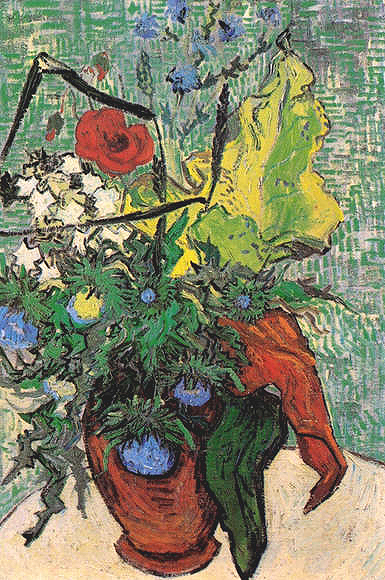
"Vase with Thistles", oil on canvas, 41 x
34 cm, June, 1890.
Pola Museum of Art, Sengokuhara, Japan.
This work is one of the
several still lifes that Van Gogh painted on either June 16 or 17, 1890,
depicting some wild flowers that he had found at Gachet's house. The only
surviving still lifes by Van Gogh of wild flowers that include thistles are
this work and Wild Flowers and Thistles in a Vase in a private collection.
While different flowers are featured in the two paintings, they have been
arranged in the same vase on a round table in both cases. The two works are
therefore thought to have been painted around the same time. In the outlines
that define the table and the vase, one can perceive the influence of the
ukiyo-e prints Van Gogh collected so enthusiastically in Paris. The serrated
thistle leaves and the heads of wheat extend outward as if embracing the
flowers. The nearly concentric brushstrokes of the vase and the intersecting
vertical and horizontal strokes of the pale blue background reveal that Van
Gogh was still continuing persistently to explore the effects of line,
colour, and texture. The Pola Museum of
Art opened in September 2002 in Sengokuhara located in the Fuji-Hakone-Izu
National Park. The collections of the Pola Museum of Art number more than
9,500 works which were assembled over some forty years by the late owner of
the Pola Group, Suzuki Tsuneshi (1930-2000). The collection's diverse array
of genres and periods features 400 European paintings including works by the
19th century French Impressionists and Ecole de Paris artists, along with
modern Japanese Western-style paintings, Japanese-style paintings, Oriental
ceramics, modern Japanese ceramics, glass works, and cosmetic utensils. The
museum owns 3 paintings by Van Gogh.
"Wild Flowers and Thistles in a Vase", oil on canvas,
66.0 x 45.0 cm, June, 1890. Private collection
(in 1976: Collection Meyer, New York).
"Young Man with Cornflower", oil on canvas, 39.0 x 30.5 cm,
June, 1890. Private collection, Dallas, USA.
"Daubigny's garden", oil on canvas, 50.7 x 50.7 cm, mid-June 1890.
Van Gogh Museum, Amsterdam, The Netherlands.
Charles-Francois Daubigny
(Paris 1817-1870), one of the best-known painters of the School of Barbizon,
much admired by Vincent van Gogh, moved to Auvers
around 1860. In 1860 he had a house built by Achille Oudinot in Auvers 'aux
vallées'. The house became a meeting-point for many artists. In 1886
Daubigny's son Karl-Pierre, also an artist, died here. At the time of Van Gogh’s arrival,
Daubigny's widow still occupied
their house.
Daubigny’s property included a large garden which Van Gogh would eventually
paint a number of times. This impressionistic view depicts only a small part
of the enclosure, and is a study for two larger paintings he later made of
the whole terrain. He made a little sketch of it for Theo, with a
description: “In the foreground green and pink grass […]. In the centre a
rose bush, to the right a little gate […] [and] a row of yellow lindens. The
house itself is in the background, pink with a roof of bluish tiles.”
The French artist Daubigny was born in Paris in 1817 and trained by his
father. He became a popular landscape painter. He specialized in river
scenes, and worked regularly at Villerville-sur-Mer, a village on the coast,
at the mouth of the Seine. In many cases, he executed his paintings on the
spot, in the open air.
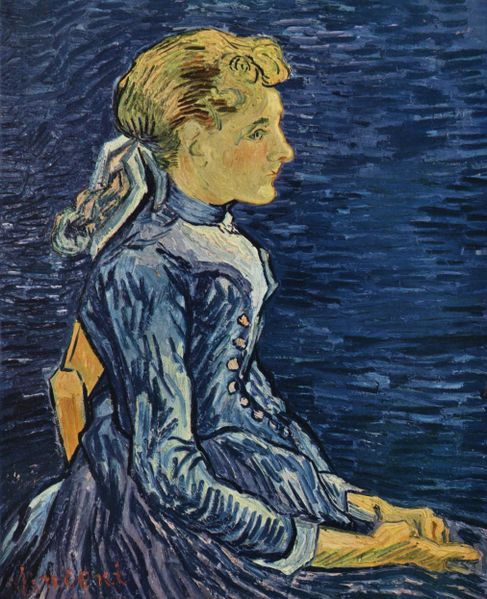
"Portrait of Adeline Ravoux", oil on canvas, 67 × 55 cm,
between June 17 and June 22, 1890. Private collection.
"Portrait of Adeline Ravoux (in blue)", oil on canvas, 71.5 × 53.0 cm,
between June 18 and 21, 1890. Private collection.
Van Gogh's glowing blue 1890
portrait of Adeline Ravoux was sold May 11, 1988 at Christie's for $13.8
million -more than six times the price paid for it in 1980. Neither the
buyer nor the seller were identified.
Van Gogh painted Adeline, the 13-year-old daughter of the innkeeper Arthur Gustave Ravoux, at a time when he was working on new approaches to portrait
painting. He completed three studies of this young girl, of which this one
was the largest and most flattering, and the version he gave his brother
Theo. ''I should like to paint portraits which would appear after a century
to the people living then as apparitions,'' Vincent wrote Theo. (New York
Times).
Adeline Ravoux was the daughter of Arthur-Gustave
Ravoux, whose inn is where Van Gogh lodged in Auvers-sur-Oise. She later
wrote a memoir of Van Gogh's stay with them. She witnessed Van Gogh's return
to the inn after the fatal incident where he shot himself: "Vincent walked
bent, holding his stomach, again exaggerating his habit of holding one
shoulder higher than the other. Mother asked him: " M. Vincent, we were
anxious, we are happy to see you to return; have you had a problem?" He
replied in a suffering voice: "No, but I have…" he did not finish, crossed
the hall, took the staircase and climbed to his bedroom. I was witness to
this scene. Vincent made on us such a strange impression that Father got up
and went to the staircase to see if he could hear anything."
Landscape at Twilight, 1890, oil on canvas, 50 x 101 cm, between June 18 and
22, 1890.
Van Gogh Museum, Amsterdam, The Netherlands.
‘A crepuscular effect: two pear-trees, wholly black, against a yellowing
sky, with grain-fields; and, in the purple background, the castle, enfolded
by dark foliage.’ This was how Van Gogh described his brother Theo in letter
644 (24 or 25 June 1890) the evocative landscape he
painted shortly after sunset in the surroundings of the château at Auvers.
During the final months of his life, Vincent painted a number of works in
this striking format, twice as wide as they were high – ideally suited to
broad landscape views.
"Undergrowth with a Couple", oil on canvas, 50.0 x
100.5 cm, between June 18 and 22, 1890.
Cincinnati Art Museum, Cincinnati, USA.
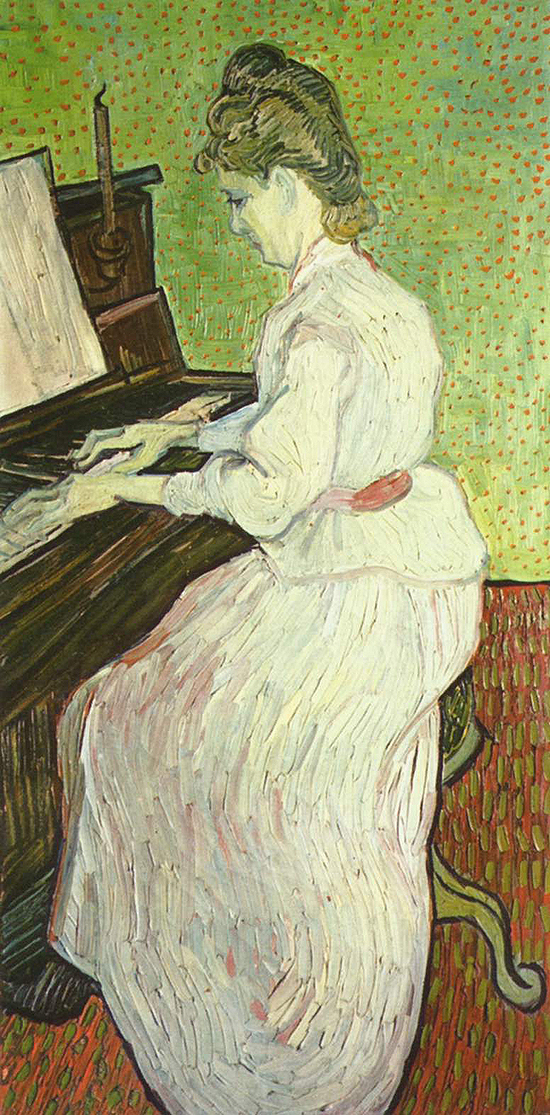
"Marguerite Gachet at the Piano", oil on canvas
102,5 × 50 cm, late June, 1890.
Kunstmuseum Basel, Switzerland.
"I am also going to paint a portrait of his daughter, who is nineteen years
old",
Vincent wrote his sister Wilhelmina on June 5, 1890.
June 28, 1890 he wrote Theo about this portrait: “Yesterday and the day
before I painted
Mlle. Gachet's portrait, which I hope you will see soon; the dress is pink,
the wall in the background green with orange spots, the carpet red with
green spots,
the piano dark violet; it is 1 metre high by 50 cm wide.
It is a figure that I painted with pleasure - but it is difficult".
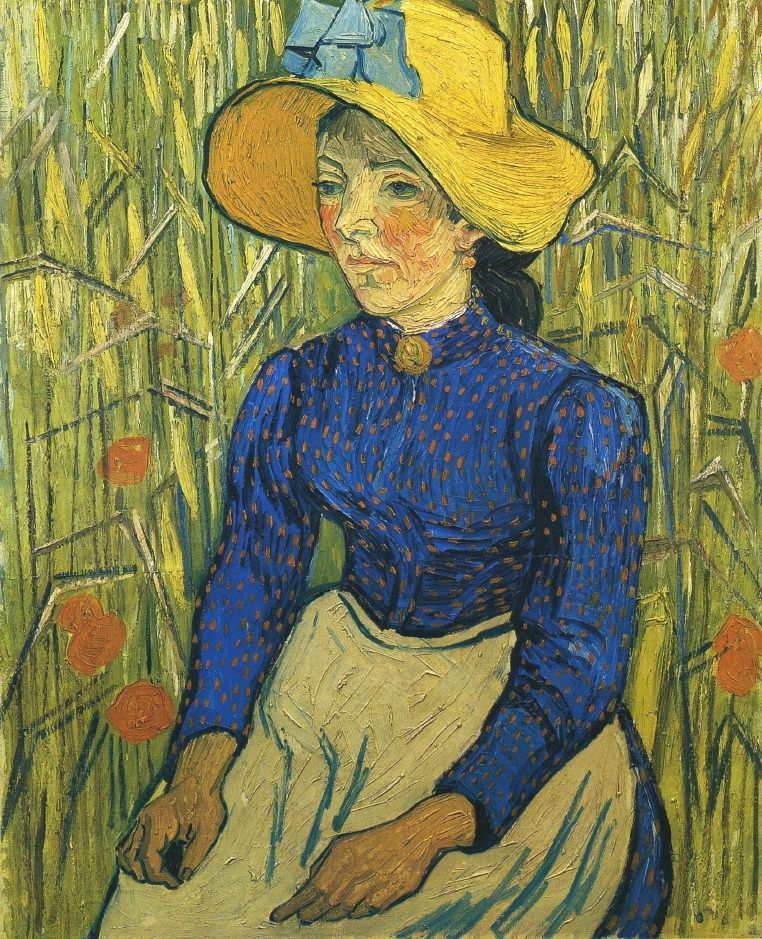
"Young Peasant Woman with Straw Hat Sitting in the
Wheat", oil on canvas, 92.0 x 73.0 cm, late June, 1890.
Private collection Steven A. Cohen, Greenwich, Connecticut, USA.
On October 7, 2005,
it was announced that Stephen Wynn had sold the painting
along with Gauguin's Bathers to Steven A. Cohen for $100 million.
"La petite Arlésienne", oil on canvas, 51.0 x 49.0 cm, June 1890.
Kröller-Müller Museum, Otterlo, The Netherlands.
"Fields near Auvers", oil on canvas, 50.0 x 101.0 cm, June, 1890.
Österreichische Galerie Belvedere, Vienna (Wien). Austria.
"Glass with Carnations", oil on canvas, 41.0 x 32.0 cm,
June, 1890. Private collection.
"Glass with Wild Flowers", oil on canvas, 41.0 x 34.0 cm,
June, 1890. Private collection.
"Japanese Vase with Roses and Anemones", oil on canvas, 51.7 x 52.0 cm,
June, 1890. Musée d’Orsay, Paris, France.
"Pink Roses", oil on canvas, 32.0 x 40.5 cm, June, 1890.
Ny Carlsberg Glyptotek, Copenhagen, Denmark.
"Vase with Rose-Mallows", oil on canvas, 42.0 x 29.0 cm, June, 1890.
Van Gogh Museum, Amsterdam, The Netherlands.
"Two Girls, out of Temper", oil on canvas, 51.2 x 51.0 cm,
June 1890.
Musée d’Orsay, Paris, France.
"Two Girls, smiling", oil on canvas, 51.5 x 46.5 cm, June, 1890.
Collection Joseph Albritton, Washington, D.C., USA.
"Garden in Auvers", oil on canvas, 64.0 x 80.0 cm,
June-July, 1890.
Collection Pierre Vernes and Edith Vernes-Karaoglan, Paris, France.
"Young Girl Standing Against a Background of
Wheat", oil on canvas,
66.0 x 45.0 cm. late June, before July 2, 1890.
National Gallery of Art, Washington, USA.
"Daubigny's Garden", oil on canvas, 53.0 x 104.0
cm, between July 17 and 23, 1890.
Hiroshima Museum of
Art, Hiroshima, Japan.
"Daubigny's Garden (with cat)", oil on canvas, 50.0
x 101.5 cm, between July 17 and 23, 1890.
Fondation Rudolf Staechelin, Basel, Switzerland.
"Town Hall at Auvers on the 14th of July 1890, oil on canvas, 72 x 93 cm.
Collection Mr. und Mrs. Leigh B. Block, Chicago, USA .
The town hall is in front
of the Ravoux inn, where Vincent lived.
Only in 1880 the 14th of
July became officially the national holiday of France,
to celebrate the fall of the Bastille on July 1789.
In 1890 the catholic church and the rural population still opposed this public
holiday.
"Thatched Sandstone Cottages in Chaponval", oil on
canvas, 65.0 x 81.0 cm,
July 1890. Kunsthaus Zürich, Zürich, Switzerland.
"Wheat Fields at Auvers under a clouded Sky", oil on
canvas, 73.0 x 92.0 cm,
July, 1890. Carnegie Institute, Pittsburgh, USA.
"Wheat Field with Cornflowers", oil on canvas, 60.0
x 81.0 cm, July, 1890.
Fondation Beyeler, Riehen/Basel, Switzerland.
"Plain near Auvers", oil on canvas, 73.3 x 92.0 cm,
July, 1890.
Neue Pinakothek, Munich (München), Germany.
"Wheat Fields with Auvers in the Background", oil
on canvas, 43.0 x 50.0 cm, July, 1890.
Musée d'Art et d'Histoire, Geneva, Switzerland.
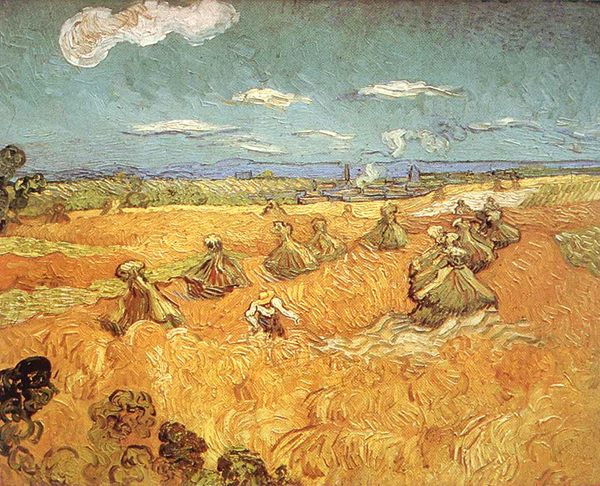
"Wheat Stacks with Reaper", oil on canvas, 73.6 x
93.0 cm, July, 1890.
The Toledo Museum of Art, Toledo, Ohio, USA..
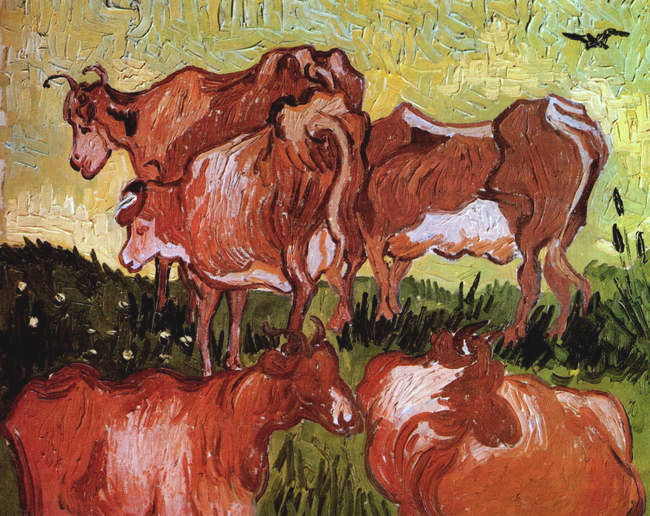
"Cows (after Jordaens)", oil on canvas, 55.0 x 65.0 cm, July, 1890.
Musée des Beaux-Arts, Lille (Rijsel), France.
The museum owns the
original Jordaens.
Dr Gachet made an engraving after the painting and Van Gogh painted his
version after the engraving.
"Wheat Field Under Clouded Sky", oil on canvas,
50.0 x 100.5 cm, July, 1890.
Van Gogh Museum, Amsterdam, The Netherlands.
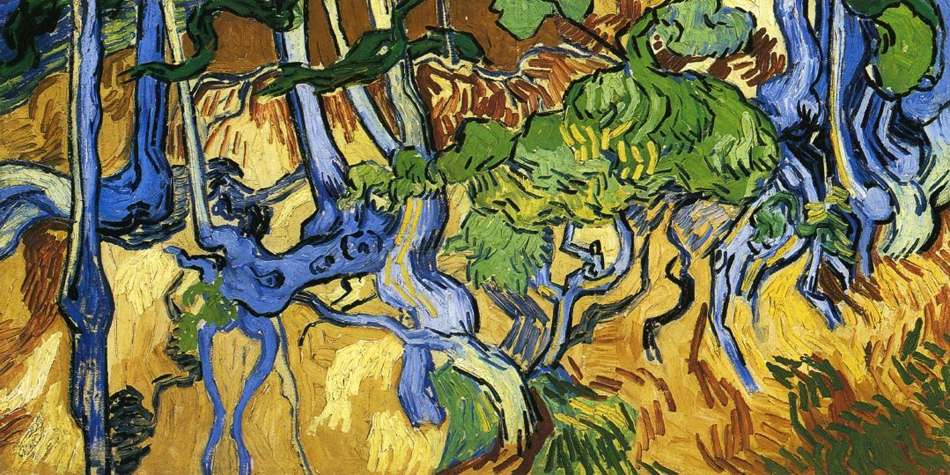
"Tree Roots and Trunks", oil on canvas, 50.0 x
100.0 cm, July, 1890.
Van Gogh Museum, Amsterdam, The Netherlands.
"Two Women Crossing the Fields", oil on paper on canvas, 32.0 x 61.0 cm,
July, 1890.
Marion Koogler McNay Art Museum, San Antonio, USA.
"Bank of the Oise at Auvers", oil on canvas, 73.3 x
93.7 cm, July, 1890.
The Detroit Institute of Art, Detroit, USA.
"Wheat fields with Crows", oil on canvas, 50.5 x
103.0 cm, July, 1890.
Van Gogh Museum, Amsterdam, The Netherlands.
Wheatfield with Crows is one of Van Gogh’s most famous paintings and
probably the one most subject to speculation. It was executed in July 1890,
in the last weeks of Van Gogh’s life. Many have claimed it was his last
work, seeing the dramatic, cloudy sky filled with crows and the cut-off path
as obvious portents of his coming end. However, since no letters are known
from the period immediately preceding his death, we can only guess what his
final work might really have been. Some scholars believe it was the
Tree-roots, but we have no proof that this was the case. In Auvers, Van Gogh
painted a large number of landscapes with wheat fields, all on unusual,
elongated canvases (50 x 100 cm). He wrote to Theo about two of these works:
“They depict vast, distended wheat fields under angry skies, and I
deliberately tried to express sadness and extreme loneliness in them.” But
these pictures also had a positive side: “I am almost certain that these
canvases illustrate what I cannot express in words, that is, how healthy and
reassuring I find the countryside.”
"Landscape at Auvers in the Rain", oil on canvas,
50.0 x 100.0 cm, July, 1890.
National Museum of Wales, Cardiff, Wales.
"Field with Wheat Stacks", oil on canvas, 50.0 x
100.0 cm, July, 1890.
Fondation Beyeler, Riehen/Basel, Switzerland.
"Sheaves of Wheat", oil on canvas, 50.5 x 101.0 cm,
July, 1890.
Dallas Museum of Art, Dallas, Texas, USA.
"Haystacks under a Rainy Sky", oil on canvas, 64.0
x 52.5 cm,
July, 1890. Kröller-Müller Museum, Otterlo, The Netherlands.
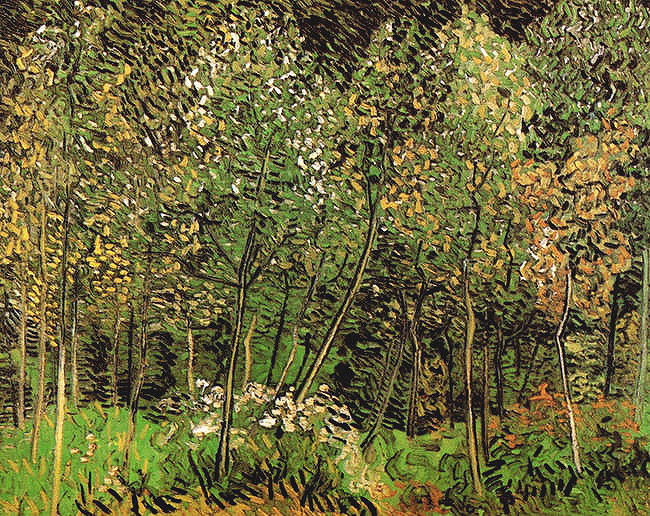
"The Grove", oil on canvas, 73.0 x 92.0 cm, July,
1890.
Private collection.
"The Fields", oil on canvas, 50.0 x 65.0 cm, July,
1890.
Private collection, Zürich, Switzerland.
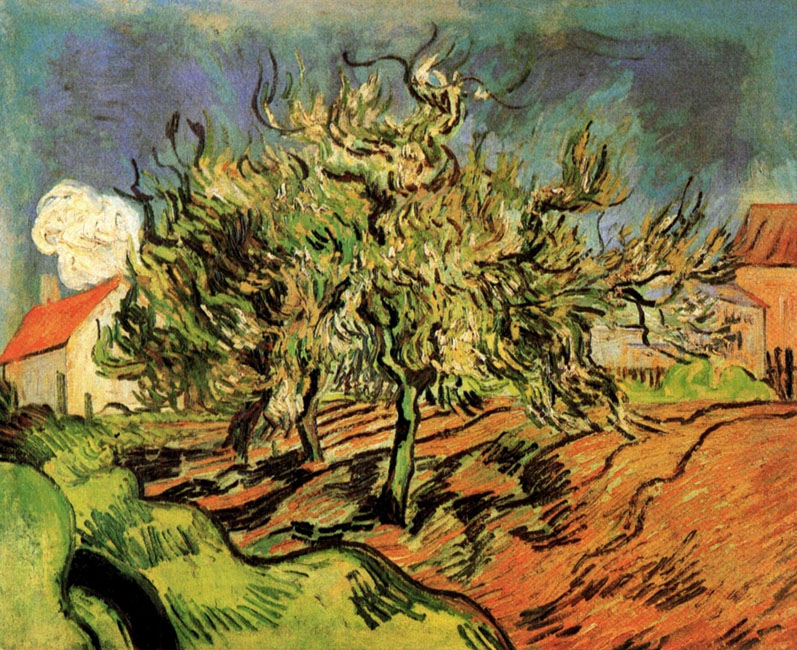
"Landscape with three Trees and a House",
65 x 80 cm, 1890.
THE
DRAWINGS
"What is drawing? How
does one learn it? It is working through an invisible iron wall that seems
to stand between what one feels and what one can do. How is one to get
through that wall - since pounding at it is of no use? In my opinion one has
to undermine that wall, filing through it steadily and patiently. And there
you are - how can one continue such work assiduously without being
distracted or diverted, unless one reflects and orders one's life according
to principles? And as it is with art so it is with other things. And great
things are not something accidental, they must be distinctly willed".
From letter 237 from Vincent van Gogh to Theo van Gogh, The Hague,
October 22, 1882.
"Cottages with thatched Roofs in the Quarter Valhermeil in Auvers",
45 x 54,5 cm, May 21, 1890.
Crayon on paper.
Van Gogh Museum, Amsterdam, The Netherlands.
"Old vineyard with a peasant woman", 44 x 54
cm, May 22 or 23, 1890.
Brush in oil and watercolour, pencil on laid paper.
Van Gogh Museum, Amsterdam, The Netherlands.
Van Gogh produced this drawing in
Auvers in May 1890, on one of his first days in the village. He experimented
in this work, and also in Cottages with thatched roofs, drawn in the same
period, with various tints of blue, ranging from deep dark blue to watery
light blue. As a contrasting accent he included a couple of bright orange
roofs, that have now faded to reddish-brown. This work harks back to Van
Gogh’s colour experiments in drawings from his Paris period from early 1887
and also to several still lifes produced in Saint-Remy, in some of which the
flowers form a simultaneous contrast with the background and in others a
complementary contrast.
Van Gogh produced more than 70 paintings in Auvers and only a small number
of large, ambitious drawings, including this work in oil and watercolour. He
began by laying out an extensive under-drawing in pencil, then filled in the
sky with watercolour, leaving some areas blank for the white clouds. The
rest of the scene is constructed of sturdy, flowing lines that cause the
work to resemble a pen-and-ink drawing. However, Van Gogh’s materials were
brush and oil paint, as is evident from the impasto application and the
seepage of oil to the verso of the paper.
"Cottages with a Woman Working in the Foreground",
May, 1890.
Musée d'Orsay, stored at the Musée du Louvre, Paris.
"Houses and Chestnut Trees", late May, 1890
Van Gogh Museum, Amsterdam.
"Sketch of a Village Street", late May, 1890.
Van Gogh Museum, Amsterdam.
"Cottages with a Woman Working in the Foreground",
470 x 620.5 mm, late May, 1890,
charcoal, reed pen and black ink, blue pastel, and white chalk on blue-gray
laid paper,
inscribed verso, upper right, in graphite: 3 digits ("5--"?) under "Go--".
Art Institute of Chicago, Chicago, USA.
"Village Street", late May 1890.
Van Gogh Museum, Amsterdam.
"Landscape with Bridge across the Oise",
473 x 629 mm, late May
1890.
Crayon, aquarelle and gouache on rose Ingres paper.
Tate Gallery, London, England.
This drawing
represents a view looking across the river Oise towards Méry and the Paris
road.
The view is taken from the top of a high and very steep embankment above a
railway line.
The old bridge of Auvers (since replaced by a modern structure) is on the
right.
The plumy forms in the bottom right-hand corner suggest the smoke of a
passing train.
It would appear that the trees along the riverbank are purely an imaginative
addition by the artist.
The work has been affected by fading and the colours are no longer as strong
as they once were.
"Sketches of a still Life and two
Women and a Girl",
May-June, 1890.
Private collection.
"Landscape with the Oise", June, 1890
Van Gogh Museum, Amsterdam.
"Landscape with the Oise", June, 1890.
Van Gogh Museum, Amsterdam.
"Little Stream Surrounded by Bushes", June, 1890.
Van Gogh Museum, Amsterdam.
"Sketches of Peasant Ploughing with Horses", June,
1890.
Van Gogh Museum, Amsterdam.
"Seated Nude (after Bargue)",
June, 1890.
Van Gogh Museum, Amsterdam.
Generations of late
19th-century art students, including Vincent van Gogh and Pablo Picasso,
made active use of a series of 197 lithographed drawings of the nude figure
created by a little-known French artist, Charles Bargue (1825/26-1883).
Bargue, hugely talented and probably self-taught, first published the
exquisite collection of plates called the Cours de Dessin in Paris with
Goupil & Cie between 1868 and 1873. Goupil connected Bargue with one of his
best selling artists, Jean-Léon Gérôme (1824–1904), and together they
published and sold thousands of these teaching manuals. They were designed
to prepare beginning art students to draw from “nature”, that is, objects,
both natural and man-made, in the real world. When the Drawing Course was
first published (Parts I and II beginning in 1868; Part III in 1871) it was
assumed that the imitation of nature was the primary goal of the artist, and
that the most important subject was the human body.
Young artists copied plates in sequence in order to perfect their drawing
skills, hoping to emulate Bargue’s refinement of line, shading, volume, and
perspective. While other such manuals were in circulation at the time,
Bargues was considered by far the most complete, and technically proficient.
It soon became the most popular drawing course of the 19th century and gave
Bargue a reputation as not only a lithographer, or craftsman, but most
importantly an artist to watch.
The three parts of the
Drawing Course correspond to a widely accepted sequence of art education in
the 19th century.
Part I, Drawing After Casts (Modeles D’Après la Bosse) and
Part II, Copying Master Drawings (Modeles d’Après Les Maîtres), began
publication in 1868 and were intended for students of industrial and
decorative arts—the very ones whose deficiencies argued so forcefully for
the Course’s necessity—as well as beginning fine arts students.
Part III, Charcoal Exercises in Preparation for Drawing the Male Academic
Nude or Académie (Exercices au Fusain Pour Preparer a l’Etude de l’Academie
d’Après Nature) presented charcoal sketches of the male nude.
It was completed in 1871 and intended for fine art students only—drawing
live models was discouraged if not forbidden in most European and American
schools of design. Published without instructive text because they were
meant to be used primarily in art schools, the Drawing Course sold briskly
from its first publication, and continued to do well for at least three
decades, with individual plates made available by Goupil & Cie and its
successors until the firm’s final dissolution in 1921.
Its primary purchasers were institutions: the city of Paris ordered a
special printing for its schools almost immediately after the first plates
were finished, and the Drawing Course was adopted in Great Britain by the
extensive system of schools and academies supervised by the South Kensington
Museum (now the Victoria and Albert Museum). Its influence was also
widespread in America -- the Pennsylvania Academy of the Fine Arts, for
example, bought Parts I and II of the Drawing Course in 1876, the year
Thomas Eakins began teaching there. Self-trained artists could also easily
make use of the plates, progressing in an orderly, rational sequence through
a program designed to develop their technical skills, while mature artists
would use the plates to hone their skills, as a trained pianist might return
to the discipline of Czerny’s piano exercises.
Vincent van Gogh copied the plates of Part III many times during his career.
Letters to his brother Theo underscore the hold that the “Bargues” had on
the artist. In 1881, he wrote to Theo, “Careful study & repeated copying of
Bargue’s Exercises au fusain have given me a better insight into
figure-drawing. I have learned to measure and to see and to look for the
broad outlines so that, thank God, what seemed utterly impossible to me
before is gradually becoming possible to me now…I no longer stand as
helpless before nature as I used to do.
Van Gogh’s interpretation of Bargue's "Seated Nude", (Part III) is
reproduced here.
"Doctor Gachet sitting at a Table with Books
and a Glass with Sprigs of Foxglove",
in Letter 638, June 3, 1890.
Van Gogh Museum, Amsterdam.
"Road with Cypress and Star", drawing after the
painting in Letter 643.
"Ears of Wheat", drawing in Letter 643.
"Marguerite Gachet at the Piano", in Letter 645,
28 June 1890. Van Gogh Museum, Amsterdam.
"Town Hall at Auvers", June-July, 1890.
Van Gogh Museum, Amsterdam.
"Sheet with a Few Sketches of Figures", June-July,
1890.
Private collection.
"Sketch of a Couple Walking with a Child",
June-July, 1890. Louvre, Paris.
"Baby in a Carriage", June-July, 1890.
Van Gogh Museum, Amsterdam.
"Study of a Fruit Tree", June-July, 1890.
Van Gogh Museum, Amsterdam.
"Sketch of a Donkey", June-July, 1890.
Van Gogh Museum, Amsterdam.
"Sketch of a Hen", June-July, 1890.
Van Gogh Museum, Amsterdam.
"Sketches of a Hen and a Cock", June-July, 1890.
Van Gogh Museum, Amsterdam.
"Sketch of a Lady with Striped Dress and Hat
and of a Lady, half-figure", June-July, 1890.
Vassar College Art Gallery, Poughkeepsie, New York, USA.
"Studies of a Woman standing, two Heads and
another Figure", June-July, 1890.
Vassar College Art Gallery, Poughkeepsie, New York, USA.
"Branch with Leaves", June-July, 1890.
Van Gogh Museum, Amsterdam, The Netherlands.
"Blossoming Branches", June-July, 1890.
Van Gogh Museum, Amsterdam.
"Carriage", June-July, 1890.
Van Gogh Museum, Amsterdam.
"Carriage Drawn by a Horse", June-July, 1890.
Van Gogh Museum, Amsterdam.
"Houses among Trees", June-July, 1890.
Van Gogh Museum, Amsterdam.
"Houses among Trees with a Figure", June-July, 1890.
Van Gogh Museum, Amsterdam.
"Hind Legs of a Horse", June-July, 1890.
Louvre, Paris, France.
"Sketch of a Woman with a Baby in her Lap",
June-July, 1890. Louvre, Paris.
"Horse and Carriage", June-July, 1890.
Van Gogh Museum, Amsterdam.
"Men in Front of the Counter in a Cafe", June-July,
1890.
Van Gogh Museum, Amsterdam.
"A House at Auvers", June-July, 1890.
Van Gogh Museum, Amsterdam.
"Lady with Checked Dress and Hat",
June-July, 1890.
Musée D'Orsay, Paris.
"Woman with Striped Skirt",
June-July, 1890.
Musée D'Orsay, Paris, France.
"Landscape with Houses among Trees and a Figure",
June-July, 1890.
Palace of the Legion of Honour, San Francisco, USA.
"Man with Scythe in a Wheat Field", June-July,
1890.
Van Gogh Museum, Amsterdam.
"Women working in a Wheat Field",
June-July, 1890.
Van Gogh Museum, Amsterdam.
"Sketch of Cows and Children", June-July, 1890
Van Gogh Museum, Amsterdam.
"A Woman picking up a Stick in Front of Trees",
June-July, 1890.
Van Gogh Museum, Amsterdam.
"Sketch of Women in a Field", June-July, 1890.
Van Gogh Museum, Amsterdam.
"A Woman working in a Wheat Field",
June-July, 1890.
Van Gogh Museum, Amsterdam.
"Two Women working in a Wheat Field",
June-July, 1890.
Van Gogh Museum, Amsterdam.
"Sketch of Two Women", June-July, 1890.
Van Gogh Museum, Amsterdam.
"Mask of an Egyptian Mummy and a figure"
(Sketch of an Eroded Garden-Wall Ornament),
June-July, 1890.
Van Gogh Museum, Amsterdam
Vincent made several
sketches of an ornament
in Rue Rajon, 56 in Auvers.
He remodelled the simple motif to an Egyptian mummy.
"Mask of an Egyptian Mummy, and a
Woman",
June-July, 1890.
Van Gogh Museum, Amsterdam.
"Mask of an Egyptian Mummy", July, 1890
Van Gogh Museum, Amsterdam.
"Mask of an Egyptian Mummy", July, 1890
Van Gogh Museum, Amsterdam.
"Mask of an Egyptian Mummy", July, 1890
Van Gogh Museum, Amsterdam.
"Wheat Field with a Stack", July, 1890.
Black chalk, goose- and reed pen with brown ink on Ingres paper, 465 x 610 mm.
Whitworth Art Gallery, University of Manchester, England.
"Sheaves",
July, 1890.
Black chalk, reed pen with brown ink, grey washed on blue-grey vergé paper, 474 x 630 mm.
Van Gogh Museum, Amsterdam.
"Girl with Straw Hat, Sitting in the Wheat",
July 1, 1890, in letter 646.
Van Gogh Museum, Amsterdam.
"Wheat Fields", July 2, 1890, in letter 646.
Van Gogh Museum, Amsterdam.
"Couple walking between Rows of Trees", July 2,
1890,
in Letter 646. Van Gogh Museum, Amsterdam.
"Cottages with thatched Roofs and Figures", July
23, 1890, in Letter 651.
Van Gogh Museum, Amsterdam.
"Wheat Fields with a Barn", July 23, 1890, in
Letter 651.
Van Gogh Museum, Amsterdam.
"Wheat Fields", July 23, 1890, in Letter 651.
Van Gogh Museum, Amsterdam.
"Daubigny's Garden with Cat", July 23, 1890, in
Letter 651.
Van Gogh Museum, Amsterdam.
"A Woman with a Donkey", Auvers-sur-Oise, 1890.
Van Gogh Museum, Amsterdam.
"A Woman Standing", Auvers-sur-Oise, 1890.
Van Gogh Museum, Amsterdam.
"Two Women Working in the Field", Auvers-sur-Oise,
1890.
Van Gogh Museum, Amsterdam.
"Sketches of Boats and several Figures", Auvers-sur-Oise, 1890.
Private collection.
AUBERGE RAVOUX, THE INN AT AUVERS-SUR-OISE,
WHERE VINCENT VAN GOGH LIVED AND DIED
Mr Ravoux, Germaine Ravoux,
Raoul, the son of Vincent's neighbour, carpenter Vincent Levert and Adeline
Ravoux
From Mai 1890 until the 29th of July 1890 Vincent
lived in a small room of the Ravoux inn.
'Le peintre Vincent van Gogh vécut dans cette maison
et y mourut le 29 juillet 1890,
(The painter Vincent van Gogh lived in this house and died here June 29,
1890)
The small attic where Vincent lived and died. Photo
from the fifties, 20th century.
THE CEMETERY AT AUVERS
View of the cemetery and the church at Auvers.
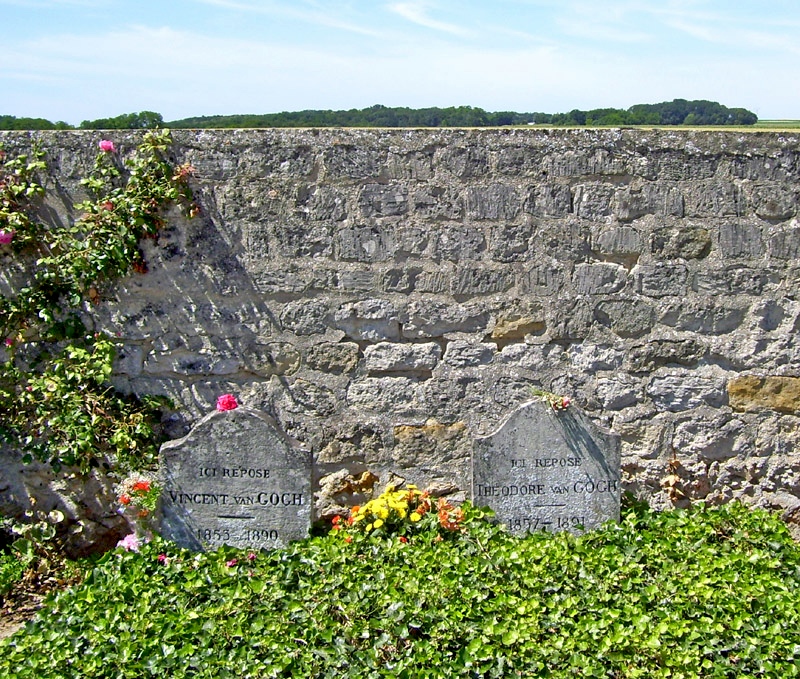
Vincent's
grave: "Ici repose (here lies) Vincent van Gogh (1853-1890)"
Vincent van Gogh and his brother Theo van Gogh, for
ever inseparable..
The last
hours of Vincent van Gogh
Sunday, July 27,
1890
Vincent went out right after lunch, not his usual custom, and had still not
returned by sunset. About 9 o'clock the innkeeper and his family were on the
terrace when Vincent appeared, clutching his stomach. Madame Ravoux asked if
he'd had some problem. "No," he replied with some difficulty, but I have "…"
He didn't finish the sentence, but went upstairs to his room. Ravoux,
worried, followed him and, through the door, heard groans. He went in and
found Vincent curled up on the bed. Vincent lifted his shirt and Ravoux
could see a small wound by the heart. "What have you done?" he cried.
"I
have tried to kill myself." (Ravoux` testimony)
It emerged that Vincent
had gone to the wheat field where he liked to paint, behind the château of Gosselin, the Parisian. It's more than half a kilometre from the inn, up a
hill. He leaned his easel against a haystack and then walked behind the
château. The popular theory is that shot himself — using a revolver (according to Adeline Ravoux) that Ravoux (or possibly
Gachet) had loaned him that morning to scare off the crows pestering him
while he painted — and then collapsed, Ravoux supposed, only to be revived
by the evening's cool, he headed back to the inn.
According to the former director of the Metropolitan Museum of Art, Thomas
Hoving (Art for Dummies), he didn't commit suicide, but fell against a
shotgun which accidently discharged. If Vincent had committed suicide he
probably had shot in his head, not in his stomach or chest.
A theory that Vincent was murdered, but covered the offender, is possible,
too. If he committed suicide, there has to be a weapon, but Adeline Ravoux
says in her memoirs that the weapon was never found. So somebody took the
weapon and that is suspicious.
If one person is a possible suspect, we need to mention Dr. Paul Gachet.
Vincent was getting much better in Auvers, everything was going forwards, he
sold his first painting (The Red Vine), also got a very positive review in a
Paris art paper, by the art critic Albert Aurier. So why killing himself
then? He didn't owned a gun, either!
Ten years before the Gachet family were implicated in a murder...
When Vincent was wounded, Dr. Gachet only cleaned the wounds and let him
smoke his pipe, waiting for the moment he died. He called Theo, brother of
Vincent Van Gogh, and they waited until Vincent died. He did not do anything
to help him. Vincent paid for his so-called medical treatment with Gachet in
invaluable paintings and after the funeral the doctor took a lot of
paintings with him. He was an art-connoisseur and knew, as one of the few in
the world, that he added masterworks to his collection, and that for free!
Probably one day the mortal remains of Vincent van Gogh will be
exhumed. A DNA-test should be possible and we shall know more about his diseases and, too, there still has to be
the
bullet that remained in the body and the bullet could tell us a lot...
Tom Hirschig was dispatched to fetch Dr. Mazery, the local practitioner, but
couldn't find him, so Ravoux sent him to get Dr Gachet. Gachet dressed
Vincent's wound, but Adeline Ravoux swears he declared the patient beyond
hope and abruptly left. Emile Bernard, though, believes Gachet thought
he could save him, but Vincent merely replied, "Then it has to be done over
again." The bullet in Vincent's chest was not removed.
Ravoux and Hirschig remained at Vincent's side, repeatedly filling and
lighting his pipe for him. He often moaned in pain but also slept on and
off.
Tuesday, July 29,
1890
Soon after the sun was up on Monday morning two gendarmes appeared at the
inn and asked Vincent if he was the one "who wanted to commit suicide".
"Yes, I believe." "You know that you do not have the right?" "My body is
mine," Vincent replied calmly, "and I am free to do what I want with it. Do
not accuse anybody — it is I who wished to commit suicide."
Ravoux had determined
that Theo van Gogh worked for the Art Gallery of Boussod Valadon on
Boulevard Montmartre in Paris and sent a telegram. Theo arrived by train by
mid-afternoon and ran from the station to the inn. He immediately joined his
brother and remained at his side. "I found him somewhat better than I
expected," Theo wrote to his wife. The siblings spoke at some length, Theo
urging him on but being spurned with the words, "The sadness will last
forever." Then Vincent lapsed into a coma. They said the last words he
uttered were, "I wish I could pass away like this."
He died at 1.30
this morning.
Ravoux signed a formal
declaration of death at the town hall.
The priest at Notre Dame d'Auvers refused to say mass for a suicide. The
windows of the hotel were shuttered and, in the afternoon, Vincent's body
was bought downstairs to the lobby, which had been adorned with flowers by
Hirschig, mostly cheerful sunflowers.
Théo ringed the room with Vincent's paintings, among them "The Church of
Auvers", "Irises", "The Garden of Daubigny" and "Child with an Orange", the
last one a portrait of the two-year-old son of the village carpenter,
Levert, who had built the coffin and provided the supports on which it
rested. At its foot were Vincent's palette and brushes. He still had
plenty of material from Theo to continue painting and he'd talked of new
ideas he wanted to try.
Wednesday, July 30, 1890
In the afternoon the funeral procession, followed the casket out past Notre Dame d'Auvers,
which wanted nothing to do with Vincent, to the farther cemetery. And there
were Emile Bernard, Père Tanguy, Lucien Pissarro, Theo van Gogh, Dr Gachet and his son
Paul, Ravoux and his wife, Lauzet, the Dutch painter Van der Valk, Hirschig,
Léonide Bourges and Mlle Mesdag and several neighbours. Dr Gachet attempted a
eulogy but didn't get far beyond "an honest man and a great artist", and
this, presciently: "It is the art that he cherished above all else that will
ensure that he lives on."
Adeline Ravoux: "On the
return, Theo, Tom, Dr. Gachet and the latter's son, Paul, who may have then
been sixteen, accompanied Father. They entered "the painters room " where
the coffin left from and where the canvases were on display.
Theo, wanting to thank those that had helped his brother, offered them to
take, in memory, some canvases of the departed artist. Father was content
with my portrait and the Town Hall of Auvers that M. Vincent had given him
when he was alive. When the proposal was
made to Dr. Gachet, the former chose many canvases and passed them to his
son Paul: "Roulez Coco", telling him to make a parcel. Then Theo took my
sister Germaine to choose a toy: this was a basket of intertwined shavings
containing a small iron kitchen utensil. Finally, Theo took his brother's
belongings. We never saw him again".
Dr Gachet made these drawings of
Vincent on his deathbed, July 29, 1890.
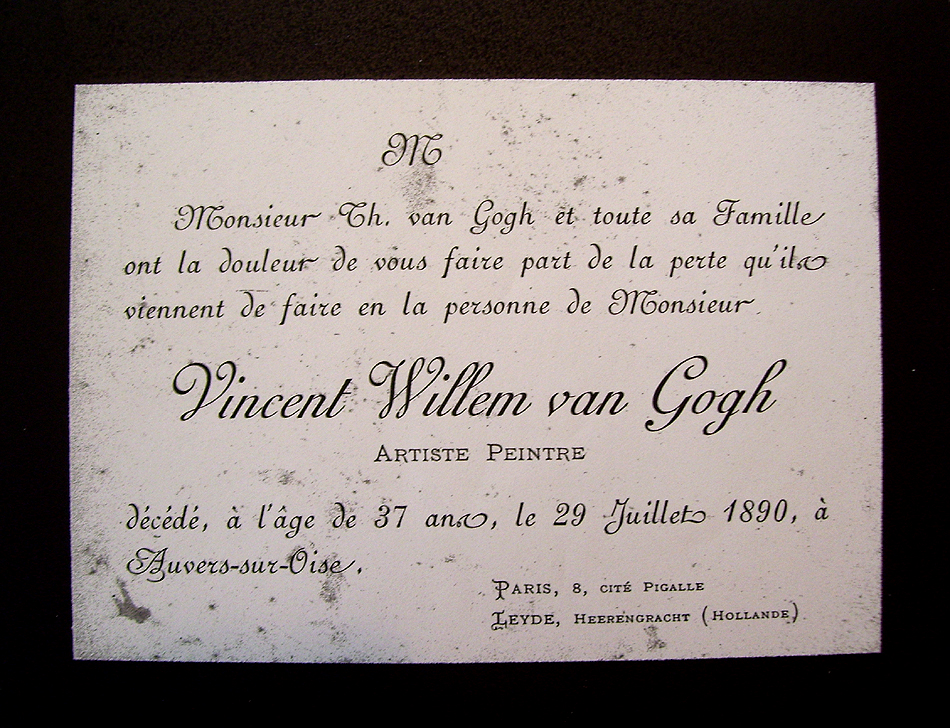
"Acte de Décès" (death certificate) of Vincent Willem
van Gogh.
Adeline Ravoux: "It was Father who, with Theo, in the morning made the
declaration of the death to the town hall".
Emile Bernard: "L’Enterrement de Vincent van Gogh"
(The Funeral of Vincent van Gogh),
oil on canvas, 73 x 93 cm, 1893. Musée d’Orsay, Paris, France.
August 1893 this
painting was published by Maurice Dennis in 'Art et Critique', with the
famous terms:
"...essentiellement une surface plane recouverte de couleurs en un certain
ordre assemblées".
The painting is a reconstruction, painted from memory, 3 years after the
funeral in 1893.
Behind the partly
hidden bier are walking, half hidden behind a black drapery:
1. Theo van Gogh;
2. Charles Laval;
3. André Bongert;
4. Lucien Pissarro;
5.
Emile Bernard; 6. The painter Lauzet;
7. Le père Tanguy;
8. Le père Ravoux;
9. Dr. Gachet. Further some artists
and men and women from Auvers and surroundings.
(Information from Michel-Ange
Bernard, son of the artist Emile Bernard)
Newspaper-report in L'Echo Pontoisien,
August 7, 1890: "_ Auvers-sur-Oise. _ Sunday, July
27,
a certain Van Gogh, aged 37, Dutch nationals, artist,
en route in Auvers, has shot himself with
a revolver in the fields and, only wounded,
returned to his room, where he died the day after the next day."
OTHER
ARTISTS BURIED
ON THE CEMETERY OF AUVERS
Norbert Goeneutte (1854-1894), peintre graveur
(painter and graphic artist).
Jeanne Kosnick-Kloss (1892-1966), peintre et
sculpteur (painter and sculptor);
compagne du peintre et sculpteur (companion of life of the artist and sculptor)
Otto Freundlich (1878-1943).
Mort en deportation au camp du Lublin Maïdanek.
[Otto
Freundlich fled to Paris for the Germans, fled again to the south of France,
but was betrayed and deported to the concentration camp Lublin Majdanek and
murdered the same day]
[The German paintress, carpet-weaver and singer Jeanne (Hannah)
Kosnick-Kloss studied in Köln and Genève.
She married the pianist and writer Henri Kosnick and moved to Paris in 1925.
In 1929 she met Otto Freundlich and became his partner in life.]
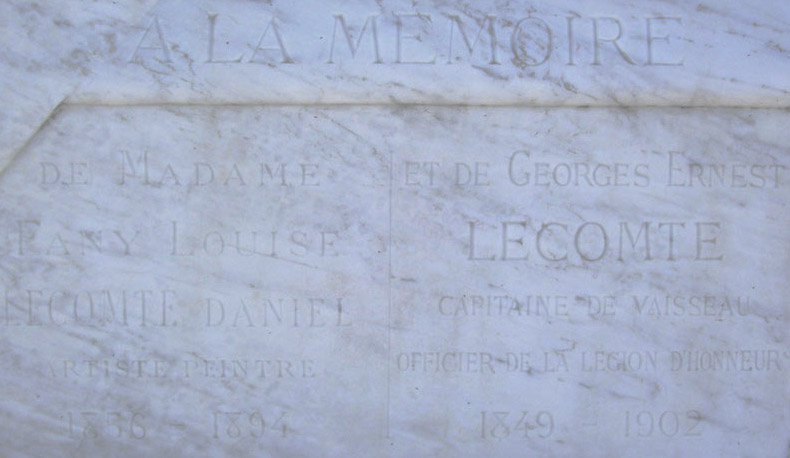
Fany Louise Lecomte Daniel (1836-1894), artiste
peintre (painter).
[Also buried in this grave: Georges Ernest Lecomte (1849-1902),
capitaine de vaisseau (ship-captain), officier de la legion d'honneur;
Marie-Louise Cherouise, née (=born) Vavasseur (1906-2004)
and Pierre Cherouse (1934-2001)].
A part of the sepulchral monument of the artist Fany Louise
Lecomte Daniel.
Jean Baptiste Yollant (1852-1894), architect.
RELEVANT LETTERS
Letter
from Vincent van Gogh to Theo van Gogh The Hague, 15-16 July 1882 [letter 215]
Dear Theo,
(...)
The other day I saw the exhibition of French art from the
Mesdag, Post, etc., collections. There are many beautiful
things by Dupré, Corot, Daubigny, Diaz, Courbet, Breton,
Jacque, etc. What I particularly admired was the large
sketch by Th. Rousseau from the Mesdag collection - a herd
of cows in the Alps - and a landscape by Courbet - yellow,
sandy hillocks covered here and there with fresh young grass
and bordered by dark woods, which a few white birch trees
stand out against; far in the distance little grey houses
with red and blue slated roofs, and a narrow, light,
delicate grey streak of sky above. But the horizon very
high, so that the soil is the principal thing. And that fine
streak of sky serves more as a contrast to make you feel the
roughness of the masses of dark earth. I think this is the
most beautiful thing of Courbet's I have ever seen.
The Duprés are superb, and there
is a Daubigny which I could not get enough of - large
thatched roofs against the slope of a hill 1.
Also a small Corot, a pond and lisière de bois [edge of a
wood], at four o'clock or thereabouts on a summer morning.
One single little pink cloud shows that the sun will soon
rise - a silence and a calm and a peace which are
fascinating.
I am glad I have seen all this.
Now I am going to finish this letter; I hope you will
write soon, and I especially hope that you will really come
to Holland by August. I write you “between times,” for as
you can imagine, there is a lot to do. (...) I am not yet
out of cash, but if you could send something about the 20th,
it would be welcome for getting through the last days of the
month.
Adieu, with a hearty handshake in thought,
Yours sincerely, Vincent
Letter
from Vincent van Gogh to Theo van Gogh Saint-Rémy, 5 October 1889
Relevant
paintings:
"The Mulberry Tree," Vincent van Gogh
"Two Poplars on a Road through the Hills," Vincent
van Gogh
"Trees in the Garden of Saint-Paul Hospital,"
Vincent van Gogh
My dear Theo,
I was longing for your letter, and so I was very glad to
get it and to see from it that you are well, also Jo and the
friends you speak of.
I have to ask you to send the white that I had ordered as
soon as possible, and to add five or ten meters of canvas,
at your discretion. Now I must begin with some rather
irritating news, as I see it. It is that there have been
some expenses during my stay here which I thought M. Peyron
had notified you of as they occurred, which he told me the
other day he had not done, so that it has mounted up to
about 125 francs, deducting from it the 10 that you sent by
money order. It is for paints, canvas, frames and
stretchers, my journey to Arles the other day, a linen suit
and various repairs.
I use two colours here, white lead and ordinary blue, but
in rather large quantities, and the canvas is for when I
want to work on unprepared and stronger canvas.
Unfortunately, this comes just at the time when I would
gladly have repeated my journey to Arles, etc.
That said, I tell you that we are having some superb
autumn days and that I am taking advantage of them. I have
some studies, among others a mulberry
tree all yellow on stony ground, outlined against the blue
of the sky, in which study I hope you will see that I
am on Monticelli's track.
You will have received the package of canvases that I
sent you last Saturday. It surprises me very much that M.
Isaacson wants to write an article on my studies. I should
be glad to persuade him to wait, his article will lose
absolutely nothing by it, and with yet another year of work,
I could - I hope - put before him some more characteristic
things, with more decisive drawing, and more expert
knowledge with regard to the Provencal south.
It was very kind of M. Peyron to speak of my affairs in
those terms - I have not dared to ask leave to go to Arles
lately, which I very much want to do, thinking that he would
disapprove. Not, however, that I suspected that he believed
in any connection between my previous journey and the attack
which closely followed it. The thing is that there are some
people there whom I felt, and again feel, the need for
seeing.
Though not having, like the good Prévot, a mistress in
the Midi who holds me captive, I can't help getting attached
to people and things.
And now that I am staying on here provisionally and, as
far as I can see, shall stay the winter - till spring -
shan't I stay here too till the summer? That will depend
mostly on my health.
What you say of Auvers1 is
nevertheless a very pleasant prospect, and either sooner or
later - without looking further - we must fix on that. If I
come north, even supposing that there were no room at this
doctor's house, it is probable that after your
recommendation and old Pissarro's he would find me board
either with a family or quite simply at an inn. The main
thing is to know the doctor, so that in case of an attack I
do not fall into the hands of the police and get carried off
to an asylum by force.
And I assure you that the North will interest me like a
new country.
But anyway, for the moment there is absolutely no hurry.
I reproach myself for being so behindhand in my
correspondence. I would like to write to Isaacson, Gauguin
and Bernard, but writing does not always succeed, and
besides, my work presses.
Yes, I should like to tell Isaacson that he would do well
to wait, there is nothing in it yet of what, with continued
health, I hope to attain. There isn't anything worth
mentioning about my work now. When I am back, it will form
at best a sort of whole, “Impressions of Provence,” but what
could he say now, when I still have to get the accent of the
olives, the fig trees, the vines, the cypresses, all the
other characteristic things, the same as the Alps, which
must be given more character.
How I should like to see what Gauguin and Bernard have
brought along. I have a study of two yellowing poplars
against a background of mountains and a view of the park
here, an autumn effect in which the drawing is a little more
naïve and more - home-felt.
Altogether it is difficult to leave a country before you
have done something to prove that you have felt and loved
it.
If I return to the North, I propose to make a lot of
Greek studies, you know, studies painted with white and blue
and a little orange only, as if in the open air.
I must draw and seek style. Yesterday I saw at the
Almoner's here a picture which impressed me, a Provencal
lady with a face full of intelligence and race, in a red
dress, a figure like those that Monticelli had in mind.
It wasn't without great faults, but there was simplicity
in it, and how sad it is to see how they have degenerated
here, as we have from our people in Holland.
I am writing you in haste so as not to delay replying to
your kind letter, hoping that you will write again without
waiting long. I have seen very beautiful subjects for
tomorrow - in the mountains.
Many kind regards to Jo and to the friends, especially
thank old Pissarro, when you have a chance, for his
information, which will certainly be useful.
Shaking both your hands, believe me,
Ever yours, Vincent
Pissarro had talked to Theo about Dr.
Gachet in Auvers, a great art lover and art collector
who might be willing to have Vincent live with him.
Letter
from Theo van Gogh to Vincent van Gogh Saint-Rémy, 10 May 1890
Letter T34
Paris, 10 May 1890
My dear Vincent,
Many thanks for your two letters; I am happy to see that
you continue to feel better, and it would give me a great
deal of pleasure if you could undertake the journey without
danger. Does it seem to you too that it is such a long time
since we have seen each other? If you think it so annoying
to travel in the company of one of the people of the
establishment, my God, you must take the risk, although I
must say that I am not like you, and that if I were you I
should do it to avoid all the misery that would be brought
about by the recurrence of a crisis, for instance if at some
unknown railway station you should fall into the hands of
people you don't know, and of whom you cannot tell how they
would treat you. Now as soon as you start be sure to send me
a telegram at once to let me know what time you will arrive
at the Gare de Lyon, so that I may be able to go meet you.
Of course it is understood that you will stay with us, if
you will content yourself with the little room where we have
lodged Wil and many others.
I wrote to Dr. Gachet yesterday to ask him when he is
coming to Paris, for then he will sit for consultations, and
I asked him at the same time to look for a boarding house for
you. A change of country might certainly do you good, but
with a view to wintertime it might be better if you were in
a warmer climate. But we shall have time enough to talk
about it. I also wrote to Dr. Peyron to tell him that,
unless there should be some definite danger, I should like
him to let you do as you wish, and to let you go. As he has
been good to you, try not to hurt him.
I have ordered the paints you asked for from Tanguy and
Tasset, as I told myself that they would never be lost. If
the paints have not arrived yet, please leave orders for
them to be returned. Would it be possible for you to find a
quiet spot where you will not be surrounded by people or
things that annoy you? I hope so from the bottom of my
heart, and at any rate it would mean an improvement, but
people are much the same everywhere, and when you are
engrossed in artistic things, you will find precious few
people who understand you. To them it is Latin, and they see
only a pastime in it, which one should not take seriously.
I have not yet been to the Salon, which they say is
pretty mediocre, but there is an exhibition of Japanese
drawings and crêpe prints - you will see it when you are
here - which is superb. I wish you were here already.
Don't forget to wire. Cordial greetings from Jo and the
little one; they are both well; a cordial handshake, and I
hope to see you soon.
Theo
I am sending you herewith 150 francs for the journey; and
if there should not be enough money, please send me a
telegram.
Letter
from Vincent van Gogh to Mr. and Mrs. Ginoux Saint-Rémy, 11 or 12 May 1890 [Letter 634a]
My dear Mr. Ginoux,
This is to ask you to be so kind as to send my two beds,
which are still with you, by goods train.
I think it will be wise to empty the pallets, for buying
new straw will not be more expensive than the money paid for
carriage.
The rest of the furniture, goodness yes, there is the
mirror, for instance, which I should like to have. Will you
kindly paste strips of paper across the glass to prevent its
breaking? - but the two chests of drawers, the chairs,
tables, you may keep for your trouble, and if there are
extra expenses, please let me know.
I greatly regret I fell ill on the day I came to Arles to
say goodbye to you all - after that I was ill for two months
without being able to work. However, at present I am quite
well again. But I am going to return to the North, and so, my
dear friends, I vigorously shake your hands in thought, as
well as the hands of the neighbours, and believe me when I
say that over there I shall often think of you all, for what
Mrs. Ginoux said is true - if you are friends, you are
friends for a long time. If you should happen to see the
Roulins, you will surely not forget to remember me to them.
So I stop for now, hoping that Mrs. Ginoux has quite
recovered from her indisposition, and with another
handshake, I am
Sincerely yours, Vincent
Please send the beds to:
Monsieur V. van Gogh, Paris
By goods train, to be called for at the station
I do not intend to stay in Paris longer than a fortnight
at the most, after that I am going to work in the country,
so kindly take care to add to the address:
To be called for at the station.
Otherwise, if you want to write to me, my address in
Paris is: 19, Boulevard Montmartre -(c/o) Maison Boussod &
Cie.
Letter
from Vincent van Gogh to Theo van Gogh Saint-Rémy, 11 or 12 May 1890 [letter 633]
Relevant
paintings:
"Still Life: Vase with Roses," Vincent van Gogh
"Still Life: Vase with Irises," Vincent van Gogh
"Still Life: Vase with Irises against a Yellow
Background," Vincent van Gogh
My dear brother,
Many thanks for your registered letter, containing 150
fr. - which arrived this morning. Also I received canvases
and paints from Tasset and L'Hôte (were the ones from Tanguy
in the same package?) and I cannot be too grateful to you
for them, for if I had not had my work, I should long ago
have been even more broken. At present all goes well, the
whole horrible attack has disappeared like a thunderstorm
and I am working to give a last stroke of the brush here
with a calm and steady enthusiasm. I am doing a
canvas of roses with a light green
back-ground and two canvases
representing big bunches of violet irises, one lot
against a pink background in which the effect is soft and
harmonious because of the combination of greens, pinks,
violets. On the other hand, the other violet bunch (ranging
from carmine to pure Prussian blue) stands out against a
startling citron background, with other yellow tones in the
vase and the stand on which it rests, so it is an effect of
tremendously disparate complementaries, which strengthen
each other by their juxtaposition.
These canvases will take a whole month to dry, but the
attendant here will undertake to send them off after my
departure.
I intend to leave this week as soon as possible, and I am
starting to pack today.
I'll send you a wire from Tarascon. Yes, I also feel that
there is a very long stretch of time between the day we said
goodbye at the station and now.
But another strange thing, just as we were so struck by
Seurat's canvases on that day, these last days here are like
a fresh revelation of colour to me. As for my work, my dear
brother, I feel more confidence than when I left, and it
would be ungrateful on my part to curse the Midi, and I
confess to you that I leave it with great grief.
If your work should prevent you from coming to meet me at
the station, or if it should be at an awkward time or the
weather too bad, don't worry, I'll find my way quite well,
and I feel so calm that I'd be very much surprised if I lost
my mental balance. I do so want to see you again and make
Jo's and the baby's acquaintance. I shall probably arrive in
Paris about five o'clock in the morning, but anyway the wire
will tell you exactly when.
The day of my departure depends on when I'm packed and
have finished my canvases; I am working on the latter with
such enthusiasm that packing seems to me more difficult than
painting. Anyway, it won't be long. I am very glad that this
has not dragged along, which is always regrettable once you
have made up your mind. I am looking forward so much to
seeing the exhibition of Japanese prints again, and I don't
at all despise seeing the Salon, where I think there must
still be some interesting things, though having read the
account in the Figaro, it certainly left me pretty cold.
Kind regards to Jo, and a good handshake in thought.
Ever yours, Vincent
Letter
from Vincent van Gogh to Theo van Gogh Saint-Rémy, 13 May 1890 [letter 634]
Relevant
paintings:
"Still Life: Pink Roses in a Vase," Vincent van Gogh
My dear brother,
After a last discussion with M. Peyron, I have permission
to pack, and have sent my luggage by goods train. The 30
kilos of luggage which one may carry will be enough for me
to bring some frames, the easel and stretchers, etc., with
me. I shall leave as soon as you write M. Peyron. I feel
quite calm and I do not think that in my present condition I
shall be easily upset.
In any case I hope to be in Paris before Sunday so as to
spend your free day quietly with you all. I very much hope
to see André Bonger too at the first opportunity.
I have just finished another canvas of
pink roses against a yellow-green
back-ground in a green vase.
I hope that the canvases I am doing now will make up for
the expense of the journey.
This morning when I had been to pay for my luggage, I saw
the country again after the rain, quite fresh and full of
flowers - what things I could still have done.
I have also written to Arles, asking them to send off the
two beds with the bedding by goods train. I figure that this
can only cost about 10 francs or so for carriage, and it is
always so much saved from the wreck. For it will certainly
be useful to me in the country. If you have not yet answered
M. Peyron's letter, please send him a wire, so that I can
make the journey on Friday or Saturday at the latest, so as
to spend Sunday with you. By doing so I shall also waste
less time for my work, which for the moment is finished
here.
In Paris - if I feel strong enough - I should very much
like to do at once a picture of a yellow bookshop (gas
effect), which I have had in mind so long. You will see that
I'll be fit for it the day after my arrival. I tell you, I
feel my head is absolutely calm for my work, and the brush
strokes come to me and follow each other logically. Anyway,
till Sunday at the latest, I shake your hand, and meanwhile
kindest regards to Jo.
Ever yours, Vincent
Probably the reply to M. Peyron will already have been
sent - I hope so. I was a little worried because it was
delayed a few days, as this seems utterly pointless to me.
For either I shall plunge into fresh work here, or it is
just now that I have leisure for the journey.
Spending days here or elsewhere doing nothing would make
me miserable in my present state of mind.
Besides, M. Peyron does not object, but naturally when
one leaves, the position with regard to the rest of the
management is rather difficult. But that will be all right,
and we'll separate amicably.
Letter
from Vincent van Gogh to Theo van Gogh Auvers-sur-Oise, 20 May 1890 [letter 635]
My dear Theo and dear Jo,
After having made Jo's
acquaintance, henceforth it will be difficult for me to
write only to Theo, but Jo will allow me, I hope, to write
in French, because after two years in the Midi, I really
think that I shall say what I have to say more clearly this
way.
Auvers is quite beautiful, among other things a lot of old
thatched roofs, which are getting rare. So I should hope
that by settling down to do some canvases of this there
would be a chance of recovering the expenses of my stay -
for really it is profoundly beautiful, it is the real
country, characteristic and picturesque.
I have seen Dr. Gachet, who made the impression on me of
being rather eccentric, but his experience as a doctor must
keep him balanced while fighting the nervous trouble from
which he certainly seems to me to be suffering at least as
seriously as I. He piloted me to an inn where they asked 6
francs a day. All by myself I found one where I will pay
3.50 fr. a day.
And until further notice I think I will stay there. When I
have done some studies, I shall see if it would be better to
move, but it seems unfair to me, when you are willing and
able to pay and work like any other labourer, to have to pay
almost double because you work at painting. Anyway, I am
going to the inn at 3.50 first.
Probably you will see Doctor Gachet this week - he has a
very fine Pissarro, winter with a red house in the snow, and
two fine bouquets by Cézanne.
Also another Cézanne, of the village. And I in my turn will
gladly, very gladly, do a bit of brushwork here.
I told Dr. Gachet that for 4 francs a day I should think the
inn he had shown me preferable, but that 6 was 2 francs too
much, considering the expenses that I have. It was useless
for him to say that I should be quieter there, enough is
enough.
His house is full of black antiques, black, black, black,
except for the impressionist pictures mentioned.
Nevertheless, he is a strange fellow. The impression he made
on me was not unfavourable. When he spoke of Belgium and the
days of the old painters, his grief-hardened face became
smiling again, and I really think that I shall go on being
friends with him and that I shall do his portrait.
Then he said that I must work boldly on, and not think at
all of what went wrong with me.
In Paris I felt very strongly that all the noise there was
not for me. I am so glad to have seen Jo and the little one
and your apartment, which is certainly better than the other
one.
Wishing you good luck and health and hoping to see you again
soon, good handshakes,
Vincent
Letter
from Vincent van Gogh to Theo van Gogh Auvers-sur-Oise, 21 May 1890 [letter 636]
Relevant
paintings:
"Thatched Cottages," Vincent van Gogh 1890
[Enlarge]
My dear Theo and Jo,
In the other letter I forgot to give you the address
here, which is temporarily Place de la Mairie, chez Ravoux.
Besides, when I wrote to you, I had not yet made anything.
Now I have one study of old thatched
roofs with a field of peas in flower in the foreground and
wheat, background of hills. A study which I think you will
like. And I already feel that it did me good to go
South, the better to see the North.
It is as I thought, I see more violet hues wherever they
are. Auvers is decidedly very beautiful.
So much so that I think it will pay better to work than
not to work, in spite of all the bad luck with the
paintings that may be expected.
It is very colourful here - but there are such pretty
bourgeois country houses, much prettier than Ville d'Avray,
etc., to my thinking. Seems that Desmoulins, the man who did
Japan, was here, but has gone. So if you can send me some
money toward the end of the week, what I have will last me
till then, but I haven't any for a longer time.
I would also ask you for 10 meters of canvas if it does
not inconvenience you; but if, seeing that it is near the
end of the month, it should inconvenience you, would you
send 20 sheets of Ingres paper.
These I need in any case so as not to waste time. There
is a lot to draw here. Dear fellow, having thought it over,
I do not say that my work is good, but the thing is that I
can do less bad stuff. Everything else, relations with
people, is very secondary, because I haven't the gift for
that. I can't help that.
Not working or working less would cost double, that is
all I can see. If we look for another road to success
than the natural road of work - which we shall hardly do.
Look here, if I work, people here are just as likely to come
to my house without my going to see them purposely as if I
took steps to make acquaintances.
It is by working that you meet people, and that is the
best way. Besides, I am quite convinced that this is your
opinion and Jo's too. I can do nothing about my illness. I
am suffering a little just now - the thing is that after
that long seclusion the days seem like weeks to me.
I felt that in Paris and here too, but serenity will come
as my work gets on a bit. However that may be, I do not
regret being back, and things will go better here. I'll be
very glad if some time from now you were to come here one
Sunday with your family.
You will see clearly that in order to come to understand
the country and the way of life, seeing other countries as
all to the good.
But I find the modern villas and the bourgeois country
houses almost as pretty as the old thatched cottages which
are falling into ruin. Mmes. Daubigny and Daumier, they say,
are still staying here, at least I am sure that the former
is.
When you can, you might send me Bargue's Exercises au
fusain for a while. I need it urgently, I will copy them so
as to keep the copies for good.
Very hearty handshakes,
Vincent
Letter
from Vincent van Gogh to Theo van Gogh Auvers-sur-Oise, 25 May 1890 [letter 637]
Relevant
paintings:
"Old vinyard with peasant woman," Vincent van Gogh
[Enlarge]
"Chestnut Tree in Blossom," Vincent van Gogh
[Enlarge]
"Chestnut Trees in Blossom," Vincent van Gogh
[Enlarge]
My dear Theo, my dear Jo,
Thank you for your letter, which I received this morning,
and for the fifty francs which were in it.
Today I saw Dr. Gachet again and I am going to paint at
his house on Tuesday morning, then I shall dine with him and
afterwards he will come to look at my painting. He seems
very sensible, but he is as discouraged about his job as a
country doctor as I am about my painting. Then I said to him
that I would gladly exchange job for job. Anyway I am ready
to believe that I shall end up being friends with him. He
said to me besides, that if the depression or anything else
became too great for me to bear, he could quite well do
something to diminish its intensity, and that I must not
find it awkward to be frank with him. Well, the moment when
I shall need him may certainly come, however up to now all
is well. And things may yet get better, I still think that
it is mostly a malady of the South that I have caught, and
that the return here will be enough to dissipate the whole
thing. Often, very often, I think of your little one and
then I start wishing he was big enough to come to the
country. For it is the best system to bring them up there.
How I do wish that you, Jo and the little one would take a
rest in the country instead of the customary journey to
Holland.
Yes, I know quite well that Mother will insist on seeing
the little one, and that is certainly a reason for going,
but she would surely understand if it was really better for
the baby.
Here one is far enough from Paris for it to be real
country, but nevertheless how changed since Daubigny. Yet
not changed in an unpleasant way, there are many villas and
various modern bourgeois houses, very radiant and sunny and
covered with flowers.
This in an almost lush country, just at the moment when a
new society is developing in the old, is not at all
unpleasing; there is much well-being in the air. I see or
think I see in it a quiet like that of Puvis de Chavannes,
no factories, but lovely greenery in abundance and well
kept.
Please tell me sometime, which is the picture that Mlle.
Bock has bought? I must write to her brother to thank them
and then I shall suggest exchanging two of my studies for
one of each of theirs. I have a
drawing of an old vine, from which I intend to make a
canvas of size 30, and a study of pink
chestnuts and one of white
chestnuts. But if circumstances allow it, I hope to
work a little at the figure. Some pictures present
themselves vaguely to my mind, which it will take time to
get clear, but that will come bit by bit. If I had not been
ill, I should have written to Bock and Isaacson long ago.
My trunk has not yet arrived, which annoys me. I sent a
wire this morning.
I thank you in advance for the canvas and paper.
Yesterday and today it has been wet and stormy, but it is
not unpleasant to see these effects again. The beds have not
arrived either. But in spite of these annoyances, I feel
happy at not being far from you two and my friends any
longer. I hope you are well. It seemed to me however that
you had less appetite than formerly, and according to what
the doctors say, constitutions like ours need very solid
nourishment. So be sensible about this, especially Jo too,
having her child to nurse. Really she ought to eat at least
double, it would not at all be overdoing it when there are
children to bring into the world and rear. Without that it
is like a train going slowly where the line is straight.
Time enough to reduce steam when the line is more uneven.
A handshake in thought from
Yours, Vincent
Letter
from Vincent van Gogh to Joseph Jacob Isaacson Auvers-sur-Oise, 25 May 1890 [letter 614a]
Relevant
paintings:
"Still Life: Vase with Roses," Vincent van Gogh
"Still Life: Vase with Irises against a Yellow
Background," Vincent van Gogh
"Still Life: Vase with Irises," Vincent van Gogh
Dear Mr. Isaacson,
Back in Paris I read the continuation of your articles on
impressionism.
Without wanting to enter into a discussion of the details
of the subject that you have attacked, I wish to inform you
that it seems to me that you are conscientiously trying to
tell our fellow countrymen how things are, basing yourself
on facts. As it is possible that in your next article you
will put a few words about me, I will repeat my scruples, so
that you will not go beyond a few words, because it
is absolutely certain that I shall never do important
things.
And this, although I believe in the possibility that a
later generation will be, and will go on being, concerned
with the interesting research on the subject of colours and
modern sentiment along the same lines as, and of equal value
to, those of Delacroix, of Puvis de Chavannes and that
impressionism will be their source, if you like, and future
Dutchmen will likewise be engaged in the struggle - all this
is within the realm of possibility and certainly your
articles have their raison d'étre.
But I was straying into vaguenesses: so here is the
reason for this letter - I wanted to let you know that in
the South I have been trying to paint some olive groves. You
surely know the existing pictures of olive trees. It seems
probable to me that there are such in Monet's and Renoir's
work. But apart from this, I have not seen anything of the
work I suppose to exist - apart from this, not much has been
made of olive trees.
Well, probably the day is not far off when they will
paint olive trees in all kinds of ways, just as they paint
the Dutch willows and pollard willows, just as they have
painted the Norman apple tree ever since Daubigny and Cesar
de Cock. The effect of daylight, of the sky, makes it
possible to extract an infinity of subjects from the olive
tree. Now, I on my part sought contrasting effects in the
foliage, changing with the hues of the sky. At times the
whole is a pure all-pervading blue, namely when the tree
bears its pale flowers, and big blue flies, emerald rose
beetles and cicadas in great numbers are hovering around it.
Then, as the bronzed leaves are getting riper in tone, the
sky is brilliant and radiant with green and orange, or, more
often even, in autumn, when the leaves acquire something of
the violet tinges of the ripe fig, the violet effect will
manifest itself vividly through the contrasts, with the
large sun taking on a white tint within a halo of clear and
pale citron yellow. At times, after a shower, I have also
seen the whole sky coloured pink and bright orange, which
gave an exquisite value and colouring to the silvery
grey-green. And in the midst of that there were women,
likewise pink, gathering fruits.
These canvases, together with a number of flower studies,
are all that I have done since our last correspondence.
These flowers are an avalanche of
roses against a green background, and
a very big bouquet of irises, violet
against a yellow background,
against a pink background.
I begin to feel more and more that one may look upon
Puvis de Chavannes as having the same importance as
Delacroix, at least that he is on a par with the fellows
whose style constitutes a “hitherto, but no further,”
comforting for evermore. Among other pictures his canvas, now
at the Champ de Mars, seems to contain an allusion to an
equivalence, a strange and providential meeting of very
far-off antiquities and crude modernity. His canvases
of the last few years are vaguer, more prophetic if possible
than even Delacroix, before them one feels an emotion as if
one were present at the continuation of all kinds of things,
a benevolent renaissance ordained by fate. But it is better
not to pursue the subject when one is standing gratefully
enthralled before a finished painting like the “Sermon on
the Mount.” Ah, he would know how to do the olive trees of
the South, he the seer. As for me, I tell you as a
friend, I feel impotent when confronted with such nature,
for my Northern brains were oppressed by a nightmare in
those peaceful spots, as I felt that one ought to do better
things with the foliage. Yet I did not want to leave things
alone entirely, without making an effort, but it is
restricted to the expression of two things - the cypresses -
the olive trees - let others who are better and more
powerful than I reveal their symbolic language. Millet is
the voice of the wheat, and Jules Breton too. Therefore I
assure you that I cannot think of Puvis de Chavannes without
having a presentiment that one day he or someone else will
explain the olive trees to us. For myself I can see from
afar the possibility of a new art of painting, but it was
too much for me, and it is with pleasure that I return to
the North.
Look here, there is another question that comes to mind.
Who are the human beings that actually live among the olive,
the orange, the lemon orchards?
The peasant there is different from the inhabitant of
Millet's wide wheat fields. But Millet has reawakened our
thoughts so that we can see the dweller in nature. But until
now no one has painted the real Southern Frenchman for us.
But when Chavannes or someone else shows us that human
being, we shall be reminded of those words, ancient but with
a blissfully new significance, Blessed are the poor in
spirit, blessed are the pure of heart, words that have such
a wide purport that we, educated in the old, confused and
battered cities of the North, are compelled to stop at a
great distance from the threshold of those dwellings. And
however deeply convinced we may be of Rembrandt's vision,
yet we must ask ourselves:
And did Raphael have this in mind, and Michelangelo, and
Da Vinci? This I do not know, but I believe that Giotto, who
was less of a heathen, felt it more deeply - that great
sufferer, who remains as familiar to us as a contemporary.
[The end is missing.]
Letter
from Vincent van Gogh to His Parents Auvers-sur-Oise, 25 May 1890 [letter 639]
[Written at the top in his mother's
handwriting: "Last letter from Vincent: 10 days before."
Dear Mother,
Many thanks for your last letter, which I have not yet
answered. At the time Wil told me that you have been to
Nuenen, which I can quite well understand, and I am already
longing to hear from you how you found things there and of
your visits to old friends.
Time passes quickly, though some days last long. And it
was with great interest that I heard that Wil was working in
the Walloon hospital. In fact, I did not intend to return to
Paris so soon; I should have stayed in St. Rémy another year
if I had not attributed my last attack partly to the
influence which the illness of others had on me, for which
reason I decided it was time to change my surroundings if I
wanted to keep my energy, such as it is, and what I have
left of common sense. I wrote this to Dr. Peyron today; we
had words over it, but we separated on good terms, and he
has asked Theo for news of me. I liked him very much, and in
turn he differentiated between me and his other patients in
my favour.
And things are such that if I should ever want to go back
there, I should be there as with friends. But the pleasure
of seeing Theo again and making the acquaintance of Jo, who
seems to me sensible and cordial and simple, and my new
little namesake, and further, to be back among painters and
interested in all the struggle and discussions and
especially in the work of the little self-contained world of
painters - all this distraction has, it seems to me, a
favourable effect in so far as the symptoms of the disease,
which are a sort of thermometer, have quite disappeared
these days - though, as I have learned, one must not count
too much on this.
The physician here has shown me much sympathy, I may come
to his house as often as I want, and he has a good knowledge
of what is being done these days among the painters. He
himself is very nervous, which I suppose has not improved
since his wife's death. He has two children, a girl of 19
and a boy of 16. He tells me that in my case work is the
best thing to keep my balance.
Well, during the last fortnight or three weeks which I
spent in St. Rémy I worked from morning till night without
stopping. And I stayed in Paris for only a few days, and
started working here right away.
Theo was waiting for me at the station, and my first
impression was that he was looking paler than when I left.
But while talking, and when I saw him busy at home, it was
not so bad - though he was coughing, but in fact he has not
grown worse during this time. Even if it only stayed the
same, I should almost believe that this may be considered as
something gained. And that next year he will grow stronger
rather than weaker. It is a matter of patience, his
constitution and the kind of life he has to lead.
I heard some details about Cor from him. When you write,
please send my best regards, and tell him I am back again. I
would write him, but it is such a different profession, his
and mine.
Theo's vacation is approaching, and so you will see him
again pretty soon. They also intend to spend a few days
here, for we saw each other for only a short time and
hurriedly.
Unfortunately it is expensive here in the village, but
Gachet, the physician, tells me that it is the same in all
the villages in the vicinity, and that he himself suffers
much from it compared with before. And for some time to come
I shall have to stay near a physician I know. And I can pay
him in pictures, and I could not do that with anyone else if
anything happened and I needed help.
Now I say goodbye to you, for I have to go out. Hoping
you and Wil will receive this in good health, and embracing
you in thought,
Your loving Vincent
------------------------------------------------------------------------------
In original Dutch:
[In moeders handschrift: Laatste brief van Vincent: 10 dagen
tevoren.]
Beste Moeder,
Wel bedankt voor uw laatsten brief,
dien ik nog niet beantwoordden. Wil heeft mij verteld dat U
nog naar Nuenen zijt geweest. Wat ik mij zoo erg goed kan
begrijpen en reeds verlangend ben van U te hooren hoe U daar
de dingen gevonden hebt en oude vrienden hebt bezocht.
De tijd gaal snel voorbij al duren
sommige dagen lang. En het was met veel belangstelling dat
ik hoorde dat Wil in het hopital Wallon werkzaam is geweest.
Het was eigentlijk mijn plan niet om reeds weer naar Parijs
terug te gaan ik had er nog een jaar gebleven als niet de
laatste keer ik niet wel was ik het bepaald gedeeltelijk
moest toeschrijven aan den invloed die de ziekte van anderen
op mij maakte. Waarom ik besloot dat het tijd was te
veranderen van omgeving wilde ik mijn betrekkelijke
werkkracht en wat mij rest van gezond verstand behouden. Dat
schreef ik nog heden aan Dr. Peyron ik had er met hem
woorden over gehad maar wij waren toch goed gescheiden en
hij had Theo naar tijding van me gevraagd. Ik hield veel van
hem en wederkeerig maakte hij een onderscheed in mijn
voordeel tusschen mij en anderen van zijn patiënten.
En het is zoo dat als ik er ooit
wilde terug kunnen ik er als bij vrienden zijn zoude. Doch
`t het genoegen Theo terug te zien en kennis te maken met Jo
die mij verstandig en hartelijk en eenvoudig voorkomt en met
mijn nieuw naamgenootje en verder terug te zijn onder de
schilders en weer verdiept in al de strijd en discussie en
vooral arbeid in het wereldje op zich zelf van de schilders
al die afleiding werkt naar `t mij voorkomt gunstig in
zoover dat de symptomen van de kwaal die er als de
thermometer van zijn geheel verdwenen dezer dagen - ofschoon
men naar ik leerde daar niet heel vast staat op mag maken.
De doktor hier heeft mij veel
sympathie beloond ik kan er aan huis komen zoo dikwijls ik
wil en hij is goed op de hoogte van wat er onder de
schilders dezen dagen behandeld wordt. Hij is zelf zeer
zenuwachtig vooral denkelijk is dat er niet beter op
geworden sedert den dood van zijne vrouw. Hij heeft twee
kinderen een meisje van 19 en een jongen van 16. Hij zegt
mij dat het werken nog `t beste is om in mijn geval er boven
op te blijven.
Nu in de laatste 14 dagen of 3
weken die ik te St-Rémy was heb ik nog gewerkt van `s
morgens vroeg tot `s avonds zonder ophouden. En ben maar een
paar dagen te Parijs gebleven en hier dadelijk weer aan den
gang gegaan.
Theo wachtte me aan de spoor op en
mijn eerste indruk was hij bleeker zag dan toen ik vertrok,
maar al pratende en toen ik hem thuis aan den gang zag viel
het mij mede - ofschoon hij hoestte - toch is het werkelijk
waar hij er in dien tijd niet op achteruit ging. Al bleef `t
dus `t zelfde zou ik haast durven gelooven dat dit reeds wat
gewonnen mag worden gerekend. En het volgend jaar hij eer
sterker dan zwakker zal worden. Het is een geduld werk zijn
gestel en het leven in zijn omstandigheden.
Enkele bijzonderheden hoorde ik van
hem betreffende Cor. Als ik schrijft groet hem regt
hartelijk voor me en vertel hem eens ik weer terug ben. Ik
zou hem wel schrijven maar het is een zoo heel ander vak het
zijne en het mijne.
Theos` vacantie nadert en dus zult
U hen betrekkelijk spoedig terug zien. Zij hebben plan ook
een paar dagen naar hier te komen, want wij hebben elkaar
maar weinig en kort en gehaast gezien.
Het is hier ongelukkig duur in het
dorp maar Gachet de dokter zegt me het in al de dorpen in
den omtrek al mee net eender is en hij zelf er ook veel van
te lijden heeft bij vroegen vergeleken. En in de eerste
tijden dien ik nog in de buurt van een doktor dien ik ken te
blijven. En hem kan ik in schilderijen betalen en een ander
zou ik dat niet kunnen in geval er eens iets gebeurde dat ik
zijn hulp noodig had.
Nu zeg ik U goeden dag want ik moet
er op uit. Hopende U zelf en Wil in goede gezondheid deze
zult ontvangen en in gedachten omhelsd.
Nu liefs, Vincent
Letter
from Theo van Gogh to Vincent van Gogh Auvers-sur-Oise, 2 June 1890
Letter T35
Paris, 2 June 1890
My dear Vincent,
I was kept very busy last week by that Raffaelli
exhibition; we stayed open as late as ten o'clock at night.
If it hadn't been for that I should have answered your last
letter sooner. I hope you will like the country, and that
the boarding house is a good one. 1
At Mother Siron's at Barbizon one paid 5 francs, and 4.50
francs if one stayed for any length of time, and it was
excellent. When I was at Auvers I dined with my friend
Martin at an inn in the low-lying plain. I think there was
first the Oise, and then fields and the highroad, and at the
side of this road there was the inn. One dined there very
well at the time, and it was not expensive. At some time or
other I shall have to go there, and I shall be pleased to
lend a willing ear to your proposal to come with Jo and the
little one, for I am feeling rather exhausted, and the
country will do me good. But we shall also have to go see
Mother and Jo's parents. If I could get a vacation of three
weeks or thereabouts, we should first go to you and after
that to Holland. This will probably be in the beginning of
August. It would be a good thing for all us to be in the
country for a while. What you write me about Dr. Gachet
interests me a good deal. I hope you will become friends.
I should like very much to have a friend who is a doctor,
for one wishes to know at any given moment, especially on
account of the little one, the cause of those fits of
depression and indisposition. Fortunately he is quite well,
but precisely eight days ago we went to St. Cloud, and there
we were overtaken by a cloudburst such as I have never seen.
The café where we took refuge was flooded; there was a foot
of water. This and the hurry of jostling at night to catch
the train made us uneasy, but all he had was a severe cold
in the head, and Jo had nothing wrong with her, though her
milk might have been spoiled - this may be caused by wet
feet.
A package from St. Rémy which I had sent you came back
here. Dr. Peyron advised me of it, and inquired after you.
If you were here the little one would stir you up gently.
How free a baby's smile is from all preoccupation.
A cordial handshake and kindest regards from Jo and the
little one.
Theo
See Vincent's letter 635.
Letter
from Vincent van Gogh to Theo van Gogh Auvers-sur-Oise, 3 June 1890 [letter 638]
Relevant
paintings:
"Portrait of Doctor Gachet," Vincent van Gogh
[Enlarge]
"Self-Portrait," Vincent van Gogh
"L'Arlesienne (Madame Ginoux)," Vincent van Gogh
"L'Arlésienne (Madame Ginoux)," Vincent van Gogh
"Doctor Gachet's Garden in Auvers," Vincent van Gogh [Enlarge]
"Marguerite Gachet in the Garden," Vincent van Gogh [Enlarge]
"Pieta (after Delacroix)," Vincent van Gogh [Enlarge]
My dear Theo,
I have been wanting to write you in a quiet moment for
several days already, but I've been absorbed in my work.
This morning your letter arrived, for which I thank you, and
for the 50-fr. note it contained. Yes, I think that for many
reasons it would be good if we could all be together again
for a week of your holidays, if longer is impossible. I
often think of you, Jo, and the little one, and I notice
that the children here in the healthy open air look well.
And yet even here it is difficult enough to bring them up,
therefore it must be all the more terrifying at times to
keep them safe and sound in Paris on a fourth floor. But
after all, we must take things as they come. M. Gachet says
that a father and mother must naturally feed themselves up,
he talks of taking 2 litres of beer a day, etc., in those
quantities. But you will certainly enjoy furthering your
acquaintance with him, and he already counts on all of you
coming, and talks about it every time I see him. He
certainly seems to me as ill and dazed as you or me, and he
is older and lost his wife a few years ago, but he is very
much the doctor, and his profession and faith still sustain
him. We are great friends already, and as it happens, he
already knew Brias of Montpellier and has the same idea of
him that I have, that there you have someone important in
the history of modern art.
I am working on his portrait, the
head with a white cap, very fair, very light, the hands also
a light flesh tint, a blue frock coat and a cobalt blue
background, leaning on a red table, on which are a yellow
book and a foxglove plant with purple flowers. It is
in the same sentiment as the self-portrait I did when I left
for this place.
M. Gachet is absolutely fanatical about this
portrait, and wants me to do one of him, if I can,
exactly like it, which I should like to myself. He has now
managed to understand the last
portrait of the Arlésienne, of which you have
one in pink; he always comes
back to these two portraits when he comes to see the
studies, and he accepts them completely, but completely, as
they are.
I hope to send you a portrait of him soon. Then I have
painted two studies at his house, which I gave him last
week, an aloe with marigolds and
cypresses, then last Sunday
some white roses, vines and a white figure in it.
I shall most probably also do the portrait of his
daughter, who is 19 years old, and with whom I can easily
imagine Jo would quickly become friends.
Then I am looking forward to doing the portraits of all
of you in the open air; yours, one of Jo and one of the
little one.
I have not yet found anything interesting in the way of a
possible studio, and yet we shall have to take a room to put
the canvases in which are taking up too much of Tanguy's or
your place. For I must still touch them up a lot. But anyway
I am living from day to day - the weather is so beautiful.
And I am well. I go to bed at 9 o'clock, but get up at 5
most of the time. I hope that it will not be unpleasant to
meet myself again after a long absence. And I also hope that
this feeling I have of being much more master of my brush
than before I went to Arles will last. And M. Gachet says
that he thinks it most unlikely that it will return, and
that things are going quite well.
But he also complains bitterly of the state of things
everywhere in the villages where he has gone as a total
stranger, that living there gets so horribly expensive. He
says he is amazed that the people I lodge with can give me
board and feed me for that amount, and that compared with
others who have been here and whom he has known I am even
comparatively lucky. And that if you come with Jo and the
little one, you could not do better than stay at this same
inn. Now nothing, absolutely nothing, is keeping us here but
Gachet - but he will remain a friend, I should think. I feel
that I can do not too bad a painting every time I go to his
house, and he will continue to ask me to dinner every Sunday
or Monday.
But till now, while it is pleasant to do a painting
there, it is rather a burden for me to dine and lunch there,
for the good soul takes the trouble to have 4 or 5 course
dinners, which is as dreadful for him as for me - for he
certainly hasn't a strong stomach. The thing that has
somewhat prevented me from protesting against it is that it
recalls the old times for him, when there were those family
dinners which we ourselves know so well. But the modern idea
of eating one - or at most two - courses is certainly
progress, as well as a return to real antiquity. Altogether
father Gachet is very, yes very like you and me. I read with
pleasure in your letter that M. Peyron asked for news of me
when he wrote you. I am going to write him this very evening
that all is well, for he was very good to me and I shall
certainly not forget him.
Desmoulins, the man who has some Japanese pictures at the
Champ de Mars, has come back here and I hope to meet him.
What did Gauguin say of the last portrait of the
Arlésienne, which is done after his drawing? You will see in
the end, I think, that this is one of the least bad things I
have done. Gachet has a Guillaumin, a nude woman on a bed,
that I think very beautiful; he also has a very old
self-portrait by Guillaumin, very different from ours, dark
but interesting.
But you will see that his house is full, full like an
antique dealer's, of things that are not always interesting.
But nevertheless there is this advantage, there is always
something for arranging flowers in or for a still life. I
did these studies for him to show him that if it is not a
case for which he is paid in money, we will still compensate
him for what he does for us.
Do you know the etching by Bracquemond, the Count's
portrait? It is a masterpiece.
I shall need as soon as possible 12 tubes zinc white from
Tasset and 2 medium tubes geranium lake. Then as soon as you
can send them, I am terribly anxious to copy once more all
the charcoal studies by Bargue, you know, the nude figures.
I can draw the 60 sheets comparatively quickly, say within a
month, so you might send a copy on approval; I will be sure
not to stain or soil it. If I neglect to study proportion
and the nude again, I shall be badly muddled later on. Don't
think this absurd or useless.
Gachet also told me, that if I wished to give him great
pleasure, he would like me to do again
the “Pieta” by Delacroix for him, he looked at it for
a long time. In the future he will probably lend me a hand
in getting models; I feel that he understands us perfectly
and that he will work with you and me to the best of his
power, without any reserve, for the love of art for art's
sake. And he will perhaps get me portraits to do. Now in
order to get some clients for portraits, one must be able to
show different ones that one has done. That is the only
possibility I see of selling anything. Yet notwithstanding
everything, some canvases will find purchasers someday. Only
I think that all the babble that has been started on account
of the high prices paid for Millets, etc., lately has made
the chances of merely getting back one's painting expenses
even worse. It is enough to make you dizzy. So why think
about it? - it would exhaust us. Better perhaps to seek a
little friendship and to live from day to day.
I hope that the little one continues well and you two the
same. Till I see you again, goodbye for now. A good
handshake
Vincent
Letter
from Vincent van Gogh to Wilhelmina van Gogh Auvers-sur-Oise, c. 4 June 1890
Relevant
paintings:
"Still Life: Vase with Irises against a Yellow
Background," Vincent van Gogh
"Still Life: Pink Roses in a Vase," Vincent van Gogh
"Still Life: Vase with Roses," Vincent van Gogh
W21 1
Auvers, c. 4 June 1890
My Dear Sister,
For many days now I have wanted to reply to your kind
letter which I received while still at St. Rémy. It didn't go
too well there, and I became rather worse because of the
treatment. In Paris it was a great joy for me to see Theo
again, and to make the acquaintance of Jo and the little
one. Jo made an excellent impression of me; she is charming
and very simple and brave. Yes, it seems to me that things
are going as well as possible for the moment.
And as for myself, at the moment I am still afraid of the
noise and the bustle of Paris, and I immediately went off
into the country - to an old village.
Here there are mossy thatched roofs which are superb, and
which I am certainly going to do something with.
Moreover, I think that the doctor I am recommended to
will just leave me to my own devices, as if there were
nothing wrong with me.
During the final days at St. Rémy I still worked in a
frenzy, great bouquets of flowers,
violet irises, big bouquets of
roses, landscapes.
It was funny to see all my canvases again from when I
started, those which I left there.
But I should very much have liked you to see the olive
orchards that I have brought back with me now, with their
skies of yellow, pink and blue, different enough. I think
that these are canvases that have never been painted in
quite this manner up until now. Up to the present the others
have always painted them in grey.
I was immensely pleased to see the exhibition at the
Champ de Mars, where there were a lot of things that I liked
very much.
[The letter stops abruptly on the third page, which just
contains the final sentence. It was obviously a rough
draught for letter W 22, which contains all of the ideas
above.]
Written in French.
Letter
from Theo van Gogh to Vincent van Gogh Auvers-sur-Oise, 5 June 1890
Relevant
paintings:
"Cypresses with Two Female Figures," Vincent van
Gogh
Letter T36
Paris, 5 June 1890
My dear Vincent,
I cannot tell you how happy we are because you could
write us that you continue in good health, and that your
stay at Auvers has had rather a good influence on your
condition. Dr. Gachet came to see me yesterday, but
unfortunately there were customers, which prevented me from
talking with him very much, but at any rate he told me that
he thought you entirely recovered, and that he did not see
any reason for a return of your malady. He invited us to
visit him next Sunday, when you will also be there.
We should be damned glad to do it, but it is not possible
all the same for Jo to make a definite promise. On
Whitsunday we went to St. Cloud, where we had that terrible
cloudburst, which must have reached your part of the country
too. Without actually catching cold the little one has been
quite upset ever since, probably by the crowd we had to
struggle though. Will you be so kind as to go to Dr. Gachet
and tell him that, if the weather is fine, we shall accept
his invitation with great pleasure, but that we cannot
absolutely promise it, and that, if we should come, we
should like to be home again in the evening. There is a
train at 5:58 which we might take. In the morning we could
go by the 10:25 train, which arrives at Chaponval at 11:26.
The doctor told us to get off the train there, and that he
wanted to come get us.
My dear fellow, I had to let this letter go for a while,
and now I must finish it in a hurry. The exhibition gives me
a lot of work, but also satisfaction.
Tasset sent the colours today; they will go off tomorrow
together with the Bargues. 1
Guillaumin has placed at your disposal a magnificent
picture which he had at Tangui's, a Sunset. It will show to
great advantage in your studio.
Gausson will make an exchange with you, anything you
would like to have from him as against anything you would
like to give him. I told him he must go with me someday to
see you at home. Aurier will come too one of these days. He
is delighted with your picture,
and will come with me on a Sunday to look you up.
Now I must say goodbye. In any case I should come myself
at the appointed hour. Kindest regards from Jo, and a smile
from the little one.
Yours, Theo
Don't tire yourself, and take care of your health; kind
regards to the doctor. Did your things arrive?
See Vincent's letter 637.
Letter
from Vincent van Gogh to Wilhelmina van Gogh Auvers-sur-Oise, 5 June 1890
Relevant
paintings:
"Doctor Gachet's Garden in Auvers," Vincent van Gogh
[Enlarge]
"Marguerite Gachet in the Garden," Vincent van Gogh
[Enlarge]
"Still Life: Vase with Irises against a Yellow
Background," Vincent van Gogh
"Still Life: Vase with Irises," Vincent van Gogh
"Blossoming Almond Tree," Vincent van Gogh
"L'Arlásienne (Madame Ginoux)," Vincent van Gogh
"L'Arlésienne (Madame Ginoux)," Vincent van Gogh
"Self-Portrait," Vincent van Gogh
"Portrait of Doctor Gachet," Vincent van Gogh
[Enlarge]
"Sketch of Arlésienne & Puvis,"
W22 1
Auvers-sur-Oise, 5 June 1890
My Dear Sister,
I ought to have replied to the two letters I received
when I was still at St. Rémy, but the journey, the work and
a lot of new emotions caused me to postpone from day to day
until this moment writing you a letter. I was greatly
interested to hear that you nursed the patients at Walloon
Hospital. It is certainly in this way that one learns a lot
of the best and most necessary things one can ever learn,
and I for one am very sorry that I know nothing, or next to
nothing, about this.
It was a great happiness to me to see Theo again, and to
make the acquaintance of Jo and the little one. Theo's cough
was worse than it was when I left him two years ago, but
when I talked with him and saw him at close range it seemed
certain to me that, all things considered, there is a change
rather for the better, and Jo is full of good sense, as well
as good intentions.
The little one is not weakly but on the other hand he is
not strong either. It is a good system that, when you are
living in a big city, the wife goes into the country for her
confinement, and stays there with her baby for some months.
You know what it is, the first confinement in particular is
a very serious thing, and they never could have acted better
or otherwise than they did. I hope that before long they
will come to Auvers for a few days.
As for myself, the travelling and all the rest have come
off very well so far, and coming back north has been a great
distraction for me. And then I have found a true friend in
Dr. Gachet, something like another brother, so much do we
resemble each other physically and also mentally. He is a
very nervous man himself and very queer in his behaviour; he
has extended much friendliness to the artists of the new
school, and he has helped them as much as was in his power.
I painted his portrait the other day, and I am also going to
paint a portrait of his daughter, who is nineteen years old.
He lost his wife some years ago, which greatly contributed
to his becoming a broken man. I believe I may say we have
been friends from the very first, and every week I shall go
stay at his house one or two days in order to work in his
garden, where I have already painted two studies, one with
southern plants, aloes, cypresses, marigolds; the other with
white roses, some vines and a figure, and a cluster of
ranunculuses besides. Apart from these I have a larger
picture of the village church -
an effect in which the building appears to be violet-hued
against a sky of simple deep blue colour, pure cobalt; the
stained-glass windows appear as ultramarine blotches, the
roof is violet and partly orange. In the foreground some
green plants in bloom, and sand with the pink flow of
sunshine in it. And once again it is nearly the same thing
as the studies I did in Nuenen of the
old tower and the cemetery, only it is probably that
now the colour is more expressive, more sumptuous.
But during the last weeks at St. Rémy I worked like a man
in a frenzy, especially on bunches of
flowers, roses and violet irises. I brought along a
relatively large picture for Theo's and Jo's little boy -
which they hung over the piano - white
almond blossoms - big branches against a sky-blue
background - and they also have a new portrait of
the Arlésienne in their
apartment.
My friend Dr. Gachet is decidedly enthusiastic
about the latter portrait of an Arlésienne, which I also
have a copy of for myself
- and also about a self-portrait,
which I am very glad of, seeing that he will urge me to
paint figures, and I hope he is going to find some
interesting models for me to paint.
What impassions me most - much, much more than all the
rest of my métier - is the portrait, the modern portrait. I
seek it in colour, and surely I am not the only one to seek
it in this direction. I should like - mind you, far
be it from me to say that I shall be able to do it, although
this is what I am aiming at - I should like to paint
portraits which would appear after a century to people
living then as apparitions. By which I mean that I do not
endeavour to achieve this by a photographic resemblance, but
by means of our impassioned expressions - that is to say,
using our knowledge of and our modern taste for colour as a
means of arriving at the expression and the intensification
of the character. So the portrait of
Dr. Gachet shows you a face the colour of an
overheated brick, and scorched by the sun, with reddish hair
and a white cap, surrounded by a rustic scenery with a
background of blue hills; his clothes are ultramarine - this
brings out the face and makes it paler, notwithstanding the
fact that it is brick-coloured. His hands, the hands of an
obstetrician, are paler than the face. Before him, lying on
a red garden table, are yellow novels and a foxglove flower
of a sombre purple hue.
My self-portrait is done in nearly the same way but the
blue is the fine blue of the Midi, and the clothes are a
light lilac. The portrait of the Arlésienne has a drab and
lustreless flesh colour, the eyes calm and very simple, a
black dress, the background pink, and with her elbow she is
leaning on a green table with green books.
But in the copy which is in Theo's possession the dress
is pink, the background yellowish white, and the front of
the open bodice is of muslin of a white colour emerging into
green. Among all these colours only the hair, the eyebrows,
and the eyes form black spots.
I do not succeed in making a good
sketch of it.
There is a superb picture by Puvis de Chavannes at the
exhibition. The figures of the persons are dressed in bright
colours, and one cannot tell whether they are costumes of
today or on the other hand clothes of antiquity.
On one side two women, dressed in simple long robes, are
talking together, and one the other side men with the air of
artists; in the middle of the picture a woman with her child
on her arm is picking a flower off an apple tree in bloom.
One figure is forget-me-not blue, another bright citron
yellow, another of a delicate pink colour, another white,
another violet. Underneath their feet a meadow dotted with
little white and yellow flowers. A blue distance with a
white town and a river. All humanity, all nature simplified,
but as they might be if they are not like that.
This description does not tell you anything - but when
one sees this picture, when one looks at it for a long time,
one gets the feeling of being present at a rebirth, total
but benevolent, of all things one should have believed in,
should have wished for - a strange and happy meeting of very
distant antiquities and crude modernity.
I was very much pleased to see André Bonger again too; he
was looking strong and calm, and, upon my word, reasoned
with much correctness on artistic subjects.
I was extremely glad that he was in Paris during the time
I was there.
Once more thanks for your letters. I hope to see you
soon, I embrace you in thought.
Yours, Vincent
Written in French
Letter
from Vincent van Gogh to Theo van Gogh Auvers-sur-Oise, c. 10 June 1890 [letter 640]
Dear brother and sister,
Sunday 1 has left me a very pleasant memory;
in this way we feel that we are not so far from one another,
and I hope that we shall often see each other again. Since
Sunday I have done two studies of houses among the trees. A
whole colony of Americans has just established itself next
door to the house where I am; they are painting, but I have
not yet seen what they are doing.
On consideration, as for taking this house or else
another, this is how it is. Here I pay 1 franc a day for
sleeping, so if I had my furniture, the difference
between 365 francs and 400 would be no great matter, I
think, and then I should very much like you two to have a
pied à terre in the country along with me.
But I am beginning to think that I must consider the
furniture lost.
My friends whom it is with will not, so far as I can see,
put themselves out to send it to me, as I am no longer
there. It is mostly the traditional laziness and the old
traditional story that passing strangers leave temporary
furniture in the place where it is.
But I have just written them for the third time that I
need it; I said in my letter that if I did not hear from
them I should feel obliged to send them a louis for the cost
of carriage. Probably that will influence them, but it is
bad manners. What can you do? It's not quite the same in the
South as it is the North, the people there do what they like
and don't take the trouble to think or pay attention to
others if they are not there.
Once you are in Paris, you seem to be in another world,
and I think that they probably won't put themselves out, all
the more because they will not like to be mixed up any
further in this business which has been talked about so much
in Arles.
All the same it is odd that here the nightmares have
ceased to such an extent; I always told M. Peyron that
returning to the North would free me from it, but it is also
odd that under his direction, though he is very capable and
certainly wished me well, it was somewhat aggravated. On my
part also it has worried me, reviving all this writing to
these people.
I thought that the little one looked well and you two
also; you must come back soon.
There is no carrier direct from here to Paris, but there
is one from Pontoise. Now there is one from Pontoise to here
every day. So please ask old Tanguy to set to work
instantly, taking the nails out of all the canvases that are
on stretchers up there in the attic. He must make rolls of
the canvases, and packages of the stretchers.
Then either I will send the carrier from Pontoise, or
else I will come some time during the next fortnight with M.
Gachet to get some of them.
I also saw at your home in the heap under the bed a lot
that I can touch up, I think, to advantage. I am very sorry
not to see the Raffaelli exhibition; I should especially
like to see also your arrangements of those drawings on
cretonne that you spoke of. Someday or other I think I shall
find a way to have an exhibition of my own in a café. I
should not mind exhibiting with Cheret, who certainly must
have certain ideas about it. Goodbye for now, a good
handshake, and wishing you good luck, especially with the
little one,
Ever yours, Vincent
In a footnote to the original translation,
Jo had written, “We had brought the little one and spent
the day with Vincent at Dr. Gachet's.”
Letter
from Vincent van Gogh to Wilhelmina van Gogh Auvers-sur-Oise, c. 12 June 1890
Relevant
paintings:
"Landscape with Carriage and Train in the
Background," Vincent van Gogh
[Enlarge]
"Vineyards with a View of Auvers," Vincent van Gogh
[Enlarge]
"Wheat Field at Auvers with White House," Vincent
van Gogh
[Enlarge]
"Portrait of Doctor Gachet," Vincent van Gogh
[Enlarge]
Letter W23 1
Auvers-sur-Oise, c. 12 June 1890
My dear sister,
I am adding to my letter to Mother 2 a few
words to you.
Last Sunday I had a visit from Theo and his family; I
find it very pleasant to be less far away from them. These
days I am working a good deal and quickly ; by doing this I
seek to find an expression for the desperately swift passage
of things in modern life.
Yesterday in the rain I painted a
large landscape, showing fields as far as one can see,
looked at from a height, different kinds of green growth, a
potato field of a somber green, between the regular beds the
rich violet earth, on one side a field of peas in white
bloom, then a field of clover with pink flowers and the
little figure of a mower, a field of long and ripe grass
somewhat reddish in tone, then various kinds of wheat,
poplars, on the horizon a last line of blue hills, along the
foot of which a train is passing, leaving behind it an
immense trail of white smoke over all the green vegetation.
A white road crosses the canvas. On the road a little
carriage, and white houses with harshly red roofs by the
side of this road.
A fine drizzle streaks the whole
with blue and grey lines.
There is another landscape with
vines and meadows in the foreground, and behind them the
roofs of the village.
And another one with nothing but a
green field of wheat, stretching away to a white country
house, surrounded by a white wall with a single tree.
I painted a portrait of M. Gachet with
an expression of melancholy, which would seem to look
like a grimace to many who saw the canvas. And yet it is
necessary to paint it like this, for otherwise one could not
get an idea of the extent to which, in comparison with the
calmness of the old portraits, there is expression in our
modern heads, and passion and like a waiting for things as
well as a scream. Sad and yet gentle, but clear and
intelligent - this is how one ought to paint many portraits.
At times this might make a certain impression on people.
There are modern heads which people will go on looking at
for a long time to come, and which probably they will mourn
over after a hundred years. Knowing what I know now, if I
were ten years younger, with what ambition I should work at
this! Under the present circumstances I cannot do very much
for I do not hold intercourse with, nor should I know how to
hold intercourse with, the people I want to influence.
I sincerely hope to be able to paint your portrait
someday.
I am very anxious to have another letter from you, I hope
to see you soon, I embrace you in thought.
Yours, Vincent
Written in French.
See letter 641a to Vincent's mother.
Letter
from Vincent van Gogh to His Parents Auvers-sur-Oise, c. 12 June 1890 [letter 641a]
Dear Mother,
I was struck by what you say in your letter about having
been to Nuenen. You saw everything again, “with gratitude
that once it was yours” - and are now able to leave it to
others with an easy mind. As through a glass, darkly - so it
has remained; life, the why or wherefore of parting, passing
away, the permanence of turmoil - one grasps no more of it
than that.
For me, life may well continue in solitude. I have never
perceived those to whom I have been most attached other than
as through a glass, darkly.
And yet there is good reason why my work is sometimes
more harmonious nowadays. Painting is unlike anything else.
Last year I read somewhere that writing a book or painting a
picture was like having a child. I don't go so far as to
make a claim for myself, however - I have always considered
the last-named the most natural and the best of the three -
if indeed they are comparable. That is why I at times
try my very hardest, although it is this very hard work that
turns out to be the least understood, and though for me it
is the only link between the past and the present.
There are a lot of painters in this village - next door a
whole family of Americans who paint away day in, day out. I
haven't seen any of their work yet - it's unlikely to be up
to much.
Theo, his wife and his child were here last Sunday and we
lunched at Dr. Gachet's. There my little namesake made his
acquaintance of the animal world for the first time, as
there are 8 cats, 3 dogs, as well as chickens, rabbits,
ducks, pigeons, etc., in large numbers. As yet he doesn't
understand much of it all, I think. But he looked well, and
so did Theo and Jo. It is a very reassuring feeling for me
to live so much closer to them. You too will probably be
seeing them soon.
Once again thanks for your letter, and hoping that you
and Wil remain in good health, I embrace you in my thoughts,
Your loving Vincent
Letter
from Vincent van Gogh to Mr. and Mrs. Ginoux Auvers-sur-Oise, c. 12 June 1890 [letter 640a]
My dear friends Ginoux,
I will reply to Mrs. Ginoux's letter without delay, to
tell you that I am happy to have heard from you; I am very
sorry to hear that Mr. Ginoux was injured and suffered much
pain. I urgently request you to let somebody else pack my
things, so that he need not wear himself out with it; I
shall be pleased to pay you back all the expenses that you
may incur, but I insist upon his not exerting himself too
much lest the wound burst open again. In this way, however,
I count on your sending the things off on Saturday, for I am
anxiously awaiting them.
Yes, I too was very sorry that I could not return to
Arles to say goodbye to you all, for you know well that I
had become attached to the people and things of your town
with a sincere friendship. But lately I had contracted the
other patients' disease to such an extent that I could not
be cured of mine. The other patients' society had a bad
influence on me, and in the end I was absolutely unable to
understand it. Then I felt I had better try a change, and
for that matter, the pleasure of seeing my brother, his
family and my painter friends again has done me a lot of
good, and I am feeling completely calm and normal. The
doctor here says that I ought to throw myself into my work
with all my strength, and so distract my mind.
This gentleman knows a good deal about painting, and he
greatly likes mine; he encourages me very much, and two or
three times a week he comes and visits me for a few hours to
see what I am doing.
Twice they have written articles on my pictures. Once in
a Paris newspaper, and the other time in a newspaper in
Brussels, where I had an exhibition, and now, a very short
time ago, there was an article in a paper of my native
country, Holland, and the consequence was that many people
went to look at my pictures. And this is not the end.
Besides, it is a certain fact that I have done better work
than before since I stopped drinking, and that is so much
gained.
But still I often think of you all, one cannot do what
one wants in life. The more you feel attached to a spot, the
more ruthlessly you are compelled to leave it, but the
memories remain, and one remembers - as in a looking glass,
darkly - one's absent friends.
Here is the address:
Vincent van Gogh,
chez Ravoux, Place de la Mairie,
Auvers-sur-Oise,
(Seine-et-Oise)
Petite vitesse
In this way there can be no mistakes. And I thank you in
advance for your trouble, and mind that Ginoux hires a man
to do the packing, and does not exert himself; I shall repay
your expenses.
Wishing you good health and complete recovery,
Cordially yours, Vincent van Gogh
Letter
from Vincent van Gogh to Theo van Gogh Auvers-sur-Oise, 14 June 1890 [letter 641]
Relevant
paintings:
"Harvest at La Crau, with Montmajour in the
Background," Vincent van Gogh
"Landscape with Carriage and Train in the
Background," Vincent van Gogh
[Enlarge]
"Vineyards with a View of Auvers," Vincent van Gogh
[Enlarge]
My dear Theo,
At last I have heard news of my furniture, the man with
whom it is has been ill all the time, having been gored by a
bull when he was helping to unload them. So his wife wrote
me that this was the reason why they put it off from one day
to another, but that on Saturday, that is today, they will
send it. They have had no luck, the wife has been ill too
and is not yet completely recovered, but there wasn't a word
of reproach in the letter, except that it had pained them
that I did not come to see them before leaving; that pained
me too.
Enclosed I must send you an order for some paints. I have
another study in the style of the “Harvest,”
which is in your room where the piano is.
Some fields seen from a height, with a
road and a little carriage on it; now I am working on
a field of poppies in alfalfa.
I have a vineyard study,
which M. Gachet liked very much the last time he came to see
me.
For the moment I have nothing else to tell you; a letter
came from Mother, she had been at Nuenen and was longing for
your arrival and to see the little one. A good handshake for
you both.
Ever yours, Vincent
Letter
from Theo van Gogh to Vincent van Gogh Auvers-sur-Oise, 15 June 1890
Relevant
paintings:
"L'Arlésienne: Madame Ginoux with Gloves and
Umbrella," Vincent van Gogh
Letter T 37
Paris, 15 June 1890
My dear Vincent,
I am very pleased to see that the news about yourself
goes on being good, and that the courage to do your work is
far from leaving you.
Today Tasset is going to send you the paints you ordered.
The other day Tangui told me that Tasset's tubes were much
shorter and therefore contained less paint than his. If this
should be the case, please tell me, for then I could make
use of it to get a reduction in price. It will be much
easier for you when your furniture has arrived, for then you
might be able to get a comrade to stay with you too. There
is a Dutchman who is going to call on you; he was
recommended by De Bock 1, who had advised him to
go to Fontainebleau, but he doesn't like it. I don't know if
he has any talent; he had nothing to show me.
Lauzet came yesterday morning to see your pictures; he is
very busy with his Monticellis, which are to appear within
some ten days. He likes the “Portrait
of a Woman” which you did at Arles very much. As
regards his [Gauguin's] project with reference to
Martinique, perhaps it is what he needs, but if it depends
wholly on a payment to be made to an inventory, it is not
very certain yet. Herewith enclosed you will find a letter
from him, which he asked me to send on to you. Staying with
Schuffenecker doesn't do him any good; he is hardly doing
any work, whereas Brittany inspires him. So it is right that
he should go away.
I give you Jo's greetings; I must hurry to finish this
letter, otherwise it will not go off today. She is a little
indisposed, but I hope it is nothing serious.
Cordial handshake.
Theo
Theophile Emile Achille de Bock
(1851-1904), Dutch painter and graphic artist, and
admirer of the Barbizon school.
Letter
from Vincent van Gogh to Paul Gauguin Auvers-sur-Oise, c. 17 June 1890 [letter 643]
Relevant
paintings:
"L'Arlésienne (Madame Ginoux)," Vincent van Gogh
"Portrait of Doctor Gachet," Vincent van Gogh
[Enlarge]
Thank you for having written to me again, my dear friend,
and rest assured that since my return I have thought of you
every day. I stayed in Paris only three days, and the noise,
etc., of Paris had such a bad effect on me that I thought it
wise for my head's sake to fly to the country; but for that,
I should soon have dropped in on you.
And it gives me enormous pleasure when you say the
Arlésienne's portrait, which
was based strictly on your drawing, is to your liking. I
tried to be religiously faithful to your drawing, while
nevertheless taking the liberty of interpreting through the
medium of colour the sober character and the style of the
drawing in question. It is a synthesis of the Arlésiennes,
if you like; as syntheses of the Arlésiennes are rare, take
this as a work belonging to you and me as a summary of our
months of work together. For my part I paid for doing it
with another month of illness, but I also know that it is a
canvas which will be understood by you, and by a very few
others, as we would wish it to be understood. My friend Dr.
Gachet here has taken to it altogether after two or three
hesitations, and says, “How difficult it is to be simple.”
Very well - I want to underline the thing again by etching
it, then let it be. Anyone who likes can have it.
Have you also seen the olives? Meanwhile I have a
portrait of Dr. Gachet with the
heart-broken expression of our time. If you like, something
like what you said of your “Christ in the Garden of Olives”
not meant to be understood, but anyhow I follow you there,
and my brother grasped that nuance absolutely.
[Here Vincent drew a sketch of the
"Cypress with Star."]
I still have a cypress with a star
from down there, a last attempt - a night sky with a moon
without radiance, the slender crescent barely emerging from
the opaque shadow cast by the earth - one star with an
exaggerated brilliance, if you like, a soft brilliance of
pink and green in the ultramarine sky, across which some
clouds are hurrying. Below, a road bordered with tall yellow
canes, behind these the blue Basses Alpes, an old inn with
yellow lighted windows, and a very tall cypress, very
straight, very sombre.
On the road, a yellow cart with a white horse in harness,
and two late wayfarers. Very romantic, if you like, but also
Provence, I think.
I shall probably etch this and also other landscapes and
subjects, memories of Provence, then I shall look forward to
giving you one, a whole summary, rather deliberate and
studied. My brother says that Lauzet, who does the
lithographs after Monticelli, liked the head of the
Arlésienne in question.
But you will understand that having arrived in Paris a
little confused, I have not yet seen your canvases. But I
hope to return for a few days soon.
[Here was drawn a sketch of "Ears
of Wheat."]
I'm very glad to learn from your letter that you are
going back to Brittany with De Haan. It is very likely that
- if you will allow me - I shall go there to join you for a
month, to do a marine or two, but especially to see you
again and make De Haan's acquaintance. Then we will try to
do something purposeful and serious, such as our work would
probably have become if we had been able to carry on down
there.
Look, here's an idea which may suit you, I am trying to
do some studies of wheat like
this, but I cannot draw it - nothing but ears of wheat with
green-blue stalks, long leaves like ribbons of green shot
with pink, ears that are just turning yellow, lightly edged
with the pale pink of the dusty bloom - a pink bindweed at
the bottom twisted round a stem.
After this I would like to paint some portraits against a
very vivid yet tranquil background. There are the greens of
a different quality, but of the same value, so as to form a
whole of green tones, which by its vibration will make you
think of the gentle rustle of the ears swaying in the
breeze: it is not at all easy as a colour scheme.
Letter
from Vincent van Gogh to Theo van Gogh Auvers-sur-Oise, 17 June 1890 [letter 642]
Relevant
paintings:
"L'Arlésienne (Madame Ginoux)," Vincent van Gogh
"Wild Flowers and Thistles in a Vase," Vincent van
Gogh
[Enlarge]
"White House at Night," Vincent van Gogh
[Enlarge]
Many thanks for your letter of the day before yesterday
and for the 50-fr. note it contained. I have been waiting for
the package of paints and canvas from Tasset - which has
just arrived and for which also I thank you very much -
before answering your questions as to the difference between
Tanguy's and Tasset's colours. Well, it all comes to the
same thing, among Tasset's tubes there are now and then
some, especially those containing white, which are badly
filled. But when Tanguy in his turn fills them badly too -
certainly without doing it on purpose - e. g. the tubes of
cobalt, I am holding one just now - so, considering that the
facts of the case are the same on both sides, I do not see
why they should have anything very serious to reproach each
other with.
If there were any difference in the composition, that's
what would interest me more. And in paint there is
adulteration just as there is in wines, and how can you
judge accurately, when you, like me, do not know chemistry?
Nevertheless, as old Tanguy is taking the trouble to send
off the canvases which are in his attic for us, I should
strongly approve of your getting paints from him, even if
they were a bit worse than the others. That would only be
fair. But I repeat, what he says about a difference in the
tubes is pure imagination on his part, and the reason people
go to Tasset is because the latter's paints are generally
less insipid.
But the difference is not important, and if Tanguy is
ready and willing to pack the canvases deposited with him,
it's fair that he should have the order for the paints.
I was pleased to make the acquaintance of the Dutchman
1 who came yesterday; he looks much too nice to
paint under the present conditions. If, however, he persists
in wanting to do it, I told him he would do well to go to
Brittany and stay with Gauguin and De Haan 2,
because there he could live for 3 francs a day instead of 5
francs and would have pleasant company - and that I hope
very much to join them, since Gauguin is going there. I am
very glad to hear that they are going to renew their attempt
there.
You are certainly right that it is better for Gauguin
than staying in Paris. Very glad too that he thinks well of
the head of the Arlésienne in
question. I hope he does some etchings of southern subjects,
say six, since I can print them without cost at M. Gachet's,
who is kind enough to print them for nothing if I do them.
That is certainly something that ought to be done, and we
will do it in such a way that it will form a sort of sequel
to the Lauzet-Monticelli publication, if you approve. And
Gauguin will probably engrave some of his canvases in
conjunction with me. His picture that you have, for
instance, and for the rest, the Martinique things
especially. M. Gachet will print these plates for us too. Of
course he will be at liberty to print copies for himself. M.
Gachet is coming to see my canvases in Paris someday and
then we could choose some of them for engraving.
At the moment I am working on two studies, one
a bunch of wild plants,
thistles, ears of wheat, and sprays of different kinds of
leaves - the one almost red, the other bright green, the
third turning yellow.
The second study, a white house
in the verdure with a star in the night sky and an
orange-coloured light in the window and black verdure and a
note of sombre pink. That is all for the moment. I am
planning to make a more important canvas of
Daubigny's house and garden, of
which I already have a little study.
I am very glad that Gauguin is going away with De Haan
again. Naturally I thought the Madagascar project almost
impossible to put into practice, I would rather see him
leaving for Tonkin. If he went to Madagascar, however, I
should be capable of following him there, for you must go
there in twos or threes. But we aren't that far yet.
Certainly the future of painting is in the tropics, either
in Java or Martinique, Brazil or Australia, and not here,
but you know that I am not convinced that you, Gauguin or I
are the men of that future. But I repeat, no doubt probably
someday in the near future impressionists who will hold
their own with Millet and Pissarro will be at work there and
not here. It is natural to believe this, but to go there
without means of existence or relations with Paris is
madness, when for years you have been getting rusty
vegetating here.
Thank you once more, and a good handshake for you and
your wife, and good health to the little one, whom I am
longing to see again.
Ever yours, Vincent
A young painter named Thomas Hirschig had
been introduced to Theo by Bock, and the former had
advised him to go to Auvers.
From September, 1889, through at least
December, De Haan was to be Gauguin's sole financial
support: “If I hadn't helped him with the necessaries
these last three months, and paid for everything, he
would literally have starved, for he hasn't had a penny
since September.” [Extract from letter to Theo from
Meyer de Haan, December 13, 1889.]
Letter
from Theo van Gogh to Vincent van Gogh Auvers-sur-Oise, 23 June 1890
Relevant
paintings:
"Mountains at Saint-Remy with Dark Hut," Vincent van
Gogh
I have something to tell you which I think will give you
pleasure. In the first place I went to the Salon with De
Bock yesterday; he came to lunch with us, and then we looked
at your pictures. He likes them very much, and he gives me
the impression of understanding them. As you told me that
you would be glad to exchange a picture with him, when I saw
that he preferred the canvas you did after reading the book
by Rod, I told him he could take that one in exchange for a
picture of his. He seemed to be enraptured, and put
everything he had at your disposal. I went with him to see
what he had at home, and among his pictures there was a size
20 canvas or thereabouts made at Frameries in the Borinage,
representing the Crachet and Pecry Works, which you may
remember; the whole factory looms in a fog of smoke and
steam, and stands out gloomily against the green wheat, with
vivid reflections of sunlight on one side. The sky is very
luminous. Above all I think that the subject and the
intention of what he wanted to do are remarkable 1.
It is not very skilfully done, nor is it vigorous, but it
is very truthful, like the young fellow himself.
If you should not like this canvas, he will be pleased to
exchange it for something else, but I should be surprised if
you didn't like it at all. The Salon is deplorably wretched,
there is hardly anything there which is not profoundly
boring. But let me tell you that you judged rightly in the
matter of Quost. If I had to choose, I'd take him. They are
primroses. It is very mild, harmonious, but for all that
there is colour in it. The Jeannins are good too, but they
are blustering.
I met Quost the other day, and I spoke with him about
you. I told him that you greatly admire his talent, which
pleased him very much, he said. If you should come to Paris,
you must not fail to look him up - he will be very happy
when you come to see him, either at the garden or at home.
And now I must tell you something about
your etching. It is actually an
etching done by a painter. There is no refinement of
process, but it is a drawing on metal. I like that drawing
very much - De Bock liked it too.
It's funny that Dr. Gachet has that printing press; the
others are forever complaining that they have to go to a
printer to get proofs.
I think Auvers has a lot of good, and I should like you
to share this opinion. We are looking forward with a great
deal of pleasure to going to you. For different reasons: (1)
to see you, (2) to see your work, (3) on account of the fine
scenery, and (4) because I hope that seeing the countryside
will give me the strength to do a lot of work. The Raffaelli
exhibition is over, now everybody is going to the country,
and I shan't lose much by not being there.
Enclosed I send you 50 francs. Last week Jo had to stay
in bed all the time, but fortunately that is over now. The
little one is well.
Kindest regards from Jo and the little one.
Yours, Theo
See Vincent's letter 644.
Letter
from Vincent van Gogh to Theo van Gogh Auvers-sur-Oise, 24 or 25 June 1890 [letter 644]
Relevant
paintings:
"Still Life: Vase with Irises against a Yellow
Background," Vincent van Gogh
"Road with Cypress and Star," Vincent van Gogh
[Enlarge]
"Portrait of Adeline Ravoux," Vincent van Gogh
[Enlarge]
"Portrait of Adeline Ravoux," Vincent van Gogh
[Enlarge]
"Wheat Fields near Auvers," Vincent van Gogh
[Enlarge]
"Undergrowth with Two Figures," Vincent van Gogh
[Enlarge]
"Landscape with the Chateau of Auvers at Sunset,"
Vincent van Gogh
[Enlarge]
Auvers-sur-Oise, 24 or 25 June 1890
My dear Theo,
Many thanks for your letter and for the 50-franc note it
contained. The exchange you have made with Bock is very
good, and I am very curious to see what he is doing now.
I hope that Jo is better, as you say that she has been
indisposed. Certainly you must come here as soon as
possible; nature is very, very beautiful here and I am
longing to see you all again.
M. Peyron wrote to me two days ago, enclosed is his
letter. I told him that I thought about 10 francs for the
servants would be enough.
The canvases have arrived now from there;
the irises are quite dry and I
hope you will find something in it, and there are also the
roses, a field of wheat, a little canvas with mountains and
finally a cypress with a star.
This week I have done a portrait of
a girl of about 16, in blue against a blue
background, the daughter of the people I am lodging with. I
have given her this portrait, but I made
a variant of it for you, a size
15 canvas.
Then I have a long canvas one meter by just 50
centimeters high, of wheat fields,
and one which makes a pendant, of
undergrowth, lilac poplar trunks and below them grass
with flowers, pink, yellow, white and various greens.
Lastly, an evening effect - two
pear trees all black against a yellowing sky, with some
wheat, and in the violet background the château surrounded
by sombre greenery.
The Dutchman works quite diligently, but still has many
illusions about the originality of his way of seeing things.
He is doing studies somewhat like those Koning did, a little
grey, a little green, with a red roof and a whitish road.
What is one to say in a case like this? If he has money,
then certainly he would do well to paint, but if he has to
intrigue a lot to make sales, I pity him because he does
paintings like the others because they buy them at a
relatively excessive price. He will get there though, if
only he works diligently every day. But alone or with
painters who work little, he won't come to much, I think.
I hope to do the portrait of Mlle. Gachet next week, and
perhaps I shall have a country girl pose too. I am glad that
Bock made that exchange with me, for I find that, between
friends, they have paid a little dearly relatively for the
other canvas.
A little later on I should very much like to come to
Paris for several days just to go and look up Quost and
Jeannin and one or two others. I should very much like you
to have a Quost, and there might probably be some way of
exchanging one. Gachet came today to look at the canvases of
the Midi. Good luck with the little one and a good handshake
in thought to you and Jo.
[No signature]
Letter
from Vincent van Gogh to Theo van Gogh Auvers-sur-Oise, 28 June 1890 [letter 645]
Relevant
paintings:
"Marguerite Gachet at the Piano," Vincent van Gogh
[Enlarge]
"Wheat Fields near Auvers," Vincent van Gogh
[Enlarge]
Auvers-sur-Oise, 28 June 1890
Copy of a letter which I gave to Dr. Gachet.
My dear Theo,
You should send the enclosed order for paints at the
beginning of the month, anyway at the most convenient time,
there is no hurry, a few days sooner or later don't
matter.Yesterday and the day before I paintedMlle. Gachet's
portrait, which I hope you will see soon; the dress is pink,
the wall in the background green with orange spots, the
carpet red with green spots, the piano dark violet; it is 1
metre high by 50 cm wide.
It is a figure that I painted with pleasure - but it is
difficult.
He has promised to make her pose for me another time at
the small organ. I will do one for you - I have noticed that
this canvas goes very well with another horizontal
one of wheat, as one canvas is
vertical and in pink tones, the other pale green and
greenish yellow, the complementary of pink; but we are still
far from the time when people will understand the curious
relation between one fragment of nature and another, which
all the same explain each other and enhance each other. But
some certainly feel it, and that's something.
And then there is this improvement, that in clothes you
see combinations of very pretty light colours; if you could
make the people you are walking past pose and do their
portraits, it would be as pretty as any period whatever in
the past, and I even think that often in nature there is
actually all the grace of a picture by Puvis, between art
and nature. For instance, yesterday I saw two figures: the
mother in a gown of deep carmine, the daughter in pale pink
with a yellow hat without any ornament, very healthy country
faces, browned by fresh air, burned by the sun; the mother
especially had a very, very red face and black hair and two
diamonds in her ears. And I thought again of that canvas by
Delacroix, “L'Éducation Maternelle.” For in the expression
of the faces there was really everything that there was in
the head of George Sand. Do you know that there is a
portrait - “Bust of George Sand” - by Delacroix, there is a
wood engraving of it in L'Illustration, with short hair.
A good handshake in thought for you and Jo and good luck
with the little one.
Ever yours, Vincent
[Editors Note: The original letter is missing; the text
here is from a copy of the letter in Johanna's handwriting.
The sketch Vincent drew of Mlle. Gachet at the piano, F
2049, is recorded, but its location (presumably with the
rest of the original letter) is unknown. Jo's copy has just
a blank rectangle in its place.]
Letter
from Theo van Gogh to Vincent van Gogh Auvers-sur-Oise, 30 June 1890
Relevant
paintings:
"Marguerite Gachet at the Piano," Vincent van Gogh
[Enlarge]
Letter T39
Paris, 30 June 1890
My dearest brother,
We have gone through a period of the greatest anxiety;
our dear little boy has been very ill, but fortunately the
doctor, who was uneasy himself, told Jo, You are not going
to lose the child because of this 1. Here in
Paris the best milk you can buy is downright poison. We are
now giving him ass's milk, and this is doing him good, but
you never heard anything so grievously distressing as this
almost continuous plaintive crying all through many days and
many nights, when you don't know what to do, and all you do
seems to aggravate his sufferings. It's not that the milk
isn't fresh, but what is wrong is the fodder and the
treatment of the cows. It's abominable. You can well imagine
how happy we are that it is going better. Jo was admirable,
which you can imagine too. A true mother, but for all that
she wore herself out a good deal too much; may she recover
her strength and not be subjected to new trials. Fortunately
she is asleep at the moment, but she is moaning in her
sleep, and there is nothing I can do for her. If only the
baby, who is sleeping too, will let her sleep for some
hours, both them will wake up with a smile, at least I hope
so. In general she is having a hard time of it at the
moment.
At present we do not know what we ought to do; there are
problems. Ought we to take another apartment - you know, on
the first floor of the same house? Ought we to go to Auvers,
to Holland, or not? Ought I to live without a thought for
the morrow, and when I work all day long not earn enough to
protect that good Jo from worries over money matters, as
those rats Boussod and Valadon are treating me as though I
just entered their business, and are keeping me on a short
allowance? Oughtn't I to be calculating, if I spend nothing
on extras and am short of money - oughtn't I to tell them
how matters stand, and if they should dare refuse me,
oughtn't I to tell them at last, Gentlemen, I am going to
take the plunge, and establish myself as a private dealer in
my own house?
While writing I think I came to the conclusion that this
is my duty, and that if Mother, or Jo, or you or I myself
should resign ourselves to starvation, it won't be of the
slightest service to us - on the contrary. What would be the
good of you and me going through the world like a pair of
down-and-out beggars with nothing to eat? On the contrary,
by keeping up our courage, and by living, all of us,
sustained by our mutual love and mutual esteem, we shall
make better headway, and we shall be able to fulfil our
duty and our task with much greater security than if we were
to weigh every mouthful of bread. What do you have to say to
this, old fellow?
Don't bother your head about me or about us, old fellow,
but remember that what gives me the greatest pleasure is the
knowledge that you are in good health and that you are busy
with your work, which is admirable. You have too much ardour
as it is, and we shall be ready for battle for a long time
to come yet, for we shall have to battle all through life
without eating the oats of charity they give to old horses
in the mansions of the great. We shall draw the plough until
our strength forsakes us, and we shall still look with
admiration at the sun or the moon, according to the hour.
We like this better than being put into an armchair and
rubbing our legs like the old merchant at Auvers. Look here,
old boy, watch your health as much as you can, and I shall
do the same, for we have too much in our noodles to forget
the daisies and the lumps of earth freshly cast up by the
plough, neither do we forget the branches of the shrubs
which put forth buds in spring, or the bare branches of the
trees shivering in winter, nor the limpid blue of the serene
skies, nor the big clouds of autumn, nor the uniformly grey
sky in winter, nor the sun rising over our aunts' garden,
nor the red sun going down into the sea at Scheveningen, nor
the moon and stars of a fine night in summer or winter - no,
come what may, this is our profession.
Is this enough? No - I have, and I hope from the bottom
of my heart that you too will someday have, - a wife to whom
you will be able to say these things; and as for me - whose
mouth is so often closed, and whose head is so often empty -
it is from her that I receive the germs, which in all
probability come from afar, but which were found by our
beloved father and mother - perhaps they will grow so that
at least I may become a man, and who knows whether my son,
if he can stay alive and if I can help him - who knows
whether he will not grow up to be Somebody. As for you, you
have found your way, old fellow, your carriage is steady on
its wheels and strong, and I am seeing my way, thanks to my
dear wife. Take it easy, you, and hold your horses a little,
so that there may be no accident, and as for me, an
occasional lash of the whip would do me no harm.
Your portrait of Miss Gachet
must be admirable, and I shall be happy to see it with those
spots of orange in the background. The sketch of the
landscape makes me think of something exquisite. I am
anxious to see it. That letter from father Peyron was good.
After all, these people are of sterling quality. Now listen,
as soon as Jo is a little stronger and the little one
entirely recovered, you must come and stay with us for a day
or two, at least on a Sunday and some days after. The Salons
are closed, but it will not be much of a loss to you, for we
shall go see the Quost together, and it is decidedly a fine
picture. We are going to ask him if I can display it in the
show window on the Boulevard, at least if it's not too
large. But it must be possible, and there will also be one
of your things, old fellow. It is only fair that the two of
you should be together, for it was you who drew my attention
to that beautiful picture of Quost's. Do you know that I
sold that fine picture by Corot, and that those duffers
Boussod and Valadon said it could not be sold? Well,
Tersteeg sold it to Mesdag at a profit of 5000 and Mesdag is
so pleased with it that he wants to buy other ones like it,
and he has written to Arnold & Trip asking them to look out
for similar pieces.
Good-by, dear old brother, the paints are going off. I
shake your hand most cordially, and I am glad that the
little one and his mummy are sleeping soundly.
Yours, Theo
See Vincent's letter 646.
Letter
from Vincent van Gogh to Theo van Gogh Auvers-sur-Oise, 2 July 1890 [letter 646]
Relevant
paintings:
"Young Peasant Woman with Straw Hat Sitting in the
Wheat," Vincent van Gogh
[Enlarge]
"Wheat Fields near Auvers," Vincent van Gogh
[Enlarge]
"Undergrowth with a Couple," Vincent van Gogh
[Enlarge]
I have just received the letter in which you say that the
child is ill; I should greatly like to come and see you, and
what holds me back is the thought that I should be even more
powerless than you in the present state of anxiety. But I
feel how dreadful it must be and I wish I could help you.
I am afraid of increasing the confusion by coming
immediately. But I share your anxiety with all my heart. It
is a great pity that M. Gachet's house is so encumbered with
all sorts of things. But for that, I think that it would be
a good plan to come and stay here - with him - with the
little one, for a full month at least. I think that country
air has an enormous effect. In this very street there are
youngsters who were born in Paris and were really sickly -
who, however, are doing well now. It would also be possible
to come to the inn, it's true. So that you should not be too
much alone, I should come to you myself for a week or
fortnight. That would not increase the expenses.
As for the little one, really, I am beginning to fear
that it will be necessary to give him fresh air and, even
more, the little bustle of other children that a village
has. I think Jo, too, who shares our anxieties and risks,
ought to have a change of air in the country from time to
time.
Rather a gloomy letter from Gauguin, he talks vaguely of
definitely having decided on Madagascar, but so vaguely that
you can see that he is only thinking of this because he
really does not know what else to think of.
And carrying out the plan seems almost absurd to me.
Here are three sketches - one of a
peasant woman, big yellow hat with a knot of sky-blue
ribbons, very red face, rich blue blouse with orange spots,
background of ears of wheat.
It is a size 30 canvas, but I'm afraid it's really a bit
coarse. Then the horizontal landscape
with fields, like one of Michel's, but then the
colour is soft green, yellow and green-blue.
Then the undergrowth around
poplars, violet trunks running across the landscape,
perpendicular like columns; the depths of the wood are blue
and at the bottom of the big trunks, the grassy ground full
of flowers, white, pink, yellow and green, long grass
turning russet, and flowers.
The people at the inn here used to live in Paris, where
they were constantly unwell, parents and children; here they
never have anything wrong with them at all, especially the
youngest one, who came when he was two months old, and then
the mother had difficulty nursing him, whereas here
everything came right almost at once. On the other hand, you
work all day, and at present you probably hardly sleep. I
honestly believe that Jo would have twice as much milk here,
and that when she comes here, you will be able to do without
cows, donkeys and other quadrupeds. And as for Jo - so that
she should have some company in the daytime - well, she
could stay right opposite old Gachet's house, perhaps you
remember that there is an inn just across the way at the
bottom of the hill?
What can I say about a future perhaps, perhaps, without
the Boussods? 1
That will be as it may, you have not spared yourself
trouble for them, you have served them with exemplary
loyalty at all times.
I myself am also trying to do as well as I can, but I
will not conceal from you that I hardly dare count on always
being in good health. And if my disease returns, you would
forgive me. I still love art and life very much, but as for
ever having a wife of my own, I have no great faith in that.
I rather fear that toward say forty - or rather say nothing
- I declare I know nothing, absolutely nothing as to what
turn this may take. But I am writing to you at once because
I think that you must not be unreasonably worried about the
little one; if it's just that he's cutting teeth, well, to
make the job easier for him, it would perhaps be possible to
distract him with more here where there are children, and
animals, and flowers, and fresh air. I shake your hand and
Jo's in thought and a kiss for the little one.
Ever yours, Vincent
An Englishman, an Australian, named Walpole Brooke, will
probably come to see you, he lives at 16 Rue de la Grande
Chaumière - I told him that you would let him know when he
could come to see the canvases that are at your place.
He will probably show you some of his studies, which are
still rather smeary, but all the same he does observe
nature. He has been here at Auvers for some months and we've
sometimes gone out together. He was brought up in Japan, you
would not know it to look at his painting - but that may
come.
Thanks for the package of paints, for the 50-fr. note,
and the article on the Independents.
See letter T39; Theo had written that the
child was ill; he also spoke of a plan to give up his
job and set out on his own. So much was needed, and
under the circumstances Vincent as well as Theo had to
economize. Theo also wished in his letter that Vincent
too might find a wife someday to share his life with
him. A few days later Vincent himself came to see Theo
and Jo in Paris.
[Sketches enclosed with letter:
Girl with Straw Hat, Wheat Field and Undergrowth with Two
Figures.]
Letter
from Theo van Gogh to Vincent van Gogh Auvers-sur-Oise, 3 July 1890
Letter T40
Paris, 3 July 1890
My dear Vincent,
Many thanks for your letter. Happily, mine contains good
news of the little one. After some days of suffering he is
beginning to be merry again and not to cry so much. This is
due to the good ass's milk we are giving him now. The
animals come to the door, and in the morning he gets warm
milk, always from the same animal. After that there remains
enough for two portions which he gets alternately with his
mother's milk, which is now coming in abundance. At the
moment he is looking very well.
It is necessary for him to take ass's milk for at least
15 days, so we shall not be able to go visit Pissarro on
July 14. Therefore I have reserved this day to go see Claude
Monet with Valadon, who will be sure to annoy me that day,
but I am glad to be going to see the new works by Monet.
There is no reason for you to put off your visit - not
that we didn't appreciate your willingness to come share our
troubles; on the contrary; many thanks for that, but with a
patient in the house the fewer visitors the better. So come
if you want on Sunday by the first train; in the morning you
will see Walpole Brook, who has just seen your paintings at
Tangui's. Afterwards we are going to look at a Japanese
Buddha that I have seen at a curio dealer's, and then will
lunch at home and look at your studies with you. You can
stay with us as long as you like, and you can advise us with
regard to the arrangement of our new apartment.
Probably Dries and Annie will take the ground floor, and
they will have a little garden, which we shall make good use
of, of course. If the two women can hit it off, it promises
well. It is quite possible that Dries will join us. I have
been quite lucky in business, although my painting sales do
not amount to 800,000,000,000 frs., but among other things I
have sold two Gauguins, for which I sent him the money.
Pissarro wrote to tell me that he could not pay his rent; I
shall send him a little advance upon the business we are
going to do. It is true, his exhibition brought in
something, but it is only enough to plug the leaks. He has
an abscess in one eye. Poor old fellow.
Good-by, brother, we count on seeing you on Sunday.
Kindest regards from Jo, and the little one is smiling as
before his illness. A cordial handshake from your brother
who loves you.
Theo
Regards to Dr. Gachet and family.
The sketch of the landscape in the manner of Michel is
promising [JH 2039], and the portrait must be superb.
Letter
from Theo van Gogh to Camille Pissarro Paris, 5 July 1890
Dear Sir,
It's still misery for - may I say it? - us other
impressionists. I tried the over doors 1 again at
Mme. Boivin's, but she says it is her husband and he says it
is she who does not want them, even after having read your
letter, he did not want me to hang a painting very high so
that he might judge the effect. Thus I can do only one
thing, which is to send you the enclosed 500 francs in
advance on the business that we will do and we will do a
lot, that is said and promised, if you will just take
good care of yourself and care for your eye.
I have had great difficulties; we almost lost our little
child. Cow's milk in Paris is poisoned by the dirty food and
bad treatment of these animals. Donkey's milk has saved him
and at the moment he is better and even thriving. But you
can well understand that we must not travel at the present
time. It is therefore not possible that we offer ourselves
the pleasure of all three of us coming to visit you. But
since on the 14th of this month I must be at
Monet's with M. Valadon, I am inviting myself, along with my
brother-in-law 2 and perhaps with my brother
Vincent, to come and spend that day with you. We will sleep
anywhere, so don't worry about it. To see the great artist
in his home and surroundings will give me pleasure.
When Miss Rogers comes, I shall show her all my
[Pissarro] paintings. When she came she asked me, referring
to Monet, “If I bought a small painting of his, do you think
he would give me some lessons?” I told her the story about
the young man going to show him his studies and saying to
him, “Ah, M. Monet, I admire your paintings so much, they
all have the character of being made from nature.” “If you
have seen that, then what is it that you come to do in my
house?” was his reply. She did not dare ask him the same
thing and she cooled off. She must buy a painting of
yours and not the least expensive. She ought to be able to
afford a fine painting at the customary price and she must
not let us down.
Best regards from me and my wife, also to Mme. Pissarro.
When you have something new, let me know.
Theo van Gogh
Theo had been trying to sell four over
door
paintings by Pissarro.
Andries Bonger.
Letter
from Vincent van Gogh to Theo van Gogh Auvers-sur-Oise, 7 July 1890 [letter 647]
Auvers-sur-Oise, 7 July 1890
Dear brother and sister,
My impression is that since we are all rather confused
and also that a little overwrought, it matters comparatively
little to insist on having very clear definitions of the
position we find ourselves in. You rather surprise me by
seeming to want to force the situation and are in discord.
Can I do anything about it - perhaps not - but have I done
something wrong, or is there anything you would like me to
do?
However that may be, once again, a good handshake, and in
spite of everything it gave me a great deal of pleasure to
see you all again.
Be very sure of that.
Ever yours,
Vincent
Letter
from Vincent van Gogh to Theo van Gogh Auvers-sur-Oise, 10 July 1890 [letter 648]
Relevant
paintings:
"Old vineyard with peasant woman," Vincent van Gogh
[Enlarge]
My dear Theo and dear Jo,
Under ordinary circumstances I should certainly have
hoped for a line from you these first few days.
But considering how things have happened - my goodness -
I think that Theo, Jo and the little one are a little on
edge and are worn out - and besides, I myself am also far
from having reached any kind of tranquillity.
Often, very often I think of my little nephew - is he
well? Jo, believe me - if ever you happen, as I hope, to
have more children - don't get them in the city, have your
confinement in the country and stay there until the child is
three or four months old. At present it seems to me that
while the child is still only 3 months old, your milk is
already drying up, already - like Theo - you are too tired.
I do not at all mean to say exhausted, by anyway worries are
looming too large, and are too numerous, and you are sowing
among thorns.
That is why I would ask you to consider not going to
Holland this year; the journey is always very, very
expensive, and it never does any good. Yes, it will surely
delight Mother, who will like to see the little one - but
she will understand, and will prefer the well-being of the
little one to the pleasure of seeing him.
Besides, she would lose nothing, she will see him later.
But - without daring to say that this is enough - however it
may be, it is certainly preferable that father, mother and
child should take a month of absolute rest in the country.
On the other hand, I very much fear that I too was
distressed, and I think it strange that I do not in the
least know under what conditions I left - if it is at 150
francs a month paid in three instalments, as before. Theo
fixed nothing and so to begin with I left in confusion.
Would there be a way of meeting each other again more
calmly? I hope so, but I fear that the journey to Holland
will be the last straw for all of us.
I always foresee that the child will suffer later on for
being brought up in the city. Does Jo think this
exaggerated? I hope so, but anyway I think that one ought to
be cautious all the same.
And I say what I think, because you quite understand that
I take an interest in my little nephew and am anxious for
his well-being: since you were good enough to name him after
me, I should like him to have a less troubled soul than
mine, which is foundering.
Now speaking about Dr. Gachet. I went to see him the day
before yesterday, I did not find him in.
Just now I am very well, I am working hard, have painted
four studies and two drawings.
You will see a drawing of an old
vineyard with the figure of a peasant woman. I intend
to make a big canvas of it.
I think that we must not count on Dr. Gachet at all.
First of all, he is sicker than I am, I think, or shall we
say just as much, so that's that. Now when one blind man
leads another blind man, don't they both fall into the
ditch?
I don't know what to say. Certainly my last attack, which
was terrible, was in a large measure due to the influence of
the other patients, and then the prison was crushing me, and
old Peyron didn't pay the slightest attention, leaving me to
vegetate with the rest, all deeply tainted.
I can get a lodging, three small rooms at 150 fr. a year.
That, if I find nothing better, and I hope to find a better
one, is in any case preferable to the bedbug infested hole
at Tanguy's, and besides, I should find a shelter for myself
and could retouch the canvases that need it. So that the
pictures will be less ruined, and by keeping them in good
condition, there will be a greater chance of getting some
profit out of them. For - I don't speak of my own - but the
canvases by Bernard, Prévost, Russell, Guillaumin and
Jeannin were going to ruin there, it is no place for them.
Now canvases like these - again I do not speak of my own
- are merchandise which has kept and keeps a certain value,
and their neglect is one of the causes of our mutual penury.
It makes me a little sad to have to insist that you send
me at least a part of my monthly allowance from the
beginning. But I will still do what I can so that all will
go well.
It is certain, I think, that we are all of us thinking of
the little one, and that Jo says what she wants. Theo, like
myself, will, I believe, arrange ourselves to her opinion.
For myself, I can only say at the moment that I think we all
need rest - I feel exhausted. So much for me - I feel that
this is the lot which I accept and which will not change.
But all the more reason, putting aside all ambition, we
can live together for years without ruining each other. You
see that with the canvases which are still at St. Rémy,
there are at least 8 with the 4 here, I am trying not to
lose my skill. It is the absolute truth, however, that it is
difficult to acquire a certain facility in production, and
by ceasing to work, I shall lose it more quickly and more
easily than the pains it has cost to acquire it. And the
prospect grows darker, I see no happy future at all.
Write me by return mail if you haven't already written,
and good handshakes in thought. I would hope that there was
a possibility of seeing each other again soon with more
collected minds.
Vincent
Letter
from Vincent van Gogh to Theo van Gogh Auvers-sur-Oise, c. 10 July 1890 [letter 649]
Relevant
paintings:
"Wheat Fields at Auvers under Clouded Sky," Vincent
van Gogh
[Enlarge]
The letter from Jo has really been like a gospel for me,a
deliverance from the distress caused by the hours I shared
with you, which were a bit difficult and trying for us all.
[Earlier in the month Vincent had gone on his last visit to
Paris.] It is no slight matter when we are all made aware
that our daily bread is at risk, no slight matter when for
different reasons we are also made aware of the
precariousness of our existence.
Back here, I, too, still felt very sad, and the storm
which threatens you continued to weigh heavily on me as
well. What is to be done? Look here, I try to be fairly
good-humoured in general, but my life too is threatened at
its very root, and my step is unsteady too.
I was afraid - not entirely - but nevertheless a little -
that my being a burden on you was something you found
intolerable - but Jo's letter proves to me clearly that you
do realize that I am working and making an effort just as
much as you are.
So - having arrived back here, I have set to work again -
although the brush is almost falling from my fingers - and
because I knew exactly what I wanted to do, I have painted
three more large canvases. They are
vast stretches of corn under troubled skies, and I
did not have to go out of my way very much in order to try
to express sadness and extreme loneliness. I hope you will
be seeing them soon since I'd like to bring them to you in
Paris as soon as possible. I'm fairly sure that these
canvases will tell you what I cannot say in words, that is,
how healthy and invigorating I find the countryside.
The third canvas is Daubigny's
garden, a picture I have had in mind ever since I
came here.
I hope with all my heart that the proposed journey will
help a little to take your mind off things.
I often think of the little one, I don't doubt it's
better to bring up children than to spend all one's nervous
energy on making pictures, but it can't be helped, I am, or
at least I feel I am, too old now to retrace my steps or to
desire anything different. That desire has left me, though
the mental suffering remains.
I was very sorry not to have seen Guillaumin again, but I
am pleased that he has seen my canvases. If I had waited for
him, I should probably have stayed talking to him so long I
would have missed my train.
Wishing you both luck, a stout heart and comparative
prosperity, may I ask you to tell Mother and our sister once
again that I think of them very often. Indeed, I had a
letter from them this morning and will be replying soon.
Handshakes in thought,
Ever yours,
Vincent
My money will not last me very long this time, for on my
return I had to pay the bill for the luggage from Arles. I
have some very pleasant memories of that journey to Paris. A
few months ago I hardly dared to hope to see my friends
again. I think that Dutch lady [the sculptress Saar de
Swart] is most talented. Lautrec's picture,
Portrait de Musicienne, is
quite wonderful, it moved me when I saw it.
Letter
from Vincent van Gogh to His Parents Auvers-sur-Oise, c. 10-14 July 1890 [letter 650]
Relevant
paintings:
"Wheat Fields at Auvers under Clouded Sky," Vincent
van Gogh
[Enlarge]
[Written at the top of this letter in his mother's
handwriting was “Very last letter from Auvers.”]
Dear Mother and sister,
Many thanks for your excellent letters, which gave me a
great deal of pleasure. For the present I am feeling much
calmer than last year, and really the restlessness in my
head has greatly quieted down.
In fact, I have always believed that seeing the surroundings
of the old days would have this effect.
I often think of you both, and should very much like to
see you once again.
It is good that Wil went to work in the hospital, and
that she says that the operations were not as bad as she
expected, because she appreciates the means of lessening the
pain and also the efforts of the many physicians to do what
has to be done, simply and intelligently and kindly - well,
that is what I call looking at things sensibly - and
trustingly.
But for one's health, as you say, it is very necessary to
work in the garden and to see the flowers growing.
I myself am quite absorbed in that immense plain with
wheat fields up as far as the hills, boundless as the ocean,
delicate yellow, delicate soft green, the delicate purple of
a tilled and weeded piece of ground, with the regular
speckle of the green of flowering potato plants, everything
under a sky of delicate tones of blue, white, pink and
violet. I am in a mood of almost too much calm, just the
mood needed for painting this.
I sincerely hope that you will spend very happy days with
Theo and Jo, and you will see, as I did, how well they take
care of the little child, who is looking well.
Anna's children must be quite big now.
Goodbye for today, I have to go out to work.
In thought embraced by,
Your loving Vincent
Written in Dutch:
Beste moeder en zuster,
Hartelijk dank voor uwe goede
brieven, die mij recht veel genoegen deden. Tegenwoordig
voel ik me kalmer dan verleden jaar en werkelijk de onrust
in mijn hoofd is zoo veel bedaard. Ik heb trouwens wel
altijd dat geloofd dat het terugzien van de omgeving van
vroeger dat zou uitwerken.
Dikwijls denk ik aan u beiden en
zou wel erg graag u nog eens terugzien.
Erg goed dat Wil in het hospitaal
is gaan werken, en dat zij zegt de operaties vielen me mee,
juist omdat zij apprecieert de middelen om de smart te
verminderen en het eropuit zijn van veel dokters om hetgeen
gedaan moet worden, eenvoudig en verstandig en met goedheid
te doen - wel dat noem ik de dingen goed aankijken en -
vertrouwen.
Maar juist voor de gezondheid zoals
ge zegt, is het erg nodig in den tuin te werken en de
bloemen te zien groeien.
Ik voor mij ben geheel geabsorbeerd
in de onafzienbare vlakte met korenvelden tegen de heuvels,
groot als een zee, fijn geel, fijn zacht groen, fijn paarsch
van een omgewerkt en gewied stuk grond, regelmatig met het
groen van bloeiende aardappel planten gespikkeld alles onder
een lucht met fijn blauwe, witte, roze, violette toonen. Ik
ben geheel in een stemming van haart al te groote kalmte en
een stemming om dat te schilderen.
Hartelijk hoop ik dat u met Theo en
Jo recht gezellige dagen zult hebben en evenals ik zult u
wel zien hoe goed zij voor het kindje zorgen dat er toch
goed uitziet.
Wat zullen Anna`s kinderen al groot
worden.
Gegroet voor heden ik moet op mijn
werk uit.
In gedachten allen omhelsd,
En liefs, Vincent
Letter
from Theo van Gogh to Vincent van Gogh Auvers-sur-Oise, 14 July 1890
Letter T41 1
Paris, 14 July 1890
My dear brother,
We are very happy that you are not as much under the
impression of the unsettled business questions as you were
when you were here. Indeed, the danger is really not as
serious as you believed. If only we can continue in good
health, which will allow us to undertake what is growing
little by little into a necessity in our minds, all will go
well. Disappointments? - certainly, but we are no beginners,
and we are like wagoners who by all the efforts of their
horses almost reach the top of the hill, do an
about-turn, and then, often with one more push, manage to
gain the summit. If only we could always keep this in mind.
Today we are finishing the packing of our trunks to leave
for Leyden tomorrow morning 2. From there I shall
go to Mesdag on Wednesday to speak with him about Corot, and
then to Antwerp with a picture by Diaz. Although the eight
days are past now, those gentlemen have not said a word
about what they intend to do with me.
Dries, on the contrary, has shown himself to be very
cowardly and really under his wife's domination. He freely
confessed that everything I had offered him was in order to
attract him to the apartment below us, so that we could have
his wife as some sort of maid. I do not believe that this
came from him. However, I didn't think that his wife was as
crazy as that. This is the second time that he has withdrawn
at a decisive moment, and yet you were here when we spoke
about it and he answered me that I could definitely count on
him. I really don't understand him at all, and blame his
hesitancy on his wife. That is his problem.
Enclosed you are receiving 50 francs. If I should have
the good fortune to do business during my trip, it would
make things still easier for me. Goodbye, old fellow; I
shall probably be back after eight days.
Kindest regards from Jo, and believe me your loving
brother.
Theo
This is Theo's last letter to Vincent
[Jo's note, but see T41a].
See Vincent's letter 650.
Letter
from Theo van Gogh to Vincent van Gogh Auvers-sur-Oise, 22 July 1890
Paris, 22 July 1890 1
My dear Vincent,
Jo has sent your letter, which followed us to Holland, to
me and I have read it with a little surprise 2.
Where did you see these violent domestic quarrels? That we
were very tired by these interminable preoccupations on the
subject of the future of us all, yes, that with this affair
vis-à-vis the house, about which I am unsure if it is in my
own best interest, yes, but truly I don't see these intense
domestic quarrels that you talk about. Was it the discussion
with Dries? Certainly I had hoped to see a bit more audacity
in him in undertaking something, but he is like that and
there is no reason to break with him. Is it perhaps, but I
really do not believe it, that you consider it an intense
domestic quarrel when Jo asked you not to put the Prévost
3 up where you wanted to hang it? She did not
mean to hurt you with this and would certainly have
preferred that you leave it there rather than anger you. Her
child preoccupies her too much for her to have much time to
think about paintings and no matter that she sees things
better than she used to, she does not always understand what
the painting means. No, if it was this trifling matter, I
tell you to stop it because it is not worth worrying about.
I hope, my dear Vincent, that your health is good, and since
you say that you write with difficulty, and don't talk about
your work I am a little afraid that there is something
troubling you or not going right. In this case drop in to
see Dr. Gachet, he will give you something to make you feel
better. Give me your news as soon as possible. Last Tuesday
[15 July] I took Jo and the child to Leiden and stayed there
until Thursday. Mother is well, a little older, but she was
so happy to see her little boy and it was fun to see her
pick him up and how happy it made her. Wil is also fine and
was very kind to us. Jo stayed there [again?] for a day
after I left and then she went on to Amsterdam, where she is
now. I hope that everyone tries a little not to be so tired,
but that everyone gets a little rest, we all need it for it
is a duty I assure you.
Unfortunately, the weather there, as it is here, is
unsettled, with the result that she cannot get much fresh
air, nor can the child either. I think that if it were
possible she wants to return home sooner than we had
planned, but on the other hand it is good that she likes her
home here more than her parent's house. I will be very happy
when she returns because the house is so empty! And the
little one misses me too. Our lives, justified by this
child, are so closely linked that you do not have to fear
that a small difference of opinion, if you saw any, would
cause any rift that would be difficult to reconcile.
Therefore, don't think about it any more. My travelling in
Holland has done me good, and has given me a lot of rest,
which I really needed. Hope the health is good. Enclosed I
send you 50-fr. - write to me quickly and believe me your
brother who loves you,
Theo
Theo said (T41) that he was leaving for
Leiden on Tuesday 15th July 1890, from there
he was going to Mesdag on Wednesday and then on to
Antwerp; he would be gone about eight days. Thus he
should have been back in Paris on the 23rd or
24th of the month. Since this letter is dated
Tuesday the 22nd, and is obviously written in
Paris, he must have returned sooner than he expected.
In view of what Theo says of this letter,
it cannot be reconciled with any of Vincent's existing
letters. Letter 651 is obviously in reply to this one,
and the previous letter to Jo and Theo, 649, of about
the 10th July, does not mention any
“violentes querelles domestiques” [violent domestic
quarrels].
In letter 648 Vincent says that the
paintings owned by him and Theo of other artists, stored
at Tanguy's, including the Prévost, were “going to ruin
there.”
Letter
from Vincent van Gogh to Theo van Gogh Auvers-sur-Oise, 23 July 1890 [letter 651]
Thanks for your letter of today and the 50-fr. note it
contained.
I would like to try, perhaps, to write to you about a lot
of things, but the inclination has passed, and then I feel
the pointlessness of it all.
I hope that you found these worthy gentlemen favourably
disposed toward you.
As far as the peace of your household is concerned, I am
as much convinced that it can be preserved as I am that it
is threatened by storms.
I would rather not forget the little French I know, and
am certainly unable to see the sense in delving deeper into
the rights or wrongs of one side or the other in any
discussion. It wouldn't be my concern anyway.
Things move quickly here. Aren't Dries, you and I rather
more convinced of that, don't we understand that rather
better than those ladies? So much the better for them - but
in the long run we can't even count on talking coolly about
it.
As far as I'm concerned, I am giving my canvases my
undivided attention. I am trying to do as well as certain
painters whom I have greatly loved and admired.
Now I have returned, my feeling is that the painters
themselves are fighting more and more with their backs to
the wall.
Very well…but hasn't the moment for trying to make them
understand the usefulness of an association already passed?
On the other hand an association, should it come about,
would go under if the rest were to go under. In that case,
you might say, the dealers could throw their lot in with the
impressionists - but that would be very short-lived.
Altogether, it seems to me that personal initiative is of no
avail, and given the experience we've had, should we really
be starting all over again?
I noted with pleasure that the Gauguin from Brittany I
saw is very beautiful, and it seems to me that the others he
has done will probably be so as well.
Perhaps you will take a look at this sketch of
Daubigny's garden - it is one
of my most carefully thought-out canvases. I am adding a
sketch of some old thatched roofs
and the sketches of two size 30
canvases representing vast fields of wheat after the rain.
Hirschig has asked if you to be kind enough to order for him
the list of paints enclosed from the same dealer where you
buy my paints.
Tasset could send them to him direct, cash on delivery,
but then he would have to give him the 20 per cent discount.
Whatever would be the simplest. Or else you could put them
in with the package of paints for me, adding the bill, or
telling me how much the total amount comes to, and then he
would send the money to you. You cannot get anything good in
the way of paints here. I have cut my own order to the
barest minimum.
Hirschig is beginning to get a better idea of things, it
seems to me. He has done a portrait of the old schoolmaster,
which he has given to him, good - and then he has some
landscape studies which are almost the same colour as the
Konings at your place. They may turn out to be quite like
these, or like the things by Voerman which we saw together.
Goodbye for now, keep well and good luck in business,
etc., remember me to Jo and handshakes in thought.
Letter
from Vincent van Gogh to Theo van Gogh Auvers-sur-Oise, 23 July 1890 [letter 652]
[Jo's note: 'This letter, evidently his
penultimate one to Theo, was found on Vincent's body after
his suicide on the 27th. There is a note at the top in
Theo's handwriting on it: “Letter he was carrying on him
July 29”'. In fact, it is obviously a rough draught of
letter 651].
My dear brother,
Thanks for your kind letter and for the 50 fr. note it
contained
There are many things I should like to write you about,
but I feel it is pointless. I hope you have found these
gentlemen favourably disposed toward you.
Your reassuring me as to the state of peace of your
household was not worth the trouble, I think, having seen
the other side of it for myself. And I quite agree with you
that rearing a boy on a fourth floor is a hell of a job for
you as well as Jo.
Since it is going well, which is the main thing, I should
insist on things of less importance. My word, before we have
a chance of talking business more calmly, there is probably
a long way to go. That is all I want to say, that I noted it
with a certain fright and I cannot hide it. But that is all
there is to it.
The other painters, whatever they think of it,
instinctively keep themselves at a distance from discussions
about actual trade.
Well, the truth is, we cannot speak other than by our
paintings. But still, my dear brother, there is this that I
have always told you, and I repeat it once more with all the
earnestness that can be imparted by an effort of a mind
diligently fixed on trying to do as well as one can - I tell
you again that I shall always consider that you are
something other than a simple dealer in Corots, that through
my mediation you have your part in the actual production of
some canvases, which even in the cataclysm retain their
calm.
For this is what we have got to, and this is all or at
least the chief thing that I can have to tell you at a
moment of comparative crisis. At a moment when things are
very strained between dealers in paintings by dead artists,
and living artists.
Well, my work to me, I risk my life on it, and my reason
has half foundered - all right - but you are not one of
those dealers in men, as far as I know, and you can take
sides, I find, truly acting with humanity, but what is the
use?
Letter
from Theo van Gogh to His Mother Paris, 1 August 1890
Paris, 1 August 1890
[…]
One cannot write how sad one is, nor find solace in
pouring out one's heart. May I come to you soon? I still
have to make all sorts of arrangements here, but if it is
possible, I would like to leave here on Sunday morning to be
with you in the evening. It is a grief that will weigh on me
for a long time and will certainly not leave my thoughts as
long as I live, but if one should want to say anything about
it, it is that he himself has found the rest he so much
longed for. If he could have seen how people behaved toward
me when he had left us and the sympathy of so many for
himself, he would at this moment not have wanted to die.
Today I received your letter and the one from Wil, and I
thank you both. I can better tell you everything than write.
Dr. Gachet and the other doctor were exemplary and have
looked after him well, but they realized from the first
moment that there was nothing one could do. Vincent said “I
would like to go like this,” and half an hour later he had
his wish. Life weighed so heavily upon him, but as happens
so often everyone is now full of praise, also for his
talent. Maybe it was fortunate that Jo was not here, it
would have been such a shock for her. May she also come once
I am there? Later we will go to Amsterdam for a couple of
days. Oh, Mother, I so much long to be with you. I suppose
you will have written to Lies. I can't do it at this time.
Tomorrow I will only know for certain whether I can leave,
and if I cannot come, I will let you know. Oh, Mother, he
was so very much my own brother.
[…]
Letter
from Emile Bernard to Albert Aurier Paris, 2 August 1890
My dear Aurier,
Your absence from Paris means that you have not heard the
dreadful news which however I am obliged to tell you without
delay:
Our dear friend Vincent died four days ago.
I think that you will have already guessed the fact that
he killed himself.
On Sunday evening he went out into the countryside near
Auvers, placed his easel against a haystack and went behind
the chateau and fired a revolver shot at himself. Under the
violence of the impact (the bullet entered his body below
the heart) he fell, but he got up again, and fell three
times more, before he got back to the inn where he was
staying (Ravoux, place de la Mairie) without telling anyone
about his injury. He finally died on Monday evening, still
smoking his pipe which he refused to let go of, explaining
that his suicide had been absolutely deliberate and that he
had done it in complete lucidity. A typical detail that I
was told about his wish to die was that when Dr. Gachet told
him that he still hoped to save his life, he said, “Then
I'll have to do it over again.” But, alas, it was no longer
possible to save him….
On Wednesday 30 July, yesterday that is, I arrived in
Auvers at about 10 o'clock. His brother, Theodore van ghohg
[sic], was there together with Dr. Gachet. Also Tanguy (he
had been there since 9 o'clock). Charles Laval accompanied
me. The coffin was already closed, I arrived too late to see
the man again who had left me four years ago so full of
expectations of all kinds… The innkeeper told us all the
details of the accident, the offensive visit of the
gendarmes who even went up to his bedside to reproach him
for an act for which he alone was responsible…etc…
On the walls of the room where his body was laid out all
his last canvases were hung making a sort of halo for him
and the brilliance of the genius that radiated from them
made this death even more painful for us artists who were
there. The coffin was covered with a simple white cloth and
surrounded with masses of flowers, the sunflowers that he
loved so much, yellow dahlias, yellow flowers everywhere. It
was, you will remember, his favourite colour, the symbol of
the light that he dreamed of as being in people's hearts as
well as in works of art.
Near him also on the floor in front of his coffin were
his easel, his folding stool and his brushes.
Many people arrived, mainly artists, among whom I
recognized Lucien Pissarro and Lauzet, the others I did not
know, also some local people who had known him a little,
seen him once o twice and who liked him because he was so
good-hearted, so human…
There we were, completely silent all of us together
around this coffin that held our friend. I looked at the
studies; a very beautiful and sad one based on
Delacroix's La Vierge et Jesus.
Convicts walking in a circle
surrounded by high prison walls, a canvas inspired by Doré
of a terrifying ferocity and which is also symbolic of his
end. Wasn't life like that for him, a high prison
like this with such high walls - so high…and these people
walking endlessly round this pit, weren't they the poor
artists, the poor damned souls walking past under the whip
of Destiny?…
At three o'clock his body was moved, friends of his
carrying it to the hearse, a number of people in the company
were in tears. Theodore Van ghohg who was devoted to his
brother, who had always supported him in his struggle to
support himself from his art was sobbing pitifully the whole
time…
The sun was terribly hot outside. We climbed the hill
outside Auvers talking about him, about the daring impulse
he had given to art, of the great projects he was always
thinking about, and of the good he had done to all of us.
We reached the cemetery, a small new cemetery strewn with
new tombstones. It is on the little hill above the fields
that were ripe for harvest under the wide blue sky that he
would still have loved…perhaps.
Then he was lowered into the grave…
Anyone would have started crying at that moment…the day
was too much made for him for one not to imagine that he was
still alive and enjoying it…
Dr. Gachet (who is a great lover and possesses one of the
best collections of impressionist painting of the present
day) wanted to say a few words of homage about Vincent and
his life, but he too was crying so much that he could only
stammer a very confused farewell…(the most beautiful way,
perhaps).
He briefly outlined Vincent's achievements, stating how
sublime his goal was and how great an admiration he felt for
him (though he had only known him a short time). He was,
Gachet said, an honest man and a great artist, he had only
two aims, humanity and art. It was art that he prized above
everything and which will make his name live.
Then we returned. Theodore Van ghog was broken with
grief; everyone who attended was very moved, some going off
into the open country while others went back to the station.
Laval and I returned to Ravoux's house, and we talked
about him…
But that is quite enough, my dear Aurier, quite enough,
don't you think, about this sad day. You know how much I
loved him and you can imagine how much I wept. You are his
critic, so don't forget him but try and write a few words to
tell everyone that his funeral was a crowning finale that
was truly worthy of his great spirit and his great talent.
"The Pietà (after
Delacroix)", oil on canvas, 73.0 x 60.5 cm,
Saint-Rémy, May, 1890.
Van Gogh Museum, Amsterdam.
"Prisoners Exercising
(after Gustave Doré)",
oil on canvas, 80.0 x 64.0 cm,
Saint-Rémy, February 10-11, 1890.
Pushkin Museum, Moscow, Russia.
Letter
from Theo van Gogh to Elisabeth van Gogh Paris, 5 August 1890
Theo to his sister Lies
5th August 1890
To say we must be grateful that he rests - I still
hesitate to do so. Maybe I should call it one of the great
cruelties of life on this earth and maybe we should count
him among the martyrs who died with a smile on their face.
He did not wish to stay alive and his mind was so calm
because he had always fought for his convictions,
convictions that he had measured against the best and
noblest of his predecessors. His love for his father, for
the gospel, for the poor and the unhappy, for the great men
of literature and painting, is enough proof for that. In the
last letter which he wrote me and which dates from some four
days before his death, it says, “I try to do as well as
certain painters whom I have greatly loved and admired.”
People should realize that he was a great artist, something
which often coincides with being a great human being. In the
course of time this will surely be acknowledged, and many
will regret his early death. He himself wanted to die, when
I sat at his bedside and said that we would try to get him
better and that we hoped that he would then be spared this
kind of despair, he said, “La tristesse durera toujours”
[The sadness will last forever]. I understood what he wanted
to say with those words.
A few moments later he felt suffocated and within one
minute he closed his eyes. A great rest came over him from
which he did not come to life again.
Letter
from Theo van Gogh to His Mother Paris, c. 6 August 1890
Relevant
paintings:
"The Mulberry Tree," Vincent van Gogh
Last Monday I have started work immediately and it has
done me good, but it took all my time and there were friends
in the evening or I was too tired. If that had not been the
case you would have heard from me sooner, for my hurried
line of last week was of no importance and there still are
so many things I have to tell you. In the first place that
Durand-Ruel came with me one morning to see Vincent's work,
he stayed more than an hour and then had to leave, for he
has not yet seen one of his works from Auvers since those
are at Tanguy's. What he saw he found very artistic and very
remarkable, but he is still hesitating about an exhibition
in his gallery as he is afraid that it will start a
controversy, particularly amongst the artists and literary
people, whether he is either a great artist or not and that
the general public, which is unable to understand this, may
take sides against him and Durand-Ruel. He suggested himself
if I could receive him again next week to see them once more
and also look at the other ones. Proofs of friendship and
admiration of his talent and character are still coming in.
Pissarro is in town and he saw the latest paintings and was
full of admiration; he immediately wanted to make an
exchange against a painting that pleased him. I don't know
if you remember, Wil. A mulberry tree
golden yellow in the autumn against a blue sky1.
Bernard had said to Dries [Bonger] when they went to Paris
after the funeral, that he absolutely regarded Vincent as a
master. There was also Serret, you know Wil, the one who
makes such beautiful little drawings of children. We have
one hanging in our drawing room. He was with me at Tanguy's
and he was so very much moved when he saw his last work. He
spoke nothing but good of it and Serret happens to be
someone who looks through people and sees farther than most.
I had to tell him everything and he asked me a lot of
questions about Dad and Mum to find out where he got such
masterly talent and genius from. I wish you had heard him
speak, it was marvellous to hear him. Then we had Dr. Gachet
to dinner last Wednesday. I will send you a letter one of
these days which you should read to see something of what he
thinks of him. After the funeral he has been ill from
emotion, but he was somewhat better then. While he was ill
he wrote about Vincent and he will let it appear sometime in
a magazine. It may be good. Aurier is not home yet. In the
latest issue of the Mercure de France there has been a short
article about Vincent by one of his friends but it is not
good. It says much in his favour, that is true, but it
belittles his personality and reduces the seriousness of the
contents by introducing me into it and now half of it looks
like an advertisement by a tradesman. Still, I will send it
sometime, but keep it for yourself. Dr. Gachet brought me a
sketch in pencil after a portrait of Vincent, which he had
made as an exercise for the etching he wanted to make later
on, as well as a small drawing of a sunflower. He stayed
that evening till twelve and there came no end to his
admiration for the things of Vincent that I was able to show
him. He promised to return in a fortnight or so…
Apparently Camille Pissarro was successful
in getting the painting, for it was recorded as being in
the collection of Mme. Pissarro in 1901.
--------------------------------------------------------------------------
Memoir of Johanna
Bongers
For some time Theo had been looking around for
a suitable place - near Paris and yet in the country - where
Vincent could live under the care of a physician who would
at the same time be a friend to him. On Pissarro's
recommendation he finally found this at Auvers sur Oise, an
hour by train from Paris; Dr. Gachet, who in his youth had
been a friend of Cézanne, Pissarro and the other
impressionists, lived there.
Vincent returned from the South on May 17, 1890. First he
was going to spend a few days with us in Paris. A telegram
from Tarascon informed us that he was going to travel that
night and would arrive at ten in the morning. That night
Theo could not sleep for anxiety lest something happen to
Vincent on the way; he had only just recovered from a long
and serious attack, and had refused to be accompanied by
anyone. How thankful we were when it was at last time for
Theo to go to the station!
From the Cité Pigalle to the Gare de Lyon was a long
distance; it seemed an eternity before they came back. I was
beginning to be afraid that something had happened when at
last I saw an open fiacre enter the Cité; two merry faces
nodded to me, two hands waved - a moment later Vincent stood
before me.
I had expected a sick man, but here was a sturdy,
broad-shouldered man, with a healthy colour, a smile on his
face, and a very resolute appearance; of all the
self-portraits, the one before the easel is most like him at
that period. Apparently there had again come the sudden
puzzling change in his condition that the Reverend Mr.
Salles had already observed to his great surprise at Arles.
“He seems perfectly well; he looks much stronger than
Theo,” was my first thought.
Then Theo drew him into the room where our little boy's
cradle was; he had been named after Vincent. Silently the
two brothers looked at the quietly sleeping baby - both had
tears in their eyes. Then Vincent turned smilingly to me and
said, pointing to the simple crocheted cover on the cradle,
“Do not cover him too much with lace, little sister.”
He stayed with us three days, and was cheerful and lively
all the time. St. Rémy was not mentioned. He went out by
himself to buy olives, which he used to eat every day and
which he insisted on our eating too. The first morning he
was up very early and was standing in his shirt sleeves
looking at his pictures, of which our apartment was full.
The walls were covered with them - in the bedroom, the
“Orchards in Bloom”; in the dining room over the
mantelpiece, the "Potato Eaters”; in the sitting room
(salon was too solemn a name for that cosy little room), the
great "Landscape from Arles” and the “Night View on the
Rhône.” Besides, to the great despair of our femme de
ménage, there were under the bed, under the sofa, under
the cupboards in the little spare room, huge piles of
un-framed canvases; they were now spread out on the ground
and studied with great attention.
We also had many visitors, but Vincent soon perceived
that the bustle of Paris did him no good, and he longed to
set to work again. So he started on May 21 for Auvers, with
an introduction to Dr. Gachet, whose faithful friendship was
to become his greatest support during the short time he
spent at Auvers. We promised to come and see him soon, and
he also wanted to come back to us in a few weeks to paint
our portraits. In Auvers he lodged at an inn and went to
work immediately.
The hilly landscape with the sloping fields and thatched
roofs of the village pleased him, but what he enjoyed most
was having models and again painting figures. One of the
first portraits he painted was of Dr. Gachet, who
immediately felt great sympathy for Vincent. They spent most
of their time together and became great friends - a
friendship not ended by death, for Dr. Cachet and his
children continued to honour Vincent's memory with rare
piety, which became a form of worship, touching in its
simplicity and sincerity.
“The more I think of it, the more I think Vincent was a
giant. Not a day passes that I do not look at his pictures.
I always find there a new idea, something different each
day...I think again of the painter and I find him a
colossus. Besides, he was a philosopher...” Gachet wrote to
Theo shortly after Vincent's death. Speaking of the latter's
love for art, he said, “Love of art is not exact; one
must call it faith - a faith that makes martyrs!”
None of his contemporaries had understood him better.
It was curious to note that Dr. Cachet himself somewhat
resembled Vincent physically (he was much older), and his
son Paul - then a boy of fifteen years - looked somewhat
like Theo.
The Gachet house, built on a hill, was full of pictures
and antiques, which received but scanty daylight through the
small windows; in front of the house there was a splendid
terraced flower garden, at the back a large yard where all
kinds of ducks, hens, turkeys and peacocks walked about in
the company of four or five cats. It was the home of an
original, but an original of great taste. The doctor no
longer practiced in Auvers, but had an office in Paris where
he held consultations several days a week; the rest of the
time he painted and etched in his room, which looked like
the workshop of an alchemist of the Middle Ages.
Soon after, on June 10, we received an invitation from
him to spend a whole day in Auvers and bring the baby.
Vincent came to meet us at the train, and he brought a
bird's nest as a plaything for his little nephew and
namesake. He insisted upon carrying the baby himself and had
no rest until he had shown him all the animals in the yard.
A too-loudly crowing cock made the baby red in the face with
fear and made him cry; Vincent cried laughingly, “The cock
crows cocorico,” and was very proud that he had
introduced his little namesake to the animal world. We
lunched in the open air, and afterward took a long walk; the
day was so peacefully quiet, so happy, that nobody would
have suspected how tragically our happiness was to be
destroyed a few weeks later. Early in July, Vincent visited
us once more in Paris. We were exhausted by a serious
illness of the baby; Theo was again considering the old plan
of leaving Goupil and setting up in business for himself;
Vincent was not satisfied with the place where the pictures
were kept, and our removal to a larger apartment was talked
of - so those were days of much worry and anxiety. Many
friends came to visit Vincent - among others Aurier, who had
recently written his famous article about Vincent 1
and now came again to look at the pictures with the painter
himself. Toulouse Lautrec stayed for lunch and made many
jokes with Vincent about an undertaker's man they had met on
the stairs. Guillaumin was also expected, but it became too
much for Vincent, so he did not wait for this visit but
hurried back to Auvers - overtired and excited, as his last
letters and pictures show, in which the threatening
catastrophe seems approaching like the ominous black birds
that dart through the storm over the wheat fields.
“I hope he is not getting melancholy or that a new attack
is threatening again, everything has gone so well lately,”
Theo wrote to me on July 20, after he had taken the baby and
me to Holland and had returned to Paris for a short time,
until he also could take a vacation. On July 25 he wrote to
me, “I have a letter from Vincent which seems quite
incomprehensible; when will there come a happy time for him?
He is so thoroughly good.” That happy time was never to come
for Vincent; fear of an impending attack or the attack
itself drove him to death.
On the evening of July 27 he shot himself with a
revolver. Dr. Gachet wrote that same evening to Theo: “With
the greatest regret I must disturb your repose. Yet I think
it my duty to write to you immediately. At nine o'clock in
the evening of today, Sunday, I was sent for by your brother
Vincent, who wanted to see me at once. I went there and
found him very ill. He has wounded himself...as I did not
know your address and he refused to give it to me, this note
will reach you through Goupil.” Consequently, the letter did
not reach Theo until the next morning; he immediately
started for Auvers. From there he wrote to me the same day,
July 28. This morning a Dutch painter 2 who also
lives in Auvers brought me a letter from Dr. Gachet that
contained bad news about Vincent and asked me to come.
Leaving everything, I went and found him somewhat better
than I expected. I will not write the particulars, they are
too sad, but you must know, dearest, that his life may be in
danger...
“He was glad that I came and we are together all the
time...poor fellow, very little happiness fell to his share,
and no illusions are left him. The burden grows too heavy at
times, he feels so alone. He often asks after you and the
baby, and said that you could not imagine there was so much
sorrow in life. Oh! if we could only give him some new
courage to live. Don't get too anxious; his condition has
been just as hopeless before, but his strong constitution
deceived the doctors.” This hope proved idle. Early in the
morning of July 29 Vincent passed away.
Theo wrote to me, “One of his last words was, `I wish I
could pass away like this,' and his wish was fulfilled. A
few moments and all was over. He had found the rest he could
not find on earth...The next morning there came from Paris
and elsewhere eight friends who decked the room where the
coffin stood with his pictures, which came out wonderfully.
There were many flowers and wreaths. Dr. Gachet was the
first to bring a large bunch of sunflowers, because Vincent
was so fond of them...
“He rests in a sunny spot amid the wheat fields...”
From a letter of Theo's to his mother: “One cannot write
how grieved one is nor find any comfort. It is a grief that
will last and which I certainly shall never forget as long
as I live; the only thing one might say is that he himself
has the rest he was longing for…Life was such a burden to
him; but now, as often happens, everybody is full of praise
for his talents...Oh Mother! he was so my own, own brother.”
Theo's frail health was broken. Six months later, on
January 25, 1891, he followed his brother.
They rest side by side in the little cemetery amid the
wheat fields of Auvers.
December, 1913
J. VAN GOGH-BONGER
1. “Les Isolés,” Mercure de France, 1890.
2. Anton Hirschig.
Johanna Bonger and Theo
van Gogh at the time of their wedding.
Theo and Vincent were strongly attached to
each other from childhood.
Theo van
Gogh died six months after Vincent.
He was buried in Utrecht,
but in 1914 Theo's wife, Johanna, such a dedicated and tireless supporter
of Vincent's works, had Theo's body
reburied in the Auvers cemetery next
to Vincent.
Jo requested that a sprig of ivy
from Dr. Gachet's garden be planted
among the grave stones. That same
ivy carpets Vincent and Theo's grave
site to this day.
Memoir of Vincent Willem van Gogh, the son of
Johanna and Theo:
"She (his mother
Johanna Bonger) devoted herself to her child,
her second husband and other things.
In 1901 she married
Johan Cohen Gosschalk, a painter and writer on
art, who was a good deal younger than she. We
then moved to a house built by Willem Bauer, a
brother of Marius Bauer.
He had a fine,
sensitive mind, but his health was poor. After
his death (in 1912) my mother said that through
him she had often learned to see things more
clearly and purely.
In 1903 we went to live
in Amsterdam. The same arrangement of the
pictures was repeated. For twenty-three years my
mother lived in the same flat, Brachthuijzer
Street 2, at the corner of Koninginneweg.
During the summer of
1905 there was a great exhibition of Vincent's
work in the Stedelijk (Municipal) Museum at
Amsterdam; my mother was able to hire its
galleries for this purpose. In two months there
were two thousand visitors.
At the time the
Rijksmuseum at Amsterdam declined a loan of any
picture by Vincent; it only would expose two
drawings if they were offered as a gift. In
other countries more exhibitions were held,
among others several at Cassirer's in Berlin.
The Folkwang Museum at Hagen in Westphalia was
the first to have pictures by Vincent in its
collection; around 1936 these were sold in
Amsterdam, In 1910 Vincent's paintings were
shown for the first time in London at the
Post-Impressionist Exhibition, and many people
still laughed at them. Now the “Sunflowers” and
the "Old Chair” are in the Tate Gallery.
All through the years
my mother had been steadily engaged arranging
Vincent's letters in chronological order; many
of them bore no date. The sequence could only by
fixed by comparison of facts or references. In
the beginning she copied them by hand, later on
they were typewritten. The proofs she corrected
herself.
The first volume of the
Dutch edition was published in the spring of
1914. In 1915 she moved to New York, where she
started translating Vincent's letters into
English. At her death, September 2, 1925, she
had reached letter 526. She had been back in
Holland since 1919. During her lifetime a second
printing of the Dutch edition was required,
which meant a great success for a small country;
she rejoiced in it very much.
My mother used to read
much; later on she took a special interest in
biographies. Young people liked her very much
and her company was always interesting and worth
while.
At her burial the
directors of the Wereldbibliotheek, the
publishers of the Dutch edition of the letters,
sent a wreath with the inscription:
Faithfulness, Devotion, Love".
V. W. VAN GOGH
Memoirs of Vincent van Gogh's
stay
in Auvers-sur-Oise by Adeline Ravoux (1956):
Vincent Van Gogh arrived at our place at the end May 1890; I
cannot be more specific on the date from memory. It is
claimed that before this he stayed briefly at the hotel
Saint Aubin when he arrived in Auvers, but I never heard him
speak of it. You have been able to see the small bedroom
that he lived in with us, on the second floor, the room
whose door faces the staircase. Having gone to Auvers on
7th. May last, I rectified errors that the current manager
made on this subject, with respect to the bedroom on the
first floor that he had never occupied. The room in the
lobby where he painted (the "artists room" as we had called
it) still exists, although reduced by a corridor. I have
given an account of my trip to Auvers, which was published
in Les Nouvelles Littéraires of 12 August 1954.
Of his dress, I remember only a blue drill jacket, shorter
than an ordinary jacket, which he wore constantly. He did
not wear either collar or tie. For headgear, he wore a felt
hat with large flaps, and when the sun shone a straw hat
like those worn by gardeners or fishermen. Overall his
appearance was neglected.
He was a man of good build, one shoulder slightly leaning on
the side of his wounded ear, a very penetrating glance,
gentle and calm, but not a very communicative character.
When one spoke to him, he always replied with an agreeable
smile. He spoke French very correctly, hunting a bit for his
words. He never drank alcohol. I insist on this point. The
day of his suicide, he was not in the least intoxicated, as
some claim. When I later learnt that he had been interned in
an asylum for lunatics in the Midi, I was very surprised, as
he always appeared calm and gentle in Auvers. He was well
respected at our place. We called him familiarly "Monsieur
Vincent". He never mixed with the clients of the café.
He took his meals with our two other boarders, who were
Tommy Hirschig (who we called familiarly Tom) and Martinez
de Valdivielse. Tommy Hirschig was a Dutch painter, to me he
seemed twenty-three or twenty - four years old; he arrived
at ours a bit after Van Gogh. He knew very little French and
long continued to speak it badly, with vocabulary mistakes
that provoked foolish laughter. He was a bright lad, not
much of a worker, more preoccupied with beautiful girls than
painting. His relationship with Vincent seemed to have been
superficial. It was difficult to follow their conversation,
because they spoke in Dutch. Vincent did not seem to take
him very seriously. Hirschig left our house in Auvers a
short while after the death of Van Gogh. I think, for my
part, that it was our low rent (3,50 Francs per day) that
attracted Van Gogh to us. In any case, it certainly was not
Dr. Gachet who bought him. We had no relationship with this
physician, who I had never seen at our place before the
death of Vincent.
Martinez de Valdivielse was a Spanish watercolourist exiled
from his homeland for his carless opinions. He received
large subsidies from his family. Martinez had a house in
Auvers and only took his meals with us. He was a great
handsome man with a long grizzled brown beard, with a
profile as on a medal. Very vibrant and nervous, he strode
the house from one end to the other. He expressed himself
very well in French and was happy to speak to Father, whom
he well respected. The first time that he saw a canvas of
Van Gogh, with his usual fire he cried: " What pig made
that? " Vincent, standing behind his easel replied with his
ordinary calm: "It is me, Monsieur." This is how they met
one another.
They hit it off quite well and had long moving
conversations, especially on art and artists that they knew,
one expressing himself with fire and enthusiasm, the other
with calm. I do not think that Martinez really appreciated
the painting of Van Gogh. Vincent does not in speak of him
in his letters, at least in those that have been bought to
public knowledge. In the Van Gogh correspondence, he does
not name Dr. Gachet among his relationships. But I believe
that the legend that suggests that Vincent went to dinner
there every Sunday and Monday is probably false, or at least
strongly exaggerated, because I have no memory of repeated
absences of M. Vincent at mealtimes which he regularly took
with us. In fact, I am persuaded that there were no intimate
relationships between the doctor and the artist. That is a
problem on which scholars will have to work.
The menu was that served during the period in restaurants:
meat, vegetables, salad, dessert. I do not remember M.
Vincent having any food preference. He never refused a dish.
He was not a difficult boarder. The question of religion was
never raised in our house. We never saw Vincent Van Gogh
either in church or at the priests'. I never knew any
Protestants in Auvers. Vincent did not visit anybody in the
village, to the best of my knowledge. He had few
conversations with us. Father, who had been established in
Auvers only a few months before the arrival of Vincent, was
then forty - two years old. He did not hold a conversation
on art and did not discuss with him any material questions.
On the other hand, Vincent had attached himself to my little
sister Germaine (today Mrs. Guilloux, who lives with me).
She was then a baby; two years old. Every evening, following
the meal, he took her on his knees, and drew The Sandman for
her on a slate: a horse harnessed to a cart, in which the
sandman stood upright, throwing sand by the handful.
Following this the little girl kissed everyone and went to
bed.
Vincent had not spoken to me before he did my portrait,
other than for some polite words. One day, he asked me:
"Would it please you if I did your portrait? "He appeared to
really want to. I accepted and he asked my parents'
permission. I was then thirteen years, but to some I
appeared sixteen. He did my portrait in an afternoon, in one
sitting. During the sitting Vincent did not say a word to
me; he smoked his pipe non-stop.
He found me very well behaved and complimented me for not
having moved. I was not tired, but it amused me to see him
paint and I was very proud to pose for my portrait. Dressed
in blue, I was sitting on a chair. A blue ribbon held my
hair. I have blue eyes. He used blue for the background of
the portrait: it was therefore a Symphony in blue. M.
Vincent also made a copy in a square format that he sent to
his brother, as he indicates in one of his letters. I did
not see him do this copy. There is also a third portrait of
me. I don't know this last.
What I wish to emphasize is that I only posed for one
portrait. I confess that I was only poorly satisfied with my
portrait, that I was even disappointed: I did not see a
resemblance. Nevertheless, last year, someone who came to
see me to talk about Van Gogh: the first time that they met
me they recognized me from this portrait that Vincent had
done and added: "This is not the youthful girl that you were
that Vincent saw, but the woman that you would become".
Neither of my parents really appreciated this painting, nor
did anyone else that saw it then. At this time very few
people understood the paintings of Van Gogh. We kept this
picture until 1905, I believe, as well as that representing
the Town Hall of Auvers that Vincent had offered to Father.
Again I saw Vincent paint this last canvas, on our sidewalk
in front of the cafe: it was 14th. July; the town hall was
decked out and there was a garland of lanterns around the
trees.
After fifteen years, the paint on these canvases started
flaking. We were then in Meulan. Across from our café was
the Hotel Pinchon, where some artists were lodging; there
were two Americans, Harry Harronson who also lived in Paris,
rue du Marché au Beurre, no. 2, I believe, and, in Meulan,
the other was nicknamed "Le petit père Sam" [little father
Sam]; there was also a German and a Dutchman who claimed to
be of the Van Gogh family. They knew that Father possessed
two works by Van Gogh.
They asked to see them, and then later insisted that Father
give them these canvases, because, they said "The paint is
damaged and it is necessary to give them special care."
Faced by the threat of seeing these paintings deteriorating,
Father told them: "Huh! Well, give me ten Francs each." Thus
it is that these paintings of Vincent Van Gogh were given up
for forty Francs: The Woman in blue and The Town Hall of
Auvers on 14 July.
Van Gogh filled his days in an almost uniform way: He took
his breakfast, then at nine he left for the countryside with
his easel and his artist's box, always with his pipe in his
mouth: he was going to paint. He returned punctually at noon
for lunch. In the afternoon, he often worked on a painting
in progress, in "the painters room". Sometimes he worked
there until dinner, sometimes he went out for four hours
until the evening meal. After dinner he played with my
little sister, drawing her the Sandman, then he immediately
went up to his bedroom. I never saw him write in the cafe: I
think that he wrote in the evening in his bedroom.
Here is what I know on his death.
That Sunday he went out immediately after lunch, which was
unusual. At dusk he had not returned, which surprised us
very much, for he was extremely correct in his relationship
with us, he always kept regular meal hours. We were then all
sitting out on the cafe terrace, for on Sunday the hustle
was more tiring than on weekdays. When we saw Vincent arrive
night had fallen, it must have been about nine o'clock.
Vincent walked bent, holding his stomach, again exaggerating
his habit of holding one shoulder higher than the other.
Mother asked him: " M. Vincent, we were anxious, we are
happy to see you to return; have you had a problem?"
He replied in a suffering voice: "No, but I have…" he did
not finish, crossed the hall, took the staircase and climbed
to his bedroom. I was witness to this scene. Vincent made on
us such a strange impression that Father got up and went to
the staircase to see if he could hear anything.
He thought he could hear groans, went up quickly and found
Vincent on his bed, laid down in a crooked position, knees
up to the chin, moaning loudly: " What's the matter, "said
Father," are you ill? Vincent then lifted his shirt and
showed him a small wound in the region of the heart. Father
cried: "Malheureaux [unhappy man], what have you done?"
"I have tried to kill myself," replied Van Gogh.
These words are precise, our father retold them many times
to my sister and I, because for our family the tragic death
of Vincent Van Gogh has remained one of the most prominent
events of our life. In his old age, Father became blind and
gladly aired his memories, and the suicide of Vincent was
the one that he told the most often and with great
precision.
In parenthesis here, I want to clear up any doubt about the
fidelity of Father's memory, which was prodigious. He
sometimes told clients of our cafe his memories of the war
of 1870. This was bought to the knowledge of a chronicler of
the Petit Parisien, a specialist in historical questions -
he was called M. Saint -Yves, I believe - and the former
verified Father's accounts; all the details that he gave
were confirmed: he was never caught out with an error from
his lips.
The value of Father's testimony being thus well established,
I continue the account of his memories on the death of the
great painter. I must confess that the manner in which some
biographers have spoken to me of Father has shocked me.
Father was not a vulgar man. His reputation of honesty was
proverbial: he was not called "Father Ravoux" for nothing.
He commanded respect.
Arthur-Gustave Ravoux;
photo ca. 1910.
I
continue therefore the account of the confidences that
Vincent Van Gogh made to Father in the course of the night
of Sunday to Monday that he spent with him.
Vincent had gone to the wheat field where he had painted
previously, it was situated behind the Auvers château, and
then belonged to Mr. Gosselin who resided in Paris, rue de
Messine. The château was more than a half - kilometre from
our house. It was reached by going up a steep hill, shaded
by great trees. We do not know how far he got from the
château. In the course of the afternoon, on the road that
passes under the château wall - so my father understood -
Vincent shot himself with a revolver and fainted. The
freshness of the evening revived him. On all fours he sought
the revolver to finish himself off, but could not find it
(and it was not found the following day). Then Vincent gave
up looking and came down the hill to regain our house.
I
never, obviously, assisted at the agony of Van Gogh, but I
was witness to most of what happened, which I am going to
relate now.
After seeing his injury in the region of the heart, Father
descended rapidly from the bedroom where Vincent groaned and
he asked Tom Hirschig to go in search of a physician. In
Auvers there was a physician from Pontoise who had a
pied-a-terre where he gave consultations. This physician was
absent. Father sent then Tom to Dr.Gachet who resided in the
upper part of the town, but did not practice in Auvers.
What was Dr.Gachet's connection with Van Gogh? Father
ignored him completely, the physician had never come to the
house, and the scene in which my father assisted did not to
make him suppose any existed, in fact on the contrary.
After the physician's visit, Father told us: "Dr. Gachet has
examined Mr. Vincent and has dressed his wound with bandages
that he had himself brought "(someone had warned him that it
concerned a casualty). He judged the case hopeless and left
immediately. I am absolutely certain that he did not return:
neither that evening, nor the following day. Father told us
again: "During the examination and when he was bandaging the
wound, Dr. Gachet did not say a word to M. Vincent."
After escorting the physician home, Father went up to M.
Vincent and he stayed all night. Tom Hirschig remained near
him.
Before the arrival of the physician, Vincent had requested
his pipe and Father had lit it. He resumed smoking after the
departure of the doctor, and smoked thus a part of the
night. He appeared to suffer a lot and often moaned. He
asked Father to put his ear to his chest to see if he could
hear the gurgling of the internal haemorrhage. He remained
silent almost all the night, sometimes dozing.
In the morning of the following day, two gendarmes of the
Méry brigade, alerted by a public rumour probably, appeared
at the house. One of them, called Rigaumon, questioned
Father in an unpleasant tone: "It is here that there has
been a suicide?" Father, after begging him to soften his
manners, invited him to climb up to the bedridden. He
preceded the gendarme into the bedroom, explaining to
Vincent that in this case that the gendarmes were here as
French law prescribed an inquiry. The gendarme then entered
the room, and Rigaumon, always in the same tone, questioned
Vincent: "Are you the one who wanted to commit suicide?"
-
Yes, I believe, replies Vincent in his usual soft tone.
-
You know that you do not have the right?
Always in the same even tone Van Gogh replied: "Gendarme, my
body is mine and I am free to do what I want with it. Do not
accuse anybody, it is I that wished to commit suicide."
Father then asked the gendarme, a bit sharply, not to insist
any more.
Since dawn, Father had been preoccupied with how to tell
Theo, the brother of Vincent. The casualty then being
lethargic could not give precise information. (He had had a
burst of energy during the gendarme's visit that had tired
him a lot..) But, knowing that Vincent's brother was a
salesman at the Art Gallery of Boussod Valadon, boulevard
Montmartre, in Paris, Father sent a telegram to this address
when the post office opened. Theo arrived by train in the
middle of the afternoon. I remember seeing him arrive,
running. The station was close enough to us. He was a man a
little smaller than Vincent, thin, an agreeable physiognomy
and he appeared very nice. But his face was marked by
sorrow. He immediately climbed up to his brother who he
kissed and spoke to him in their native language. Father
withdrew and did not help them. He did not go back in during
the night. After the emotion that he had felt on seeing his
brother, Vincent had fallen into a coma. Theo and my father
kept watch on the casualty until his death, which occurred
at one o'clock in the morning.
It was Father who, with Theo, in the morning made the
declaration of the death to the town hall.
The house was in mourning as if for the death of one of our
own. The door of the cafe remained opened but the shutters
were closed in front. In the afternoon, after the bier was
set out, the body was bought down to " the painters room".
Tom had gone to pick greenery to decorate the room, and Theo
had had placed all around canvases that Vincent had left
there: The church of Auvers, Irises, The Garden of Daubigny,
The child with an orange, etc. At the foot of the coffin his
palette and brushes were laid out. Our neighbour, Mr. Levert,
the carpenter, had lent the trestles. The child of this
latter, two years old, had been painted by Van Gogh in the
painting The child with an orange.
It was also Mr. Levert who made the coffin.
Les Nouvelles littéraires has published a photograph of our
house in Auvers where one can see Father, my sister
Germaine, the Levert child and myself.
The interment took place two days later after the death, in
the afternoon. About twenty artists followed the body to the
village cemetery. Father was there as well as Tom and
Martinez and neighbours who, each day, saw M. Vincent when he
went to paint.
On the return, Theo, Tom, Dr. Gachet and the latter's son,
Paul, who may have then been sixteen, accompanied Father.
They entered "the painters room " where the coffin left from
and where the canvases were on display. Theo, wanting to
thank those that had helped his brother, offered them to
take, in memory, some canvases of the departed artist.
Father was content with my portrait and the Town Hall of
Auvers that M. Vincent had given him when he was alive. When
the proposal was made to Dr. Gachet, the former chose many
canvases and passed them to his son Paul: "Roulez Coco",
telling him to make a parcel. Then Theo took my sister
Germaine to choose a toy: this was a basket of intertwined
shavings containing a small iron kitchen utensil. Finally,
Theo took his brother's belongings. We never saw him again.
Later, we learnt that he had fallen gravely ill almost
immediately after the suicide of his brother and that he was
dead some months after. His body was returned to Auvers
where it is interred next to his brother. What were the
motives for the suicide of Vincent?
Here is what Father thought: Theo had a little boy and
Vincent adored his nephew. He feared that his married
brother, having further expenses, could no longer finance
him as he had up to then. This is the motive that Theo
expressed to Father and he told him that the last letter
written by Vincent was in this sense. It has been published
as No. 652 in the series of Letters of Vincent to Theo; has
it been published in its entirety? The motive of the suicide
is not discernable in the letter.
On this confidence on Vincent's embarrassment of money, made
by Theo to Father, one finds no trace in the letters, which
tends to make me think that there are gaps in the
publication of these letters. Does the correspondence of
Vincent Van Gogh pose problems that someone wanted to avoid?
His setbacks in love or the little success of his painting,
of his life, we knew nothing and we would have certainly
ignored his financial difficulties if Theo had spoken to
Father when they took care of Vincent, because the former
paid his rent regularly.
I
have finished my account. I would like it to be published
fully and without anyone modifying the text. I have lately
been interviewed by journalists who have reported my words
with more or less fidelity, or have mixed my declarations
with their personal ideas, sometimes disagreeable, even
going as far as to distort what I had told them, or have
used my memoirs for purposes that, if I had known, would
have made me decline the interview.
I
am without doubt the last surviving person who personally
knew Vincent Van Gogh in Auvers, and certainly the last
living witness of his final days.
It appears to me therefore that my testimony, of which all
literary preoccupation is excluded, has an essential value
for the history of the life of Vincent Van Gogh in Auvers,
and should not to be confused with fantasies that, over the
years, have been spread, one does not know who by, neither
to what goal. I add that my testimony can not be exploited
in such a manner when writing the history of the life of
Vincent, in Auvers, it is given under the condition to fully
respect the content. It is possible that these true
eyewitness memories go against certain now accepted legends.
But these - (and later authors who referred to their words)
– who have written the history of the life of Vincent Van
Gogh have to admit that it is only in 1953, on the occasion
of the centenary of the birth of the great artist, of whom
the press is preoccupied, have they discovered she who was
named The Lady in blue. Thus, for sixty - three years, no
retelling by a witness of his life of her memories of the
life of Vincent at Auvers-sur-Oise had been researched. They
have therefore built, on disputable foundations, a legend of
the life of Van Gogh in Auvers-sur-Oise.
In conscience, I have told what I have seen, then told what
I have heard from my father who, alone near Vincent, spent
the tragic night of 27 July 1890. I would like to remain
persuaded that my account is a document that is useful to
preserve, and which will serve as a reference when someone
wants to write the truthful history of the stay of Vincent
Van Gogh in Auvers-sur-Oise.
VINCENT'S
HEALTH
Over the years, there
has been much speculation about Vincent's mental and physical condition. It
is generally recognized that he was addicted to absinthe, a toxic alcoholic
drink popular with many artists at the time and served in cafes in Paris
during the late 1800's. Thujone is the toxin in absinthe. Other physical
problems which he may have had include syphilis (he seems to have
frequently patronized brothels) and lead poisoning (white lead was the
prevalent white pigment in use at the time). It was also noted by Dr. Peyron
that during his attacks Van Gogh tried to poison himself by swallowing paint
or drinking kerosene. One of the symptoms of lead poisoning is swelling of
the retinas which can cause one to see light in circles like halos around
objects. This can be seen in paintings like The Starry Night. He was
neurotic, and given to wide mood swings throughout his life. He suffered
from recurring hallucinations and depression, and until recently he was
thought to have had epilepsy. This latter theory has been called into
question by a study reported in the Journal of the American Medical
Association, suggesting that what van Gogh suffered from was Menière's
disease, an affliction believed to affect about 7 million Americans today.
Other factors may be related to malnutrition and
genetic predisposition. Because of his poverty, the artist seldom ate well.
Today we know that malnutrition can cause and multiply the effects of many
different conditions.
Here is a beautiful story
about Vincent's bad eating habits from a letter by Anton Kerssemakers to De
Groene Eindhoven, Nuenen, 14 April 14, 1912:
"It was some years after his stay in the Borinage - when, after
having worked in The Hague and in Drenthe, he had come to stay in Nuenen,
about the year 1884 that I made the painter's acquaintance.
In those days he was starving like a true Bohemian, and more than once it
happened that he did not see meat (for the purpose of eating) for six weeks
on end, always just dry bread with a chunk of cheese. It won't go bad on the
road, he would say. The following story may serve as proof that he was quite
accustomed to this and would not have it otherwise. Once in Nuenen, when we
were about to set out on a ramble - it was in the afternoon at the height of
summer - I said, “To begin with we'll have a pot of coffee made in that inn
over there, and eat a lot of bread and butter with trimmings, then we shall
be able to keep going until late this evening.”
No sooner said than done, for he invariably consented to whatever you
proposed.
The table was well furnished with various kinds of bread, cheese, sliced ham
and so on.
When I looked, I saw he was eating dry bread and cheese, and I said, “Come
on, Vincent, do take some ham, and butter your bread, and put some sugar in
your coffee; after all, it has to be paid for whether you eat it or not.”
“No,” he said, “that would be coddling myself too much: bread and cheese is
what I am used to,” and he calmly went on eating."
His family's medical history may also have been
against him. He had a sister who was in an asylum for the better part of her
life, and both of his brothers died young (Theo had a stroke and slipped
into a coma just six months after Vincent died).
He was certainly unstable, but not mad. The letters
that he wrote reflect someone who was struggling in this world, not someone
who was in an altogether different world. His rationality also asserts
itself in his paintings which are generally calculated and balanced, the
result of careful studies and much experimentation, processes one would
hardly expect from a madman.
If he really tried to commit suicide when he shot himself isn't clear. It
could have been a fatal accident or even a murder.
"The Drinkers", oil on canvas, 59.4 x
73.4 cm, 1890.
The Art Institute, Chicago, USA.
Vincent drank
too much alcohol:
"... the only thing to bring ease and distraction, in my case
and other people's too,
is to stun oneself with a lot of drinking or heavy smoking.
(Letter from Vincent van Gogh to Theo van Gogh, June 29, 1888)
"A Skull with a burning Cigarette", oil
on canvas, Antwerp (winter, 1885 - 86),
Van Gogh Museum, Amsterdam, The Netherlands.
Vincent smoked tobacco; now we know this is a very bad habit:
"Did I you already tell that I have taken up smoking a pipe
again?
I have found in it an old faithful friend, I believe that we
never more will separate.
Uncle Vincent told me that you smoke too."
(Letter from Vincent van Gogh to Theo van Gogh, Paris, 10
December 1875)
A SHORT BIOGRAPHY
Vincent van Gogh was born in Groot Zundert, The Netherlands on March 30,
1853. Van Gogh's birth came one year to the day after his mother gave birth
to a first, stillborn child--also named Vincent. He was the son of Theodorus
van Gogh (1822-85), a pastor of the Dutch Reformed Church, and Anna Cornelia
Carbentus (1819-1907). Unfortunately there is virtually no information about
Vincent van Gogh's first ten years. Van Gogh attended a boarding school in
Zevenbergen for two years and then went on to attend the King Willem II
secondary school in Tilburg for two more. At that time, in 1868, Van Gogh
left his studies at the age of 15.
In 1869, he got a position at the art dealers, Goupil and Co. in The
Hague, through his uncle, and worked with them until he was dismissed from
the London office in 1873. He worked as a schoolmaster in England (1876),
before training for the ministry at Amsterdam University (1877). After he
failed to get a post in the Church, he went to live as an independent
missionary among the miners of the Borinage.
He was largely self-taught as an artist, although he received help from
his cousin, Mauve. His first works were heavily painted, mud-coloured and
clumsy attempts to represent the life of the poor (e.g. Potato-Eaters, 1885,
Amsterdam), influenced by one of his artistic heroes, Millet.
He moved to Paris in 1886, living with his devoted brother, Theo, who as
a dealer introduced him to artists like Gauguin, Pissarro, Seurat and
Toulouse-Lautrec. In Paris, he discovered colour as well as the
ideas which helped to create the distinctive dashed brushstrokes of his
later work (e.g. Père Tanguy, 1887, Paris).
He moved to Arles, in the south of France, in 1888, hoping to establish
an artists' colony there, and was immediately struck by the hot reds and
yellows of the Mediterranean, which he increasingly used symbolically to
represent his own moods (e.g. Sunflowers, 1888, London, National Gallery).
He was joined briefly by Gauguin in October 1888, and managed in some works
to combine his own ideas with the latter's Synthetism (e.g. The Sewer, 1888,
Amsterdam), but the visit was not a success. A final argument led to the
infamous episode in which Van Gogh mutilated his ear.
In 1889, he became a voluntary patient at the St. Remy asylum, where he
continued to paint, often making copies of artists he admired. His palette
softened to mauves and pinks, but his brushwork was increasingly agitated,
the dashes constructed into swirling, twisted shapes, often seen as symbolic
of his mental state (e.g. Ravine, 1889, Otterlo).
He moved to Auvers, to be closer to Theo in 1890 - his last 70 days spent
in a hectic program of painting. After a fatal shot he died on
July 29, 1890.
His life is detailed in a series of letters to his brother and
others.
- Reference: u.o. The Bulfinch
Guide to Art History
Birth-record (31-03-1853) of Vincent Willem van
Gogh from the Dutch municipality Zundert and Wernhout.
Theodorus van
Gogh, 31 years old, protestant clergyman, living in Zundert, gives notice of
the birth of his son, Vincent Willem, March 30, 1853, at 11 o'clock
a.m., in Zundert, quarter A, house number 26. The mother is his wife Anna
Cornelia Carbentus, living in Zundert. The witnesses are Jacobus Jan Veerman,
42 years, official and Cornelis van Ginneken, 38 years, physician, both
living in the municipality.
References:
1. "Alle tot nu toe bekende schilderijen van Vincent
van Gogh", deel I en II, Lekturama, Rotterdam, 1976.
2. For further reading: the website vggallery.com is 'reliable' (Van
Gogh Museum, Amsterdam)!.
3. webexhibits.org/vangogh/; they have all the letters published!. We used
the letters related with Auvers.
4. "Vincent van Gogh". Exhibition Catalogue (2 books), March 30- July 29,
1990 in the Van Gogh Museum, Amsterdam (paintings) and Kröller-Müller
Museum, Otterlo (drawings). Arnoldo Mondadori Arte de Luca Edizioni d`Arte.
5. "Van Gogh achterna", by Marinus Schroevers, Het Spectrum, 1979.
6. "Vincent Van Gogh: The Complete Paintings", Ingo F. Walther, Rainer
Metzger, Taschen. A complete catalogue of 871 paintings and a detailed
monograph on van Gogh's life and art. 2001. 740 pages. Full colour
illustrations.
7. www3.vangoghmuseum.


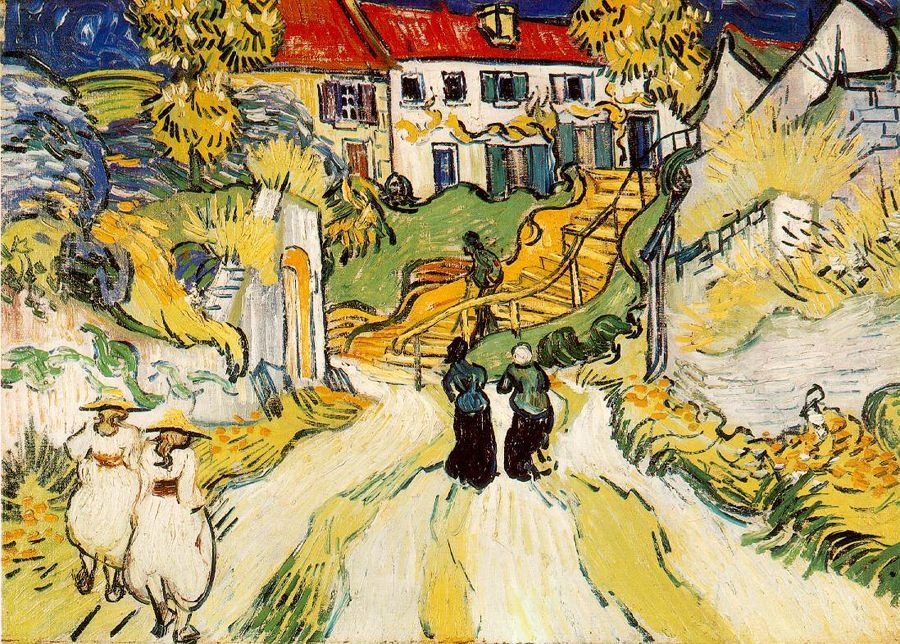

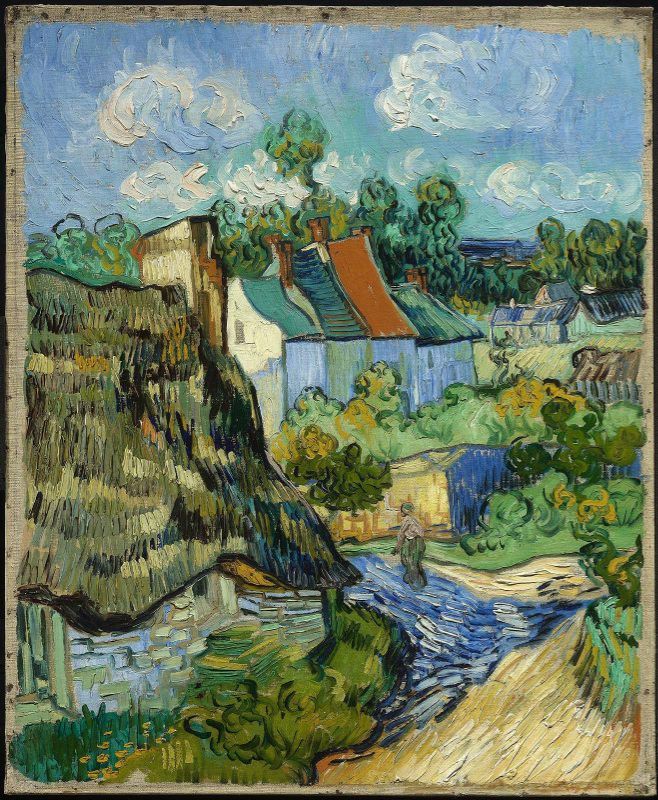
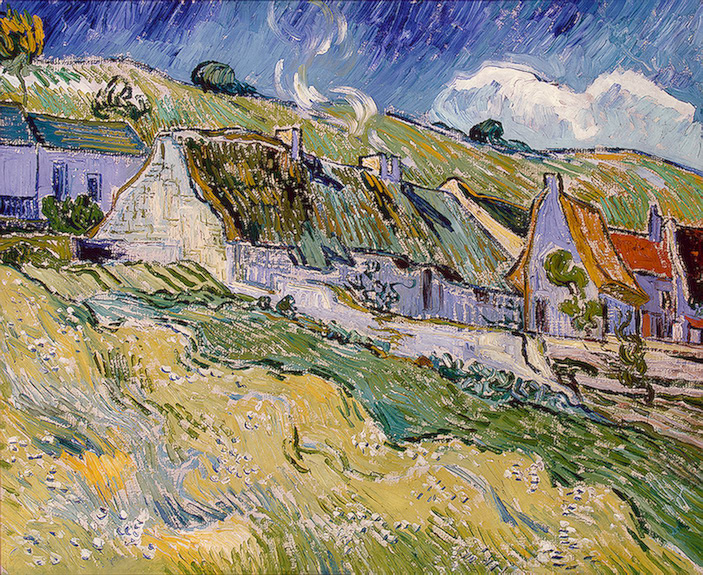


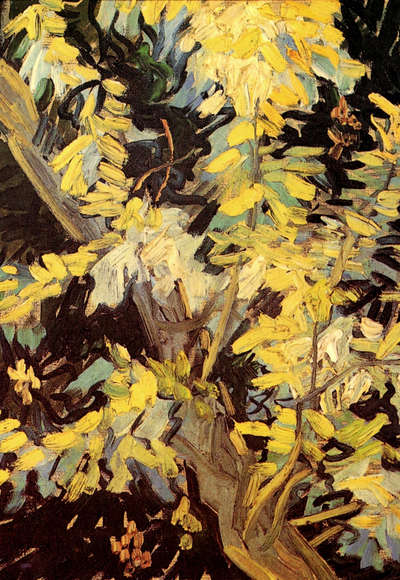

.jpg)