|
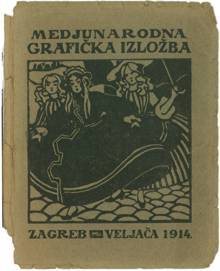
An important printmaking event
From
February 1,
1914
to March 1, 1914
an international print exhibition was
held at which 160 artists took part, showing 870 works.
It was a selling exhibition, and as was said in the
writing of the daily Jutarnji list, the intimate
feeling of the prints and the reasonable price made the
works desirable and accessible to a large number of art
lovers. The greatest praise accrued to English and
French artists, unlike the Germans, who did not leave a
particularly favourable impression. While the show was
on Isidor Kršnjavi held a lecture on the significance of
reproductive art, in which he pointed out its role in
popularisation, as well as the possibility for
independent expression that it had, as shown by the
examples of Biblia Pauperum and Rembrandt's work
in prints. At this lecture, Kršnjavi shows some of the
techniques of printmaking, creating something like a
small printmaking workshop, endeavouring to contribute
to a better understanding of the medium of the print.
The fine arts criticism published in Obzor and
Savremenik particularly highlighted the English,
particularly Frank Brangwyn, whom Lunaček in
Savremenik compared with Rembrandt and Rubens
because of his presentation of light and shade, and the
contrasts of them in a manner similar to that of the
Dutch masters. As opposite to Brangwyn, Lunaček
mentioned the American Joseph Pannel, who showed a large
number of lithographs and etchings in which the
liveliness and light of New York were particularly to
the fore. As against the enthusiasm for the English, the
Germans did not please, and the exhibition actually
diminished the current reputation of German painters.
The writer of the review in Obzor said that they
were stiff and dry, unlike the English, whose etchings
were intimate. Ferdinand Schmutzer was put forward as an
exception, but he was unfortunately represented by too
few works.
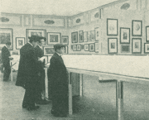

An interesting fact of the exhibition is that it
contained artists who went unnoticed who later went on
to have a major effect on the art of the 20th century -
Kandinsky, Nolde, Kollwitz and Marc. They were shown
with a small number of works. The French were given a
good deal of attention, irrespective of the few
exhibitors there were. Their skill in drawing was
particularly highlighted, and Theophile Alexandre Stein
Len was particularly referred to.
Toulouse-Lautrec, representative of the modern school of
French painting, showed only three lithographs,
according to Lunaček, alas, too few. The Czechs were
represented by Šimon who in his manner of work followed
the French school, founded on brilliant draughts manly
features, but was not represented adequately.
Croatian artists were not represented in a very large
number, just fourteen of them with 64 works, of which
there were a small number of prints, most of the works
being drawings, pastels and water colours. Among them,
the following stand out: Ljubo Babić, Menci Cl. Crnčić,
Vjera Bojničić, Oton Iveković, Dušan Kokotović, Miroslav
Kraljević and Gabrijel Jurkić.
|